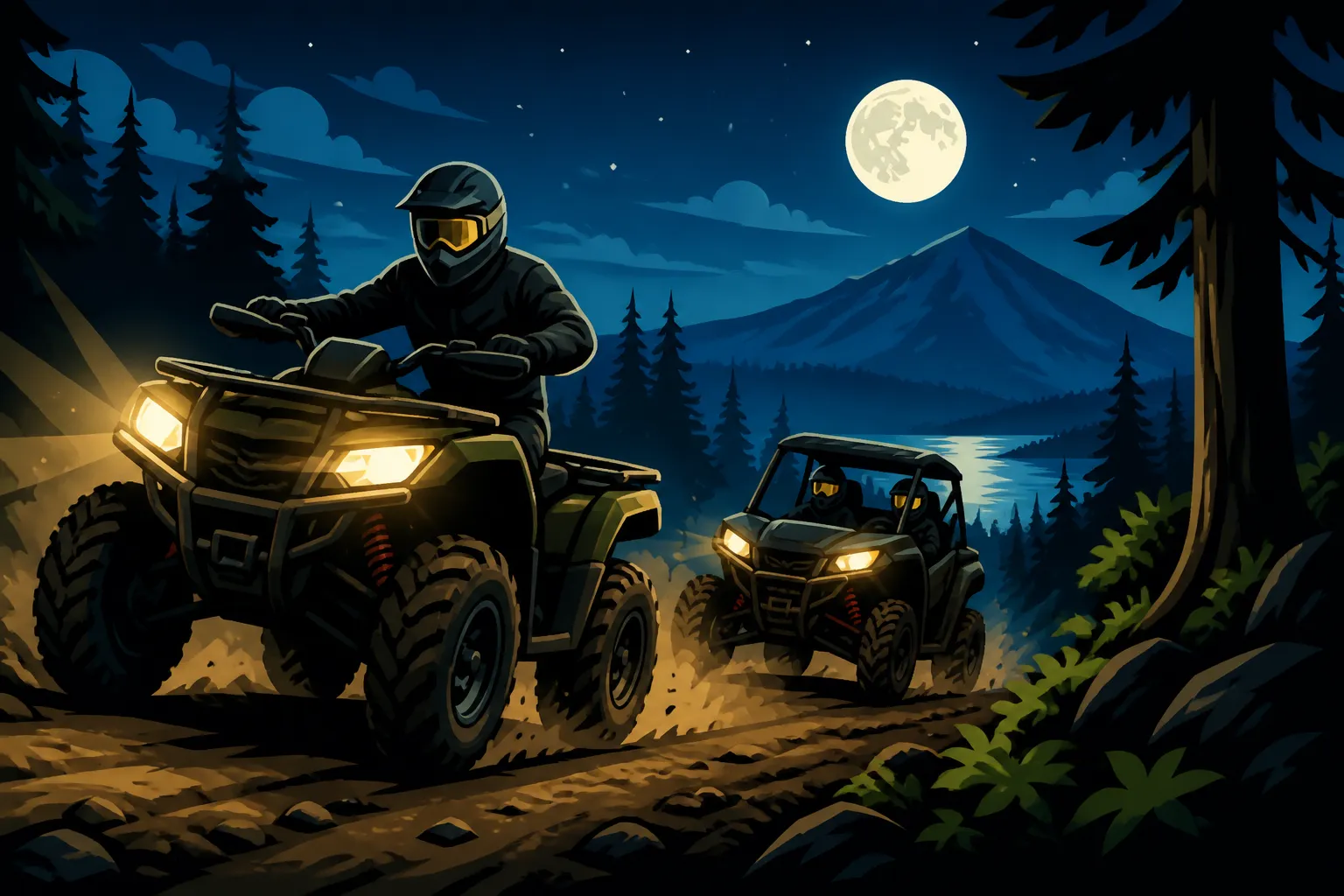
Night Riding on a New Hampshire Club Trail
Night Riding on a New Hampshire Club Trail
A trail that is open during the day may not be available after dark. Before taking an ATV or UTV onto a New Hampshire club trail at night, check the trail’s hours and current status, confirm your registration and lights meet requirements, and plan for reduced visibility and limited help if something goes wrong.
Is night riding allowed on a New Hampshire club trail?
There is no safe blanket assumption that every club trail is open after dark. A trail’s availability depends on more than the general state rules: the club, landowner, or local authority may set access hours or close a route. Seasonal closures and temporary restrictions can apply as well.
A club trail is a route made available through agreements with landowners and trail managers. Those agreements can come with conditions. Respect posted signs and gates, and don’t treat an open gate or the absence of a sign as permission to ride at night. When the rules are unclear, ask the club responsible for the trail before you go.
Check more than whether the trail is open for the season. Look for current information about:
- Nighttime or overnight riding hours
- Temporary closures, including closures for maintenance or landowner requests
- Restrictions on particular trail segments
- Whether the route is open to your type and width of machine
- Any local rules that apply where the trail enters a town or crosses a road
A map may show where a route goes without showing whether it is currently open. Use current trail updates, signs at the trailhead, and information from the relevant club. New Hampshire Trail Status Before You Ride explains why checking conditions matters, while Club Trail Access in New Hampshire covers how access depends on permission and trail rules.
Registration is a separate requirement from trail access. Having a valid registration does not give you permission to use a closed trail, and an open trail does not remove registration requirements. New Hampshire visitors should check the state’s rules for their machine rather than assume an out-of-state registration is accepted. New Hampshire Rules for a Visiting Rider and Why New Hampshire Honors No Neighbor’s Registration are useful starting points.
| Before riding after dark | What to confirm |
|---|---|
| Trail access | The route is open at the time you plan to ride |
| Local conditions | The club, landowner, or town has not imposed a closure or time limit |
| Machine eligibility | Your ATV or UTV meets the trail’s width and access restrictions |
| Registration | Your machine is registered as required for riding in New Hampshire |
| Lighting | The headlight and taillight work and meet the applicable rules |
| Route plan | You know the route, turnaround points, and a safe way back |
If you can’t confirm that night riding is permitted, choose a route with clearly stated hours or ride during daylight. A registration sticker or club membership is not a substitute for permission to be on a particular trail at a particular time.
Lights, visibility, and equipment
New Hampshire requires an OHRV being operated during the statutory nighttime period to have its headlight and taillight illuminated. The precise legal requirements can depend on the machine and the current rule, so check the current state requirements if you have a question about equipment. Before setting out, test both lights rather than relying on a quick visual check in the driveway.
A headlight lets you see obstacles, but it does not turn a rough trail into a well-lit road. Roots, rocks, ruts, branches, water, and changes in trail surface can be difficult to judge in the dark. Your speed should leave enough room to stop within the distance you can see, especially on a narrow route or one with sharp turns.
Do not assume an auxiliary light makes a machine compliant. It may help you see, but it does not replace required equipment. Aim any extra light so it improves your view without blinding other riders. Keep lenses clean and carry a practical way to deal with a failed light; if the required lighting stops working, stop riding and find a safe way to get off the trail.
A taillight matters just as much as a headlight. It helps riders behind you judge your position and distance, particularly in dust, on a climb, or when the group slows suddenly. Keep enough space between machines to avoid running into the rider ahead, and don’t follow so closely that another machine’s lights are your only reference.
Consider the rest of the machine before a night ride, too. A loose part or a tire problem that is manageable in daylight can become harder to notice and fix after dark. Check tires, brakes, controls, fuel, and any required safety equipment before leaving. Secure loose cargo and make sure passengers, if permitted on that machine and trail, understand how to stay seated and communicate.
Reflective clothing or other visible gear can make riders easier to see when they are off the machine at a stop. It is not a substitute for the required vehicle lights, and riders should not walk along an active trail without thinking about approaching machines. Choose a safe place to stop, move out of the travel path, and make the group’s position clear.
Plan the route and the group before dark
Night riding reduces the time available to react to hazards and makes it easier for a group to get separated. A route that feels straightforward in daylight may be difficult to recognize after sunset, especially where trails branch, signs are hard to see, or tracks cross similar-looking ground.
Before you leave, decide on a route that matches the least experienced rider and the conditions. Keep the group together, agree on where to stop, and make sure every rider knows what to do if someone falls behind. If a rider misses a turn, the group should not split in several directions to search. Agree on a simple procedure in advance, such as stopping at the next safe, visible location and checking in.
Carry a map or other navigation method that works where you plan to ride. Do not rely on a phone alone: reception can be limited in the North Country, and batteries can run down. Save the route or map before leaving, take a portable power source if appropriate, and know how to retrace your route if navigation fails. A map from a club can help with orientation, but it does not confirm that every mapped segment is open. New Hampshire Trail Maps From a Club has more on using club maps.
Plan fuel with darkness in mind. A detour, slow section, or unexpected stop can extend the ride. Start with enough fuel for the planned route and a sensible margin, and don’t assume a fuel stop will be open or easy to reach late in the day. Avoid carrying fuel in a way that creates a spill or fire risk.
Also plan for a breakdown. Carry basic tools and supplies suited to your machine, a charged communication device, and clothing appropriate for the weather and the possibility of waiting. Tell someone who is not riding with you where you expect to go and when you plan to return. If your machine becomes unsafe to operate, don’t continue simply to make it back on schedule.
Night conditions can make other trail users harder to spot. Slow down when visibility is limited, watch for people and animals, and leave space to respond to an unexpected stop. Be especially cautious near trailheads, road crossings, bridges, and places where a trail narrows or changes surface. If you reach a closed sign or a barrier, turn around rather than trying to find a way around it. New Hampshire Rules for Riding a Closed Trail explains why a closure applies even when the route looks passable.
A practical pre-ride checklist
A short check before departure can prevent a long, difficult return. Use this list when planning a night ride, and adapt it to the trail and machine:
- Confirm access and hours. Check current club or trail information and any signs at the staging area. If nighttime access is not clear, contact the club or choose a different ride.
- Check registration and machine eligibility. Confirm that your machine is registered as required and is permitted on the route. Check whether width restrictions apply to any section.
- Test the lights. Turn on the headlight and taillight, confirm they stay on, and clean the lenses. Do not start a night ride with a required light that is broken or unreliable.
- Inspect the machine. Check tires, brakes, controls, fuel, and cargo. Make sure passengers are permitted and properly seated.
- Set the route and turnaround time. Choose a route everyone can manage and allow time to return before conditions become more difficult.
- Prepare the group. Agree on spacing, stopping points, and what to do if riders become separated.
- Bring navigation and essentials. Have a map or saved route, a charged phone or other communication option, and basic supplies for a delay or minor problem.
- Ride within the light you have. Reduce speed when your view is short, maintain enough stopping distance, and turn back if conditions or fatigue make the route unsafe.
The most important step happens before the engine starts: confirm that the trail is actually open for night use. Then ride at a speed that suits your visibility and be prepared to end the ride early. New Hampshire Rules for Night Riding on a Trail provides a related overview of nighttime trail considerations, and New Hampshire OHRV Decal Placement can help if you also need to check how registration decals must be displayed.
Disclaimer
This article is for general informational purposes only and does not constitute professional advice. Laws, prices and regulations vary by location and change over time. Consult a qualified professional for guidance on your specific situation.