New Hampshire Rules for Riding Off a Marked Trail
Riding off a marked trail in New Hampshire can look like a harmless shortcut, but a trail’s edge is not an invitation to keep going. Whether you may leave the route depends on who controls the land, what permission you have, and any rules that apply to that area. Here’s how to check before you ride—and what to do when the boundary is unclear.
What “off a marked trail” means
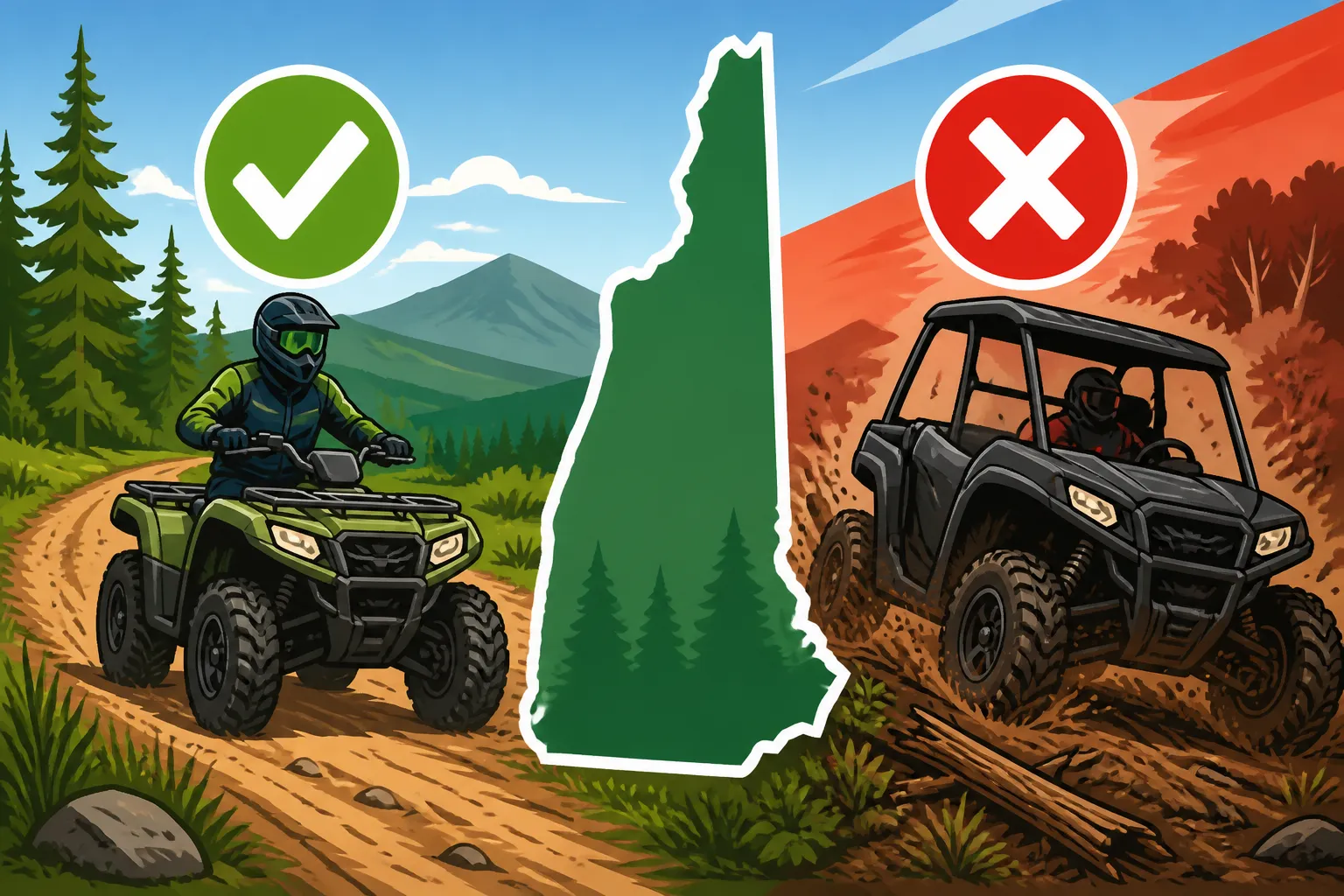
A marked trail gives you a route to follow; it does not automatically authorize riding beside it, cutting across a field, or making a new path through the woods. A turn around a muddy spot can still take you outside the route. So can following tire tracks that lead away from the marked corridor.
It helps to separate three situations:
- Leaving an authorized route: You ride beyond the route or its permitted riding area, even if you stay close to it.
- Using an unmarked route: You find a path that is not shown or identified as open for OHRV use. It may be a logging road, an old woods road, a private driveway, or a route for another kind of use.
- Riding on land where you have permission: A landowner has authorized you to ride on their property. That permission may cover an area beyond a marked trail, but it does not necessarily override other restrictions.
A visible path is not proof that ATVs or UTVs may use it. The path could be private, closed, reserved for another use, or outside the permitted trail system. Similarly, a missing marker does not necessarily mean a route is open. If a route’s status is uncertain, pause and check an up-to-date club map or trail-status notice rather than using tire tracks as a guide.
New Hampshire’s OHRV routes can cross or pass through land with different owners and access arrangements. A club may maintain a trail, but that does not mean riders can roam anywhere on the surrounding property. For a closer look at land rules, see Riding Private Ground in New Hampshire, New Hampshire Rules on State-Owned Land, and Leased Trail Ground in New Hampshire.
Permission and land boundaries
On private land, get the landowner’s permission before riding outside a route that is open to you. Ask about the specific area you intend to use, not just whether riding is allowed in the general vicinity. A trail may cross one property under an access arrangement while neighboring land remains off limits.
New Hampshire’s written-permission rules are worth taking seriously. If you have permission, get it in writing and make sure it is clear who may ride, which machines are covered, and what area or route is allowed. More detail is available in New Hampshire Written Permission Requirements. Don’t assume that permission given to a club, a friend, a previous owner, or one member of a group automatically extends to you.
An unposted property is not necessarily open for riding. Signs and markers can help identify restrictions, but a lack of signs does not establish permission. Why Unposted Land Is Not an Invitation explains why riders should not treat silence as consent.
| Situation | Safer approach |
|---|---|
| You are on a marked, open OHRV trail | Stay on the authorized route and follow posted directions. |
| You want to go around a muddy section | Don’t create a bypass unless it is clearly authorized. Check with the trail organization or land manager. |
| A path branches off the trail | Treat it as unconfirmed until a current map or the responsible organization confirms it is open to OHRVs. |
| You want to ride beyond a trail boundary on private land | Get permission from the landowner for that area before riding there. |
| You reach land with a gate, closure sign, or unclear boundary | Stop. Do not go around the barrier or assume the route continues. Check the status and access rules. |
| You are on public or leased land | Follow the rules set by the responsible land manager and the terms governing the trail. |
Permission has limits. A landowner cannot necessarily authorize riding through a restricted public area or onto property controlled by someone else. Likewise, being invited onto one parcel does not grant access across every parcel between you and your destination. If the route crosses land managed by an agency or held under a lease, check with the responsible manager or trail organization. Club Trail Access in New Hampshire and Getting a Landowner’s Signature in New Hampshire offer useful context.
Property boundaries are not always obvious from the seat of a machine. A fence, painted blaze, gate, or trail sign can be a clue, but none should be treated as a complete map of ownership or access. If you cannot tell whether you are still within the authorized route, stop somewhere safe and check the map or contact the organization responsible for the trail.
Common reasons riders leave the route—and what to do instead
Riders often go off trail for practical reasons: avoiding mud, finding a way around a fallen tree, looking for a parking spot, or reaching a view. The intention may be reasonable, but the resulting tracks can damage land, affect landowner relationships, and lead to a route being restricted or closed.
Avoiding mud or an obstacle
Do not make a new bypass around a wet section. Repeated traffic can widen the trail and damage the ground beside it. A temporary obstacle does not automatically allow riders to leave the route. Check the club’s trail-status information for a closure, detour, or update. If there is no authorized detour, turn back or wait for guidance rather than pushing through or carving a new route.
This is especially important during spring conditions, when trails may be closed to protect soft ground. A route that was open on an earlier ride may now be restricted. Before setting out, check New Hampshire Trail Status Before You Ride and New Hampshire Rules for Riding a Closed Trail.
Following a side path
A path can look well used and still be closed to OHRVs. It could serve as a landowner’s access road, a utility route, or a trail for another user group. Don’t follow it just because another machine has left tracks. Compare it with the current trail map, and ask the local club or land manager if the route is not clear.
If a mapped trail appears to branch, look for signs or map details that confirm which way is open. When markers are missing or confusing, staying on the known route is safer than guessing. Trail organizations can also clarify whether a route has changed or whether a temporary closure is in effect.
Riding around a gate or closure sign
A gate or closure sign is a reason to stop, not an obstacle to work around. Do not squeeze past it, ride beside it, or take a nearby path that appears to bypass the restriction. The closure may protect private land, prevent damage, or reflect a change in access that is not yet obvious on an older map.
If you encounter a closure while already on the trail, turn back the way you came if it is safe to do so. Check with the responsible club or land manager before trying to find another route. For more on closures, see New Hampshire Trail Closures to Check First.
Looking for a scenic spot or stopping place
A view, clearing, or open area beside the trail may be on private property or outside the approved riding area. Don’t ride over to it unless the access is clearly permitted. The same caution applies to parking, turning around, or gathering a group off the designated route. Use an authorized staging area or a location the landowner has specifically approved.
A practical check before you leave the trail
A few steps can prevent an avoidable trespass or trail violation:
- Check the current map and trail status. Use information from the club or land manager responsible for the route. An old map or a previous visit may not reflect a closure or changed access.
- Confirm who controls the land. If you want to ride outside the marked corridor, identify the landowner or land manager before you go. A club’s trail access does not automatically cover the surrounding property.
- Get permission for the exact area. Ask whether your machine and intended route are allowed. Keep written permission available if you have it.
- Look for signs, gates, and boundaries. Follow posted restrictions. If markers conflict with a map or the route is unclear, stop and ask rather than choosing the interpretation that lets you continue.
- Stay on the authorized route unless you have confirmed otherwise. If conditions make the trail impassable, turn back or wait for an approved detour.
Being prepared also means carrying your registration certificate and having the required decals displayed. An officer may ask about your machine and where you are riding; Showing a Decal and a Certificate covers the documents riders should be ready to present. Registration does not grant permission to ride every property, and permission from a landowner does not erase other applicable requirements.
If you realize you have gone beyond the route, stop as soon as it is safe. Avoid making additional tracks while trying to find a shortcut back. Return by the route you used if that is safe and lawful, then contact the trail organization or land manager if you are uncertain how to proceed. Don’t assume that because the machine has already crossed a boundary, continuing farther will make it easier to get back.
The simplest rule is also the most useful: a marked trail authorizes travel on its designated route, not unrestricted riding nearby. When you cannot confirm that a side path or open area is allowed, stay on the trail and check first.
Disclaimer
This article is for general informational purposes only and does not constitute professional advice. Laws, prices and regulations vary by location and change over time. Consult a qualified professional for guidance on your specific situation.