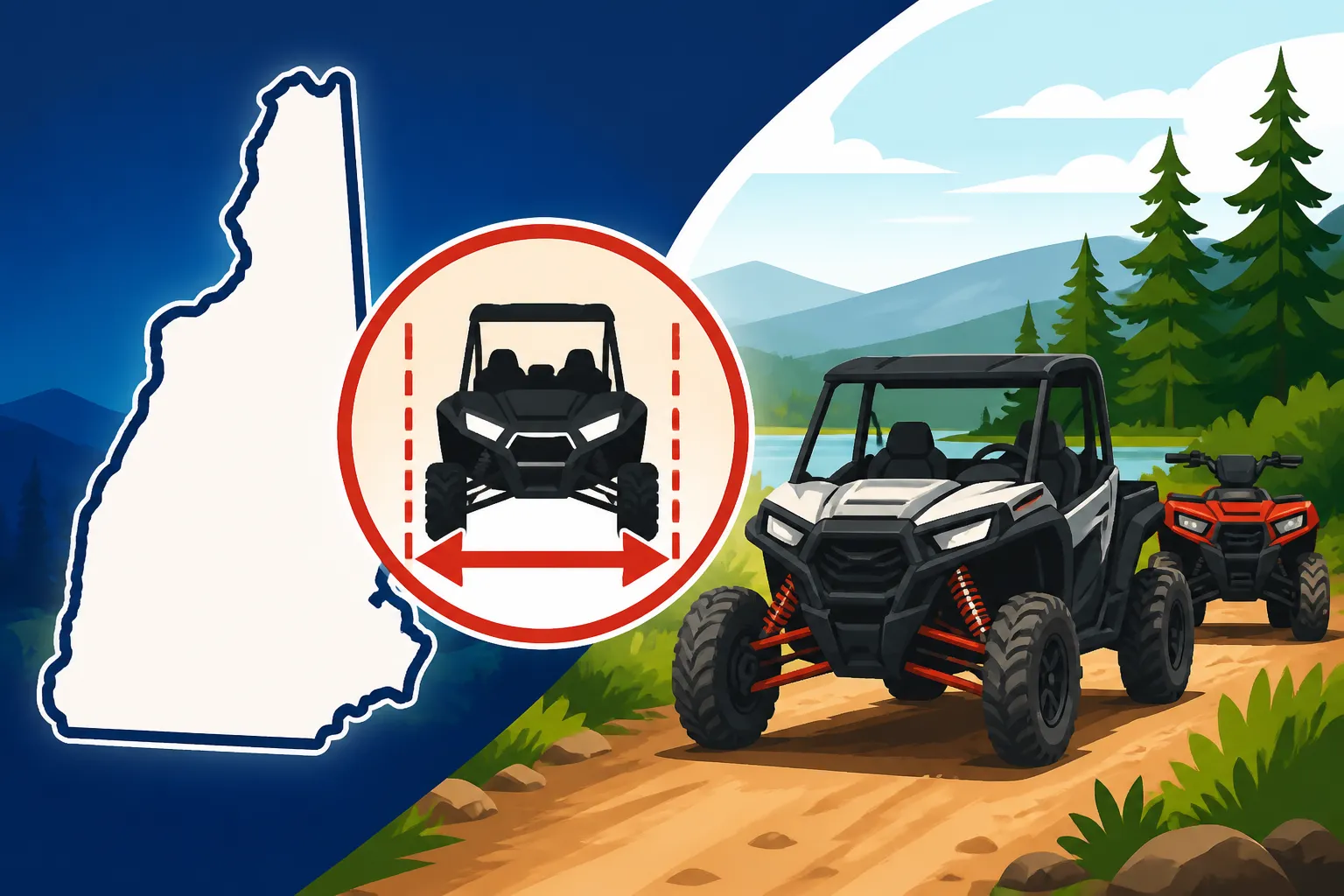
New Hampshire Rules for a Machine Over the Width Limit
A wide side-by-side can be registered for New Hampshire riding and still be barred from a particular trail. The difficult part is that there isn’t one width limit that applies to every route. Check the rules for each trail, measure your machine conservatively, and plan a legal alternative before you reach a narrow gate.
How width limits work in New Hampshire
New Hampshire does not have a single trail-width allowance that guarantees access everywhere. A width limit may apply to a specific trail, trail segment, rail trail, or riding area. The limit can reflect the physical space available, a landowner’s conditions, or a trail manager’s rules.
That means a machine’s registration is not proof that it can use every route. Registration covers the machine’s eligibility to operate where registration is required; it does not override a posted restriction or grant permission to travel across land where the machine is not allowed. See New Hampshire Rules for a Machine Over 50 Inches for more on how a specific width threshold can affect route access.
The number on a trail sign matters, but it’s only useful if you compare it with the machine’s actual width. A route advertised as suitable for wide machines may still have a narrower branch, gate, bridge, or connector. Trail status can also change, so check current information for the route you intend to ride rather than relying only on an old map or a previous visit.
| What you see or know | What it tells you | What to do |
|---|---|---|
| A posted maximum width | The trail or segment has a specific limit | Compare the limit with your machine’s measured width |
| A 50-inch restriction | Machines wider than that stated limit should not use the restricted route | Find a route that expressly allows your machine |
| A 65-inch restriction | The route may accommodate wider machines than a 50-inch route, but it still has a limit | Verify the machine and every segment fit the rules |
| No width information | You do not have confirmation that a wide machine is allowed | Check with the trail manager or club before riding |
| A gate that looks wide enough | The opening may physically fit the machine | Do not treat physical clearance as permission to ride |
| A machine that barely fits | The route may still have tight turns or narrower obstacles | Allow for safe clearance, not just a close measurement |
A common source of confusion is treating a width number as if it applies to the whole trail network. It may apply only to one corridor or section. Conversely, a machine that fits a wide trail can still be turned away by a narrower connector needed to reach it. Check New Hampshire Trails With a 50-Inch Limit and New Hampshire Trails With a 65 Inch Limit for examples of why a route’s stated limit matters.
Measure the machine before you choose a route
Manufacturer specifications are a useful starting point, not always the final answer. A listed width may describe the machine in a standard configuration. Tires, wheel spacers, aftermarket parts, mirrors, racks, or other additions can change the overall dimensions or the clearance needed to pass safely.
Measure the machine in the configuration you plan to ride. Use the widest point that could encounter a gate, post, tree, or other fixed obstruction. If the widest point is not obvious, inspect the machine from the front and rear and check its tires, bodywork, accessories, and any parts that extend outward. A tape measure from a hardware store or Amazon can help, but take the measurement on level ground and keep the tape straight across the machine.
For a practical check:
- Park the machine on level ground with its tires set as they will be for riding.
- Identify the widest installed parts, including any accessories that extend beyond the body.
- Measure from the outermost point on one side to the outermost point on the other.
- Record the measurement and compare it with the route’s posted maximum.
- If the machine is close to the limit, ask the club or trail manager how width is measured and whether any particular configuration is restricted.
It is sensible to leave a margin rather than aim to match a posted maximum exactly. A machine can be difficult to control through a narrow opening even if its measured width is technically within the stated limit. A tight turn, uneven ground, or a gate that narrows toward the bottom can make passage harder. Never force a machine through a gap or assume that moving a gate, sign, or barrier is acceptable.
If you change tires or add parts after measuring, check again. A machine’s width can change without its model name or registration changing. Keep the measurement with your trip notes, but confirm the route information each time you plan a ride. Measuring Your Machine Before You Drive North covers the planning side of that check, while New Hampshire Trails for a Wide Machine can help you look for routes intended to accommodate larger vehicles.
What to do when your machine exceeds the limit
If your machine is wider than a posted limit, do not enter that restricted segment. Being able to squeeze through a gate does not make the route permitted, and it can damage the trail or machine. It may also put you in a difficult spot if the route narrows farther ahead and there is no safe place to turn around.
Instead, adjust the route before the ride. Look for a trail system or segment with a limit that accommodates the machine, and confirm that every connection on the planned route allows it. A wide vehicle may be permitted on one trail but unable to reach it without crossing a narrower section. Ask the club or trail manager about the exact route rather than relying on a general description of the riding area.
If the route information is unclear, use these steps:
- Identify the specific trail, entrance, and connecting segments you plan to use.
- Check the posted width limit for each part of the route.
- Compare those limits with the machine’s measured width.
- Contact the relevant club or trail manager if a limit is missing or ambiguous.
- Choose a different route if you cannot confirm that the machine is allowed.
A trail map can help with route planning, but it may not show every gate or temporary restriction. Current club updates and signs at the trail are important checks. The article Two Clubs, Two Different Width Limits explains why a machine that is suitable in one area may not be accepted on a neighboring route.
Do not assume that reducing tire pressure, removing an accessory at the trailhead, or taking a different line through a gate solves the problem. A trail manager may define how a limit is applied, and the full route may remain too narrow even if the machine clears the entrance. If an accessory is removable, ask whether that change would make the machine eligible before relying on it. Never remove safety equipment or modify a machine in a way that makes it unsafe to ride.
If a route is blocked by a width restriction, turn around only where it is safe and permitted. Avoid damaging vegetation, cutting around a barrier, or crossing private land to bypass the restriction. If there is no safe turnaround, that is another reason to check width and route access before entering.
Plan for the whole ride, not just the trailhead
Width checks work best as part of a complete route plan. A wide machine may encounter restrictions at trail entrances, narrow bridges, connectors, or sections managed by a different club. The planned ride is only suitable if every necessary segment allows the machine.
Before leaving, confirm:
- The machine’s measured width in its current setup.
- The limits for the trails and connectors on the intended route.
- Whether the width information is current and applies to the whole segment.
- Whether a bridge, gate, or other obstacle has a separate restriction.
- Where you can turn around or change routes if you encounter a closure.
If the trail manager’s information conflicts with a sign at the trail, follow the posted restriction and ask for clarification before continuing. Do not rely on a measurement made from a map image or a photo of a gate. A physical opening can be wider than the allowed limit, and the route may narrow beyond it.
Also check whether the limit is a width restriction or a different access rule. Some corridors have other limits or conditions, and a machine that meets the width requirement may still not be allowed for another reason. Make sure you understand the rules for the specific trail, rather than treating width as the only requirement.
The safest approach is straightforward: measure your machine, confirm each route segment, and leave a practical clearance margin. When a machine is over the posted limit, pick a route that allows it instead of trying to make the restricted trail work. New Hampshire Trail Status Before You Ride is useful for checking current conditions, and Two Clubs, Two Different Width Limits is a reminder to verify the rules as your route crosses between trail areas.
Disclaimer
This article is for general informational purposes only and does not constitute professional advice. Laws, prices and regulations vary by location and change over time. Consult a qualified professional for guidance on your specific situation.