One Certificate for OHRV and Snowmobile
New Hampshire riders often switch between an ATV or side-by-side and a snowmobile, then wonder whether each machine needs a different safety course. The short answer is that one qualifying New Hampshire safety certificate can cover both kinds of riding. What it does not do is replace registration, age and supervision rules, or permission to use a trail.
What one certificate covers
In New Hampshire, the state safety education certificate for off-highway recreational vehicles (OHRVs) and snowmobiles is not a separate credential for each machine type. A rider who has the qualifying certificate generally does not need to take a second course just because they move from an ATV or UTV to a snowmobile. The same certificate applies across both categories.
That is useful for people who ride seasonally, families with different machines, and visitors who take part in both summer and winter activities. It also makes the term “one certificate” easy to misunderstand. It means one safety education credential can satisfy the relevant certificate requirement for both types of vehicle. It does not mean one registration covers both machines, or that the rules for operating them are identical.
An OHRV and a snowmobile are different vehicles with different registration and operating requirements. Each machine needs the registration that applies to it, and the rider still has to follow the rules for the vehicle and place they are using. For an overview of the credential itself, see New Hampshire Safety Education Requirements. The specific relationship between the two machine types is also covered in One Card for Two Kinds of Machine.
Think of the certificate as proof of safety education, not as a general riding permit. It may answer the question, “Has this operator met the applicable safety-course requirement?” It does not answer questions such as:
- Is this particular machine registered for use in New Hampshire?
- Is this trail open to this type of machine today?
- Is the rider old enough to operate it in this setting?
- Does the rider need an adult supervisor?
- Has the landowner or trail manager allowed access?
- Does this location require a separate day-use payment or other permission?
Those questions remain separate. A rider with the right certificate can still be unable to ride legally if the machine is unregistered, the route is closed, or the operator does not meet the applicable age or supervision rules.
| Question | What the safety certificate does | What it does not do |
|---|---|---|
| OHRV and snowmobile courses | A qualifying New Hampshire certificate can apply to both | It does not grant permission to ride a specific trail |
| Registration | Confirms safety education where required | It does not register an ATV, UTV, dirt bike, or snowmobile |
| Age and supervision | May meet the course requirement for the operator | It does not waive age limits or adult-supervision rules |
| Trail access | May be one item a rider needs to meet applicable rules | It does not open a closed trail or replace landowner permission |
| Out-of-state credentials | May be relevant if the rider has a qualifying credential | It does not automatically establish that every other state’s rules are met |
Who needs the certificate and what age changes
The certificate requirement is tied to state rules and the rider’s circumstances, including age. New Hampshire’s safety course has a minimum age, but completing it at that age does not automatically give a young rider the same operating privileges as an adult. An operator may need to meet additional requirements about supervision, where they ride, or what kind of machine they operate.
For OHRV-specific age details, see New Hampshire Rules for Riders Under 18. For the point at which a young rider can take the course, see New Hampshire’s Safety Certificate at Twelve. These are related but different questions: a minimum course age is not the same as a minimum age for every riding situation.
The certificate requirement may also interact with a driver’s license. A license can serve as an alternative to a safety certificate in some situations under New Hampshire rules, but do not assume that having any license automatically covers every machine, rider, or circumstance. The details can depend on the rule being applied and the operator’s status. See Why a Driver’s License Substitutes in New Hampshire for that distinction.
When a child or teenager is riding, check requirements for the specific vehicle and setting rather than relying on a simple “has a certificate” check. For example, rules for an underage rider may distinguish between riding with a qualified adult and riding independently. They may also vary depending on whether the rider is on a trail, public property, or private land. The certificate does not cancel those distinctions.
A practical way to check is to ask three questions:
- Does the rider need a safety certificate for this activity? Check the current New Hampshire requirement for the rider’s age and circumstances.
- Does the rider meet the age and supervision rules for this machine and location? A certificate alone may not be enough.
- Is the machine and route otherwise legal? Check registration, access, and any location-specific restrictions.
For families, it is sensible to verify this before a child joins a ride, rather than discovering a restriction at the trailhead. If a young rider uses both an OHRV and a snowmobile, keep the certificate details accessible and confirm that the rider also meets the separate rules that apply to each activity.
Adults should not assume the course requirement is identical for everyone either. The fact that an adult has ridden for years, owns a machine, or has a registration in their name does not by itself prove that the adult has the credential required in a particular situation. Likewise, an adult’s driver’s license may affect whether a course certificate is needed, but it does not replace the need to check the specific rule.
How to get, keep, and show proof of the certificate
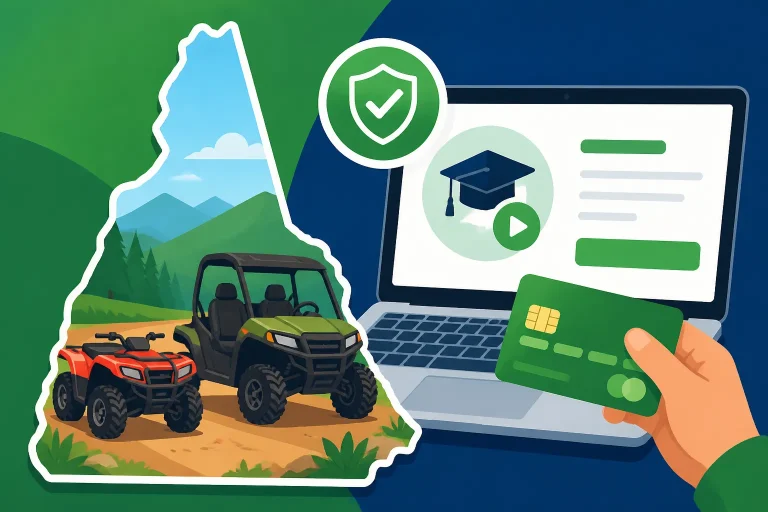
If you do not already have a qualifying safety certificate, use the New Hampshire course information to identify an approved way to complete the required education. New Hampshire offers safety education for OHRV and snowmobile operation, and course availability and enrollment details can change. Check the current instructions from the relevant state program before registering. For options, see Where to Take the Free Classroom Safety Course and Paying for the Online Course.
The course is intended to teach more than a few mechanical steps. Safe operation involves judgment about speed, visibility, terrain, other trail users, and the limits of the machine. OHRV and snowmobile riders share some general safety concerns, but each vehicle also has its own handling characteristics and seasonal hazards. A certificate provides evidence of required education; it is not a promise that every trail condition is safe or that a rider is prepared for every situation.
After completing an approved course, keep the certificate information available. The exact way proof is issued or displayed can depend on the program and the current process, so follow the directions provided when the course is completed. If you have an older card or document and are unsure whether it remains usable, confirm its status rather than assuming that a worn, lost, or incomplete record will be accepted.
Before a ride, make sure you can readily show the required proof if asked. That does not necessarily mean the certificate has to be attached to the machine. It means you should know how the credential is documented and be able to follow the current requirement for carrying or presenting it. Do not confuse it with the machine’s registration certificate. The registration document is evidence related to the machine; the safety certificate is evidence related to the operator’s education.
If your record is missing, damaged, or hard to read, contact the course provider or the state program that maintains the relevant record. Keep a digital copy if the program permits it, but do not assume a phone image will substitute for an officially required document. It is also helpful to keep the certificate details with the rest of your ride planning information, especially when different family members operate different machines.
For a group ride, the organizer should not treat one person’s certificate as covering the whole group. Each operator is responsible for meeting the requirements that apply to them. A parent, trip leader, rental provider, or club may want to check that each rider understands their responsibilities, but that check does not transfer the legal responsibility away from the individual operator.
What the certificate does not replace
The most common mistake is to treat the safety certificate as if it were a universal pass. It is not. The credential covers a narrow purpose: documenting that an operator has completed qualifying safety education or otherwise meets the applicable certificate rule. It does not authorize the use of a machine or a route by itself.
Registration for each machine
A rider may use one safety certificate for both an OHRV and a snowmobile, but the machines do not share a registration simply because their operator has a common credential. The registration process, fees, documents, and decals depend on the machine and its use. Learn more about New Hampshire OHRV Permits Explained and Why Your Registration Is the Access.
A valid registration for one machine should not be treated as proof that another machine is registered. If you own an ATV, a side-by-side, and a snowmobile, check the requirements for each one. Registration may also be required for a visiting or out-of-state machine, so do not rely only on a home-state registration. Riding New Hampshire With an Out-of-State Machine explains why a visitor should check New Hampshire’s requirements before riding.
Age, supervision, and licensing
Having the certificate does not override requirements for a young rider or an unlicensed adult. A rider may need a qualified adult nearby, may be limited in where they can ride, or may be subject to a different rule depending on the vehicle and circumstances. A safety course helps demonstrate education; it does not change the rider’s age or licensing status.
If an operator is close to a relevant age threshold, confirm the current requirement before the ride. Do not assume that a rule for an OHRV automatically applies in the same way to a snowmobile. The same certificate may serve both categories, while the operating rules still differ.
Permission and trail access
A safety certificate does not grant access to private land, a closed trail, or a route that does not allow the machine. New Hampshire riding access depends on the land and the designated trail system. Written permission may be needed on private property, and an unposted area is not automatically open for riding. See Written Permission on New Hampshire Private Land for the permission issue.
Trail conditions can change with weather, maintenance, landowner decisions, seasonal closures, or other restrictions. Check the status of the route before setting out, and follow posted signs and directions from the trail manager. A certificate cannot turn a closed route into an open one.
Equipment and safe operation
The certificate is not a substitute for appropriate equipment or sound decisions. Operators remain responsible for using a machine that is maintained, equipped, and suitable for the conditions. Requirements can include items such as lighting, a mirror for certain road riding, a spark arrester, or protective gear, depending on the machine and circumstances.
A rider should also consider the practical hazards of the day. Snow can hide obstacles, ice conditions can change, and a route that is manageable on one machine may be difficult for another. On an ATV or UTV, terrain, water, and other trail users create their own risks. Plan for the actual conditions rather than assuming that completing a course makes every ride appropriate.
A simple checklist for OHRV and snowmobile riders
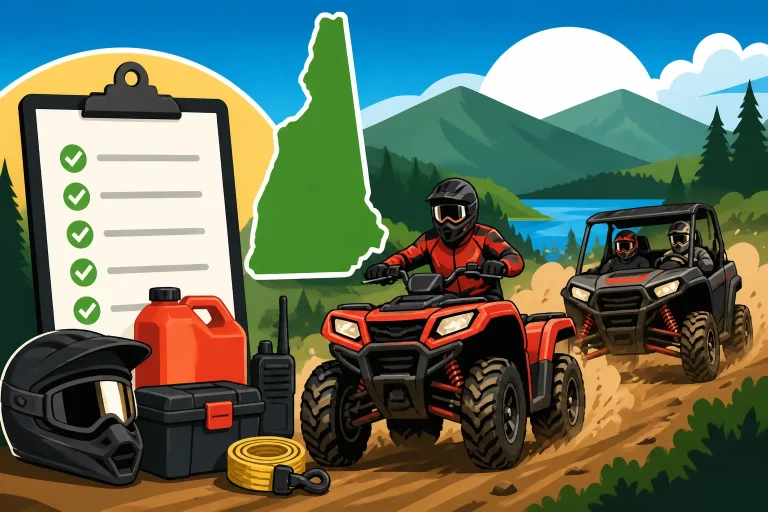
Before switching from one type of machine to another, use a short checklist. The purpose is not to add paperwork for its own sake. It is to separate the operator credential from the machine and access requirements so that one correct detail does not create false confidence about the rest.
- Confirm the certificate. Make sure the rider has the qualifying New Hampshire safety certificate, or verify whether another recognized credential or license satisfies the requirement in that situation.
- Check the operator’s age and status. Confirm any age, supervision, or licensing rule that applies to the rider, machine, and location.
- Verify the machine’s registration. Check the registration for the specific vehicle being ridden, not just the other machine in the garage.
- Check where the machine may go. Confirm the route is open and allows that type of vehicle. Do not infer trail access from the certificate or registration alone.
- Review equipment and conditions. Make sure the machine and rider are prepared for the terrain, visibility, weather, and season.
- Carry or access proof as required. Keep the certificate and machine documents in the form required by the current rules, and know how to present them if asked.
- Recheck before a later trip. A certificate may remain useful across machine types, but trail status, registration periods, and local conditions can change.
If you already completed a New Hampshire course for one type of riding, do not sign up for another course solely because you want to use the other type of machine. First confirm that your existing credential is the qualifying one and that it is recorded in a usable form. If you are uncertain, ask the course provider or the relevant state office to check the record.
Visitors should be especially careful not to assume that a certificate, card, or online course from another state automatically satisfies every New Hampshire requirement. Recognition can depend on the credential and the rule. Check New Hampshire’s current guidance before traveling, and separately confirm registration and trail access. The same caution applies when riding across a state line: requirements may change as soon as the machine enters another jurisdiction.
Frequently Asked Questions
Does one New Hampshire certificate cover both an ATV and a snowmobile?
A qualifying New Hampshire safety certificate can apply to both OHRV and snowmobile operation. It does not register either machine or replace the separate rules for operating each one.
Do I need a new course when I switch from an ATV to a snowmobile?
Not solely because you changed vehicle type, if your existing credential is the qualifying certificate accepted for both. Confirm that your certificate is valid for the purpose and that you meet any age or other requirements.
Does the certificate work as a trail pass?
No. It is proof of safety education, not trail access. Registration, trail status, landowner permission, and any location-specific requirements remain separate.
Does every rider need a certificate?
The requirement depends on the rider’s circumstances and New Hampshire’s current rules. Age and, in some cases, licensing status can matter. Check the rule that applies to the specific rider and activity rather than assuming the same answer for every operator.
Can I use a certificate from another state?
Do not assume that every out-of-state credential is automatically accepted. Confirm whether the specific certificate meets New Hampshire’s current requirement before riding.
Disclaimer
This article is for general informational purposes only and does not constitute professional advice. Laws, prices and regulations vary by location and change over time. Consult a qualified professional for guidance on your specific situation.