New Hampshire Fines for a Trail Violation
A trail ride can turn into an expensive interruption if you cross a closure, leave a marked route, or ride where you do not have permission. New Hampshire does not have one catch-all fine for every trail violation. The consequence depends on what happened, where you were riding, and the citation issued. Here’s how to understand the risk and what to do next.
Why There Is No Single Fine for a Trail Violation
“Trail violation” can mean several different things. A rider might be on a route that is temporarily closed, stray beyond a marked trail, ride on land without permission, or fail to meet a registration or equipment rule. Each issue can involve a different legal requirement, so there is no reliable one-size-fits-all dollar amount.
The amount and process depend on the specific offense listed on the citation and the applicable law. More than one alleged violation may be involved in the same stop. For example, a rider could be accused of using a closed route and operating a machine that is not properly registered. Treat each item on the ticket as a separate allegation rather than assuming that one payment resolves everything.
| Situation | Why it may lead to a citation | What to check |
|---|---|---|
| Riding on a closed trail | The route may be closed by a club, land manager, or other authority | The closure notice, location, and date |
| Leaving a marked route | Riding beyond an authorized trail may violate land-access rules | Trail markings, map, and property boundaries |
| Riding without permission | Private land access is not automatic, even when land is unposted | Whether permission was required and granted |
| Riding without valid registration | Registration and access rules may apply to the machine and location | Registration status and the specific charge |
| Ignoring a width or vehicle restriction | A trail may be limited to certain machine types or widths | Posted restriction and machine measurements |
The citation is the most important document for understanding the allegation. Read the description, the statute or rule cited, the location, and any instructions about responding. The officer’s verbal explanation can help clarify the stop, but do not rely on memory alone when deciding what the citation requires.
A ticket for a trail offense is also different from a trail club’s access decision. A club or land manager may close or restrict a route to protect the property, respond to conditions, or comply with a landowner’s request. The possibility of a citation depends on the applicable rules and enforcement authority; the closure itself is still a reason to turn around.
For a closed route, see New Hampshire Fines for Riding a Closed Trail. For registration-related allegations, New Hampshire Fines for Riding Without Registration covers a separate issue. The specific charge matters because a registration problem and a trail-access violation are not interchangeable.
Trail Rules That Commonly Lead to Trouble
Riding a closed trail
A route can close because of seasonal conditions, maintenance, landowner direction, or a temporary problem such as a washout. A trail that was open on a previous visit may not be open today. Riding past a gate, sign, or other clear closure notice can create a serious problem, and claiming that you did not check conditions may not undo the violation.
Before setting out, check current notices for the trail system and the particular route you plan to use. New Hampshire Trail Status Before You Ride explains why checking conditions is part of ride planning, not just a way to avoid mud or a wasted trip.
If you encounter a closure while riding, do not go around a barrier or continue along a route that appears closed. Turn back using an open, authorized route. If there is no safe way back without crossing a closure, stop and seek guidance rather than improvising a new route across land.
Leaving the marked trail
A trail map is not permission to ride anywhere within the general area it shows. Stay on the authorized route and follow signs, markers, and restrictions. Cutting across a field, taking a shortcut around a muddy section, or riding along the edge of a trail can take you onto land where riding is not allowed.
A GPS track can help with navigation, but it does not prove that a route is currently open or that you have permission to use it. Old tracks and user-submitted maps may not reflect changed boundaries, closures, or landowner decisions. When a sign or barrier conflicts with an older route on your device, stop and confirm what is open.
For the rules behind this issue, see [New Hampshire Rules for Riding Off a Marked Trail]. If a route crosses private property, permission matters. New Hampshire Written Permission Requirements explains the importance of having permission documented when required.
Riding on private or restricted land
Unposted land is not automatically open to ATV or UTV riding. A route may cross private property even when the trail looks established, and a landowner may restrict or withdraw access. Do not assume that a worn track, a gap in a fence, or another rider’s tire marks establish permission.
State-owned land and land leased for trail use can also have specific restrictions. A trail’s presence on a map does not mean every nearby road, clearing, or spur is part of the authorized route. Check the rules that apply to the land and stay on marked trails. For more detail, see New Hampshire Rules for Riding State Land.
If you are uncertain whether a route is authorized, the practical choice is to stop and confirm before proceeding. A short detour to verify access is usually less costly than a citation, a dispute with a landowner, or damage to a trail relationship that clubs depend on to keep routes open.
Machine limits and other operating rules
Some trails have restrictions for machine width or type. A route suitable for a narrow ATV may not be open to a wider side-by-side. Measure the machine as directed by the relevant trail system, and do not assume that a machine that fits through a gate is necessarily allowed on that trail.
A stop may also involve registration documents, decals, or other operating requirements. Keep the required documents accessible and make sure the machine’s registration is current for the ride. Showing a Decal and a Certificate provides more information about what may be checked during a stop.
What to Do If You Receive a Citation
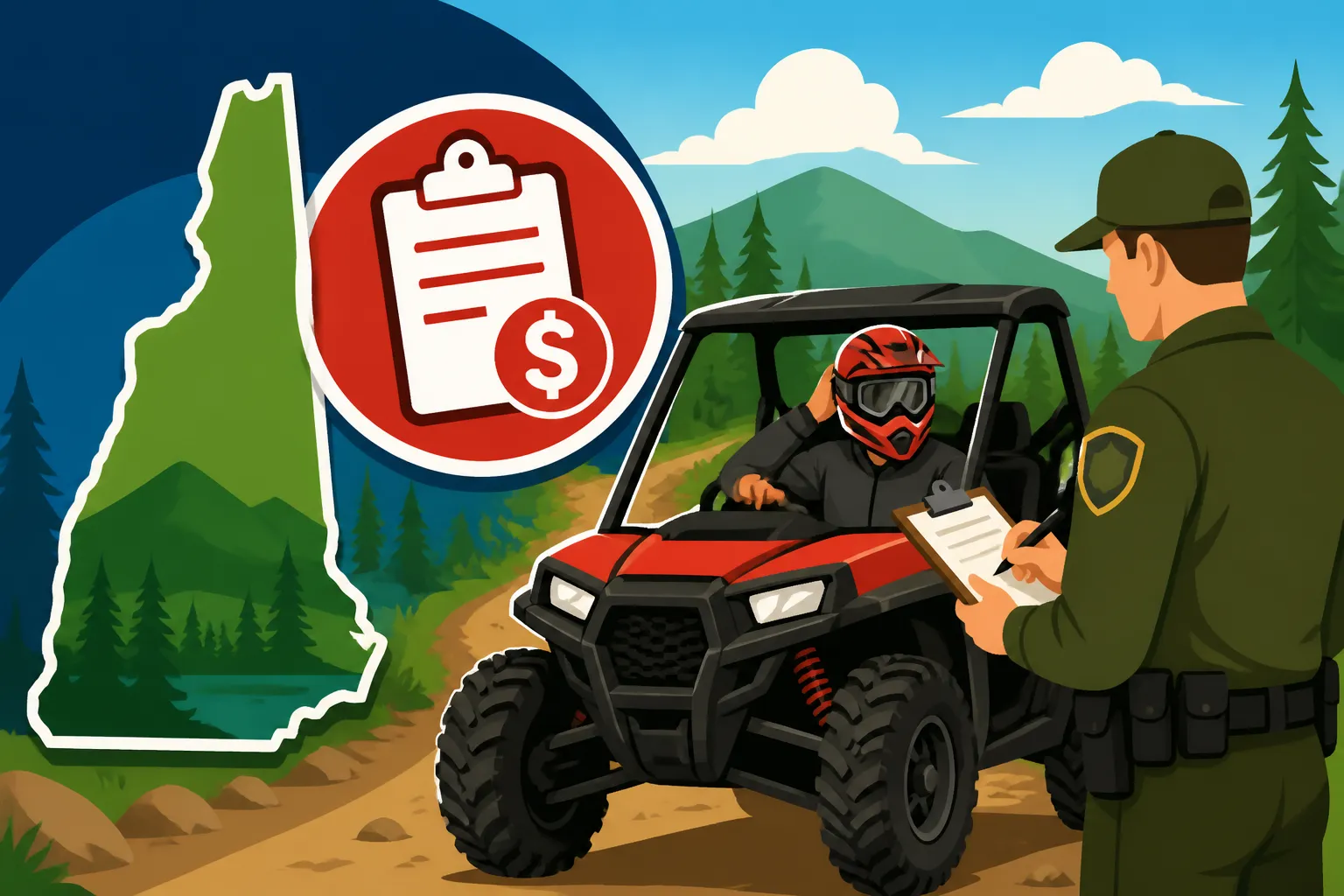
Stay calm and courteous during the stop. Do not argue on the trail or try to leave before the officer has finished. Ask which conduct is being cited and where the alleged violation occurred. If you can do so safely and without interfering, note the location, nearby signs, trail markers, and conditions. Do not move, remove, or alter a closure sign or barrier.
When the citation is issued, check that you understand the response instructions. The document may tell you how to pay, contest the allegation, or appear. Do not assume that paying is the only option, that ignoring the ticket will make it disappear, or that an informal conversation with a club resolves a citation issued by an enforcement officer.
A practical checklist:
- Read every charge. Note the alleged conduct, location, cited law or rule, and any response deadline or appearance instruction.
- Preserve relevant information. Save the citation, trail map, dated closure information, photos, registration records, and any messages about permission or access.
- Write down your recollection. Record the route taken, signs you saw, weather and trail conditions, and what was said during the stop while the details are fresh.
- Follow the instructions on the citation. Confirm where and how to respond, and do so within the stated time.
- Get qualified advice if needed. If the allegation is serious, you dispute the facts, or you are unsure about the legal consequences, speak with a qualified attorney before deciding how to respond.
Photos and maps can help establish what you saw or where you were, but they do not automatically prove that riding was allowed. A map may be outdated, and a photograph of one entrance may not show a closure farther along the trail. Keep original files and note when and where they were taken.
If you believe the citation is incorrect, use the formal response process described on the ticket. Explain the facts clearly and provide relevant records. Avoid contacting a landowner or club in a way that could be interpreted as pressure, and do not post claims about the incident that could complicate a dispute.
Appealing an OHRV Citation covers the citation challenge process in more detail. The ticket’s own instructions control where to respond and what steps apply to your particular allegation.
How to Reduce the Risk Before Your Next Ride
The best way to avoid a trail citation is to plan around access, not just distance. A route that looks passable may be closed, and a route that appears on a map may cross land where riding is not permitted. Check the current trail status shortly before leaving, then follow posted directions throughout the ride.
Use this pre-ride routine:
- Confirm that the trails you intend to use are open on the day of the ride.
- Check for temporary closures, width limits, and machine-type restrictions.
- Make sure your machine is properly registered for the ride.
- Carry required documents where you can reach them.
- Stay on marked, authorized routes and respect gates and signs.
- Get permission before riding on private property when required.
- Turn around when access is unclear instead of creating a new route.
Do not rely on another rider’s account as your only source of access information. Someone may have ridden before a closure took effect, may be using a different route, or may have permission that does not extend to you. Likewise, a trail map is useful for planning but should be paired with current status information and on-the-ground signs.
If the trail system is unclear, contact the appropriate trail manager or club before riding. Ask specifically about the route, machine type, current opening status, and any restrictions. A general answer that a system is “open” may not mean every segment is open or suitable for every vehicle.
When you receive a citation, focus first on the exact allegation and the response instructions. Avoid guessing at the fine based on another rider’s story: the charge, location, and circumstances can differ. Respond on time, keep relevant records, and seek qualified advice if the stakes or facts are unclear.
Disclaimer
This article is for general informational purposes only and does not constitute professional advice. Laws, prices and regulations vary by location and change over time. Consult a qualified professional for guidance on your specific situation.