Why a Driver’s License Substitutes in New Hampshire
In New Hampshire, a qualifying driver’s license can take the place of an OHRV safety certificate for an eligible rider. That can save a separate course and card, but it does not register an ATV or UTV, override age and supervision rules, or make every trail or road legal. Here’s what the substitution means and what to check before riding.
What the substitution means
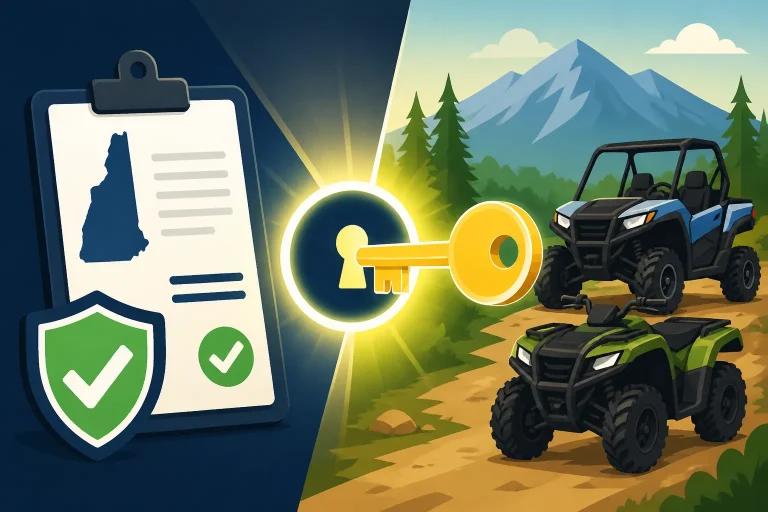
New Hampshire recognizes a valid driver’s license as an alternative to holding an OHRV safety certificate for a rider who is otherwise permitted to operate the machine. In practical terms, an eligible rider can meet the safety-education requirement by having a qualifying license instead of completing a separate OHRV course and carrying its certificate.
That is a limited substitution. A driver’s license does not replace the machine’s registration, landowner permission, a club’s access requirements, or any rule about where and how you may ride. It also does not give a young rider permission to operate a machine they are not old enough to ride, or remove supervision requirements that apply to them.
It helps to think of the requirement as one part of a larger checklist:
- Safety education: A qualifying driver’s license may satisfy this requirement instead of an OHRV safety certificate.
- Registration: The ATV or UTV still needs the required New Hampshire registration when registration applies.
- Age and supervision: The rider must still meet the rules for their age, machine, and riding location.
- Access: The trail, road, or land must be open to the machine and rider.
- Other riding requirements: Equipment, passenger, crossing, and conduct rules still apply.
New Hampshire does not sell a separate statewide trail pass in place of registration. For many rides, registration is the key document that permits access to the relevant trail system, subject to closures and local restrictions. See [Do You Need a Trail Pass in New Hampshire?] for how registration and trail access fit together.
The driver’s-license option is most useful for riders who already have a valid license and are trying to work out whether they need an additional safety card. It is not a general exemption from OHRV requirements. If you are planning a ride with a teen, a visitor, or a group with mixed experience, check each rider’s status rather than assuming one document covers everything.
Who can rely on a driver’s license
The substitution applies only when the rider has a qualifying, valid driver’s license and is otherwise eligible to operate the OHRV. A learner’s permit, expired license, or license that is not currently valid should not be treated as equivalent without confirmation from the appropriate New Hampshire authority.
A driver’s license is evidence that the rider meets the safety-education alternative; it is not a universal OHRV permit. For example, a rider cannot use a license to bypass a minimum age, ride on a closed trail, or operate where the landowner has not allowed access.
A license is different from a learner’s permit
A learner’s permit is not the same document as a driver’s license. The license substitution is described in terms of a valid driver’s license, so do not assume that a learner’s permit qualifies. If a young rider has a permit but no full license, check whether they need an OHRV safety certificate and what supervision rules apply.
This distinction matters when a family is organizing a ride. A teenager may be able to drive a car under certain conditions but still have separate OHRV obligations. The rules depend on the rider’s age and the type of operation, not just whether the person is learning to drive on public roads.
A license does not erase age rules
The safety-certificate alternative and the minimum-age rules answer different questions. One concerns whether the rider has met the required safety education standard. The other concerns whether the rider may operate the machine at all, and under what supervision.
New Hampshire’s requirements vary by age. Young riders may need a safety certificate, an adult companion, or both, depending on the situation. A driver’s license should not be read as permission to ignore those requirements. For the age-specific overview, see New Hampshire’s Age and Supervision Rules and [New Hampshire ATV Safety Certificate Requirements].
If the rider is a minor, make the age and supervision check before deciding that a license settles the question. A parent or accompanying adult should also confirm that the proposed route and machine are appropriate. A rider can meet the education requirement and still be barred from operating alone or from using a particular road or trail.
A license does not have to be an OHRV document
There is no separate OHRV driver’s license that replaces a regular driver’s license. The point is that a qualifying driver’s license may serve in place of the safety certificate. Do not confuse this with a road-use permission or assume that having a car license makes an ATV or UTV street legal.
OHRV operation on roads is restricted and depends on the road and local designation. A driver’s license does not by itself open a town road to OHRVs or authorize ordinary street travel. For the separate road question, see Are ATVs Street Legal in New Hampshire?.
What the license does not replace
The easiest way to avoid a costly misunderstanding is to treat the driver’s license as a safety-education alternative only. It does not take care of the other pieces of a legal and prepared ride.
| Requirement | Does a driver’s license replace it? | What to check |
|---|---|---|
| OHRV safety certificate | It may, for an eligible rider with a qualifying valid license | Confirm the rider’s age and license status |
| New Hampshire OHRV registration | No | Confirm the machine is properly registered for the ride |
| Trail or land access | No | Check the trail’s status, width rules, and access permission |
| Age and supervision rules | No | Apply the rules for the rider’s age and location |
| Road-use permission | No | Check whether the road is designated for OHRV use |
| Required riding equipment | No | Check the requirements for the machine and route |
| Rental-company requirements | No | Ask the operator what documents and conditions apply |
Registration still belongs to the machine
Registration is separate from the rider’s education record. A person may have a valid driver’s license and still be unable to ride a machine that is not properly registered for New Hampshire use. The registration rules can also differ for residents and visitors, and some visitors may have a limited-duration option.
Before setting out, confirm that the registration applies to the particular machine and the planned use. Do not assume a registration from another state automatically provides the access needed in New Hampshire. The details are covered in Riding New Hampshire With an Out-of-State Machine and New Hampshire OHRV Registration Paperwork.
Also check that the registration certificate and decals are current and properly displayed. A driver’s license does not substitute for either. If you are unsure what documents need to be on the machine or carried by the operator, review New Hampshire’s Printed Certificate and Two Decals.
Trail access is a separate decision
A registration does not guarantee that every trail is open, suitable, or available to every machine. Clubs and land managers may set width restrictions, seasonal closures, or other access conditions. Private land requires permission, and a closed sign should be treated as a real closure, not a suggestion.
Likewise, a driver’s license does not give the holder permission to cross private land as a shortcut. If a route includes private property, confirm that the access is authorized and follow any stated conditions. See Written Permission on New Hampshire Private Land for the distinction between riding permission and simply finding an unposted area.
For a public ride, check current trail status before leaving. Seasonal opening and closing dates, weather, maintenance, and landowner decisions can change what is available. The best route on a map may not be open on the day you arrive.
Road rules remain in force
A driver’s license does not turn an ATV or UTV into a street-legal vehicle. New Hampshire limits where OHRVs may operate on roads, and a town’s decision to designate particular roads is separate from the rider’s licensing status. Even on an authorized road, crossing and equipment rules still matter.
If a route crosses a road, the rider must follow the applicable crossing requirements. If a town road is open to OHRVs, the designation may be limited by location, time, or other conditions. For a starting point, read New Hampshire Towns That Allow OHRVs on Roads and What New Hampshire Requires to Cross a Road.
What to carry and how to check your status
If you rely on a driver’s license instead of an OHRV safety certificate, carry the license when you ride. The document is the basis for the alternative, so having it available makes it easier to show that you meet the education requirement if an officer asks. Keep the registration certificate and any other required papers with the machine as well.
Before the ride, make a short document check:
- Confirm the license is valid. Check that it is not expired, suspended, or otherwise invalid. Do not assume a learner’s permit qualifies.
- Check the rider’s age and supervision rules. A license does not cancel age-based restrictions.
- Confirm the machine’s registration. Make sure it covers the machine and the New Hampshire use you plan.
- Check access and trail status. Confirm the route is open and allows your machine’s width and type.
- Pack the relevant documents. Carry the driver’s license if relying on the substitution, along with the registration certificate and any other required items.
If you are unsure whether a particular license qualifies, ask the appropriate New Hampshire agency or a registration agent before riding. This is especially sensible if the license is from another jurisdiction, the rider is a minor, or the license has a restriction that may affect its validity. Avoid relying on a verbal assumption from another rider when a quick official check can settle the issue.
The same care applies if you rent. A rental company may verify age, license, experience, or other conditions as part of its own rental process. Those requirements are separate from the state’s safety-certificate substitution. Ask the company what documents every driver must bring, and check whether the rental is registered for the planned trail use. For general rental questions, see Does a Rental Include a Certificate? and Does a Rental Come With Its Own Registration?.
If you have a safety certificate instead
A rider who has completed the approved safety course may use the certificate to meet the applicable safety-education requirement. If you already have one, follow the instructions for carrying or presenting it. If you do not have a qualifying license or certificate, do not assume that riding with an experienced friend is enough; check the rules that apply to your age and circumstances.
New Hampshire offers safety education options for OHRV riders. Course availability and current procedures can change, so use the official course information when choosing a class. The certificate requirement and course pathways are explained in Where to Take the Free Classroom Safety Course and The Online OHRV Safety Course Costs $34.95. Confirm current course details directly before enrolling.
Having both a license and a safety certificate is generally not a reason to skip the rest of the preparation. The key is to meet the rule that applies to you and carry the relevant proof. If the license expires or becomes invalid, do not assume that an old license continues to satisfy the alternative.
Common misunderstandings to avoid
The most frequent mistake is treating “a driver’s license substitutes” as though it means “a driver’s license covers everything.” It does not. The license relates to safety education; registration, age limits, land access, road designations, and equipment requirements are separate.
A few common scenarios show where the distinction matters:
- An adult with a valid license and an unregistered ATV: The license may satisfy the education alternative, but it does not register the ATV.
- A licensed teenager riding without checking supervision rules: The license may address the safety-education question, but age rules still apply.
- A visitor with a home-state registration: A driver’s license does not establish that the machine’s registration is accepted for New Hampshire use.
- A rider with a learner’s permit: Do not assume the permit qualifies as a driver’s license for the substitution.
- A licensed rider approaching a closed trail: The license does not override a closure or grant access to land without permission.
- A driver’s license holder riding on a public road: The license does not automatically authorize OHRV travel on that road.
Another common confusion is assuming that a driver’s license is required to operate an OHRV. The substitution works the other way around: for an eligible operator, the license may stand in for a safety certificate. It does not mean every OHRV rider must hold a driver’s license, nor does it mean a rider without one can ride without meeting the safety-education requirement.
People also mix up safety education with registration. Both relate to legal riding, but they attach to different things. The safety-education requirement concerns the operator. Registration concerns the machine. A rider can have the right document while the machine lacks the right registration, or the machine can be registered while the rider lacks the required proof.
Finally, do not assume that the rules are identical across every place where OHRVs operate. A route may combine club trails, town roads, and private land. Each segment can have its own access conditions. Check the full route rather than relying on a single general rule.
Frequently Asked Questions
Does a New Hampshire driver’s license replace an OHRV safety certificate?
It may satisfy the safety-education requirement for an eligible rider if the license is valid and qualifies. It does not replace registration, age rules, trail access permission, or other riding requirements.
Does a learner’s permit count?
Do not assume it does. The substitution refers to a valid driver’s license, not simply permission to practice driving. Confirm the status of a learner’s permit with the appropriate New Hampshire authority before relying on it.
Can a driver’s license make an ATV or UTV street legal?
No. Road access for OHRVs depends on the applicable road rules and local designation. A driver’s license does not authorize general street use.
Should I carry my driver’s license on the trail?
If you rely on it instead of an OHRV safety certificate, carry it so you can show the basis for the substitution. Also carry or keep available any registration documents required for the machine.
Disclaimer
This article is for general informational purposes only and does not constitute professional advice. Laws, prices and regulations vary by location and change over time. Consult a qualified professional for guidance on your specific situation.