Retrieving a Deer by Machine
Retrieving a deer after a hunt can mean crossing land, trails or roads where an ATV or UTV is not automatically allowed. In New Hampshire, a machine may help with recovery, but hunting rules, land access and OHRV rules still apply. Plan the route before the hunt, keep the firearm separate from machine operation, and secure the deer for transport.
Start With the Rules for the Hunt and the Route
A machine used to carry a deer is not the same as permission to ride wherever the deer falls. The route to the animal and the route back both matter. A trail may be open to OHRVs without allowing a detour off the trail, and a hunting area may have restrictions on motorized travel.
Before the season, check the current New Hampshire Fish and Game hunting rules for the species, method of take and location. Confirm what they allow for retrieving legally taken game by motorized vehicle. Rules can depend on where you are hunting and the type of land involved, so do not rely on a general assumption that a machine can reach every downed deer. The overview in New Hampshire Rules for Retrieving Game can help you identify the questions to check.
Also confirm that the machine may legally use the specific route. A New Hampshire OHRV registration is not a general trail pass and does not grant permission to cross private property. Registration, trail access and landowner permission are separate issues. New Hampshire OHRV Permits Explained explains why a registration does not replace permission or access rules.
| Situation | What to check before riding |
|---|---|
| The deer is beside an open OHRV trail | Confirm the trail is open to your machine and that you can reach the deer without leaving the authorized route. |
| The deer is on private land | Get permission for motorized access from the landowner; permission to hunt does not necessarily include permission to drive a machine. |
| The deer is on state-owned land | Check the specific land’s rules for motorized travel and game recovery. Do not assume ordinary trail access extends off-trail. |
| The route uses a town road or highway | Verify that OHRVs are authorized on that road and follow the applicable road-riding rules. |
| The deer is beyond a closed trail, gate or restricted area | Do not bypass the closure. Find out whether an authorized recovery route exists or make a different plan. |
Confirm the hunting and machine rules separately
A hunting license or lawful harvest does not automatically authorize every method of retrieval. Likewise, machine registration does not determine whether a particular hunting-area route is open. Check both sets of rules rather than treating one as a substitute for the other.
New Hampshire’s riding rules during hunting season may affect where and how you travel. See New Hampshire Rules for Riding in Hunting Season when planning a ride in an area shared with hunters. If the recovery route crosses private property, New Hampshire Rules for Riding Private Land is a useful reminder that access needs to be lawful, not merely convenient.
For land managed by the state, check the restrictions that apply to the particular location. [Riding State-Owned Ground in New Hampshire] can help clarify why permission to hunt on public land should not be read as blanket permission to ride off-trail.
Do not treat a road or trail as a shortcut
A machine can be registered and still be prohibited from a road, trail or parcel. Towns decide whether certain roads are open to OHRVs, while clubs and landowners may control access to trails crossing their property. The route can also change seasonally or close temporarily.
If you need to cross a road, use only a lawful crossing point and follow the applicable crossing rules. If a trail is closed, do not ride around a gate or sign to reach the animal. New Hampshire Rules for Riding a Closed Trail covers the importance of respecting closures, including when the detour seems short.
Get Permission and Plan the Recovery Route
The simplest recovery is one planned before the shot: know where your machine can go, where it must stay, and how the deer will get from the recovery point to a legal route. If the animal moves or falls somewhere unexpected, pause and reassess rather than following it off-trail.
Ask about motorized access specifically
Permission to hunt, walk, or retrieve a deer on private land may not mean permission to drive an ATV or UTV there. Ask the landowner directly about machine access, the permitted route and any limits on timing or ground conditions. If permission is verbal, write down the details for everyone in the hunting party. When written permission is required, follow that requirement; Getting a Landowner’s Signature in New Hampshire addresses the value of documenting access.
Be clear about what you are asking to do. A landowner may allow a machine on an established woods road but not across a field, through a wet area or onto a trail. They may also restrict access after rain, during logging or when soil is soft. A route that is physically passable is not necessarily an authorized one.
Check trail status and boundaries before setting out
A club trail may cross a patchwork of leased or private land. Do not assume that an open section gives you permission to leave the marked route and follow a deer into adjoining woods. Check the current trail status and map, and identify where the trail crosses parcel boundaries if that affects your plan.
If recovery requires a route that is not open to your machine, consider non-motorized options or contact the land manager or landowner for guidance. Avoid making a new path through brush or wetlands. Besides causing damage, going off-route can create problems for landowners and future trail access.
Make a backup plan
A deer may be farther from the trail than expected, or the ground may be too steep, muddy or soft for a machine. Decide in advance who will stay with the deer, who will bring equipment and whether the group has a legal alternative for hauling it out.
A backup plan might involve a hand sled, a suitable game cart, help from another hunter or a different legal access point. It should not depend on towing the machine through a closed route or crossing land without permission. If conditions are unsafe or access is uncertain, stop and get advice rather than forcing the recovery.
Keep the Firearm and the Machine Separate
Operating a machine while carrying or handling a firearm creates an avoidable safety risk. The firearm should not be loaded or handled while you are driving, winching or securing the deer. Follow New Hampshire’s current hunting and firearm rules for transport, and make a clear handoff between hunting and recovery tasks.
Before moving the machine, unload and secure the firearm as required by the rules that apply to your situation. Store it so it cannot shift, become damaged or interfere with the controls. Keep ammunition and other gear secured as well. Do not put a firearm somewhere it could be struck by the load or caught in a strap.
Assign clear roles
In a group, decide who is responsible for the machine, who handles the deer and who checks the route. Only a person who is legally permitted and capable of operating the machine should drive it. Passengers should stay seated in approved positions and keep clear of the winch, cable, straps and moving parts.
Avoid having someone walk beside a moving machine while holding the deer or a firearm. If a person needs to guide the driver, stop first, agree on hand signals and keep the guide out of the machine’s path. On uneven ground, the driver should move slowly and stop if the load shifts or the machine loses traction.
Keep the route visible and controlled
Use lights when visibility requires them, and make sure the machine is in good condition before leaving. Check brakes, tires or tracks, steering, fuel and any winch or recovery equipment you intend to use. A loaded machine handles differently from an empty one, especially on slopes, soft ground and uneven trails.
Do not exceed the machine’s rated capacity or carry people in positions not designed for passengers. If you use a trailer, confirm that it is appropriate for the machine and that the load is secured for the trip. A deer, tools and extra gear can add up quickly.
For legal road riding, make sure the machine meets applicable requirements and that the road is open to OHRVs. New Hampshire Rules for Riding a Town Street can help distinguish an authorized road route from a public road that remains closed to machines.
Load and Transport the Deer Safely
Once the animal is recovered, the task shifts to safe handling and secure transport. A deer that is poorly attached can slide, snag vegetation or affect steering and braking. Take time to position the load rather than trying to move quickly.
Choose a stable way to move the deer
Use a method suited to the terrain and the machine. A winch can help bring an animal to a safe loading point, but it is not a reason to pull the machine beyond a lawful route or onto unstable ground. Keep people clear of a tensioned cable, and follow the equipment maker’s instructions. Never wrap a winch line around a person or use a strap in a way that could recoil toward someone.
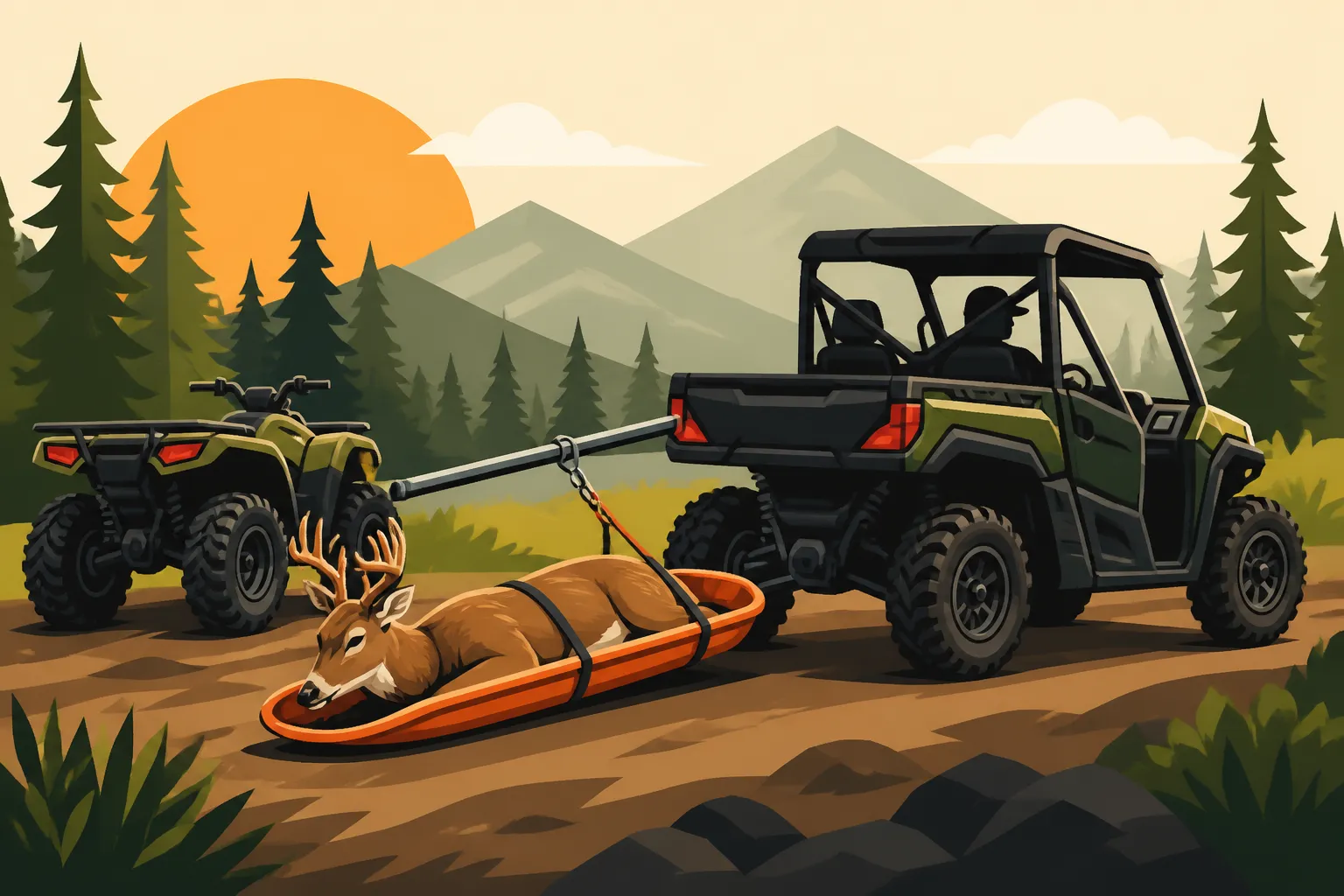
If you drag the deer, avoid dragging it across a marked trail where it could damage the surface or create a hazard for other users. A sled or suitable cart may reduce friction and make it easier to control the load. On steep or slippery ground, do not attempt a pull that could overturn the machine or injure someone.
For a UTV, secure the deer in the cargo bed without blocking the driver’s view, controls or access to safety equipment. For an ATV, use a rack or trailer designed for the load. Keep the center of gravity low and balanced, and make sure straps cannot reach wheels, axles, exhaust components or moving suspension parts. Recheck them after the first short stretch.
Protect the load and the machine
Use clean materials to keep the animal from contacting fuel, oil, exhaust or dirty equipment. If you carry knives, gloves or other processing supplies, pack them so they cannot fall or become entangled in a strap. Keep sharp tools sheathed and secured.
Do not overload the machine or trailer. A load that looks manageable at a standstill can become unstable on a slope or while braking. If the deer is too heavy for the machine or the route is too rough, use a safer hauling method or make more than one trip if that is lawful and practical.
Keep the machine’s decal and registration documents available as required. Officers may check that the machine is properly registered and that the rider has the necessary documents. See Showing a Decal and a Certificate for a practical overview of what to have ready.
Respect other trail users
If you must use an open trail to leave the area, travel at a controlled speed and yield as required. A large or awkward load can make it harder to maneuver, so leave room for other riders and stop in a safe location if you need to adjust a strap. Do not block a trail while loading or leave equipment behind.
Carry out all packaging and waste. If the route is busy, choose a safe place away from traffic to secure the load. If the animal or equipment falls from the machine, stop and recover it only when it is safe to do so.
Before You Ride Back
A short checklist can prevent a difficult recovery from turning into a legal or safety problem:
- Confirm the deer was lawfully taken and check the current game-retrieval rules.
- Verify that the route is open to your machine, including any road, trail or land crossing.
- Get the landowner’s permission for motorized access where needed.
- Secure and transport the firearm according to applicable rules before operating the machine.
- Check the machine, recovery gear, passenger positions and load capacity.
- Attach the deer securely, keep the load balanced and recheck it after moving a short distance.
- Stop if the route is closed, the ground is unsafe or the load cannot be controlled.
A registration is only one part of the answer. The key is to know that both the recovery route and the method of travel are allowed, then move the deer without creating a hazard for the rider, other trail users or the landowner.
Disclaimer
This article is for general informational purposes only and does not constitute professional advice. Laws, prices and regulations vary by location and change over time. Consult a qualified professional for guidance on your specific situation.