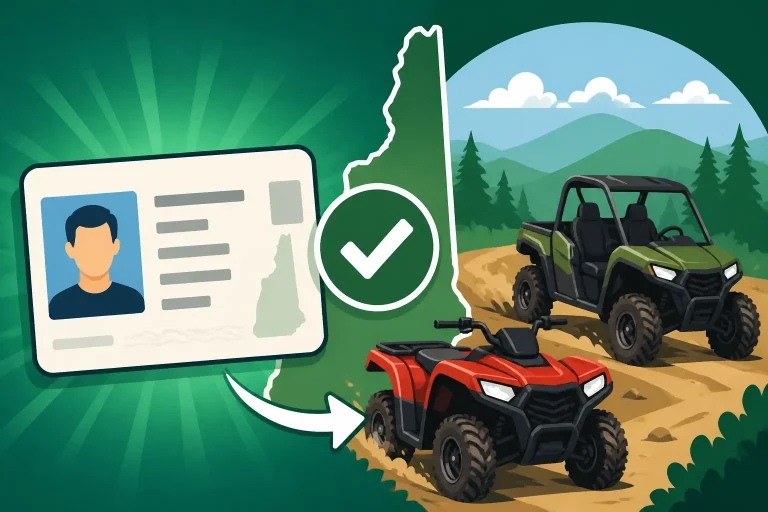
Riding a Rented Quad in New Hampshire
Riding a rented quad in New Hampshire can be simpler than bringing your own machine, but the rental does not automatically settle every permit, age, or trail-access question. The rental company should explain what its registration covers and where you may ride. Before booking, confirm who can operate the quad, what paperwork comes with it, and whether your planned route is open to OHRVs.
What the Rental Registration Covers
A rental quad used on New Hampshire trails and other public riding areas generally needs a valid New Hampshire OHRV registration. For a machine rented from a local outfitter, the rental company should arrange the registration and provide the required decals and certificate. You should not need to register the shop’s quad in your own name simply because you are renting it.
That does not mean you can skip checking the paperwork. Before you leave the counter, ask whether the specific machine is registered for use on your planned route, where the registration certificate is kept, and whether you need to carry or display anything beyond the decals. The shop should be able to show you the current registration information or explain how to access it. If the machine has no visible decals or staff cannot clarify its status, pause and get an answer before riding.
A rental’s registration is tied to the machine, not a general pass that lets you take any quad anywhere. Registration also does not provide permission to ride on land or trails that are closed or off-limits. For a closer look at what to confirm with the provider, see Does a Rental Come With Its Own Registration? and New Hampshire OHRV Permits Explained.
| Before riding | What to confirm with the rental company |
|---|---|
| Registration | The quad has a valid New Hampshire OHRV registration for the intended use |
| Decals and certificate | Required decals are in place, and you know where the certificate is or how to present it |
| Route access | The company identifies trails or areas where the rental may be operated |
| Riders | Each proposed operator meets applicable age, supervision, and safety requirements |
| Passengers | The machine is designed and authorized for the passenger you plan to carry |
| Road use | The route does not assume that an OHRV can use ordinary public roads |
| Return and emergency procedure | You know when the rental is due back and whom to contact if something goes wrong |
Registration is not the same as a trail-wide permission slip
New Hampshire does not treat OHRV registration as permission to ride on every path, road, or parcel. Access depends on the land, trail designation, local rules, and current conditions. A registered quad can still be prohibited from a closed trail, a trail that does not allow that type or width of machine, or private land where you lack permission.
Ask the rental company for the route it expects customers to use, and check whether the route is open on the day of your ride. Do not assume a trail shown on an older map is still available. New Hampshire Trail Status Before You Ride can help you understand why a same-day check matters.
If you are visiting from another state, your personal machine’s registration is a separate issue from the registration on a New Hampshire rental. A rental company’s New Hampshire-registered quad is not relying on your home-state registration. But if you bring a machine from home instead, do not assume its registration gives it access here; read Why New Hampshire Honors No Neighbor’s Registration and [New Hampshire Rules for a Visiting Rider].
Who Can Operate the Quad
Being old enough to rent a machine under a company’s policy does not necessarily answer every state-law question. Rental businesses may set their own minimum age, require a driver’s license, restrict who can drive, or require a parent or guardian to sign paperwork. State requirements for OHRV riders can also depend on the rider’s age, supervision, location, and safety education.
Ask the shop to confirm the rules for each person who may take the controls—not just the person paying or signing the rental agreement. If a teenager will ride, provide the rider’s age when you call and ask what proof, certificate, or adult supervision is required for the planned route. For the broader state requirements, see [New Hampshire ATV Safety Certificate Requirements] and New Hampshire Supervision Rules for Young Riders.
Do not assume that a driver’s license, a rental waiver, or a signed permission form replaces every safety or supervision rule. A rental agreement is a contract with the company; it does not change the public rules that apply on a trail. Likewise, taking a course does not automatically make every rider eligible to operate every rental machine.
Check who is allowed to drive
Some rental agreements authorize only named drivers. Others may require every operator to complete an orientation or show identification. Before handing the controls to someone else, check the contract and ask the company. A person who is not authorized by the shop may be excluded from coverage or held responsible under the rental terms, even if that person is otherwise legally allowed to ride.
If your group includes riders with different ages or experience levels, clarify the arrangement before booking. The shop may have a minimum age or experience rule that is stricter than the general legal requirements. It may also decide that a particular rider needs to operate with a guide or on a more suitable route. Treat those conditions as part of the booking, not as details to sort out at the trailhead.
Confirm passenger arrangements
A quad is not automatically safe or permitted for two people just because two people can sit on it. Ask whether the machine is designed for a passenger and whether the rental agreement allows one. Confirm any passenger age or size limits with the shop, and make sure the passenger has the required protective equipment.
Never carry a passenger on a machine that is intended for one rider. A passenger changes how the quad handles, brakes, and turns. If you need room for two, book a machine specifically designed for that use and verify the rules that apply to the passenger. See New Hampshire Rules for Carrying a Passenger for more detail.
Where You May Ride and What Reciprocity Means
A rental registration does not make every trail or road available. The rental provider should identify where its machine may be used, but you remain responsible for following signs, closures, local restrictions, and the route instructions. This is especially important when a route crosses several trail areas or connects trails using a town road.
New Hampshire roads are not automatically open to OHRVs. A town must allow the relevant use, and road access can be limited to specific streets, times, or conditions. Do not follow a road just because it appears on a GPS map or because another vehicle is using it. Ask the rental shop whether its route includes any public-road riding and how that section is authorized. New Hampshire Rules for Riding a Town Street explains why a marked route and a normal road are not interchangeable.
The same caution applies to private land. A trail may cross privately owned ground under a permission or lease arrangement, but that does not grant riders permission to leave the marked route. Do not cut across a field, driveway, logging road, or unmarked connector unless the owner or authorized route information clearly permits it.
Don’t confuse rental registration with reciprocity
Reciprocity is about whether one jurisdiction recognizes another jurisdiction’s registration. It is not a way to extend a rental agreement or gain access to land. If a rental company gives you a machine registered in New Hampshire, the question is whether that machine’s registration and the route are appropriate for your ride. Your home-state registration does not change the rental quad’s status.
If you are renting outside New Hampshire and bringing the machine across the border, ask the rental provider how it is registered and whether it may legally be operated on the New Hampshire route you plan to use. Do not assume that a registration valid where you picked up the quad will automatically be accepted for riding here. Registering an Out-of-State Machine in New Hampshire covers the separate situation of bringing a machine into the state.
Also ask whether the route has any additional site-specific requirements. A riding area may have its own entry process or fee, or a trail may be unavailable because of seasonal conditions. The rental’s registration does not pay every possible access charge, and a booking confirmation does not guarantee that a trail will remain open.
Before You Book and Before You Ride
A few questions before paying can prevent an awkward or unsafe surprise at the counter. Tell the rental company where you plan to ride, who may operate the quad, and whether you need a passenger seat. Ask what is included, what the company requires you to bring, and what happens if the route closes or the machine develops a problem.
Rental terms vary. The company can explain its current requirements, including any identification, deposit, cancellation conditions, damage responsibilities, or return-time rules. For general preparation, [Renting an ATV in New Hampshire] and What a New Hampshire ATV Rental Includes are useful starting points. Do not rely on an old booking page or someone else’s past rental experience for current terms; confirm them directly with the provider.
Use this sequence when arranging the ride:
- Describe the group. Give the company each rider’s age and experience, identify who will drive, and say whether anyone needs a passenger seat.
- Confirm eligibility. Ask what license, safety certificate, supervision, or orientation each operator needs for the planned ride.
- Confirm the machine’s registration. Ask whether the exact rental quad is registered for New Hampshire OHRV use, and where its certificate and decals are located.
- Get the route details. Ask where the route starts, which trails or roads are authorized, and whether any width, seasonal, or local restrictions apply.
- Check conditions on ride day. Confirm that the route is open and ask about closures, detours, or weather-related changes.
- Read the rental terms. Understand who may drive, what damage or recovery costs may apply, when the quad must be returned, and how to report a breakdown.
- Inspect the quad at pickup. Note existing damage, check the controls and lights as directed, and report anything that looks unsafe before leaving.
- Follow the orientation. Make sure every operator understands the controls, stopping procedure, route instructions, and emergency contact process.
At pickup, ask the staff to point out the decals and explain how to show the registration certificate if you are stopped. The company should also explain whether it has loaded a route onto a GPS or provided a map. A mapped route is helpful, but it does not override a closed sign or authorize riding beyond the marked trail.
Wear the protective equipment the company and applicable rules require. A helmet is a basic part of a responsible ride, and eye protection may be needed depending on the machine and conditions. Check fit before departure; borrowed gear that does not fit properly is not a useful substitute for suitable protection. Bring any personal items the shop says are not supplied, and secure them so they cannot interfere with the controls.
Stay on the route the company identifies. If you reach a gate, closure sign, or unclear junction, stop and contact the provider rather than guessing. Do not use a quad on a sidewalk, parking lot, or ordinary road as a shortcut. If weather or a trail closure changes the plan, follow the shop’s direction and ask what alternatives are permitted.
A smooth rental ride usually comes down to three checks: the machine is properly registered, every operator is eligible under both state rules and the rental contract, and the route is open and authorized. Get those answers before you ride, and you can focus on handling the quad safely instead of sorting out paperwork or access questions on the trail.
Disclaimer
This article is for general informational purposes only and does not constitute professional advice. Laws, prices and regulations vary by location and change over time. Consult a qualified professional for guidance on your specific situation.