Guiding Riders for Pay in New Hampshire
Charging to lead ATV or UTV rides in New Hampshire involves more than choosing a route and meeting guests at a trailhead. You need to sort out machine registration, permission to use trails for a commercial activity, rider requirements and business coverage. The key is to confirm each part before advertising or taking payment, rather than assuming that ordinary trail access includes paid guiding.
What paid guiding changes
A person riding with friends and a business leading paying customers may use the same machine and trail, but the arrangements are not necessarily the same. A trail network may allow recreational riding while requiring separate permission for a commercial tour, instruction, rental operation or organized event. Do not treat a guest’s registration, a guide’s membership or a trail map as proof that a paid business is authorized to use every part of a route.
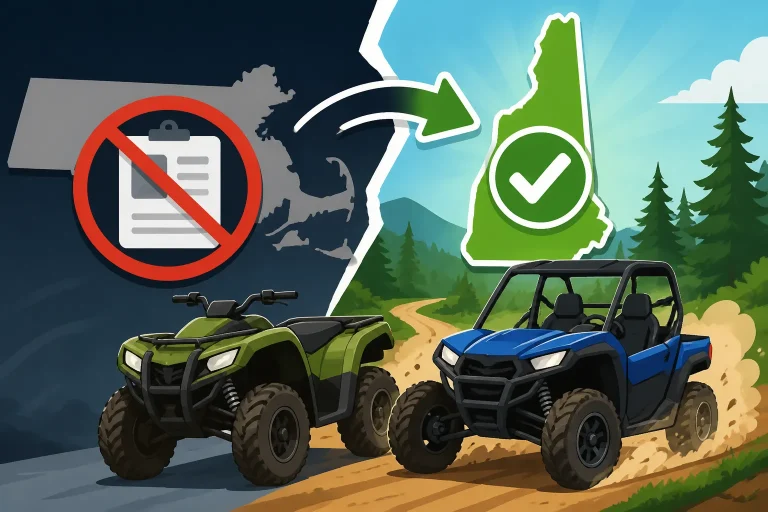
New Hampshire’s OHRV registration system and trail access are connected, but registration does not grant permission to ride wherever you choose. The state’s registration requirements apply to machines used in situations where registration is required; the landowner, trail manager or town still controls access to the land or road. There is no separate statewide trail pass that substitutes for registration or landowner permission. For background, see New Hampshire OHRV Permits Explained and Why New Hampshire Sells No Separate Trail Sticker.
Before offering paid rides, find out whether the route’s owners or managers allow commercial use. Much of the trail network depends on private landowner permission and club relationships. Permission for individual recreation should not be assumed to cover a business bringing customers through regularly. Ask the relevant landowner, club, park or other manager directly, describe the activity honestly and keep the response in writing. The practical distinction is covered in New Hampshire Club Membership and Access and New Hampshire Written Permission Requirements.
A business should also ask the state and local authorities whether its particular operation needs a permit, license or other approval. The answer can depend on what the business does: guiding guests on their own machines, supplying machines, renting them, teaching a course, running an organized group event or operating on a designated road may raise different questions. Do not assume that a guide’s status automatically covers rentals or special events. The relevant considerations are outlined in New Hampshire Rules for a Commercial Guide and New Hampshire Rules for an Organized Ride.
A useful way to separate the issues is to ask four questions:
- Is each machine properly registered for the planned ride?
- Does the business have permission for commercial use of every trail, road and staging area on the route?
- Are the guide and guests allowed to ride under the applicable age, supervision and safety rules?
- Does the business have the insurance and operating arrangements appropriate for paid rides?
A “yes” to one question does not answer the others. For example, a registered machine can still be on a closed trail, and a club membership does not necessarily authorize a commercial tour.
Registration and reciprocity for guided rides
Plan for the registration status of every machine, not just the guide’s lead vehicle. That includes customer-owned ATVs and UTVs, machines supplied by the business and any backup or support vehicle that is itself an OHRV. Check the current rules for the machine type and the exact riding locations before the trip.
Out-of-state registration is not a safe assumption for riding New Hampshire trails. Visitors may need a New Hampshire registration even when their machine is registered at home. The answer can depend on the rider’s situation and the machine, so confirm it rather than relying on a customer’s home-state sticker. See New Hampshire Rules for a Visiting Rider and Riding New Hampshire With an Out-of-State Machine.
If the business supplies the machines, clarify who is responsible for registration and what proof the operator keeps available. A guest may not need to obtain a separate registration for a machine already registered by the business, but the business should verify that the machine’s registration is valid for the planned use and that the required certificate and decals are present. If guests bring their own machines, tell them in advance what they must check; do not wait until the group is at the trailhead to sort out missing paperwork.
| Ride setup | What to confirm before accepting payment |
|---|---|
| Guests bring their own machines | Each machine’s New Hampshire registration status, required documents and suitability for the route |
| Business supplies the machines | Registration for each machine, responsibility for carrying the certificate, maintenance and the terms governing customer use |
| Guide uses a personal machine | The guide’s registration, the route’s commercial-use permission and any business-specific approvals |
| Route uses a town road | Whether OHRVs are allowed on that specific road and whether the town’s designation and operating rules apply |
| Route crosses private land | Written permission that covers the planned use, including the commercial nature and expected frequency of rides |
Registration does not resolve every reciprocity issue. A visitor may believe a valid registration from another state is enough, but New Hampshire has its own requirements. Make registration instructions part of the booking process and tell guests to verify their individual situation with the appropriate registration agent or state office. For registration details and paperwork, see Registering an OHRV in New Hampshire and New Hampshire OHRV Registration Paperwork.
Also make sure the machine class fits the route. Some trails have width restrictions, and a route that works for a narrower ATV may not work for a wide side-by-side. Measure the machine as required by the trail operator and check posted restrictions, rather than relying on a model name or a customer’s estimate. New Hampshire Rules for a Machine Over 50 Inches explains why width can affect where a machine may ride.
Trail permission, roads and route planning
A commercial route needs permission that matches what the business actually intends to do. When asking a club or landowner, explain whether customers will pay for guiding, whether the business supplies the machines, how often trips will run and how many riders will be in each group. Ask about staging, parking, signs, emergency access, noise, seasonal closures and any limits on group size or timing.
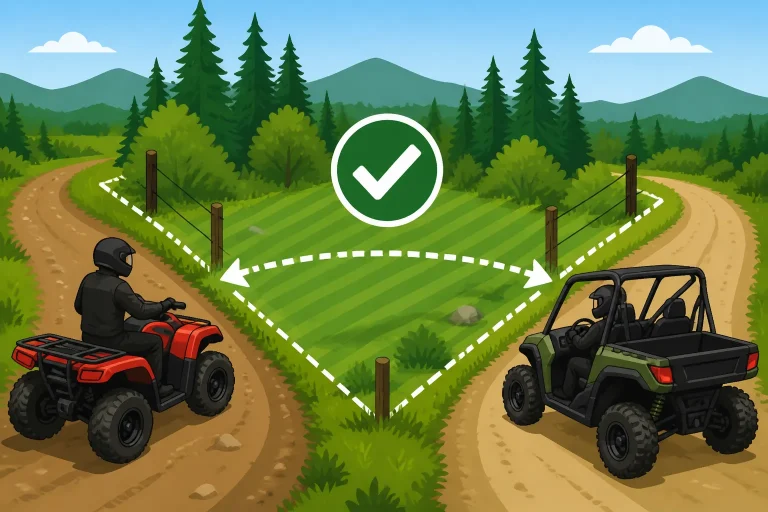
Get permission from the relevant people for each part of the route. A club may maintain a trail but not own the land underneath it. A town may regulate a road crossing without controlling adjacent private land. A route that crosses several parcels or trail systems may therefore require more than one conversation. If a landowner says no, do not plan to cross the property simply because the route appears on a map or other riders have used it.
Road sections need particular attention. New Hampshire does not make every road open to OHRVs by default. A town’s decision to allow riding applies to designated roads and may come with limits on hours, speed, direction or connections. Check the current local designation for each road on the route, including the streets used to reach the trailhead. See New Hampshire Rules for Riding a Town Street and How a New Hampshire Town Opens Its Roads.
Build the route around current access, not just a map downloaded before the season. Trails can close because of weather, maintenance, landowner decisions or seasonal changes. A commercial operator should have a backup plan and a reliable way to check conditions before sending a group out. Do not assume that a trail is open because it was open on a previous trip.
A practical route review includes:
- Confirming the managing club or landowner for every trail segment.
- Checking posted trail-width limits and machine restrictions.
- Confirming road designations and any local operating limits.
- Checking seasonal opening and closing information close to the ride date.
- Identifying legal parking and staging areas for the group.
- Planning a turnaround or alternate route if a segment closes.
- Making sure the group can complete the route without trespassing or riding an unapproved connector.
For a paid ride, route permission should be specific enough to prevent misunderstandings later. Save emails, letters or other written approvals with the business’s trip records. If a permission arrangement changes, update the route and customer information before the next ride. More on private-land access is available in Why Unposted Land Is Not an Invitation.
Guests, safety and business preparation
A guide is responsible for more than staying at the front of the group. Riders must meet New Hampshire’s age and supervision rules, and the applicable safety-certificate rules can depend on age and circumstances. Tell customers what they need before booking, then check the group at the start of the ride. Do not assume that a parent’s presence, a signed waiver or a guide’s instruction replaces a legal requirement. See [New Hampshire ATV Safety Certificate Requirements] and New Hampshire Supervision Rules for Young Riders.
Give guests clear instructions on helmets, eye protection, passenger limits, machine controls, riding distance and what to do if the group separates. Explain that riders must obey trail signs and stay on authorized routes, even when the guide is not immediately beside them. An orientation should cover the machine they will use, safe spacing, stopping signals, passing other trail users and what to do after a breakdown or injury.
Insurance deserves a separate conversation with a qualified broker who understands recreational vehicle operations. A personal policy may not cover commercial guiding, customer use of a business-owned machine or a claim arising from a paid tour. Ask about the specific activities offered and the locations used; do not rely on a generic policy summary or a customer waiver as a substitute for coverage review. If the business rents machines as well as guiding, make that distinction clear when discussing coverage and regulatory requirements.
Use customer paperwork to explain practical terms, not to imply that risk disappears. Booking information can state what the fee includes, what customers must bring, cancellation procedures, age or experience limits, machine-use rules and who to contact if plans change. Have any waiver or contract reviewed by a qualified professional. A form should not promise access that the business has not secured, and it should not ask customers to accept rules the operation cannot enforce.
A sound preparation routine is straightforward:
- Confirm the route and commercial-use permissions before publishing the trip.
- Verify registration and machine eligibility for the guide and every guest vehicle.
- Check current road access, trail status, seasonal conditions and staging arrangements.
- Confirm guest age, supervision and safety requirements during booking and check-in.
- Review insurance, contracts, emergency procedures and equipment with appropriate professionals.
- Keep records of permissions, customer information, machine checks and trip changes.
If any part of the proposed ride is unclear, pause and ask the responsible authority or land manager for a written answer. That is especially important before expanding from occasional guiding into regular tours, adding rentals or taking groups onto roads. A well-planned ride depends on four separate things working together: a legal machine, an eligible rider, an authorized route and a business prepared for the risks of carrying paying guests.
Disclaimer
This article is for general informational purposes only and does not constitute professional advice. Laws, prices and regulations vary by location and change over time. Consult a qualified professional for guidance on your specific situation.