New Hampshire Rules for Riding in Deer Season
Deer season can make an ordinary ATV or UTV ride less predictable: hunters may be nearby, access can change, and fall trail closures do not always match hunting dates. New Hampshire riders should check whether a route is open, make themselves easy to see, and avoid interfering with hunting activity. A little planning helps keep a ride safe and respectful.
Check that the trail is open before you ride
Hunting season does not automatically close every OHRV trail, and an open hunting season does not mean every trail is open to riding. Access depends on the land, the trail manager, and any seasonal restrictions in effect. A route shown on an old map may be closed for mud, maintenance, landowner concerns, or the start of winter operations.
Before heading out, check the latest information from the club or agency responsible for the route. Start with New Hampshire Trail Status Before You Ride and look for a current notice about closures, temporary restrictions, or changes to access. If a route crosses private or leased land, the permission that allows trail use may have conditions or dates. Do not assume that a trail is open just because a gate is unlocked or another rider has gone through.
This matters especially in autumn. Some New Hampshire club trails close in October, and different systems may have different closing dates. Hunting seasons can extend beyond a particular club’s riding season, so the presence of hunters is not a reliable way to judge whether OHRV access is allowed. Follow posted signs and the trail manager’s current directions. If the route is marked closed, stay off it even if it appears passable. See New Hampshire Rules for Riding a Closed Trail for why a closure sign is not optional.
State-owned land, private land, and club trails do not necessarily follow the same access rules. A public road or a familiar woods road is not automatically open to OHRVs, either. Check the rules for the specific land and route, including New Hampshire Rules for Riding State Land and New Hampshire Landowner Permission Rules. Written permission may be required on private ground, and a trail corridor may cross land that is not open for general riding.
| Before the ride | What to confirm | Why it matters |
|---|---|---|
| Club trail | Current status and seasonal closing notices | A trail may close before or during hunting season |
| State land | Whether OHRVs are allowed on that specific route | State land does not mean unrestricted vehicle access |
| Private or leased land | Permission, conditions, and any posted restrictions | Access can be limited or withdrawn |
| Road connection | Whether the road is designated for OHRV use | A road that looks rideable may still be closed to machines |
| Machine and paperwork | Required registration and documents | Seasonal access does not replace registration rules |
If you cannot verify access, choose a different route or contact the local club or land manager before riding. Do not rely only on a third-party map, an old social media post, or a GPS track. Those tools can help with navigation, but they may not reflect a new closure or a landowner’s change in permission.
Make yourself visible and give hunters room
The central safety issue during deer season is visibility. A hunter may be focused on the woods and may not expect a machine to appear around a bend. Riders may also have limited sightlines because of vegetation, terrain, dust, or the enclosed cab of a UTV. Treat every wooded section as a place where someone could be hunting nearby.
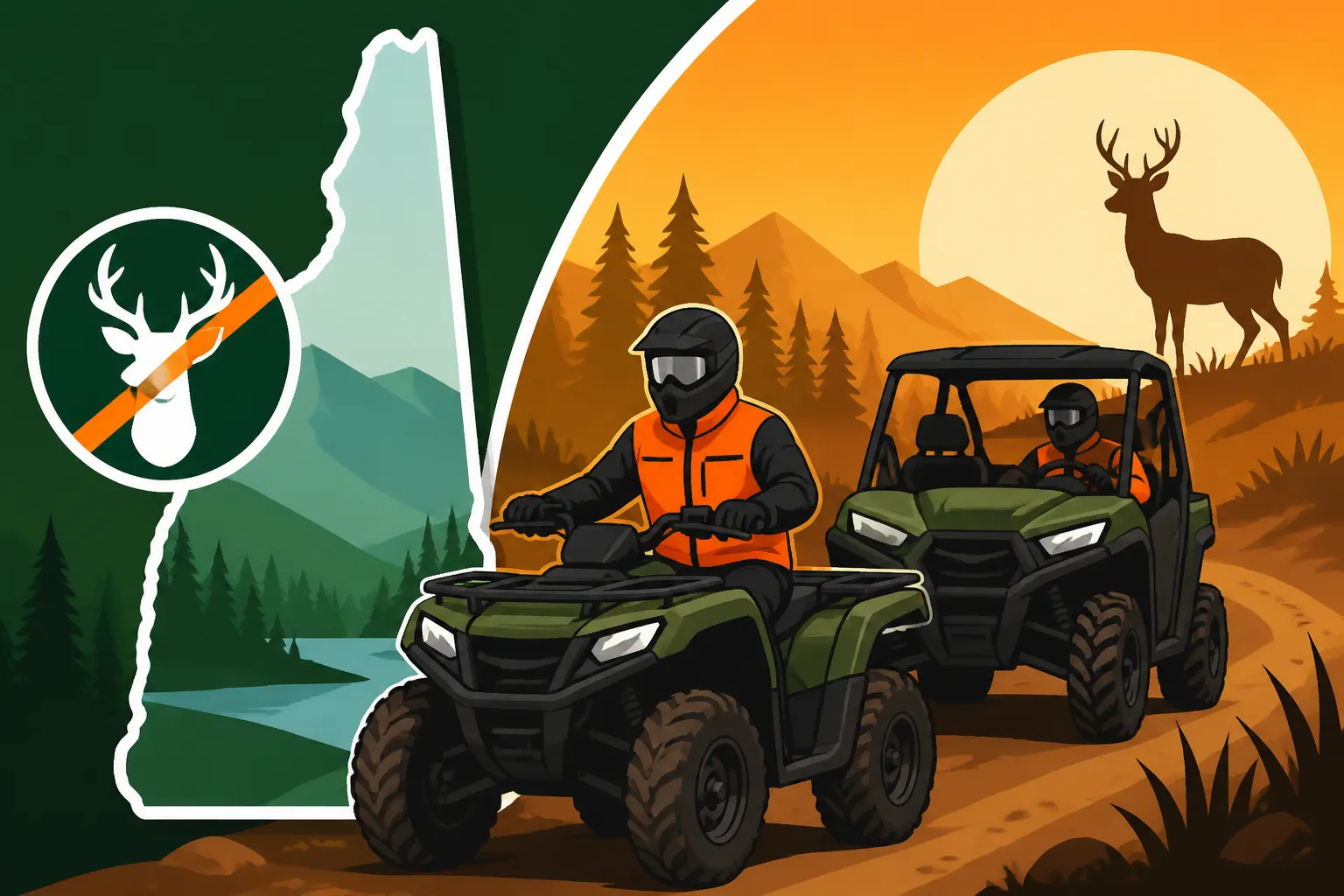
Wear conspicuous clothing, preferably blaze orange, even if you are riding rather than hunting. Choose a visible outer layer and keep it uncovered by a dark jacket or pack. A brightly colored helmet or vest can help, but visibility should not depend on a small patch of color. Passengers should dress visibly too. For more practical guidance, see Blaze Orange on a Club Trail and Sharing a New Hampshire Trail With Hunters.
Do not assume that a particular orange-clothing rule for hunters automatically applies in the same way to every OHRV rider. Requirements can depend on what a person is doing and on the current hunting regulations. If you are hunting, accompanying a hunter, or transporting hunting equipment as part of a hunt, check the applicable New Hampshire Fish and Game rules. Riders who are not hunting should still take the visibility precautions seriously and confirm whether any specific rule or land-manager requirement applies to their route.
Use your lights where appropriate, especially in shaded woods, at dusk, or when visibility is reduced. Keep your speed low enough to stop within the distance you can see. Slow down well before blind corners, trail junctions, bridges, and places where a footpath or logging road meets the riding route. A horn or other warning signal may alert someone ahead, but it does not give you the right of way or make it safe to approach quickly.
If you see a hunter, stop at a safe distance and let them decide how they want to proceed. Do not ride toward a person who is handling a firearm, and do not crowd a hunting position, stand, or vehicle. If the trail is narrow, wait until the hunter is safely clear before passing. Keep your group together and avoid revving, shouting, or unnecessary engine noise near people who are hunting.
A courteous pause is usually the simplest solution. If a hunter asks you to wait or take another route, do so when you can safely comply. If the route is legally open but the situation feels unsafe or disruptive, turning around is better than arguing over access on the trail. Landowner and club relationships depend in part on riders showing respect for other users.
Ride with extra care around hunting activity
Deer season can bring more people, parked vehicles, and equipment into areas that are otherwise quiet. A pickup at a trail entrance, a person walking away from the route, or a parked machine may signal activity nearby. Never assume a person is visible just because you can see the trail from your seat.
Keep a controlled pace and leave room to stop. Dust can reduce visibility for riders behind you, while leaves and wet ground can make braking less predictable. In a group, leave enough distance that each rider can react to a stop or obstacle without forcing the next machine to swerve. Make sure every rider knows how the group will communicate and where to regroup if someone stops.
Do not ride off the marked route to get around a hunter, a parked vehicle, or a muddy section. An unmarked bypass can damage land, lead into private property, or put you in a more dangerous spot. If a route is blocked, stop and assess the situation. Turn around when necessary rather than cutting through woods or across a field.
Be especially careful at road crossings and along roads that connect trail sections. A hunter may be walking beside the road or crossing it with equipment. Follow the applicable OHRV road rules, yield to conventional vehicles, and stop where required before crossing. Hunting season does not change the basic obligation to ride only where OHRVs are allowed.
If you encounter a person with a firearm, do not handle or display a firearm of your own in a way that could be mistaken for a threat. Keep hands visible, avoid sudden movements, and speak calmly if communication is needed. If there is an immediate safety concern, leave the area and contact the appropriate authorities from a safe place. Do not confront someone over suspected illegal hunting or trail use.
Carry your required registration paperwork and keep your decals displayed as required. That does not grant access to every piece of land, but it helps demonstrate that your machine is properly registered when registration applies. Review New Hampshire OHRV Decals and the Certificate if you need a reminder about what to carry and display.
Plan around the season, not just the weather
A dry, rideable trail is not necessarily an open trail. Before traveling, check the status of each section you expect to use, including connectors and return routes. A closure in the middle of a loop can leave you with a long detour or push you toward a road where OHRVs are not allowed.
A practical pre-ride routine can prevent most avoidable problems:
- Identify the club or land manager responsible for each trail segment.
- Check current notices for closures, hunting-related restrictions, and changes to access.
- Confirm that your machine is registered for the riding you plan to do and that your documents are available.
- Wear visible clothing and make sure passengers do the same.
- Tell someone your route and expected return time, particularly if cell coverage may be limited.
- Carry a map or navigation device, but do not use it to override a closure sign.
- Turn around if conditions, visibility, or nearby hunting activity make continuing unsafe.
If your ride includes more than one trail system, check each one separately. A club’s open trail does not guarantee that the neighboring club’s connector is open. The same goes for a route that crosses a town road, private parcel, state land, or leased land. Access can change at a boundary even when the trail looks continuous.
Hunting seasons and trail schedules do not always line up neatly. A trail may close before a hunting season ends, or hunting activity may be present while a particular trail remains open. Neither situation changes the need to obey trail notices, respect land access limits, and ride cautiously around other people. When information is unclear, contact the club or land manager rather than treating uncertainty as permission.
The best deer-season ride is one that does not surprise hunters, damage land, or leave you stranded at a closure. Check current access, wear visible orange, keep a conservative speed, and be prepared to reroute or head back. Those habits make it easier for riders, hunters, clubs, and landowners to share New Hampshire’s outdoors responsibly.
Disclaimer
This article is for general informational purposes only and does not constitute professional advice. Laws, prices and regulations vary by location and change over time. Consult a qualified professional for guidance on your specific situation.