New Hampshire Rules for Riding State Land
It's incredibly tempting to look at a vast stretch of beautiful New Hampshire forest, river, or mountain and imagine the perfect ATV or UTV ride, isn't it? The Granite State boasts some truly breathtaking landscapes, and for off-road enthusiasts, the thought of exploring them on four wheels is a powerful draw. However, one of the biggest misconceptions and sources of frustration for riders is understanding exactly where you can legally go, especially when it comes to land owned by the state. This guide is here to cut through the confusion and lay out the clear rules for riding your OHRV on New Hampshire's state lands, helping you avoid accidental trespass and hefty fines.
Understanding "State Land" in New Hampshire and Its Implications for OHRVs
When we talk about "state land" in New Hampshire, it's easy to picture one monolithic entity, but in reality, it's a diverse patchwork of properties, each with its own management goals and, critically, its own set of rules regarding Off-Highway Recreational Vehicles (OHRVs). This distinction is vital for any rider looking to explore responsibly.
The Different Types of State-Owned Property
Imagine throwing a dart at a map of New Hampshire and hitting a piece of green. That green could represent a state park, a state forest, a wildlife management area, or even a rail trail. Riders often assume that because it's "state land," it's automatically accessible, but this couldn't be further from the truth.
State Parks, for example, are managed primarily for recreation and conservation. Some, like Jericho Mountain State Park, are explicitly designed with extensive OHRV trail systems, welcoming riders with open arms. Others might be focused on hiking, picnicking, or historical preservation, and OHRVs would be completely out of place and prohibited.
Then you have State Forests, which are managed for timber production, wildlife habitat, and passive recreation. While they might have logging roads that look like perfect OHRV trails, these are typically not open to public OHRV use unless specifically designated and signed. Riding through an undesignated state forest road, even if it looks abandoned, can lead to fines and environmental damage.
Wildlife Management Areas (WMAs) are another category, managed by the New Hampshire Fish and Game Department. Their primary purpose is wildlife conservation and hunting access. OHRV use in WMAs is severely restricted, often limited to specific administrative roads for authorized personnel only, or specific periods for game retrieval, and never for general recreational riding. You wouldn't want to accidentally disturb a nesting eagle or a deer yard, would you? The rules are there to protect these vital habitats.
Finally, New Hampshire has a network of Rail Trails, many of which are state-owned or managed through agreements with local towns. Some of these multi-use corridors do permit OHRVs, but often with strict conditions, such as width limitations for side-by-sides, or seasonal restrictions. Others are reserved for hikers, cyclists, and equestrians only. It’s a real head-scratcher sometimes, trying to figure out which trail allows what, and it's why checking ahead is so important.
Why Specific Regulations Exist for State Land
These specific regulations aren't just there to make things complicated for riders; they exist for very good reasons. Think about the delicate balance our state agencies, like [New Hampshire Fish and Game and OHRVs] and the Department of Natural and Cultural Resources, have to strike. They're tasked with both promoting responsible recreation and protecting the environment for future generations.
One major reason is environmental protection. OHRVs, while incredibly fun, can impact sensitive ecosystems if not managed properly. Riding off designated trails can lead to soil erosion, damage to vegetation, and disturbance to wildlife. State lands often contain critical habitats for endangered species or fragile wetland areas that simply cannot withstand the impact of motorized vehicles.
Another factor is user conflict. On multi-use trails or in parks, OHRVs share space with hikers, mountain bikers, horseback riders, and even cross-country skiers in winter. Different recreational activities have different noise levels, speeds, and safety considerations. Rules help minimize these conflicts, ensuring that everyone can enjoy the outdoors without detracting from someone else's experience. Imagine a peaceful hike being constantly interrupted by the roar of engines; it's not ideal for anyone.
Seasonal considerations also play a huge role. For instance, many trails, especially on state land, are closed during "mud season" in the spring to prevent damage to the trail bed when the ground is soft and vulnerable. Riding during this time creates deep ruts that are difficult and expensive to repair, impacting everyone's ability to use the trails later in the year. Wildlife breeding seasons or critical migratory periods might also trigger temporary closures to protect animals. It's all about balancing access with responsibility.
Navigating Approved OHRV Trails on New Hampshire State Lands
The good news is that New Hampshire does offer fantastic opportunities for OHRV riding on state land, but it's all about knowing where to go and sticking to the designated spots. These approved areas are your best bet for a legal and enjoyable ride.
State Parks and Designated OHRV Trail Systems
When it comes to state-owned land specifically geared for OHRVs, Jericho Mountain State Park in Berlin immediately comes to mind. This park is a true gem, carved out precisely for motorized recreational vehicles, offering over 75 miles of marked trails designed to thrill and challenge riders of all skill levels. It’s not just a collection of trails; it's a dedicated facility where you can ride with confidence, knowing you're completely legal.
At Jericho, you'll find everything from smooth, meandering paths perfect for a leisurely cruise with the family to rocky, technical sections that will test your machine and your skills. The park actively manages and maintains its trails, so you're generally riding on well-cared-for surfaces. However, even within designated parks, you still need to pay attention to signage. There might be one-way trails, specific width restrictions for certain sections, or trails designated for particular types of OHRVs. For instance, some of the more extreme trails, like the [Jericho's Run to the Hills Four-by-Four Trail], have very specific requirements and may even involve an additional fee.
You'll need to pay a day-use fee to enter, so be prepared for that. You can find details on [Jericho's Day Use Fees in New Hampshire] on their official website. This fee contributes directly to the maintenance and improvement of the park's facilities and trails, ensuring they remain top-notch for riders like us. It's a small price to pay for the peace of mind and the incredible riding experience. For those looking to tackle the more demanding terrain at Jericho, having robust aftermarket parts like heavy-duty axles or reinforced suspension from a brand like SuperATV can make a real difference, giving you the confidence that your machine can handle the toughest challenges without leaving you stranded.
Rail Trails and Multi-Use Corridors
New Hampshire's extensive network of rail trails often crosses state-owned land, providing excellent opportunities for scenic rides. However, this is where it gets a little tricky. Not all rail trails are open to OHRVs. Many are strictly for non-motorized use, while others welcome a mix of activities, including OHRVs.
For example, sections of the Ammonoosuc Valley Rail Trail or the Sugar River Rail Trail allow OHRVs, but often with specific rules. The most common restriction you'll encounter on rail trails is a width limit, frequently capped at 50 inches. This means that many wider side-by-sides, which can be 60 inches or more, might not be allowed on certain segments. If you’re riding a larger machine, you absolutely need to check the specific trail regulations before you head out. Don't assume just because one rail trail allows OHRVs, they all do, or that your wide machine will fit everywhere. It's a common mistake that can lead to frustration or, worse, a ticket. You can learn more about specific regulations in articles like [New Hampshire Rules for Riding a Rail Trail] and [New Hampshire Trails With a 50-Inch Limit].
Always look for clear signage at trailheads indicating permitted uses. If you don't see signs explicitly stating OHRVs are allowed, assume they are not. These trails are often managed by a combination of state agencies and local municipalities, so their rules can vary. Checking the relevant trail association's website or the NH Fish and Game OHRV maps is crucial to ensure you're riding legally. These trails are generally flatter and less technical than mountain trails, offering a different kind of riding experience—perfect for a relaxed cruise and enjoying the scenery.
State Forests and Wildlife Management Areas
This is where the "closed by default" principle really comes into play. While state forests and wildlife management areas cover vast tracts of New Hampshire, the vast majority of them are not open for recreational OHRV riding. Their primary purposes are conservation, habitat management, timber production, and passive recreation like hiking or hunting.
You might encounter old logging roads or access paths within a state forest that look like fantastic places to ride. However, unless there is very clear, official signage at the entrance of a specific trail explicitly stating it is open for OHRV use, you should assume it is closed. The state does not have the resources to post "No OHRVs" signs on every single path in every state forest. Instead, the general rule is that if it's not a designated, marked OHRV trail, it's off-limits.
Riding in these undesignated areas can disrupt wildlife, damage sensitive ecosystems, and lead to conflicts with other users. Conservation Officers patrol these areas, and they take violations seriously. Even if you "didn't know," ignorance of the law is generally not considered a valid excuse. Always consult official maps from the New Hampshire Fish and Game Department or the Department of Natural and Cultural Resources. These resources are designed to show you exactly where you can and cannot ride. Thinking about exploring a new area? You might want to check out [New Hampshire Rules for Riding State Land] for further details on specific restrictions.
Essential Rules and Best Practices for Riding on State Land
Riding on New Hampshire's state lands, even on designated trails, comes with a responsibility to uphold the rules and act as a good steward of the environment. These aren't just suggestions; they're legal requirements designed to keep you safe, protect our natural resources, and ensure continued access for everyone.
Registration, Safety Certificates, and Equipment
Let's start with the absolute basics: before your wheels even touch a state trail, your machine needs to be properly registered, and you, as the operator, must meet the safety education requirements. This isn't just a club rule; it's state law that applies uniformly across all public and designated private trails.
- Registration: Every OHRV ridden off private property in New Hampshire, including state-owned trails, must be registered with the NH Fish and Game Department. This means displaying your decals clearly and carrying your printed registration certificate. For all the details, check out [Registering an OHRV in New Hampshire]. There's no separate "trail pass" in New Hampshire; your registration is your pass.
- Safety Certificate: If you're 12 years of age or older and don't hold a valid motor vehicle driver's license, you'll need an OHRV safety certificate. This certificate proves you understand the rules of the trail and how to operate your machine safely. Even if you're an experienced rider, if you don't have a driver's license, you need this certification. You can find more information on [New Hampshire Safety Education Requirements].
- Required Equipment: Your OHRV must meet certain equipment standards. This includes things like a functioning exhaust system that meets noise limits (usually 96 decibels), a spark arrestor, and proper lighting if you plan to ride near dusk or after dark. [New Hampshire Equipment Rules for Road Riding] might offer some insights into lighting and mirrors, which are particularly relevant if your chosen state trail has road crossings or multi-use sections. Conservation officers do conduct roadside checks, and they will verify these items. It's not uncommon to see a sound meter come out at a trailhead.
Ignoring these fundamental requirements doesn't just put you at risk of a fine; it undermines the system that keeps trails open and safe for all.
Respecting Environmental and User Regulations
Once you're on a designated state trail, how you ride matters immensely. These rules are about preserving the very experience you came for and respecting everyone else who uses the land.
- Stay on Marked Trails: This is arguably the most critical rule. State land trails are carefully designed and maintained to minimize environmental impact. Riding off-trail, even for a short distance, can damage vegetation, compact soil, create erosion, and disturb wildlife habitats. Don't be tempted by that tantalizing shortcut or unexplored path; stick to the clearly marked and signed routes. This is especially true in sensitive areas like wetlands or along stream banks.
- Speed Limits: Obey posted speed limits. Many state trails, particularly those that are multi-use or pass through developed areas, will have speed restrictions. Even where no limit is posted, ride at a speed appropriate for the conditions, your skill level, and the visibility. There are other users out there, including hikers and mountain bikers, who deserve your consideration. Speed limits exist for safety, not just to slow you down. For instance, [Gorham's 25 mph Trail Limit] is a good example of how local ordinances apply even on connected state trails.
- Noise Restrictions: New Hampshire has strict decibel limits for OHRVs. Excessive noise disturbs wildlife and detracts from the experience of other outdoor enthusiasts. Your stock exhaust is generally fine, but aftermarket systems can sometimes push you over the limit. Be mindful of your machine's sound. Check out [New Hampshire's OHRV Decibel Limit] for more information.
- Leave No Trace: Pack out everything you pack in. This means no littering, no leaving behind broken machine parts, and no disposing of fluids. If you see trash, consider picking it up. Our state lands are beautiful, and it's up to all of us to keep them that way.
- Respect Wildlife: You're a visitor in their home. Give wildlife ample space and never harass or chase animals. If you encounter an animal on the trail, slow down, give it a wide berth, or stop and wait for it to move on. This is especially important during sensitive times like breeding or nesting seasons.
- Campfires and Camping: Unless explicitly designated and permitted, campfires and overnight camping are generally not allowed on state OHRV trails or undesignated state land. Always check specific park or trail regulations if you plan an overnight trip.
Violating these rules isn't just about getting a fine; it's about potentially losing access for everyone. Clubs and state agencies work tirelessly to maintain positive relationships with landowners (both private and public) to keep trails open. One rider's irresponsible behavior can jeopardize that access for thousands. If you're cited for a violation, the fines can be significant, as detailed in articles like [New Hampshire Fines for an Unregistered OHRV].
Checking Trail Status Before You Ride
This is perhaps the most crucial "best practice" for riding on state land: ALWAYS check the current trail status before you load up and head out. New Hampshire trails, especially those managed by the state, are subject to seasonal closures, temporary closures due to weather, maintenance, or other events.
- Mud Season: Every spring, generally from March through late May, many OHRV trails, including state ones, are closed for "mud season." This is vital to prevent severe erosion and damage to the trail bed when the ground is soft from thawing snow and spring rains. Riding during this period causes deep ruts that are expensive and time-consuming for clubs and the state to repair. Respect these closures, as outlined in [New Hampshire's Mud Season Ban].
- Hunting Season: Some trails that cross state forests or wildlife management areas may have specific restrictions or advisories during hunting season, especially for big game. While OHRVs can be used for hunting access or game retrieval in certain scenarios, general recreational riding might be curtailed or require extra precautions like wearing blaze orange.
- Weather and Maintenance: Heavy rains can wash out sections of trail, or unexpected maintenance might necessitate a temporary closure. Checking official sources is the only way to know for sure.
Where to check:
- NH Fish and Game Website: This is your primary resource for statewide OHRV trail maps and general conditions.
- Jericho Mountain State Park Website: For specific information on Jericho, check their dedicated page.
- Local Club Websites: While state lands are managed by the state, many trails are maintained in partnership with local OHRV clubs. Their websites often have the most up-to-date information on specific trail sections. [New Hampshire Trail Status Before You Ride] covers this in more detail.
Arriving at a trailhead only to find it closed is frustrating, but it's far better than getting a ticket for riding a closed trail or causing irreparable damage. If you're navigating complex state land trails and want to ensure you don't get lost or stray onto closed sections, having a reliable GPS mount and a dedicated off-road GPS unit, perhaps even enhanced with sturdy mounting brackets from SuperATV, can be a game-changer. It helps you stick to the approved routes with confidence.
Common Misconceptions and Consequences of Non-Compliance
Despite the clear rules and numerous resources, certain misconceptions persist about riding on state land, often leading riders into trouble. Understanding these myths and the very real consequences of non-compliance is essential for responsible OHRV use in New Hampshire.
The Myth of "Unposted Land is Open Land"
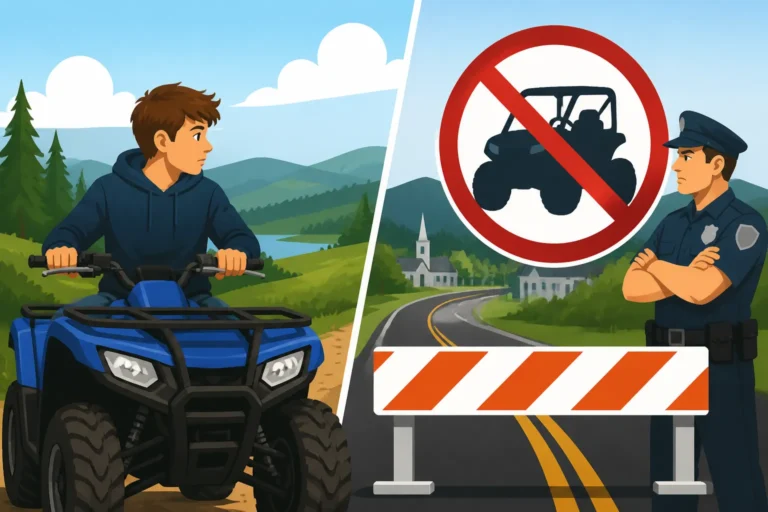
This is perhaps the most dangerous misconception for OHRV riders in New Hampshire, particularly when it comes to state land. The idea that "if it's not posted 'No Trespassing,' it must be okay to ride" is false for state-owned property.
Unlike some private land laws where explicit posting might be required to deter trespass, state land generally operates on a "closed by default" principle for OHRVs. This means that if a trail or area on state land is not explicitly designated and signed as an OHRV trail, you should assume it is off-limits.
Think about it: New Hampshire manages hundreds of thousands of acres of state forests, parks, and wildlife areas. It would be an impossible and financially crippling task for the state to post "No OHRVs" signs on every single path, logging road, or open field within these vast properties. Instead, the burden is on the rider to know where they are legally permitted to operate their machine. This concept is explored further in articles like [New Hampshire Trespass Rules for Riders].
Many riders stumble into this trap when they see an old logging road that looks like a perfect trail. They might think, "Well, no one's around, and there's no sign, so it must be fine." However, that logging road might be within a state forest dedicated to timber production or a wildlife management area where motorized recreation is prohibited. Even if it looks like a trail, if it's not on the official OHRV map and clearly marked as such, you are technically trespassing on state land. This is a crucial distinction that every New Hampshire OHRV rider must understand to avoid legal trouble.
Fines, Penalties, and Machine Impoundment
The consequences of violating New Hampshire's OHRV laws on state land can be severe and extend far beyond a simple warning. Conservation Officers are trained to enforce these regulations, and they take their role seriously in protecting state resources and ensuring rider safety.
- Substantial Fines: Riding an OHRV on undesignated state land, riding a closed trail, or failing to meet registration or safety certificate requirements can result in significant monetary fines. These aren't just minor tickets; they can range from hundreds to potentially thousands of dollars, depending on the severity of the violation and whether it's a first offense or repeat infraction. For instance, [New Hampshire Fines for an Unregistered OHRV] highlights how costly even basic non-compliance can be.
- Machine Impoundment: In certain egregious cases, or for repeat offenders, Conservation Officers have the authority to impound your OHRV. Imagine having your prized machine towed away, potentially hundreds of miles from home, and then facing the additional costs of impoundment fees, storage fees, and retrieval charges, on top of your fines. It's a logistical nightmare and a huge financial hit.
- Court Appearances: Many OHRV violations are misdemeanors, which means you might be required to appear in district court. This involves taking time off work, potential legal fees if you choose to hire an attorney, and the stress of a court proceeding. A conviction can also stay on your record.
- Environmental Damage Penalties: If your illegal riding causes significant environmental damage, such as severe erosion or damage to sensitive habitats, you could face additional penalties, including being held responsible for the cost of restoration.
Let's imagine a scenario: You're riding your UTV, equipped with some sturdy rock sliders from SuperATV for protection, on a designated trail in a state park. You see what looks like a fun, unmaintained side trail veering off into a dense section of woods. You think, "Just a quick look." But that "side trail" leads into a sensitive wetland area, part of a state forest that is closed to OHRVs. A Conservation Officer on patrol happens to be in the area, hears your engine, and intercepts you.
In this hypothetical situation, you could be facing:
- A fine for riding on undesignated state land (trespassing).
- A fine for riding in a wetland (environmental violation).
- Potentially a charge for disturbing wildlife.
- The officer might check your registration and safety certificate, adding more fines if they are not in order.
Suddenly, a "quick look" has turned into a very expensive and stressful experience. The state invests heavily in maintaining its approved OHRV trail systems and protecting its wild lands. These rules and penalties are in place to ensure that these resources are preserved for everyone, and that riders operate responsibly. Always err on the side of caution and stick to the marked, official trails. The peace of mind alone is worth it.
Here’s a quick overview of OHRV access on different types of New Hampshire state lands:
| Type of State Land | General OHRV Access | Key Considerations |
|---|---|---|
| State Parks (Designated) | Generally Allowed (e.g., Jericho Mountain State Park) | Day-use fees, specific park rules, designated trail systems only. |
| State Parks (Non-Designated) | Generally Prohibited | Focus on passive recreation (hiking, picnicking). No OHRV use unless explicitly signed. |
| State Forests | Generally Prohibited | Managed for timber, wildlife, passive recreation. Assume closed unless specifically marked as an OHRV trail. |
| Wildlife Management Areas | Strictly Prohibited (with rare exceptions) | Primary purpose is wildlife conservation and hunting access. OHRV use restricted to administrative or designated access. |
| Rail Trails | Varies by Trail/Section | Some allow OHRVs, often with width limits (e.g., 50 inches). ALWAYS check specific trail regulations and signage. |
| Flood Control Areas | Varies, generally Restricted | Often managed by federal agencies (Army Corps of Engineers) with specific rules. Limited OHRV access. |
Disclaimer
This article is for general informational purposes only and does not constitute professional advice. Laws, prices and regulations vary by location and change over time. Consult a qualified professional for guidance on your specific situation.