Why Mud Season Closes Everything
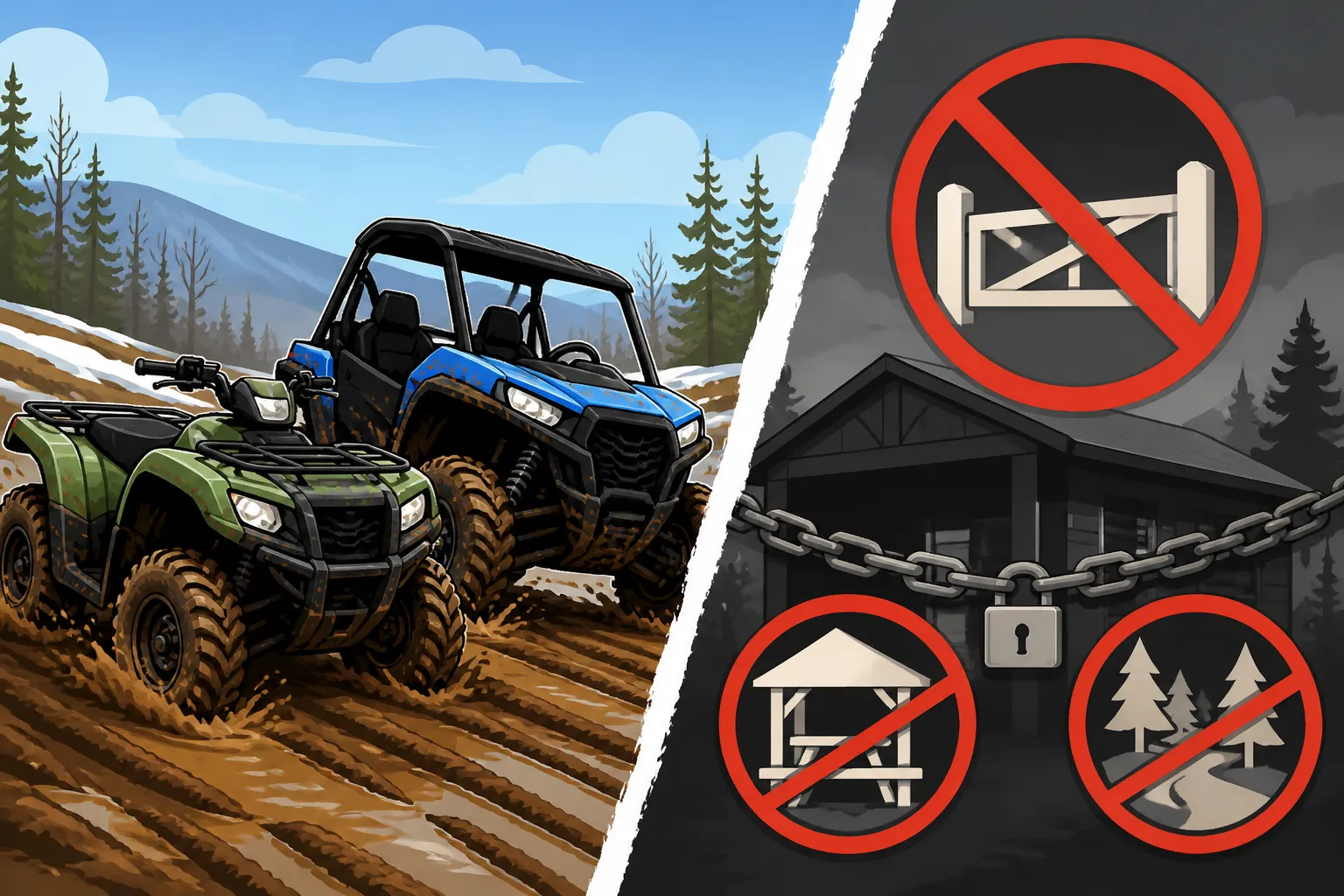
Spring mud can turn a firm New Hampshire ATV trail into a deep rut after only a few passes. That is why clubs and land managers close routes even when the weather looks sunny and the trailhead is dry. This guide explains what mud season does to trails, how closures protect them, and how to check whether a route is actually open.
Why New Hampshire trails close during mud season
Thawing ground cannot support repeated traffic
A trail can look solid on top while the soil underneath is still saturated and soft. In spring, snowmelt and rain soak into ground that may remain frozen below the surface. Water has nowhere to drain, so the upper layer becomes unstable. An ATV or UTV tire presses into that layer, displacing soil and leaving a rut that can collect even more water.
That damage is not just a cosmetic track mark. Deep ruts can channel runoff, carry sediment into nearby streams, and make a trail harder to drain. Once water starts flowing down a rut instead of across the trail, a small muddy patch can grow into a longer washout. Repeated traffic can also loosen rocks, damage trail edges, and make the route unsafe for the next rider.
A dry stretch of weather does not necessarily mean the trail has recovered. The surface may firm up while water remains underneath, especially in shaded woods, low spots, and areas with lingering snow. A route that seems rideable at the entrance can become soft farther along, where it crosses a wet hollow or sits beneath a north-facing slope.
Closures protect trails, landowners, and access
New Hampshire riding routes cross different kinds of land, and the organization responsible for a trail can vary by location. Clubs, landowners, state agencies, and other managers may close routes when the ground is vulnerable. A closure can apply to a whole system, a specific trail, or a particular section that is especially wet or damaged.
The practical reason is straightforward: repairs take time, equipment, volunteer effort, and money. A closure can prevent one short spring ride from creating damage that takes a crew much longer to fix. It also helps protect relationships with landowners. If a landowner sees repeated rutting or runoff on their property, they may decide that continued trail access is not worth the damage. For more on why access can depend on land management, see New Hampshire Rules for Riding State Land.
It can feel frustrating when a trail is closed on a clear day, especially if you have already hauled your machine north or planned a weekend around a ride. But closures are often based on the condition of the ground across a route, not just the weather at your house or the view from the staging area. The seasonal restrictions explained in New Hampshire’s Mud Season Ban are a reminder that trail access depends on conditions and the rules set for the land.
“Everything is closed” may mean a whole system is unavailable
Riders often use “everything” to describe a trail system that has shut down for spring. In practice, closures can differ by club, trail, landowner, and surface. Some routes may be closed while others are open; in other places, the full network may be unavailable until the ground dries enough for travel. Do not assume that a neighboring town or club area follows the same schedule.
A closure can also affect a route that connects two open areas. Even if most of your planned ride is accessible, one closed connector can make the loop impossible to complete legally. Treat every closed segment as closed, and do not ride around a gate or detour across private property to get past it. New Hampshire Rules for Riding a Closed Trail is useful background when you are deciding whether a tempting shortcut is actually allowed.
What riding on soft trails can do
Ruts can redirect water and worsen erosion
Ruts often begin as shallow impressions. Each pass compresses and pushes wet soil aside, making the depression deeper. When rain or snowmelt follows, water can collect in the rut and travel along it. That flow may carry soil downhill, expose roots, or undercut the trail surface.
The effects can be especially noticeable on slopes. A machine that digs into a wet incline may leave a channel that funnels water toward a lower section. Farther down the trail, the accumulated water can spread mud across the route or weaken a culvert approach. What looked like a small, rideable patch can become a maintenance problem affecting a much larger area.
Damage can close a route longer than the original thaw
A closure is meant to let the ground recover, but damage caused during the vulnerable period can add repair work. Volunteers may need to reshape the trail, improve drainage, replace material, or wait for the surface to dry before repairs are practical. A damaged crossing can require more than a quick pass with a shovel.
The schedule is not always predictable from the calendar. One section may dry quickly while another stays soft because it is shaded, low-lying, or fed by runoff. A What a Washed-Out Culvert Does to a Spring Ride gives a sense of how water-related damage can affect a route beyond the muddy spot that first catches a rider’s eye.
Access depends on continued permission
Many trails exist because landowners allow riding across their property. That permission is not a permanent guarantee that every route will remain available. Landowners may set conditions, and trail organizations need to show that riders respect closures and avoid damage.
A rider who turns around at a closure helps preserve access for everyone. Riding past a sign or around a barrier can undermine the work clubs do to maintain relationships with property owners. It can also put other riders in a difficult position if an entire section is shut because of misuse. The safest rule is simple: when the responsible organization marks a trail closed, do not ride it.
How to check trail conditions before you ride
Check the organization responsible for the route
Before loading the trailer, check the latest notices from the club or land manager responsible for the trail system you plan to ride. Trail status can change as conditions change, and a map that showed an open route earlier may not reflect a new closure. If the system provides a status board or current trail notice, use that as your first check. See New Hampshire Trail Status Before You Ride and New Hampshire Trail Conditions Before You Ride for more on making this part of your ride planning.
If the status is unclear, contact the relevant club or land manager rather than guessing. Ask specifically about your intended route, connectors, and staging area. “Is the system open?” may not be enough if only certain sections are closed. A club can often clarify whether a closure is broad, localized, or still being assessed.
| Check before departure | What to confirm | Why it matters |
|---|---|---|
| Club or land-manager notice | Whether the system and planned segments are open | A route may have a temporary or section-specific closure |
| Trail map | The trail layout and alternate routes | A closed connector can interrupt a loop |
| Staging information | Whether parking and access points are available | A ride may be inaccessible even when some trails are open |
| Local conditions | Recent rain, snowmelt, and drainage issues | Conditions can vary across a system |
| Machine suitability | Width limits and route restrictions | An open trail may still exclude some machines |
Use maps for planning, not as proof of an open trail
A map is useful for understanding where trails run, how routes connect, and whether your planned ride has a reasonable turnaround option. Tools such as onX Offroad can help you review route information and plan around terrain or distance. But a mapped trail is not automatically open, and a line on a screen does not override a closure sign or a club’s current notice.
That distinction matters when you are planning a long loop. A map may help you spot a connector that could shorten the ride if conditions change, but you still need to verify whether the connector is open and permitted. Use New Hampshire Trail Maps From a Club alongside current notices from the organization responsible for the area.
You can also save or download useful information before leaving home, since cell service can be unreliable in parts of northern New Hampshire. onX Offroad may be helpful for keeping your route plan available offline, but do not rely on a general map layer to tell you whether a trail has just closed. Check the club’s status first, and follow posted signs once you arrive.
Build a backup plan before you leave
If spring conditions are uncertain, plan a second activity or a different riding area rather than assuming you can find an open trail at the last minute. That might mean choosing a system with a confirmed opening, postponing the ride, or leaving the machines at home and enjoying the area another way. It is disappointing to change plans, but arriving at a closed gate with no alternative can turn a whole weekend into a long drive back.
A backup plan should include more than a different route on the same map. Confirm that the alternate area is open, that your machine fits its restrictions, and that you can legally reach the staging area. For the seasonal timing question, When New Hampshire OHRV Trails Open Each Spring offers related guidance, but the specific trail status still needs to be checked close to your departure.
What to do when a trail is closed
Turn around rather than testing the ground
If you reach a closed trail, stop and turn back. Do not ride around a barrier, use an informal bypass, or continue because the first stretch looks dry. The closed section may include a wet area farther ahead, and bypassing the sign can cause new damage or lead onto land where you do not have permission.
If you encounter a closure while already riding, retrace your route when it is safe to do so. Avoid making a new track through the woods or across a field to get around the blocked section. If you are unsure where to go, contact the club or land manager for directions instead of improvising a detour.
Report a problem without riding into it
A fallen tree, washout, or muddy crossing may be worth reporting to the responsible club, especially if the hazard is not already marked. Share the trail name or the nearest recognizable junction, and describe what you observed from a safe location. A clear report can help volunteers assess the issue without requiring another rider to drive deeper into a vulnerable area.
Do not attempt to repair a trail yourself unless the organization has asked you to help and you know what work is appropriate. A well-meant shovel job can redirect water or make a problem worse. Trail maintenance is usually coordinated so that repairs account for drainage, landowner requirements, and the needs of the broader route.
Return after an official reopening
Once a trail system reopens, ride with care. Soft spots may remain even after the general closure ends, and a route can still have posted restrictions or temporary repairs. Stay on the marked trail, avoid widening muddy sections, and follow any signs directing riders around maintenance work.
Opening dates differ because ground conditions differ. A club may reopen one area before another, and an individual segment may remain closed after the surrounding network is accessible. Check the status again just before riding, even if you looked a few days earlier. A careful spring ride helps avoid undoing the work that made reopening possible.
Disclaimer
This article is for general informational purposes only and does not constitute professional advice. Laws, prices and regulations vary by location and change over time. Consult a qualified professional for guidance on your specific situation.