Where New Hampshire OHRV Money Is Spent
New Hampshire OHRV registration money helps keep riding possible, but it does not all go straight to the trail nearest your home or to one local club. The money moves through a state program, where it can support administration, enforcement, safety work and trail grants. Here’s how to understand the flow, what trail funding can cover, and what riders should not assume their registration pays for.
How OHRV money enters the system
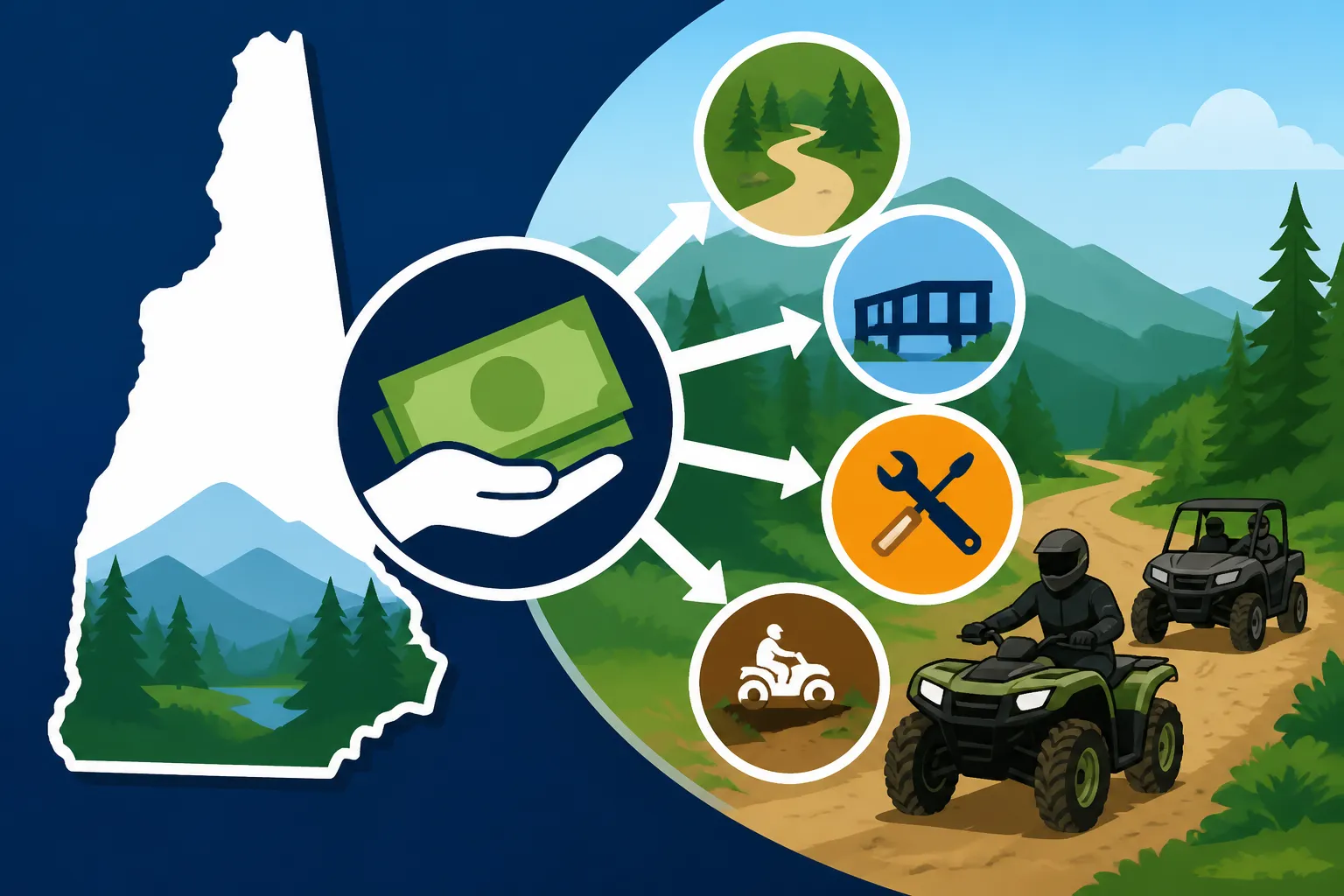
An OHRV registration is more than a sticker or a record in a state database. It is also one of the ways New Hampshire finances parts of its off-highway recreation program. Registration revenue supports designated OHRV purposes under state law and through the program’s budget. Those purposes can include processing registrations, administering the program, enforcing relevant rules, supporting safety work and helping pay for trails.
That does not mean each dollar from your transaction is handed to the club whose trail you ride that weekend. Money is collected and managed through state systems, then spent or awarded according to applicable rules and budgets. The distance between paying at a registration agent and seeing work on a trail can be confusing, especially when a bridge, culvert or sign appears to have been “paid for by registrations.” In practice, a particular project may combine public grant support, club labor, club funds and other contributions.
For an overview of the broad connection between registrations and trail work, see How New Hampshire Registration Money Funds Trails. The important point is that registration revenue helps sustain a system, not simply a single riding location.
Registration is part of the funding picture
When you register an OHRV, the registration charge is collected under the state’s registration program. The program has operational needs: applications must be handled, records maintained, decals and certificates issued, and rules administered. There are also public-safety and enforcement responsibilities associated with OHRV use.
The remaining support for trail-related work is not necessarily spent evenly among towns, clubs or trail types. A grant program can direct money toward eligible work when a qualified applicant proposes a project and meets the program’s requirements. A heavily used trail may need substantial repairs, while another area may have urgent work because of erosion, drainage problems or a damaged crossing. The right project is not always the most visible one to a visitor.
For current details on how a particular registration is structured, check the state’s current materials before you pay. Rates, categories and program procedures can change. The article New Hampshire OHRV Registration Cost explains the cost side of the question, while this article focuses on what the revenue supports.
The money is not a personal trail pass
New Hampshire does not use a separate statewide trail pass in the same way some riding systems do. Registration is central to the state’s OHRV framework, but registration does not grant unrestricted access to every road, trail, private parcel or state property. Access still depends on where you ride, who controls the land, trail status and applicable rules. Why New Hampshire Has No Separate Trail Pass explains the distinction.
That distinction matters when thinking about what your payment buys. Registration supports a public program and helps maintain the legal framework for riding. It is not a promise that every registered machine can use every route, nor is it a direct admission ticket to every facility. Some destinations may have separate access or day-use charges, and private club trails depend on landowner permission and trail conditions. For example, Why Jericho Charges Day Use on Top of Registration covers why a facility charge can exist alongside a registration.
A useful way to picture the system is this: registration helps support the statewide program; a grant may help pay for approved trail work; a club or landowner may supply labor, equipment, access or additional funding; and the rider still has to follow the rules for the specific route.
Who manages the revenue and the trail work
Several organizations and people play different roles. The state handles registration and program responsibilities. The Bureau of Trails administers trail-related work and grant programs. Clubs, municipalities and other eligible organizations may plan projects, maintain routes or apply for funding. Landowners determine whether their property can be used, and volunteers often do much of the practical work on the ground.
Those roles overlap, but they are not interchangeable. A club may maintain a trail without owning the land. A town may be involved in a project without controlling every parcel along the route. A state grant may help pay for a project without making the state the day-to-day trail operator. Understanding the division of responsibility helps explain why a request about a washed-out bridge, closed gate or missing sign may need to go to a club, landowner or local authority rather than the registration office.
Registration administration and public safety
Some of the money supports the machinery of the program itself. That includes work needed to process registrations and administer the system. OHRV rules also have an enforcement and safety dimension. Officers may need to address unregistered machines, unsafe operation, closed-trail riding, access disputes or other violations. Safety education and public information can also be part of the broader program.
These responsibilities are easy to overlook because they are less visible than a new bridge or a graded trail. A rider may see the result of trail construction on a single outing, but administration and enforcement affect how the system functions across the state. They help keep records, communicate requirements, respond to violations and support lawful use.
For information about the agency’s role in registration and enforcement, see New Hampshire Fish and Game and OHRVs. For the relationship between the Bureau of Trails and clubs, see The Bureau of Trails and New Hampshire Clubs.
The state does not maintain every trail itself
Many riding routes depend on agreements with private landowners, clubs and local partners. Clubs may organize volunteers, inspect trails, clear obstructions, work on drainage, post signs and coordinate access. A trail can cross several parcels, so access may depend on more than one landowner’s continued permission.
This arrangement can make the trail network flexible and community-based, but it also means public support is only part of the story. A grant can help pay for eligible work, yet it does not replace the need for landowner cooperation or ongoing club involvement. A route can close even when it has received public assistance if access permission is withdrawn, conditions become unsafe or maintenance cannot be completed.
The day-to-day work is often done by people who know the local terrain and can spot problems before they become major failures. Who Cuts and Maintains a Volunteer Club Trail looks more closely at that work. A registration can contribute to a system that supports trails, but it cannot substitute for the volunteers and landowners who make access possible.
What trail grants can pay for
Trail grants are one of the most direct ways registration-supported funding can reach work on the ground. A grant is generally tied to an eligible proposal and an approved project, rather than being an automatic annual payment to every club. The applicant describes what needs to be done, where it will happen, what it will cost, how the work will be carried out and how it supports the trail program. The current grant rules determine which expenses qualify and what documentation is required.
Projects may involve more than making a trail smoother. Drainage and erosion control can be essential to keeping a route usable and preventing damage from spreading. Bridges and culverts can protect crossings and keep riders away from sensitive or unsafe areas. Signs and trail information help riders stay on the intended route and understand closures or hazards. Equipment, materials and construction may be needed for larger repairs.
The exact activities supported depend on the program’s current requirements and the approved project. Riders should not assume that a category mentioned in a general description automatically qualifies for funding in every circumstance. Applicants need to check current guidance before planning work or committing money.
Maintenance and repair
Routine trail maintenance can include clearing storm damage, addressing drainage, repairing worn surfaces and correcting problems that could make a trail unsafe or cause more serious erosion. A small obstruction may be cleared by volunteers, while a damaged crossing or recurring washout may call for specialized materials, equipment and a formal project plan.
The less dramatic work is often the most important. Water that is allowed to run down a trail can carve ruts, damage the surface and create a bigger repair job later. A properly placed drainage feature may not look like much to a rider passing by, but it can protect the trail for years. Likewise, keeping an approach stable can reduce damage to a bridge or culvert.
Because conditions vary, good maintenance is not simply a matter of adding gravel or widening a route. Work needs to suit the terrain, drainage and landowner requirements. The responsible club or project manager should determine the appropriate method and follow the applicable approvals.
Bridges, culverts and crossings
A bridge or culvert can be a major part of a trail project because it lets a route cross a wet area, stream or drainage channel in a more controlled way. Proper crossings can help protect the route and reduce the temptation for riders to create an informal bypass. They may also be important for access by maintenance equipment.
Not every crossing can be built or repaired in the same way. The location, water flow, soil, access and environmental requirements all matter. Work may require planning and permissions beyond the trail grant itself. A grant recipient may need to coordinate with landowners and relevant authorities before construction begins.
For a closer look at how this type of work can connect to registration-supported funding, see Bridges Built With Registration Money. It is useful to remember that an example of a funded bridge does not mean every bridge is paid for in full from the same source. Projects can involve other contributions, and grant terms apply.
Signs and trail information
Signs help riders find their way, recognize a trail junction, notice a restriction or avoid a closed area. They also help reduce confusion where a route crosses a road, connects with another trail or approaches land with special access conditions. A sign is only useful if it is installed where riders can see it, remains in good condition and matches the current trail layout.
Funding may support eligible sign-related work, but clubs can also contribute their own time and resources. A club may be responsible for checking signs during the season and replacing or reporting damaged markers. If a sign appears missing or a route is unclear, riders should use current trail information and contact the responsible club rather than assuming the route remains open.
Signs Paid for by Registrations discusses the connection between registration money and this kind of practical trail support. A sign is a small item compared with a bridge, but clear route information can prevent trespass, reduce wrong turns and help protect landowner relationships.
How projects are chosen and carried out
Grant funding is not simply divided into equal shares among every riding area. Projects need to be eligible, timely and supported by an application that explains the need. Program priorities and available funding can change, so a club or town should use current application materials rather than relying on an old example.
A strong project proposal generally needs to show what problem it will solve and why the proposed work is appropriate. It may need a clear location, a work plan, a cost estimate, a schedule and permission to work on the land. The applicant may need to identify who will perform the work, how the site will be protected and how the completed project will be maintained. Exact requirements depend on current program guidance.
The application starts with a trail problem
Before applying, a club or other applicant needs to define the problem. “This trail needs work” is less useful than documenting a specific crossing that has failed, a drainage issue that repeatedly damages the surface or a sign system that no longer matches the route. Photos, measurements, maps and maintenance history can help explain the need.
The applicant also needs to consider whether the proposed solution addresses the cause. If water is undermining a trail, repairing the surface without addressing drainage may only postpone the next failure. If riders are leaving the marked route, replacing one sign may not solve a confusing junction. Good planning looks at the site and the rider experience together.
Projects may compete for limited resources, and not every request can be funded. A proposal can be worthwhile even if it is not selected in a particular cycle. The applicant may need to revise the scope, obtain more information, secure additional partners or apply again under the current rules.
Matching effort and local responsibility
Public grant money often works alongside local contributions. A club may contribute volunteer labor, equipment, donated materials or funds. A town or project partner may provide help with planning, access or logistics. The form of any required contribution, if applicable, depends on the current grant rules.
Volunteer time is especially significant. Trail workers may spend hours clearing a route, checking drainage, installing signs or coordinating with landowners. That contribution is easy to miss if you only look at the project’s cash budget. How a Club Wins Trail Grant Money explains the club side of the process, while [New Hampshire Grants for Club Trail Work] provides more context on trail-grant support.
A grant also does not necessarily cover every future maintenance need. A project may create a durable improvement, but trails continue to face weather, traffic, fallen trees and changing land-use conditions. The applicant and local partners still need to plan for inspection and upkeep.
Landowner permission remains essential
Public funding does not cancel private property rights. Many trails depend on permission from landowners, and a grant is not a substitute for that permission. The people responsible for a project must confirm that they can do the work where it is proposed and that any needed approvals are in place.
That is one reason trail funding and trail access are related but separate questions. A funded improvement may make a route safer and more sustainable, but riders still need to obey posted closures and stay on the authorized route. A landowner may change or withdraw access, and the trail manager may need to close or reroute a section.
If you want to understand the volunteer and financial side of club participation, read What a Club Does With Your Dues. Club dues are not the same as state registration revenue. Both can support riding in different ways, but they flow through different channels.
What registration money does not automatically pay for
It is easy to assume that every cost connected to riding comes from registration fees. That is not a safe assumption. The funding source depends on the work, the location, the responsible organization and the rules that apply to the specific program. Riders should separate registration, club membership, local facility charges, private donations and personal expenses.
Club dues are separate from registration revenue
Club dues generally support the club’s own activities, as defined by that organization. They may help pay for club operations, local trail efforts, insurance or other expenses, but the details vary from club to club. Dues do not become the same thing as a state registration payment merely because both contribute to the riding experience.
A club may also receive grant support for eligible work. That does not make every club expense a grant expense, and it does not mean a registration payment goes directly into the club’s account. If you want to know what dues support, ask the club or review its membership information. New Hampshire’s Club Membership and Access explains how club participation relates to trail access.
Some volunteers buy their own work gloves, eye protection or rain gear. A local outdoor or hardware store may be the best place to check fit and suitability; Amazon can also be one place to compare options for personal equipment. Amazon listings vary, so inspect product details and choose gear appropriate to the task. If a club organizes a volunteer workday, ask what equipment it expects people to bring rather than assuming that registration funds will provide personal items.
For small personal supplies, Amazon may offer a convenient way to compare gloves or protective eyewear, but shopping there is not the same as donating to a club or contributing to the state trail program. Amazon is a retailer, not the destination for an OHRV registration payment. Keep personal purchases separate from any official project budget, and follow the club’s guidance on safety equipment.
Facility charges can be separate
Some facilities or riding destinations may charge for particular services or access. Those charges are distinct from the state registration. A rider should check the destination’s current rules before arriving, because registration alone may not cover parking, day use, camping or other facility costs.
This is particularly important for visitors who are planning a trip around one staging area or park. Verify whether the location has a separate fee, what it covers and how it is collected. Do not assume that a registration decal functions as an all-access pass across state, municipal and private properties.
Fines and enforcement are not a club donation
A citation is not a substitute for registration, and paying a fine does not create trail access. Enforcement exists to address compliance and safety issues. The handling of fines is governed by applicable rules, so riders should not assume that a particular fine is returned to the trail or club where an incident occurred.
The practical takeaway is simple: register correctly, ride only where access is allowed, respect closures and follow the requirements for the machine and rider. Avoid treating enforcement payments as a trail-funding contribution or as a way to resolve an access problem.
How visitors and registrations connect to trail funding
Visitors who ride in New Hampshire also contribute to the state’s OHRV system when they obtain the required New Hampshire registration for their machine. The exact registration option depends on the rider’s situation and the machine. A visitor should check current requirements before traveling rather than assuming that a home-state registration is enough.
Registration revenue is pooled and managed through the program; it should not be treated as a direct payment to the town where a visitor rides. A visitor may ride across several club areas, but the registration does not assign their payment to a single trail. This is one reason it is more accurate to say that registration helps support the statewide system than to say that it pays for the particular trail used on a trip.
For visitors weighing registration options, What New Hampshire Charges Visitors to Ride gives a starting point. Riders considering whether a short-term registration or an annual option fits their plans can also read The Ten-Day Option for a New Hampshire Visitor. Always confirm current availability, eligibility and costs with the official registration source before making travel plans.
A home-state registration may not be enough
Visitors sometimes assume that because their machine is registered elsewhere, they can ride in New Hampshire without taking additional steps. New Hampshire’s requirements may not recognize a neighboring state registration as a replacement for the state registration needed to ride here. Check the current rules for your home state and machine type.
The reciprocity issue is relevant to funding as well as compliance. If a visitor must obtain a New Hampshire registration, that payment enters the New Hampshire program rather than being directed to a local trail by the rider. The payment supports the state system according to its rules, not an individual club account. For the broader issue, see Why New Hampshire Honors No Neighbor’s Registration.
The registration is not permission to use every route
Even after registering, visitors must check the trail’s width limits, seasonal status, opening dates, closures and local access rules. A machine that is legal to register may still be too wide for a particular trail. A trail shown on an old map may be closed, rerouted or unavailable because landowner permission changed.
Before setting out, check current information from the responsible club or trail manager. Do not rely on registration as proof that a route is open. Funding may support a trail network, but it does not guarantee that each section is accessible on every date or to every machine.
How riders can follow the money and support the system
A rider who wants to know where funds went should look for current program information from the agencies and organizations responsible for the work. Useful materials may include registration program descriptions, grant guidance, project announcements and summaries of approved or completed work. Because budgets and grant procedures can change, use current official information rather than relying on an older figure or an informal social media post.
A good question is more specific than “Where did my registration go?” Ask which program manages the relevant funds, what kinds of expenses are eligible, how grants are selected and which projects have been approved or completed. For a local project, ask the club or town which organization was the applicant and whether the work received public grant assistance, club funding or both.
Questions worth asking about a project
If you see a new bridge, repaired drainage feature or fresh signs, these questions can clarify how it was funded and maintained:
- Which organization manages the trail at this location?
- Was the work completed under a grant or another funding arrangement?
- What part of the project did the grant support?
- Did the club, town or landowner contribute labor, materials or funds?
- Who is responsible for checking and maintaining the improvement?
- Is the route currently open to my machine and riding season?
These questions are not about challenging the people doing the work. They help riders understand that the visible result may come from several sources and that a completed project still needs ongoing care.
Help without confusing the funding channels
Riders can support the system in several ways. Register on time and accurately. Join a club if its membership and access benefits make sense for your riding. Volunteer for trail work when the club requests help. Respect closures and landowner restrictions. Report trail damage or confusing signs through the appropriate local channel instead of creating a bypass or riding around a barrier.
Club participation can be especially useful because local organizations understand their trail network and landowner relationships. Membership dues and volunteer effort do different work from state registration revenue, but both can contribute to a functioning trail system. The article Why New Hampshire Has No Separate Trail Pass is helpful if the relationship between registration and access is still unclear.
If you are buying gear for a volunteer day, Amazon can be useful for comparing personal items such as gloves or rain layers, but check that the equipment suits the work and fits properly. Amazon purchases do not replace club dues, volunteer labor or registration. Keep your contribution clear: pay the required registration through an authorized channel, follow the club’s instructions for membership or donations, and use personal purchases only for your own equipment unless the organization has specifically arranged otherwise.
The most useful conclusion is not that every dollar can be traced to a single trail. It is that New Hampshire’s OHRV registration system helps fund a larger public framework, including eligible trail work, while local clubs, landowners, municipalities and volunteers make access possible in specific places. Knowing which part of the system you are supporting makes it easier to ask good questions, plan a legal ride and contribute in a way that actually helps.
Disclaimer
This article is for general informational purposes only and does not constitute professional advice. Laws, prices and regulations vary by location and change over time. Consult a qualified professional for guidance on your specific situation.