New Hampshire’s Safety Certificate at Twelve
New Hampshire’s Safety Certificate at Twelve
Turning twelve can make a young rider eligible to take New Hampshire’s OHRV safety course, but it does not automatically mean they can ride anywhere or without an adult. The key is to separate the course’s minimum age from the rules for riding on public trails, then confirm the machine, supervision and certificate requirements before setting out.
What changes when a rider turns twelve
Twelve is an important age because it is the minimum age to take New Hampshire’s approved OHRV safety education course and earn a safety certificate. OHRVs include ATVs, side-by-sides and other off-highway recreational vehicles. A certificate shows that the rider has completed safety education; it is not a registration, trail pass or general permission to operate any machine.
The certificate matters most on public riding areas, where age and safety-education rules apply. A child’s birthday does not remove those rules, and earning a certificate does not override age-based supervision requirements. A twelve-year-old may be eligible for the course and still need an adult alongside them while riding.
A useful way to think about the age threshold is:
| Question | What turning twelve means |
|---|---|
| Can the rider take the approved course? | Twelve is the minimum age to take the course and earn the certificate. |
| Does the certificate register the machine? | No. Registration is a separate requirement. |
| Does the certificate let the rider use every trail? | No. Trail access, machine limits and supervision rules still apply. |
| Can the rider automatically ride alone? | No. The rider’s age and applicable supervision rules still matter. |
| Does a certificate replace permission to use private land? | No. The landowner’s permission is a separate issue. |
If you are looking for the exact age and credential rules in one place, see [New Hampshire ATV Safety Certificate Requirements] and New Hampshire Rules for Riders Under 18. The age of twelve is a starting point for safety education, not a shortcut around the rest of New Hampshire’s riding requirements.
Course eligibility is not the same as riding eligibility
A course explains safe operation and gives an eligible rider a way to meet the safety-education requirement. It does not certify that a particular ATV or UTV is suitable for a child, and it does not decide whether that child may ride a specific trail alone.
Parents should consider both the legal minimums and the child’s ability to operate the machine. A young rider needs to understand the controls, stop reliably, follow directions, judge terrain and keep a safe distance from other machines. A certificate cannot make a machine that is too large, too powerful or too difficult to handle a good fit.
For that reason, treat the course as one step in preparing a rider, not a substitute for hands-on supervision. A young rider should practice in a controlled setting before entering a busy trail system, and an adult should stay close enough to respond if the rider gets into trouble.
The certificate is one credential, not a travel document
The certificate does not serve as vehicle registration, proof of ownership, landowner permission or a trail map. Those requirements can arise independently. Before a ride, check that the machine is properly registered for use in New Hampshire, that the route is open to that type and size of machine, and that the rider has the required credential available.
New Hampshire does not treat a safety certificate as a substitute for registration. For an overview of registration and out-of-state visitor requirements, see New Hampshire OHRV Permits Explained and Riding New Hampshire With an Out-of-State Machine. The certificate answers a safety-education question; registration and access answer different ones.
How to get the certificate
A rider who has reached the minimum age can take an approved OHRV safety course. The course covers safe operating practices and the rules riders need to understand before using public riding areas. Course availability, format and enrollment details can change, so confirm current options and eligibility with the official course provider before signing up.
For the current course routes and registration process, see Where to Take a New Hampshire ATV Safety Course. If you are deciding between available formats, check what each course requires, whether the student must complete online work beforehand, and how the certificate is issued after successful completion.
A sensible preparation checklist
Before enrolling a twelve-year-old, make sure the child can participate in the course and understand its material. The goal is not just to obtain a card or certificate; it is to build habits that hold up when the trail gets rough, the group gets spread out or another rider appears around a blind corner.
A parent or guardian can help by:
- Checking the student’s age and course eligibility. Confirm the provider’s current minimum-age and enrollment rules.
- Choosing an approved course. Do not assume an informal lesson or a certificate from a different type of activity meets New Hampshire’s OHRV requirements.
- Reviewing the course format. Check whether the student needs a computer, an adult’s help with enrollment, in-person attendance or any follow-up steps.
- Planning for the certificate after completion. Find out how the student receives proof of completion and what form of proof to carry.
- Practicing basic skills. Start with stopping, turning, throttle control and safe spacing in a controlled area with permission.
- Confirming the riding rules before the first public-trail trip. Check supervision, registration, trail access and machine-width restrictions separately.
A course provider can clarify administrative questions, but the rider’s parent or supervising adult still needs to make a judgment about readiness. A child who can repeat course material may not yet be comfortable managing a machine on uneven ground or around other riders.
Keep proof accessible on the ride
After the student completes the course, confirm what form of proof is accepted and keep it accessible during rides. Do not assume that a parent’s copy at home, a phone image or a course completion email will automatically satisfy an officer’s request. Check the current guidance on acceptable proof and how it should be carried.
A practical approach is to store the certificate securely with the rider’s essential documents and make sure the adult leading the ride knows where it is. For more on this point, see Carrying a Safety Certificate on a Ride. Registration proof and safety-education proof are separate; plan to have the documentation that applies to the machine and rider.
Supervision and riding alone
The most important point for families is that earning a certificate does not automatically allow a twelve-year-old to ride alone. New Hampshire’s rules distinguish between age groups, and adult supervision may still be required for younger operators on public property. The accompanying adult also needs to meet the applicable requirements; simply having an older person nearby is not necessarily enough.
The age rules can be easy to misread because the course minimum and the supervision threshold are different. A twelve-year-old can be old enough to take the course but still fall within an age group that must ride with an adult. Before a young operator rides, confirm the current age-specific requirements in New Hampshire Supervision Rules for Minors and New Hampshire Rules for a Rider Aged 12.
What supervision should look like in practice
Legal supervision is a baseline, not a reason to let a child ride beyond their ability. An adult should be close enough to monitor the rider, communicate clearly and help if the child stops, becomes confused or encounters a hazard. On a public trail, the adult should also be able to keep the group together and make safe decisions when conditions change.
For a first ride, a responsible plan usually includes:
- Choosing a route that matches the child’s skill and the machine’s size.
- Riding at a pace that allows the adult to stay near the young rider.
- Agreeing on simple signals and what to do if the group becomes separated.
- Avoiding crowded periods or difficult terrain until the child has more experience.
- Taking breaks before fatigue affects attention or control.
- Turning back if trail conditions or the rider’s confidence deteriorate.
An adult’s presence does not make every trail suitable. A narrow route, steep grade, deep mud, traffic at a road crossing or a sudden change in weather can turn a manageable ride into a demanding one. A short, familiar trip is often a better first outing than a long route planned around the adults’ abilities.
Check the adult’s eligibility too
The supervising adult should not assume that age alone is enough. New Hampshire has requirements that can apply to an adult who operates an OHRV without a driver’s license or safety certificate. Confirm that the person accompanying the child is eligible under the current rules, especially if the adult does not hold a driver’s license.
The supervision rule is about the rider and the accompanying adult, not just the child’s certificate. See Does a Driver’s License Replace the Certificate in New Hampshire? for the relationship between a driver’s license and OHRV safety education, and Why an Unlicensed Rider Needs a Companion at Any Age for the separate issue of riding without a license.
Private property is a separate question
Rules for public riding areas do not automatically answer what is allowed on private property. Permission from the landowner is essential, and the owner may set conditions on who can ride, which machine can be used and where the rider may go. New Hampshire’s public-land safety requirements and other restrictions may also matter depending on the location and activity.
Do not treat an unposted field or woods road as an invitation. Get clear permission and make sure the route does not cross land where the owner has not agreed to riding. For details, see New Hampshire Written Permission Requirements and New Hampshire Rules for Riding Private Land.
The machine and the route matter as much as age
A safety certificate belongs to the rider, not to the ATV or UTV. The child’s eligibility does not make every machine appropriate for them, and a UTV’s extra seats do not mean a young operator can drive it without meeting the same applicable requirements.
For a twelve-year-old, choose equipment that the child can control without being physically overwhelmed. They need to reach the controls, use them smoothly and stop the machine in a predictable way. A machine that is too heavy or powerful for the rider can be difficult to manage even on an open, flat surface.
Before the ride, check:
- Whether the rider can reach and use the controls properly.
- Whether the machine’s size and power suit the child’s experience.
- Whether any passenger is allowed and safe for that machine and rider.
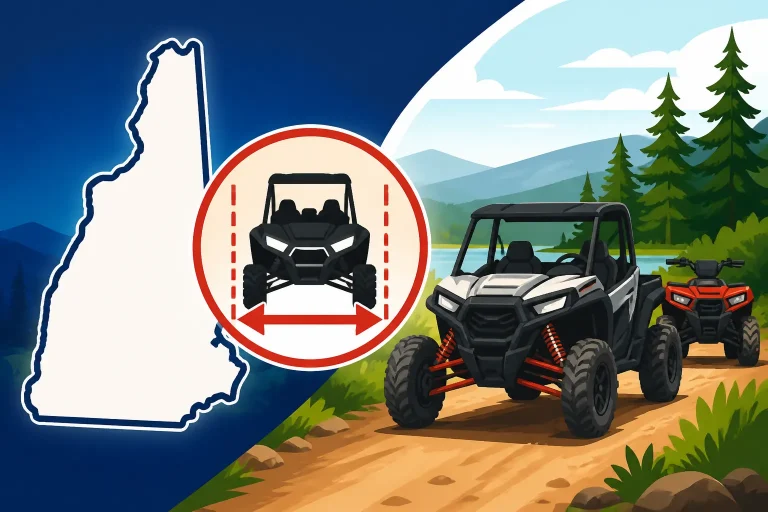
- Whether the route permits the machine’s width and type.
- Whether the trail is open and suitable for current conditions.
- Whether road crossings or shared trail sections add risks the child can handle.
A UTV should not be treated as automatically safer for a young operator simply because it has a steering wheel, seat belts or a roll cage. It still requires careful operation, appropriate supervision and compliance with applicable rules. Likewise, an ATV can be a poor fit if the child cannot manage its weight or controls confidently.
Registration and access are separate from the certificate
New Hampshire’s OHRV registration system is another step families need to handle. Having a safety certificate does not register the machine, and registering the machine does not satisfy the rider’s education requirement. Riders also need to confirm that the route is open to the machine they plan to use.
New Hampshire uses registration rather than a separate statewide trail pass for many riding situations, but individual locations can have additional conditions or fees. Trail access may depend on the system, the landowner, the machine’s width and seasonal closures. Start with [Why New Hampshire Sells No Separate Trail Sticker] and New Hampshire Trail Status Before You Ride when planning where to go.
Do not rely on the machine’s registration from another state as proof that every New Hampshire requirement has been met. Visitors should check the rules that apply to their machine and trip. A valid safety certificate and a valid registration answer different questions, and both may be relevant.
Prepare for the trail, not just the course
The first public ride should be short enough that the group can turn around without pressure. Review the route in advance, check for closures and identify any road crossings, narrow gates or sections that may challenge a new rider. Tell the child that stopping or turning back is always acceptable.
Young riders also need suitable protective equipment. Confirm what is required for the rider’s age and machine, then use gear that fits properly and can stay in place during a ride. A helmet that shifts, goggles that fog or clothing that restricts movement can make a difficult situation worse. Check the current requirements in New Hampshire Helmet Law for OHRV Riders and New Hampshire Eye Protection Requirement.
Common mistakes parents can avoid
The same misunderstandings come up when a child first becomes eligible for safety education. Avoiding them makes the planning simpler and helps keep the child from being put in a situation they are not ready to handle.
Assuming twelve means the child can ride alone
Twelve is the course minimum age, not a universal solo-riding age. Check the age-based supervision rule before riding on public property. If the child still needs an accompanying adult, the certificate does not remove that condition.
Treating a certificate as an all-purpose permit
A safety certificate is not registration, trail access or landowner permission. Keep those requirements separate when checking what the rider and machine need. If you are not sure whether a trip requires registration, start with When New Hampshire Registration Applies.
Assuming every trail accepts every machine
A trail may have a width restriction, seasonal closure or other local access condition. A machine that is registered may still be unsuitable for a particular route. Check the trail system’s current information before towing a wide UTV or planning a long family ride.
Choosing a machine based on age alone
A rider’s birthday does not tell you whether they can control a specific ATV or UTV. Consider their reach, strength, coordination, attention and experience. Start with a machine and route that provide room to learn, rather than expecting the rider to keep up with a faster adult group.
Leaving documentation behind
A certificate stored at home may be inconvenient if the rider is asked to show proof. Keep the required documents available, and make sure the adult supervising the ride knows what each document proves. A registration certificate is not the same as a safety certificate.
Relying on old information
Age, course and documentation details can be updated. Before enrollment and before riding, confirm current requirements through official New Hampshire OHRV safety-education and enforcement information. If a course provider, registration agent or trail organization gives advice that seems inconsistent, verify the rule with the relevant official source rather than guessing.
Frequently Asked Questions
Can a child take the New Hampshire OHRV safety course before turning twelve?
Twelve is the minimum age to take the approved course and earn the safety certificate. Check with the course provider for current enrollment rules and any requirements for students.
Does a safety certificate let a twelve-year-old ride without an adult?
Not by itself. The certificate satisfies a safety-education requirement; it does not cancel age-based supervision rules. Confirm the current rules for a twelve-year-old before riding on public property.
Does the certificate replace OHRV registration?
No. The certificate applies to the rider’s safety education. Registration applies to the machine, and trail access may have additional conditions.
Can a parent’s driver’s license replace the child’s certificate?
No. The parent’s license does not serve as the child’s credential. A driver’s license may affect the requirement for the person who holds it, but the child’s own age and status still matter.
What should we check before the first ride?
Confirm the rider’s course and supervision requirements, the machine’s registration, the route’s access and width rules, trail status and the required safety equipment. Choose a short route that suits the child’s skill.
Disclaimer
This article is for general informational purposes only and does not constitute professional advice. Laws, prices and regulations vary by location and change over time. Consult a qualified professional for guidance on your specific situation.