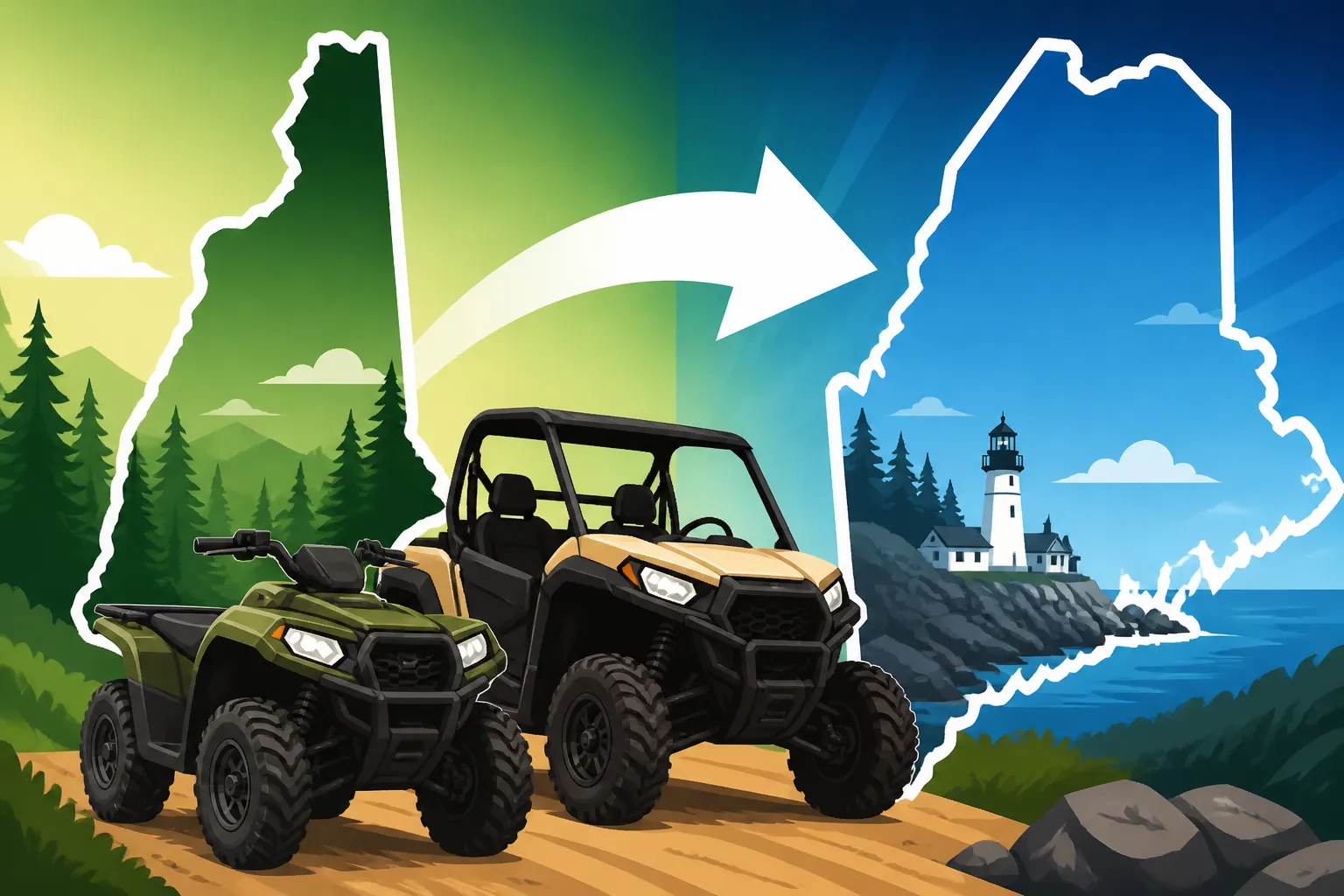
New Hampshire Rules for Crossing Into Maine
A New Hampshire ATV or UTV registration does not automatically grant access to Maine trails. Before crossing the state line, you need to sort out registration, trail permission and where machines may legally travel. The safest approach is to treat Maine as a separate riding jurisdiction, check its current requirements, and plan a route that stays on authorized connections.
Does a New Hampshire registration work in Maine?
Do not assume your New Hampshire decal and certificate are enough to ride in Maine. New Hampshire registration is not a universal trail pass, and a machine’s registration does not automatically carry the right to use another state’s trails.
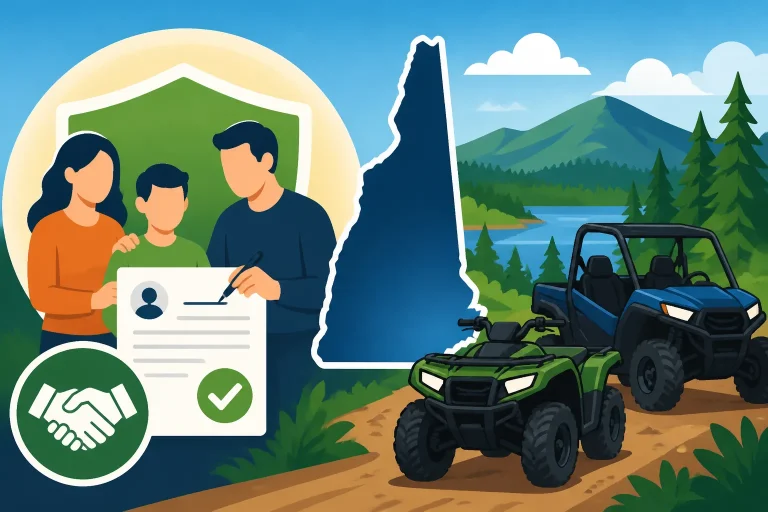
Maine has its own registration rules for out-of-state machines. Reciprocity may affect whether a visitor needs a Maine nonresident registration, but it depends on the rules between the two states. New Hampshire generally requires visiting riders to register their machines here rather than relying on a home-state registration. Because that does not provide a simple reciprocal permission for Maine riders, a New Hampshire owner should plan to obtain the Maine registration required for nonresidents before riding there.
Confirm the current requirement with Maine’s official OHRV authority before your trip. Rules and exceptions can change, and the answer can depend on the machine and the kind of riding you plan to do. If the official guidance says a Maine nonresident registration is required, get it before entering a Maine trail system. Do not rely on a New Hampshire registration, a dealer’s informal advice or a friend’s experience as proof that you are covered.
| What you have or plan to do | What to check before riding in Maine |
|---|---|
| A current New Hampshire registration | Whether Maine requires a separate nonresident registration for your machine |
| A Maine registration | That it is valid for the machine and riding period, and that required proof or decals are carried and displayed |
| A route that crosses the state line | Whether the specific trail connection is open and authorized on both sides |
| A road segment between trails | Whether Maine allows OHRVs on that particular road and under what local conditions |
| A machine that will be transported, not ridden, in Maine | Whether the planned activity is only transport or includes operation on Maine land or roads |
There is a useful distinction between transporting a machine through Maine and operating it there. A quad strapped to a trailer is not riding an OHRV on a trail. Once you unload and operate it on a Maine trail, road, field or other land, Maine’s rules become relevant. If your route includes even a short ride on the Maine side, settle registration and access questions for that section before departure.
This also works in the other direction: a Maine registration does not automatically authorize riding in New Hampshire. See Why No Maine Registration Works in New Hampshire and A Maine Rider Must Register in New Hampshire for the New Hampshire side of the issue. If you are bringing a machine from Maine to ride here, Bringing a Machine From Maine covers the separate question of New Hampshire registration.
Registration is only one part of the crossing
A valid Maine registration does not mean every trail or road is open to you. It addresses the machine’s registration status; it does not give blanket land access or replace local operating rules. Before a border ride, confirm each part of the trip independently.
Check that the trail connection actually exists
A line on a map may look like a continuous route, but an ATV trail network can stop at a state border, a road crossing or a private parcel. Trails are maintained and opened by different landowners, clubs and public agencies. A trail open in New Hampshire may connect to a closed or unauthorized section in Maine.
Look for current information from the organizations that manage the Maine route and the New Hampshire route. Check for seasonal closures, trail conditions, width limits, bridge restrictions and any notices about landowner access. A map from a previous season may help with orientation, but it is not proof that a route is open now. You can compare this with New Hampshire Trail Status Before You Ride and Downloading a Club Trail Map when planning the New Hampshire portion.
Do not improvise a connection across private land because the two trail systems appear close together. Landowner permission on one side of the line does not extend to property across the border. If the marked route ends, stop and confirm the authorized continuation rather than cutting across an unmarked field or woods road.
Verify road access locally
Some routes use roads to connect trail segments, but road access is not automatic. A town or road authority may allow OHRV use on a particular road, restrict it to certain times, or prohibit it entirely. Rules can differ between neighboring towns and between road types.
That means a route planner should identify every road segment and verify that OHRVs may use it. Do not assume a road is open because it is unpaved, because another rider used it, or because it appears on a trail map. New Hampshire road rules also differ from Maine’s. For the local New Hampshire part, New Hampshire Rules for Crossing Into Maine is the topic at hand, while New Hampshire Rules for Riding Across a Town Line explains why local designations matter once you are on this side of the border.
If the route reaches a public road in Maine, follow Maine’s requirements for that road and obey posted restrictions. A trail connection can involve a short road section that has different rules from the trail itself. If you cannot confirm that the road is open to OHRVs, choose another authorized route.
Keep land permission separate from registration
A registration is not permission to ride on any land you can reach. Maine trails may cross private land under arrangements that can be seasonal or conditional. Access can close because of maintenance, landowner decisions, weather or safety concerns. A trail shown on a map may therefore be unavailable on the day you arrive.
Respect gates, signs and closures. Do not use an unmarked woods road as a shortcut, and do not assume that land is open because it is not posted. Written permission may be needed when a route leaves an authorized trail system and enters private land. The same principle applies in New Hampshire; Written Permission on New Hampshire Private Land and Why an Unposted Field Is Still Off Limits explain why a lack of signs is not an invitation.
Plan the ride as a two-state trip
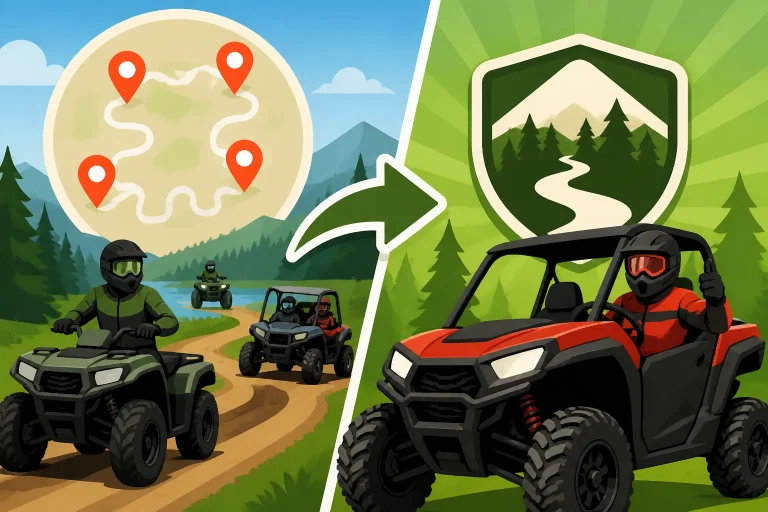
A cross-border outing needs two sets of checks. Prepare for the ride from the New Hampshire trailhead to the border, then confirm the rules and access for the Maine section. This avoids reaching the state line only to discover that your paperwork or route is not valid.
- Identify the exact machine and trip. Note whether you are riding an ATV, UTV or another OHRV, and whether you will operate it in Maine or only transport it through the state.
- Check Maine’s current registration requirement. Ask whether your New Hampshire registration qualifies for any reciprocity exception or whether you need a Maine nonresident registration. Confirm where to obtain it and what proof must be carried or displayed.
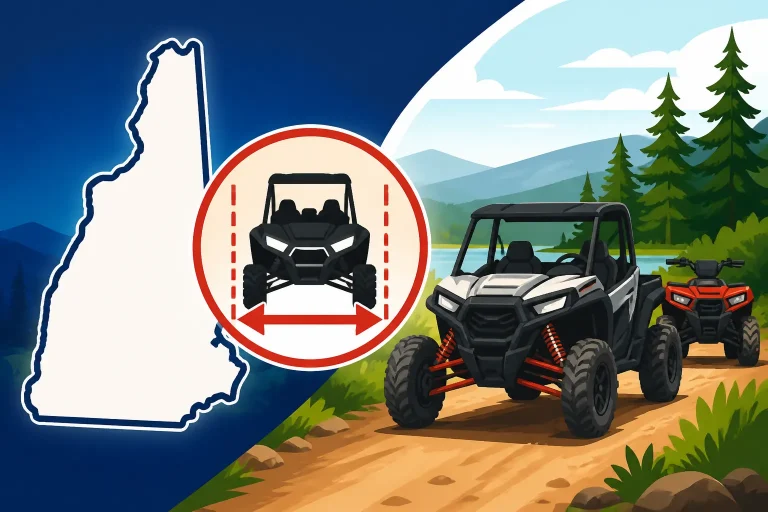
- Confirm both trail systems are open. Check the relevant clubs or land managers for the New Hampshire and Maine portions, including seasonal dates, closures and machine-width limits.
- Verify road segments and crossings. Make sure each road connection is authorized for OHRV use. Do not treat a public road, logging road or unpaved lane as a legal connector without confirmation.
- Carry the required documents. Keep the registration certificate and any additional required proof with the machine. Make sure the registration decals are attached as directed for the state and machine.
- Plan a legal return route. Confirm the route back into New Hampshire is open, and remember that a Maine registration alone does not replace New Hampshire’s own requirements.
- Recheck shortly before leaving. Trail status can change after a map is published. Confirm access close to the ride date and again if weather or land conditions have changed.
A practical trip folder can include registration details, contact information for the trail organizations, a current map and a backup route. Save offline map information if cell service may be limited. A phone map is helpful for navigation, but it should not be treated as authority to ride a closed or unmarked route. If you use a paper map or a GPS device, keep the official trail information available too.
For a group ride, make sure every rider understands where the state line is and which registration applies. The lead rider should not assume everyone has the same paperwork: a visitor’s home state, machine type or rental status may change what is required. If anyone is riding a rental machine, confirm with the rental provider that the machine is registered and approved for the Maine route; do not assume the rental’s New Hampshire paperwork covers operation elsewhere.
Common mistakes to avoid
Treating a New Hampshire decal as a Maine pass
The most important mistake is crossing the border because the machine is properly registered in New Hampshire and assuming nothing else is needed. Registration reciprocity is a specific legal arrangement, not a courtesy that riders can infer from neighboring states. Check Maine’s current rule and get the required Maine registration if the rule calls for it.
This is different from a machine being registered in another state while being transported on a trailer. If you unload it and ride in Maine, you are no longer dealing only with transport. Confirm the operating requirements for the actual route.
Assuming the border follows the trail
A trail may not cross the state line where a rider expects it to. Some routes stop at a road, private boundary or closed section. Do not use an informal track, a woods road or a narrow gap in a fence as a substitute for a marked, authorized connection. If the trail ends, check the route rather than continuing by guesswork.
Confusing registration with permission
Even when a machine is registered correctly, a landowner or trail manager can close access. Stay on marked trails and follow posted signs. Do not ride around a gate or closure because the route is short or the detour is inconvenient. A registration proves only what it is intended to prove; it does not grant permission to use private property.
Relying on old information
Trail access and operating rules can change. An old forum post, a map saved from a previous season or a rider’s recollection may not reflect present conditions. Use official state guidance for registration and current information from the trail managers for access. If two sources conflict, contact the agency or organization responsible for the specific rule or trail before riding.
Crossing into Maine can be straightforward when the registration and route are planned in advance. The key is to treat the state line as a real change in rules: verify Maine registration, confirm the trail and road connections, and carry the documents required for the machine you are operating.
Disclaimer
This article is for general informational purposes only and does not constitute professional advice. Laws, prices and regulations vary by location and change over time. Consult a qualified professional for guidance on your specific situation.