Building a Fire Ring at a Trailside Camp
A fire beside an ATV or UTV trail can seem like a simple part of camping, but the location and permission matter as much as the flames. In New Hampshire, a trail corridor is not automatically a campsite, and an existing fire ring does not guarantee that a fire is allowed. Check who manages the land, confirm current fire rules, and plan to leave the site clean and cold.
Start With Permission and the Right Place
Before you bring firewood, find out whether camping is allowed where you plan to stop. A trail, pull-off, or open patch beside a route is not necessarily a campsite. It may be private property, leased land, state-owned land, or land managed by a club under specific access terms. Rules for riding through an area do not automatically grant permission to camp or build a fire there.
On private land, get permission from the landowner before camping or making a fire. Ask specifically about both activities: permission to ride across property does not necessarily include permission to stay overnight. Written permission is a practical way to avoid misunderstandings. See New Hampshire Written Permission Requirements and New Hampshire Rules for Riding Private Land for related access considerations.
For state-owned land or leased trail ground, check with the managing agency or landowner before making plans. Some areas may allow riding but restrict camping, open flames, or both. A club-maintained trail does not mean the club can authorize a campfire on every property the route crosses. New Hampshire Rules on State-Owned Land and Leased Trail Ground explain why it matters to distinguish the riding route from the land-management rules.
If you are considering a developed campground or a designated trailside camping area, check its own fire rules rather than assuming a fire ring is available for use. An existing ring could be closed, reserved, or left over from an earlier use. If there is no clear approval, don’t create a new ring or start a fire.
| Location or situation | What to confirm before lighting a fire |
|---|---|
| Private land beside a trail | The landowner allows both camping and a fire |
| Club trail or connector | The landowner and relevant trail manager allow the stop and fire |
| State-owned or leased land | The responsible land manager allows camping and open flames |
| Developed campground | The site is open, the ring is usable, and current campground rules allow a fire |
| Unmarked pull-off or clearing | That camping and fires are permitted there; appearance alone is not permission |
You can ride through an area legally and still have no right to camp there. When the site’s status is unclear, move to a place that explicitly allows overnight stays and fires. Club Trail Access in New Hampshire and Riding a New Hampshire State Park can help clarify why trail access and permission to use a site are separate questions.
Check Fire Conditions and Local Rules
A fire ring is not a substitute for checking current fire restrictions. Conditions can change with dry weather, wind, recent rainfall, and local decisions. Before your trip, contact the relevant land manager or local fire authority and ask whether a fire is allowed at your intended site. Confirm whether the rule applies to a contained campfire, a portable fire pan, or all open flames. Don’t rely on a sign, an old online post, or what another rider says they did on a previous visit.
Ask about any required permit and how to get it. In New Hampshire, open-burning requirements and restrictions may depend on the type of fire, location, and current conditions. If the answer is unclear, treat that as a reason to avoid burning until you can confirm. A portable metal pan may reduce impact on the ground, but it does not automatically make a fire legal or exempt from local restrictions.
Look for site-specific notices too. A campground can set rules that are stricter than what may apply elsewhere. A land manager may close a fire ring temporarily, prohibit wood fires, or allow only certain kinds of fires or equipment. Follow the current instructions at the site, even if a fire has burned there before.
Plan for a no-fire evening. Bring warm layers, food that does not need a fire, and lighting that is suitable for camp use. If a restriction appears while you are already on the trail, don’t try to work around it by moving the fire off the ring or using a different fuel. Switch to your backup plan.
For practical trip planning, check New Hampshire Trail Status Before You Ride for trail conditions and closures, and separately verify fire conditions with the authority responsible for the land. Trail status and fire permission are different checks; one does not confirm the other. The broader precautions in Campfires on a New Hampshire Trail Ride are also useful when deciding whether a fire belongs in your plan at all.
Use an Existing Ring or a Safe Portable Setup
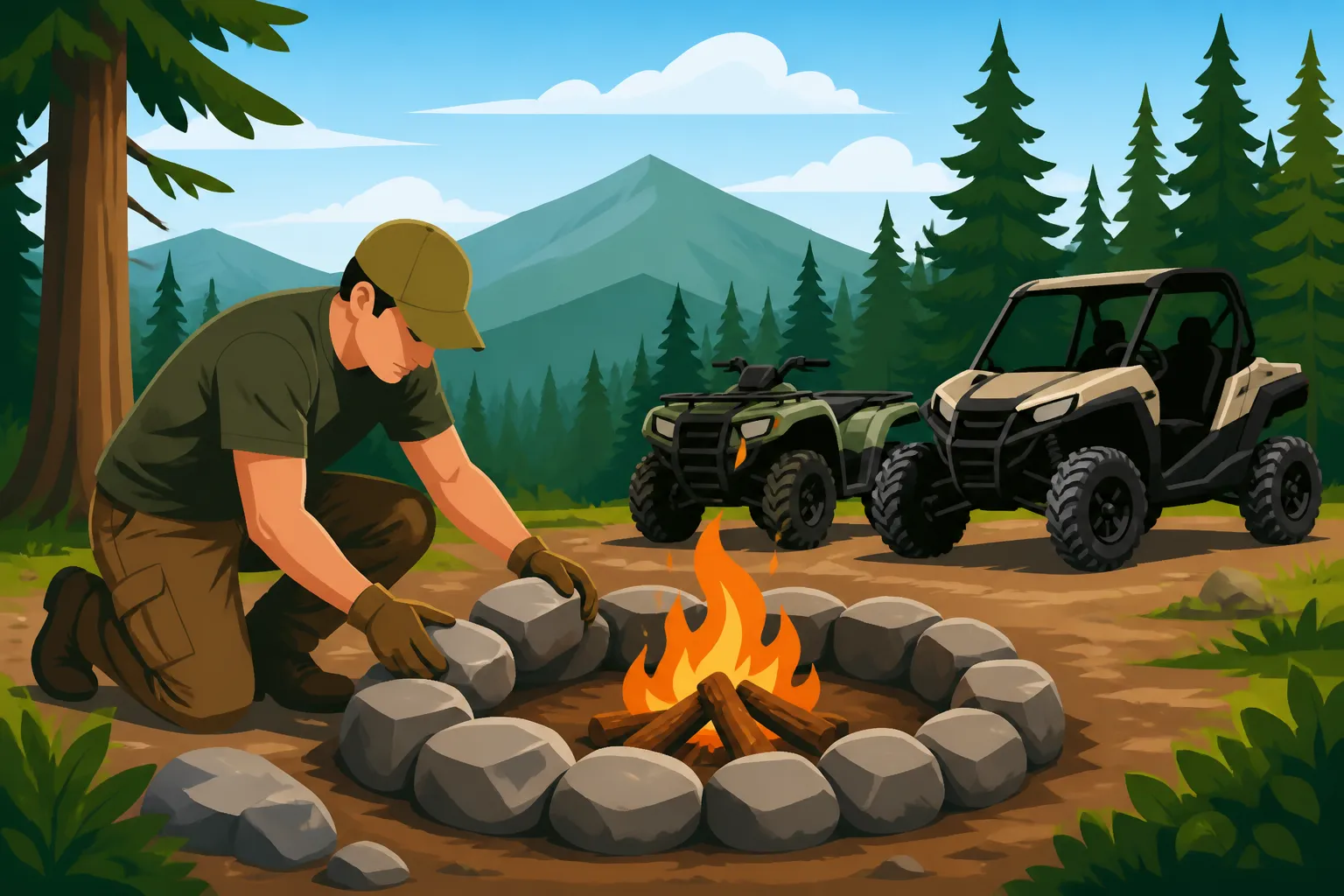
If fires are allowed, use a designated, serviceable ring rather than making a new one. A ring helps contain coals, but it does not make the surrounding area fireproof. Check that the ring is not damaged, full of hot ash, or close to dry grass, brush, low branches, tents, or stored fuel. If the ground and surrounding vegetation look unusually dry, or wind could carry sparks, skip the fire even if it is otherwise permitted.
Don’t collect rocks from a trail, stream, or other natural area to build a ring. Rocks can crack or spit when heated, and gathering them may damage the site or violate its rules. Avoid digging a pit or scraping away vegetation unless the land manager explicitly directs you to do so. Leave the site as you found it, except for properly disposing of your own waste.
A portable fire pan can be useful where it is allowed, especially when an established ring is unavailable. It still needs a stable, noncombustible surface and enough clearance from vegetation and equipment. Check the manufacturer’s setup and use instructions, and confirm with the land manager that the device is permitted. If you are comparing compact fire pans or heat-resistant mats, Amazon can be one place to review product options, but the product listing cannot confirm that local rules allow its use.
Keep the fire small and attended by a responsible adult. Have water and a shovel within reach before lighting it, not after the fire grows. Keep fuel containers, riding gear, and parked machines well away from flames and sparks. Do not burn trash, plastic, food packaging, or treated wood. These materials can create harmful smoke or leave debris that is difficult to clean up.
Use only firewood that is permitted at the site. Don’t cut trees, branches, or standing deadwood unless the land manager has expressly allowed it. Ask whether you may gather downed wood or need to bring approved firewood. Follow any current restrictions on bringing wood into the area, and pack out scraps and packaging.
A campfire should never become an excuse to ride farther than the permitted route to reach a supposed campsite. Stay on authorized routes, park only where allowed, and do not cut across a field or around a closed trail to reach the ring. New Hampshire Rules for Riding Off a Marked Trail is relevant if the route to a campsite is not obvious.
Put the Fire Completely Out and Leave No Trace
Plan enough time to put out the fire before you turn in or leave camp. A fire that looks dark can still have live embers under ash. Don’t leave it unattended while riding away, and don’t assume a light rain or a thin layer of dirt has extinguished it.
Use water if it is available and allowed at the site. Pour it slowly over the coals and ash, stir the material with a shovel, and wet it again. Repeat until the contents are cold throughout, including beneath the surface. If water use is restricted or the site provides a different method, follow the land manager’s instructions. Never scatter warm ash into brush or dump it beside the ring.
Before departing, check the ring and nearby ground for glowing embers, sparks, and hot spots. Keep monitoring until the fire is fully out. If you cannot make it cold, don’t leave the area: continue extinguishing it and ask for help from the responsible site staff or local authority if needed.
Pack out all food scraps, wrappers, cans, and other waste. Don’t bury trash or leave food for wildlife. Put ash where the campground or land manager instructs; if no disposal method is provided, ask before moving it. A ring full of unburned material is not a proper place to leave your garbage.
A final check before you go can prevent a small campfire from becoming a serious problem:
- Confirm that camping and fires are allowed at this exact location.
- Check current restrictions and any permit requirement.
- Use an approved ring or permitted portable setup, and keep the fire modest.
- Keep water and a shovel close while the fire is burning.
- Extinguish, stir, and re-wet the coals until everything is cold.
- Remove your trash and follow the site’s instructions for ash.
If you cannot confirm permission or safely extinguish the fire, don’t light it. Choosing a stove or a no-fire meal may be less atmospheric, but it is a better trade-off than risking damage to trail land or leaving a hazard for the next visitor.
Disclaimer
This article is for general informational purposes only and does not constitute professional advice. Laws, prices and regulations vary by location and change over time. Consult a qualified professional for guidance on your specific situation.