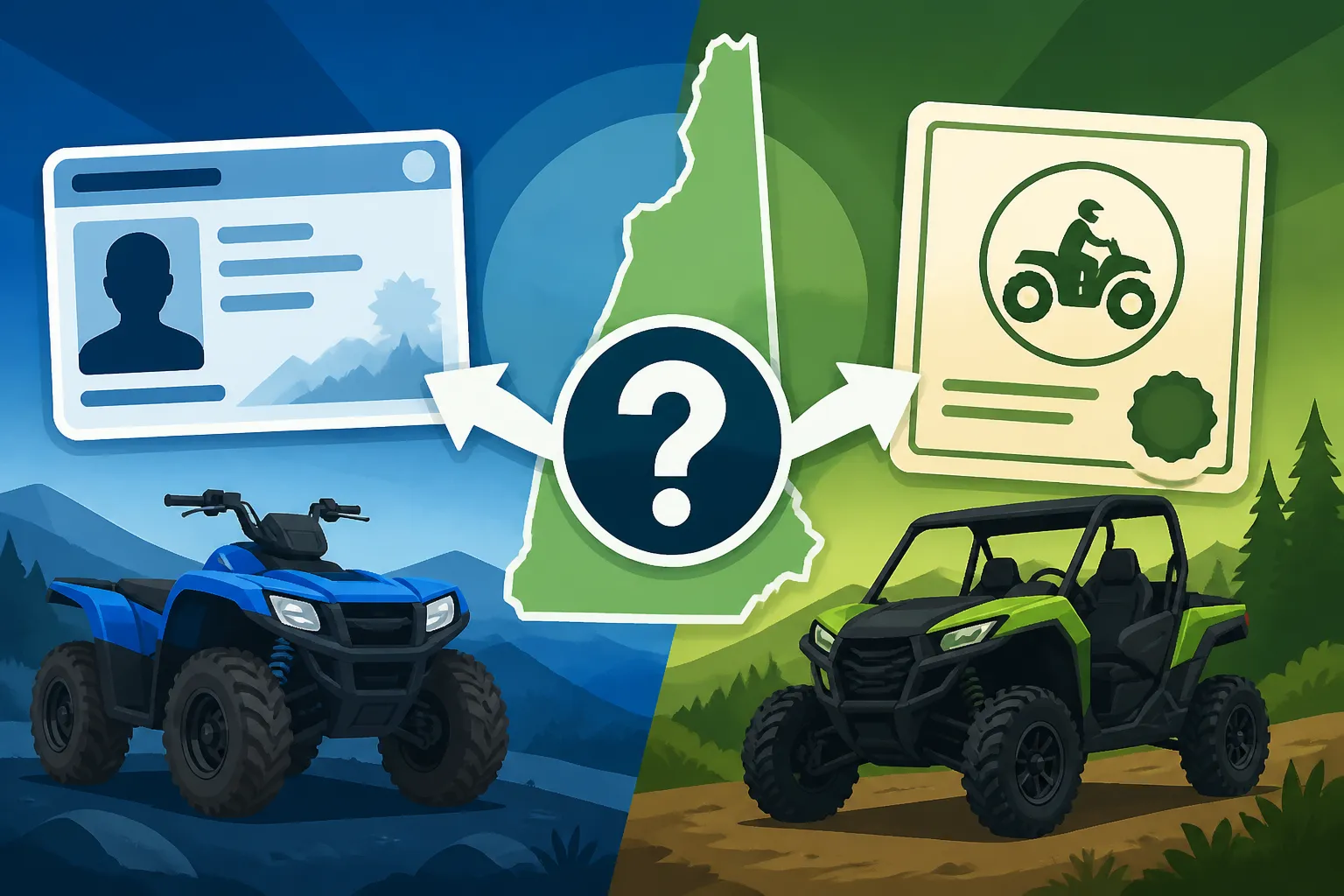
Does a Driver’s License Replace the Certificate in New Hampshire?
A New Hampshire driver’s license can satisfy the state’s OHRV safety-certificate requirement for an operator who would otherwise need the certificate. That’s a narrow substitute, not an all-purpose riding permit: registration, age and supervision rules, and permission to use a trail still apply. Here’s how to tell what your license covers—and what you need to check before riding an ATV or UTV.
When a driver’s license replaces the safety certificate
New Hampshire generally requires certain OHRV operators to complete an approved safety education course and carry the resulting certificate. A valid driver’s license can exempt an operator from that certificate requirement. In other words, if the certificate rule applies to you, an eligible license can serve as the alternative; you do not ordinarily need to complete the course just to meet that same operator qualification.
The exemption concerns safety education. It does not turn a regular driver’s license into an OHRV registration, trail pass, or permission to ride on land. Nor does it automatically remove rules that apply because of the rider’s age or the place where the machine is being operated.
The safety-certificate rule is tied to the operator, not the ATV or UTV. A machine’s owner may be licensed while another person operates it. The other operator must meet the requirements that apply to them; the owner’s license does not cover a passenger or a different rider. If you’re checking whether an operator needs a certificate, start with [New Hampshire ATV Safety Certificate Requirements] and Does New Hampshire Require an OHRV Safety Certificate?.
A license should be current and valid for the person presenting it. If it has expired, been suspended, or otherwise is not valid, don’t assume it qualifies for the exemption. If you have an out-of-state license, or a document that is not a standard driver’s license, confirm with New Hampshire Fish and Game or the registration agent before relying on it.
The practical test is simple: does the operator hold a valid driver’s license accepted for this exemption? If yes, the license can satisfy the safety-certificate requirement. If not, check whether the operator must complete an approved course before riding. Because age and operator status can affect the answer, a rider should not assume the same rule applies to every member of a group.
What a driver’s license does and does not cover
It helps to separate the requirements into categories. A license may settle the safety-education question, but each other requirement has its own purpose and must be checked separately.
| Requirement | What it concerns | Does a driver’s license replace it? |
|---|---|---|
| OHRV safety certificate | Safety education for operators covered by the certificate rule | Yes, a valid qualifying driver’s license can serve as the alternative |
| OHRV registration | The machine’s registration and required decals | No |
| Rider age and supervision rules | Who may operate and whether an adult must accompany a young rider | No |
| Trail or land access | Whether riding is allowed on that trail or property | No |
| Road-use rules | Whether a road may be used and what conditions apply | No |
| Insurance or other machine-related obligations | Requirements that may apply in a particular situation | No; check the applicable rule |
Registration is a separate requirement
The driver’s license belongs to the operator; registration applies to the machine. A licensed rider still needs to use an appropriately registered OHRV when registration is required. That distinction matters for visitors, too: a machine’s registration from another state does not automatically satisfy New Hampshire requirements. See Riding New Hampshire With an Out-of-State Machine for the visitor issue and New Hampshire OHRV Registration Paperwork for the machine-registration side.
Do not treat a safety certificate or a driver’s license as proof that a machine is registered. Keep the registration information and decals in order, and check that they correspond to the machine being ridden. For an overview of when registration applies, see When Registration Applies in New Hampshire.
Age and supervision rules still matter
The license exemption does not erase age-based rules. A young rider may face additional limits on where or with whom they may operate, even if they have completed a safety course—or hold a credential that satisfies the certificate requirement. The relevant details can depend on the rider’s age and the setting.
Before taking a young person on a trail, check New Hampshire’s Age and Supervision Rules and the more specific New Hampshire Rules for Riders Under 18. Do not assume that a certificate, license, or adult’s presence makes every type of riding permissible. Those requirements address different questions.
A parent or other adult supervising a young rider should also make sure the operator meets the applicable rules independently. An adult’s driver’s license does not substitute for a young operator’s own required qualification. If a rider’s age or license status is unusual, confirm the rule with the state before the trip rather than relying on a general summary.
A license is not trail permission
Registration and operator qualifications do not give a rider blanket access to every trail, road, or parcel of land. Use only routes that allow the machine and are open to riding. Private property may require permission, and public trails can have restrictions or seasonal closures. See New Hampshire Rules for Riding Private Land and New Hampshire Trail Status Before You Ride before setting out.
The same distinction applies to roads. A driver’s license alone does not make an ATV or UTV street legal, and it does not authorize a rider to travel along a road that is closed to OHRVs. Road access depends on the applicable rules and local designation. Are ATVs Street Legal in New Hampshire? explains why a regular license does not answer that separate question.
How to check before you ride
A little preparation can prevent a frustrating stop at registration or at the trailhead. Use this checklist for each operator and each machine, especially when a group includes people with different ages or license statuses.
- Confirm the operator’s qualification. If the person has a valid driver’s license, confirm that it qualifies for the safety-certificate exemption. If they do not, check whether they must complete an approved course and carry the certificate. For course options, see Where to Take a New Hampshire ATV Safety Course.
- Check age and supervision requirements. Apply the rules to the person who will actually operate the ATV or UTV, not just the adult who owns it or is leading the group. If a rider is a minor, confirm any additional limits before leaving.
- Check the machine’s registration. Make sure the machine meets New Hampshire registration requirements for the planned ride. A license or certificate does not register the OHRV.
- Confirm that the route is open and allows your machine. Trail access can depend on the trail, season, landowner permission, and machine restrictions. A route that appeared open on an old map may have changed.
- Carry the right documents. Bring the driver’s license if you are relying on it as the safety-certificate alternative. Keep registration information available as well. If you have a safety certificate, carry it as required; do not assume an agent or officer will accept an explanation in place of the document.
- Ask if a detail is unclear. Contact New Hampshire Fish and Game or the registration agent before riding if the license is expired, out of state, restricted, or otherwise unusual. It is also sensible to confirm any rule that depends on the rider’s age or the machine’s use.
If you are enrolling in a course, the certificate is useful beyond a single outing: it documents completion of the safety education requirement. But taking a course is not a substitute for checking registration or access rules. Conversely, holding a driver’s license may remove the need for the certificate without answering any of those other questions.
Common situations
An adult with a valid license is riding their own registered ATV. The license can satisfy the safety-certificate requirement if the exemption applies. The rider still needs to follow registration, trail-access, and operating rules.
A licensed adult lends a machine to someone without a license. The adult’s license does not transfer to the borrower. The person operating the machine must meet their own safety-certificate requirement, along with the rules that apply to their age.
A teenager has completed the course but does not have a driver’s license. The certificate may address the safety-education requirement, but age and supervision rules still need to be checked. Course completion does not automatically authorize every rider to operate alone or on every route.
A visitor brings an ATV with an out-of-state registration and a driver’s license. The license may address the operator’s certificate requirement, but it does not settle the machine’s New Hampshire registration or trail-access requirements. Check the rules for visiting machines before traveling.
A rider has a license that is not currently valid. Do not count on it as an exemption. Confirm what qualification is required and whether the rider must complete the approved safety course before operating.
The useful takeaway is to treat the license as an alternative to one specific credential—not as an all-in-one riding document. Verify the operator’s qualification, the machine’s registration, and the route’s access conditions separately. When a rider’s age or license status makes the answer uncertain, confirm it before the ride.
Disclaimer
This article is for general informational purposes only and does not constitute professional advice. Laws, prices and regulations vary by location and change over time. Consult a qualified professional for guidance on your specific situation.