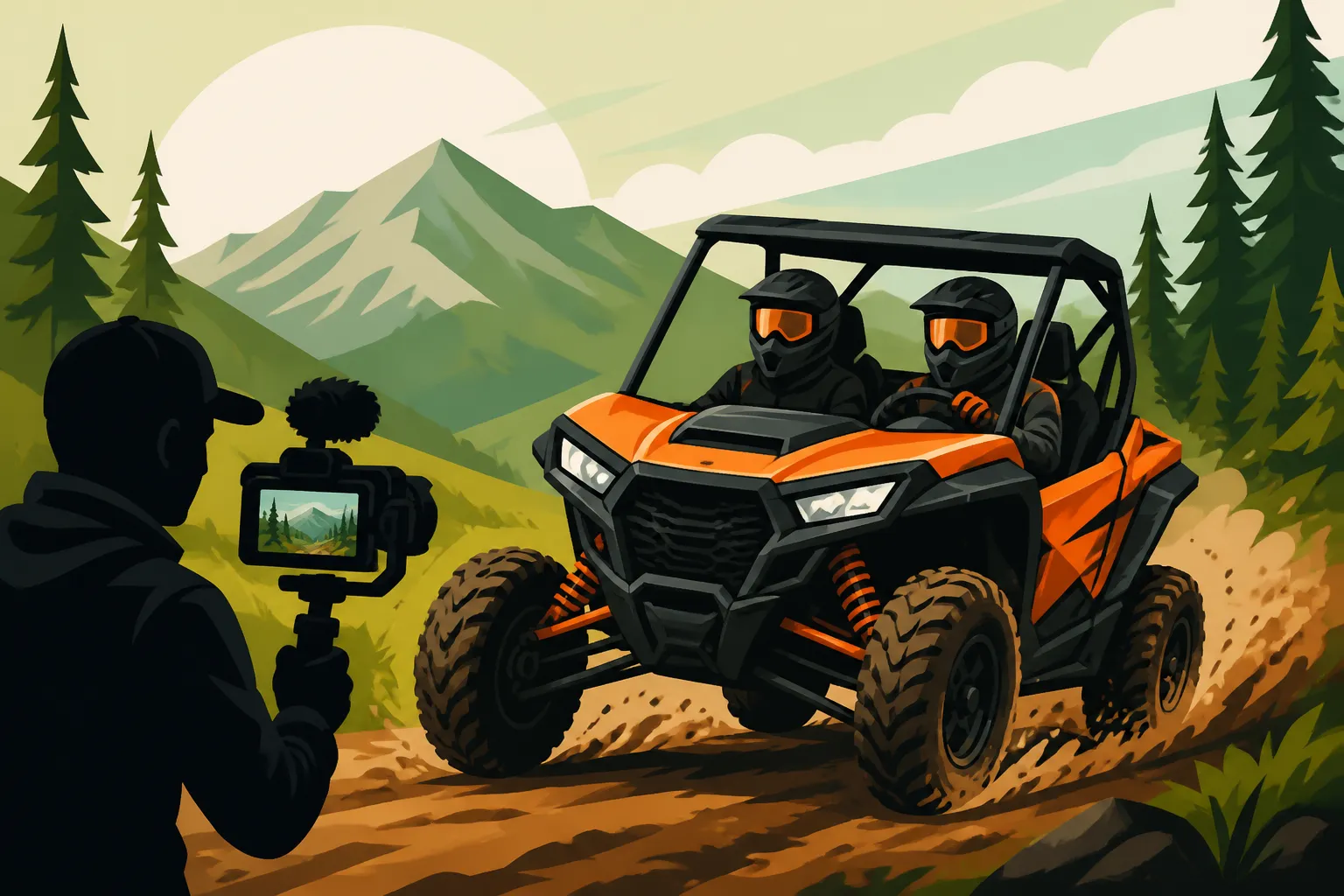
Filming on a Club Trail
Filming a ride on a New Hampshire club trail can be as simple as mounting a camera, but a planned shoot raises different questions. Trail access, landowner permission, registration and event requirements still apply, and a crew or commercial project may need advance approval. Here’s how to tell what kind of filming you’re doing and what to check before you ride.
A camera on your ride is different from a production
Recording a personal ride with a helmet camera or a securely mounted action camera is generally part of ordinary trail use. The camera does not replace the rules that apply to the rider or machine, though. You still need to use an authorized route, meet the applicable registration requirements and follow trail signs and closures.
A planned production can affect other trail users and the land supporting the trail. A crew may bring several machines, tripods, lights, sound equipment or vehicles, or pause repeatedly in a narrow section. That can turn a routine ride into an activity a club or landowner needs to review. The key question is not only what camera you use, but whether your filming changes how the trail is used.
| Type of filming | What to check |
|---|---|
| Personal camera mounted on your machine | Registration, permitted access, safe equipment placement and trail rules |
| Small group recording a recreational ride | Group size, parking, stopping locations and whether the club requests notice |
| Sponsored or commercial shoot | Written approval from the club and relevant landowner, plus any applicable agency or location requirements |
| Organized shoot with a route, crew or staging area | Advance coordination, access permission, event requirements and possible limits on time or location |
| Filming that leaves the marked route | Do not assume filming is an exception; get specific permission before going off-trail |
There is not necessarily a single, statewide “filming pass” that covers every club trail. Access arrangements depend on the land and the people managing it. Many trails cross private land made available through agreements with landowners, so a club’s permission to ride does not automatically mean that a film crew can occupy the route, stage equipment or bring additional vehicles.
For background on the limits of trail access, see New Hampshire Rules for Filming on a Trail and Getting a Landowner’s Signature in New Hampshire. If a project involves a group activity rather than a few riders recording themselves, review New Hampshire Rules for an Organized Ride as well.
Get approval before bringing a crew or staging equipment
For a production shoot, contact the club responsible for the trail area before setting a date. Explain what you want to film, how many people and machines will be involved, where you hope to stage, and whether you plan to stop or repeat passes. Be specific about support vehicles, trailers, generators, lighting, drones and any equipment that will be placed beside or across the route.
The club may need to consult the landowner or another manager before giving an answer. A club can help identify the right contact, but it cannot necessarily approve use of land beyond the authority it has been given. If the proposed location is on state-owned, town-owned or otherwise managed land, ask which agency or municipality handles that location and what its process is. Don’t treat a verbal “the trail is open” as approval for a production activity.
Ask for the terms in writing. A written approval can clarify:
- Which trail segments and staging areas are allowed
- The approved date and time window
- How many machines and support vehicles may attend
- Whether filming may pause or repeat at a particular spot
- Where crew members may stand safely
- Whether signs, barriers or traffic control are allowed
- Who to contact if the trail closes or conditions change
- Whether the footage may identify a landowner, private property or sensitive location
A simple personal ride may not need this level of coordination, but a project that could affect other riders or the land deserves it. If the plan includes a public gathering, a timed activity, a competition or a guided commercial ride, don’t assume ordinary filming approval covers those parts. Check the rules that apply to the activity itself. The requirements for a race, for example, can be different from those for a small camera crew; New Hampshire Permits for a Race and New Hampshire Rules for a Commercial Guide address distinct situations.
Permission to film also does not give permission to ride outside the designated route. Do not pull into a field, cut across a woods road or take a machine off a marked trail to get a better shot unless the person with authority over that land has expressly allowed it. See Written Permission on New Hampshire Private Land and New Hampshire Rules for Riding Off a Marked Trail for the separate access issue.
Keep registration and trail access separate from filming approval
An approval to film is not an OHRV registration, and registration is not permission to conduct a production. Treat these as separate checks. Each machine used on the trail must meet the applicable New Hampshire requirements, including any requirements that apply to visitors and out-of-state machines.
A nonresident should not assume that a home-state registration is enough for riding in New Hampshire. Check Why New Hampshire Honors No Neighbor’s Registration and Riding New Hampshire With an Out-of-State Machine before planning a shoot with visiting riders. If a machine is rented, ask the rental provider what its registration covers and what conditions apply to using it on the intended routes.
Club membership may help with a registration rate or support the organization maintaining the trail, but it is not a production permit. Likewise, a registration decal does not authorize a crew to block a trail or set up equipment wherever it likes. For the distinction between registration and access, see Do You Need a Trail Pass in New Hampshire?.
Before the shoot, confirm that the route is open to the type and width of machine you plan to use. Club trails can have different limits, and an open segment may connect to a closed or restricted one. Check the trail status close to the shoot date; conditions and access can change. New Hampshire Trail Status Before You Ride can help with that pre-ride check.
For a visitor’s shoot, build the registration and access checks into the schedule rather than leaving them until the group reaches the trailhead. A delay at registration, a closed connection or a machine that does not qualify for a route can disrupt a production just as easily as bad weather.
Film without blocking the trail or creating extra risk
The most useful filming plan is often the one that interferes least with normal trail use. A mounted camera lets the rider record while continuing with the group, but it must be attached securely and must not interfere with steering, visibility, controls or safe operation. Avoid holding a phone or camera while riding. If a shot requires the rider to handle equipment, stop only in a safe place where the machine and people are clear of the travel route.
A crew on foot should stay in a location approved for that purpose and remain visible to approaching riders. Do not place a tripod, cable, light stand or other equipment where a rider could strike it or be forced into a hazard to avoid it. If a safe setup cannot be arranged without obstructing the trail, change the shot rather than putting equipment in the route.
For multi-machine filming, agree on how the group will travel and stop. Riders should not make repeated passes through a busy section without approval, and a support vehicle should not enter a trail simply because it is carrying cameras. Park only in permitted areas and keep access points clear for other riders and emergency responders.
Drones bring another set of questions. Approval to ride or film on a trail does not automatically settle whether a drone can be launched, operated or landed at that location. Check applicable aviation rules and the rules of the land manager, and consider other trail users, wildlife and nearby property. A drone shot is not a reason to fly over people or interfere with riding.
If the shoot includes identifiable people, ask permission before making them part of the planned footage, particularly when the scene is staged or the project is commercial. Be thoughtful about filming private homes, camps, license plates or other details that could expose someone’s location. A release may be appropriate for people who are featured, but it does not replace permission to use the land.
The practical distinction is straightforward: recording your own ride is not the same as reserving a trail for a production. Stay on an authorized route, keep equipment and people out of the way, and ask the club and land manager before bringing a crew, staging gear or changing how the trail is used. If the trail status or permission is unclear, postpone the setup until it is confirmed.
Disclaimer
This article is for general informational purposes only and does not constitute professional advice. Laws, prices and regulations vary by location and change over time. Consult a qualified professional for guidance on your specific situation.