Written Permission on New Hampshire Private Land
Riding an ATV or UTV across private land in New Hampshire can look simple until you reach a boundary, a gate, or a trail connector. The safest starting point is clear written permission from the landowner or someone authorized to grant it. Here’s how to make that permission useful, understand what it does not cover, and avoid confusing private-land access with registration or trail access.
Why written permission matters
A machine that can cross a field or woods road can also cause damage, disturb neighbors, or enter land the rider does not have permission to use. In New Hampshire, get written permission before operating an OHRV on someone else’s private land. A verbal okay may be hard to verify later, and permission from one landowner does not automatically cover a neighboring parcel.
Written permission is more than a formality. It gives the rider and landowner a shared record of what was agreed: which area may be used, by whom, for what activity, and during what period. It can help prevent misunderstandings about a machine crossing a corner of a property, using a driveway, or riding beyond a marked route.
An unposted property is not an invitation. A missing sign does not establish that the owner agrees to ATV or UTV use. Don’t treat an open gate, tire tracks, a path on a map, or the fact that other people ride there as proof of permission. Why Unposted Land Is Not an Invitation
Written consent is also different from registration. Permission addresses the landowner’s consent to use private land. Registration requirements depend on the machine and where it will be operated. A private-land agreement does not authorize riding on a public road, a club trail, or another property. Check the registration rules for the route as a whole, including any public sections. When Registration Applies in New Hampshire
The permission may come directly from the property owner or from someone who has authority to give it. For example, a land manager or other authorized representative may handle access for an owner. If you are unsure whether the person has authority, ask them to confirm it in writing. Don’t assume that a neighbor, tenant, employee, club member, or previous rider can grant access on the owner’s behalf.
For a broader look at the rules, see Riding Private Ground in New Hampshire and New Hampshire Landowner Permission Rules. The practical takeaway is straightforward: ask first, get the answer in writing, and stay within the area and conditions the landowner has approved.
What to include in a written permission agreement
New Hampshire permission does not need to be treated as a complicated contract to be useful. The key is to make the agreement specific enough that everyone understands where, when, and how riding is allowed. A vague note saying “ATVs okay” may leave important questions unanswered, especially if several parcels, riders, or machines are involved.
Before heading out, make sure the written permission identifies the following:
- The landowner or authorized person. Include the name of the person granting permission and, if applicable, the owner or organization they represent.
- The riders. Name the people who may ride, or clearly describe the group covered by the agreement. Do not assume permission for one person extends to friends, guests, or a whole riding group.
- The property. Identify the parcel, access point, trail, field, or other permitted area. A street address may not be enough for a large or remote property. A marked map or clear boundary description can help.
- The machines and activity. State whether the permission covers ATVs, side-by-sides, or other OHRVs, and whether it covers riding through, parking, loading, or other requested use.
- The dates or time period. Confirm when access begins and ends, and whether it is a one-time visit or continuing permission.
- The route and restrictions. Note any gates, roads, trails, buildings, waterways, seasonal closures, speed limits, or other areas to avoid.
- How permission can be withdrawn. Ask how the landowner will communicate a change or cancellation, and agree to stop using the property if permission is withdrawn.
A simple written message can be clearer than a formal-looking document with missing details. For example, the owner might confirm that named riders may use a particular marked trail across a specified parcel on an agreed date, subject to limits on speed, group size, or hours. The point is not to invent a special state form; it is to record the actual agreement in a way both sides can understand.
A good request is specific, polite, and easy to answer. Explain who will ride, what type of machine you will use, where you hope to go, and when. If your route depends on crossing a particular part of the property, say so instead of asking for general access and assuming the crossing is included. The owner may approve a narrower route or set conditions you would not know to ask about.
| Permission detail | Why it matters | What to clarify |
|---|---|---|
| Rider names | Keeps permission from being treated as open access for anyone | Are guests included, or only named riders? |
| Property boundaries | Helps prevent accidental entry onto neighboring land | Which parcel, trail, or marked area is covered? |
| Machines | Not every owner will allow every vehicle type | Are ATVs, side-by-sides, or both permitted? |
| Dates and hours | Access may be temporary or seasonal | When may riding begin and end? |
| Route and restrictions | Permission for one path may not include the rest of the property | Which roads, trails, gates, or areas are off-limits? |
| Revocation | Owners may change their decision | How will a change be communicated? |
Keep a copy of the permission where riders can access it, whether as a printed page or an electronic copy on a phone. A digital copy is convenient, but it is sensible to save it for offline access if service may be unreliable. Make sure the version you carry includes any map or conditions that are part of the agreement.
Written permission does not necessarily settle every legal question. It does not replace other permissions, required registrations, safety rules, or restrictions that may apply to the machine or the route. If the landowner’s conditions conflict with your plans, clarify them before riding rather than deciding at the trailhead that the agreement probably covers it.
Stay inside the permission you received
Permission is limited by its terms. If an owner authorizes use of one trail, that does not automatically grant access to the rest of the parcel. If the owner permits riding on a particular date, the approval may not extend to the following weekend. Treat boundaries and conditions as real even when the ground looks open or the route appears to continue.
A common problem is a route that briefly crosses private land between two trails or access points. A short connector is still land the rider needs permission to use. A trail map, GPS track, or set of tire marks can help with navigation, but none of them proves the owner has authorized riding. If the route crosses a corner of private property, ask about that exact crossing and get the answer in writing. Crossing a Corner of Private Land Between Trails
Pay particular attention to:
- Parcel lines. A permission agreement for one owner’s land does not grant access to a neighboring owner’s property.
- Gates and barriers. Don’t bypass, move, or ride around a gate unless the landowner has specifically authorized that access.
- Closed or marked areas. Follow signs, barriers, and the owner’s instructions even if a familiar route usually goes through.
- Buildings, yards, and work areas. Permission to use a trail does not mean permission to ride near a home, farm, logging operation, or other active area.
- Other people’s property. Don’t assume that a road or path crossing a parcel is available because it appears on a map or is used by others.
- Changes in conditions. Weather, construction, forestry work, wildlife concerns, or neighbor complaints may lead an owner to restrict access.
If you discover that a trail has changed, a gate is closed, or you may have crossed onto a parcel not covered by the agreement, stop and reassess. Don’t push on because the destination is close. Use an authorized route back or contact the landowner for instructions. When a route depends on several owners’ properties, verify access with each one rather than treating one person’s permission as covering the whole trip.
Permission can also be withdrawn. An owner who previously allowed riding may later ask riders to stop or may close part of the land. When that happens, respect the change and stop using the property. Ask whether the owner wants you to leave by the route you entered or use a different exit. When a Landowner Takes Back Riding Permission
This is one reason to keep the owner’s contact details and a copy of the agreement available. If a condition is unclear, it is better to ask than to interpret it in the way most convenient for the ride. A good relationship with a landowner depends on riders following through on what they agreed to do, not just obtaining permission once.
Private land, club trails, and out-of-state machines
Private land and club trails can overlap, but they are not interchangeable. A club may have permission from landowners to maintain or use a marked trail. That arrangement does not necessarily give an individual rider permission to leave the marked route, use nearby woods roads, or continue after a closure. Stay on the authorized trail and follow the club’s current access information.
Some trail systems cross land managed through leases or other arrangements. Access may depend on an agreement between a landowner, land manager, and trail organization, and the permitted route can be narrower than the apparent property boundary. Don’t assume that a paper-company lease or a broad tract of woods means public OHRV access is allowed everywhere. Trails That Cross a Paper Company Lease
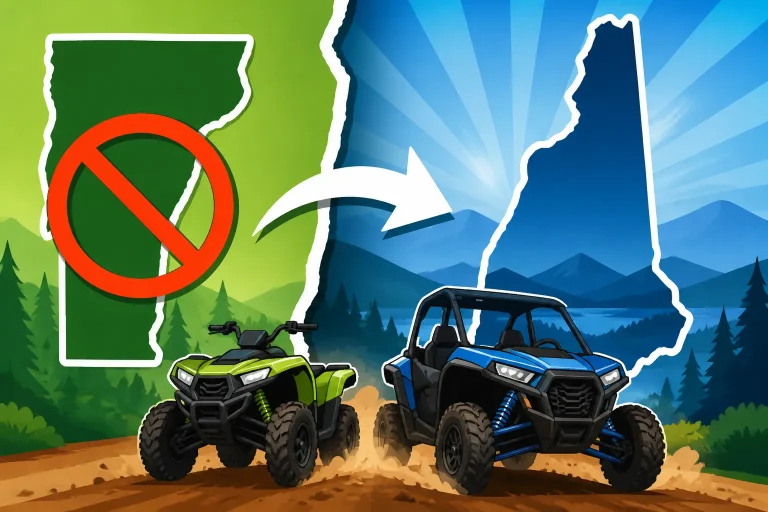
The same distinction applies to riders visiting New Hampshire from another state or country. A machine’s home-state registration does not, by itself, grant permission to ride private land. Nor does the landowner’s permission necessarily satisfy any registration requirement that applies to the route. Check both issues separately: whether you may use the property and whether your machine is properly registered for the places you plan to ride. Riding New Hampshire With an Out-of-State Machine
Use this comparison as a quick reminder:
| Where you plan to ride | What permission covers | What still needs checking |
|---|---|---|
| Someone else’s private parcel | The owner’s consent for the activity and area specified | Boundaries, conditions, machine rules, and any registration requirements |
| A marked club trail across private land | Access allowed under the trail arrangement and current trail rules | Whether the trail is open, whether your machine fits its limits, and whether riding off-route is prohibited |
| A public road or trail connector | Private-land permission does not control public access | Whether OHRV use is permitted on that route and what rules apply |
| A route crossing multiple properties | Each owner’s permission applies only to their land | Whether every parcel and connector is covered |
| Land you own or control | Your authority over your own property may differ from permission on another person’s land | Whether registration or other rules apply to the route and activity |
A trail route that leaves private land and joins a public trail can trigger separate requirements. Likewise, a rider who has permission to use a private driveway as an access point should not assume that the permission covers the public road beyond it. Plan the whole route, not just the place where the machine will be unloaded.
Carry your registration materials when required and keep permission records accessible. If an officer or land manager asks about your access, you should be able to explain where you are authorized to ride and show the relevant documentation. Showing a Decal and a Certificate
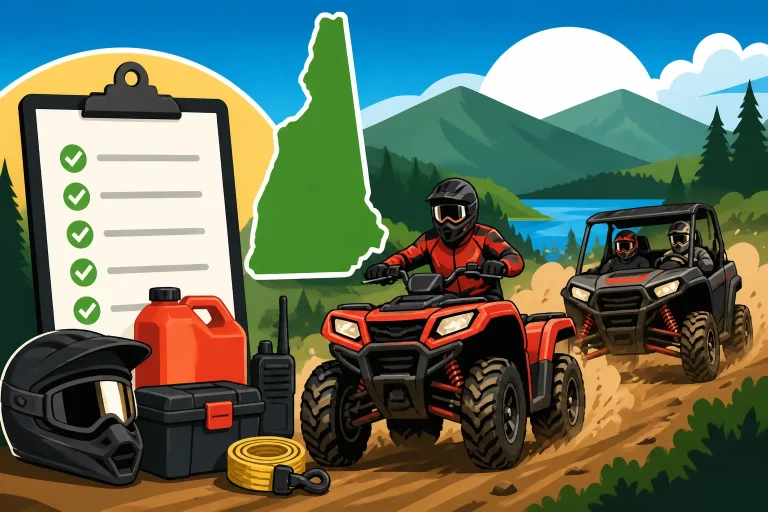
A practical checklist before you ride
A quick check before departure can prevent a small misunderstanding from becoming a trespass complaint, property damage, or a ride that has to turn around. Use this process whenever you plan to ride on private land you do not own.
- Identify every private parcel on the route. Use a current map, ask the landowner, or confirm the route with the club or land manager. Do not rely only on a GPS line or a friend’s description.
- Contact the person with authority to approve access. If the person you speak with is not the owner, confirm that they are authorized to grant permission.
- Describe the actual plan. Give the dates, number of riders, machine types, entry point, route, and purpose. Mention any proposed parking or trailer staging.
- Get the approval in writing. Save a message, letter, or other written record that clearly reflects what was approved. Include any map or route description the agreement relies on.
- Ask about conditions. Confirm hours, speed limits, gates, quiet areas, seasonal restrictions, work activity, and whether guests or passengers are covered.
- Check the rest of the route. Confirm trail status, public-road access, club requirements, and registration obligations separately.
- Bring the permission and follow it. Keep the record available, stay within the approved area, and stop if you reach a boundary or a restriction you do not understand.
- Leave the property as agreed. Close gates as directed, avoid damage, pack out rubbish, and report any problem promptly.
A request can be brief. For example: “May these named riders use the marked trail across your parcel on Saturday? We plan to use ATVs, enter at the gate on the north side, and stay on the route shown on the attached map. Please let us know whether guests, parking, or any additional restrictions are involved.” That gives the owner enough context to approve, refuse, or narrow the request.
If the owner says no or does not respond, choose another route. Silence is not permission. If the owner gives permission with restrictions, decide whether you can follow them before you set out. Don’t accept broad conditions and then assume they will not matter on the day.
Good access also depends on how riders behave once they have permission. Keep the group within the agreed size, avoid unnecessary noise, respect work activity, and don’t invite other riders without asking. If you see damage, a hazard, or an issue that could affect the owner’s property, tell the owner promptly. A well-handled visit can support future access; a rider who ignores conditions can make access harder for everyone.
For a more focused explanation of the written-consent rule, see New Hampshire Written Permission Requirements. If your route includes club or public trails, check their current status and rules before leaving, rather than assuming a private-land agreement settles access for the whole ride.
Frequently Asked Questions
Is verbal permission enough to ride on someone else’s land?
Get written permission before riding. A written record helps show what the owner approved and makes it easier to confirm the riders, route, dates, and conditions. A verbal conversation may leave those details uncertain.
Does an open gate mean I can ride through?
No. An open gate, visible tracks, or an unposted boundary does not establish permission. Ask the owner or an authorized representative and get approval in writing.
If a club trail crosses private land, can I ride anywhere on that property?
No. Access to a marked trail does not automatically authorize riding elsewhere on the parcel. Follow the route and any conditions set by the trail organization or landowner.
Does private-land permission cover a public trail or road?
No. The landowner’s permission applies only to the property and activity they approved. Check access and registration requirements separately for any public road, trail, or connector.
Disclaimer
This article is for general informational purposes only and does not constitute professional advice. Laws, prices and regulations vary by location and change over time. Consult a qualified professional for guidance on your specific situation.