Why No Vermont Registration Works in New Hampshire
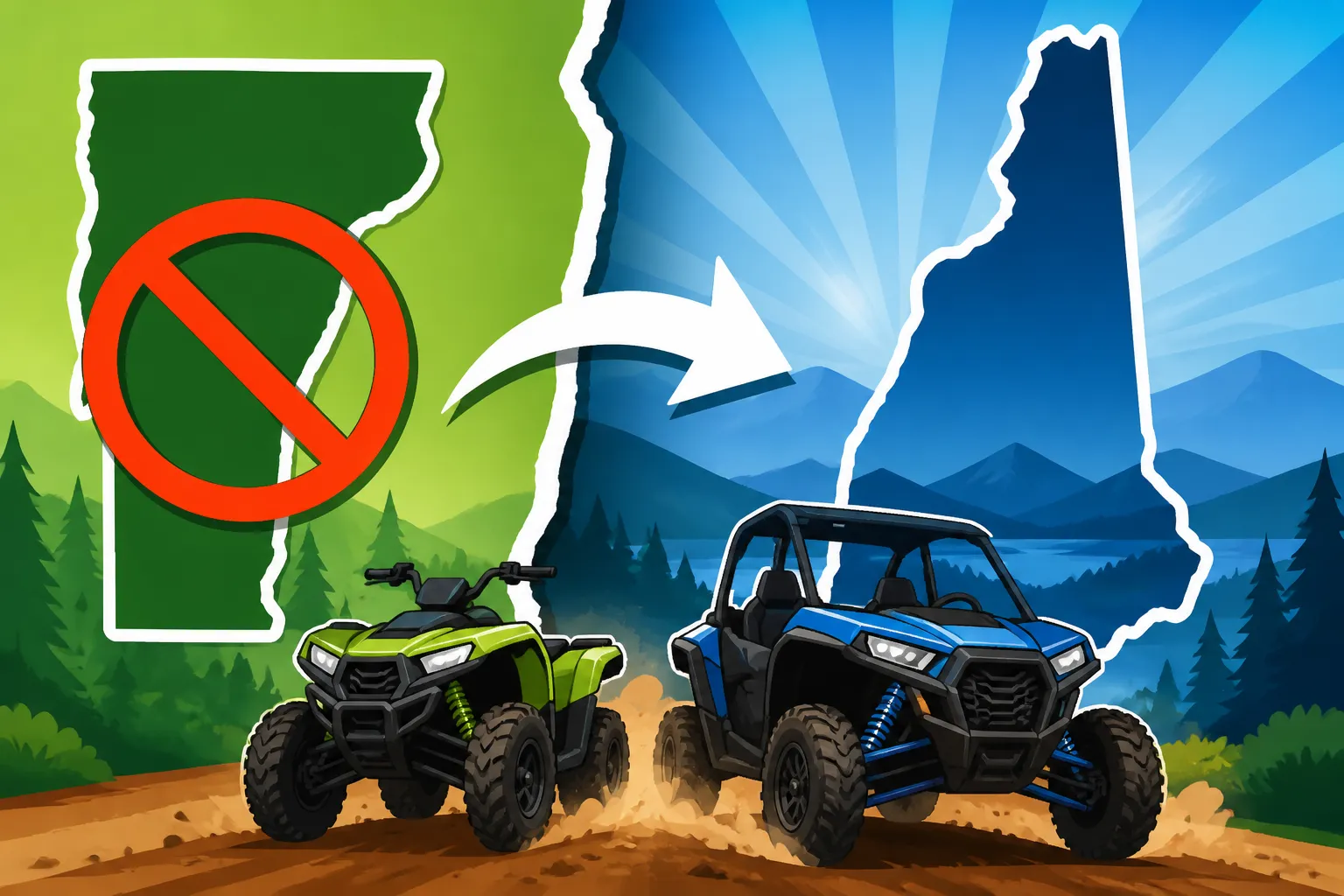
A current Vermont registration may keep your ATV or UTV legal at home, but it does not automatically authorize you to ride New Hampshire trails. The two states manage their own registration systems, and New Hampshire generally requires its own registration for an out-of-state machine operated where registration applies. Here’s what that means for a Vermont visitor, what to arrange before unloading, and how to avoid confusing registration with trail access.
Why a Vermont Registration Does Not Carry Over
An ATV or UTV registration is issued under the rules of the state that provides it. A Vermont registration does not become a New Hampshire registration just because the machine crosses the state line. New Hampshire does not generally treat a neighboring state’s registration as a substitute for its own when an OHRV is being operated in New Hampshire.
That distinction catches riders who are used to traveling between states in a car. A road-registered vehicle may be able to travel across state lines under its home-state registration, but off-highway vehicle rules are different. Each state sets the conditions for using its trails and land. New Hampshire’s registration system applies to both residents and nonresidents when they ride in places where New Hampshire registration is required.
The practical rule is simple: if you plan to ride a Vermont-registered ATV or UTV on New Hampshire trails, do not assume the Vermont sticker is enough. Check the New Hampshire requirements and arrange the correct New Hampshire registration before you ride. For the broader visitor rules, see Riding New Hampshire With an Out-of-State Machine and Does New Hampshire Honor a Vermont Registration?.
The registration is tied to the state where you ride
New Hampshire’s OHRV registration is not merely a record that your machine exists. It is part of the state’s system for authorizing OHRV use and supporting the trail network. A Vermont decal demonstrates that the machine has been registered in Vermont, not that it has met New Hampshire’s requirements.
This remains true even if:
- Your Vermont registration is current.
- You bought the machine in Vermont.
- You live in Vermont and are visiting New Hampshire for only a day.
- You have ridden the same machine legally in Vermont.
- You are traveling with a group whose other machines are registered in New Hampshire.
The visitor’s length of stay can affect which New Hampshire registration option makes sense, but it does not turn a Vermont registration into a New Hampshire one. If you are only visiting briefly, look into the short-term option for eligible wheeled vehicles. If you expect to return or ride for a longer period, compare that option with an annual registration. Start with [New Hampshire Rules for a Visiting Rider] and The Ten-Day Option for a New Hampshire Visitor.
Carrying the Vermont paperwork is still useful
The fact that Vermont registration does not replace New Hampshire registration does not mean you should leave your Vermont paperwork at home. It can help establish the machine’s identity, registration history or ownership when you apply for a New Hampshire registration. Bring it along with any other documents the registration agent asks you to provide.
Think of the two registrations as serving different purposes. The Vermont registration relates to your home state. The New Hampshire registration is the one relevant to riding where New Hampshire requires registration. Keep both sets of paperwork organized if you ride in both states.
When You Need New Hampshire Registration
For most visitors heading to a New Hampshire club trail system, the central question is not whether the machine has a valid sticker somewhere. It is whether the machine has the registration New Hampshire requires for that ride.
New Hampshire registration is generally the requirement to plan around when operating an OHRV on public trails and other places where registration applies. A machine being transported through the state on a trailer is different from a machine being ridden there. The registration issue arises when you operate it, not simply because it is physically in New Hampshire.
There can be specific circumstances involving private property or other limited uses. Do not assume that a machine is exempt simply because you are riding on land that looks private, the trail is not paved, or the owner has given you permission. Permission addresses access to the land; registration rules are a separate question. If your planned riding is not on a designated club trail, confirm the applicable rules for that exact location before you unload.
Registration and land access are separate questions
A New Hampshire registration does not give you permission to ride everywhere. It is not a universal trail pass, and it does not turn closed, private or restricted land into an authorized route. You still need to follow trail signs, closures, landowner restrictions and the rules of the area.
Likewise, a Vermont registration does not establish that you have access to a New Hampshire trail. The route may cross land used through agreements with private owners, and clubs work to keep that access available. Use the trail network only where it is open and authorized. New Hampshire Club Membership and Access explains how club access fits alongside registration, while Why New Hampshire Has No Separate Trail Pass describes why registration should not be confused with an all-purpose trail ticket.
This distinction matters in practice. A rider can have a valid New Hampshire registration and still be on a closed trail. A rider can have permission from a private landowner and still need to check whether registration is required for that use. Treat registration, land permission and trail status as three separate checks.
Road use is another separate rule
A New Hampshire OHRV registration does not automatically make an ATV or UTV legal to operate on every public road. Road use depends on the road’s designation and the rules that apply there. Towns may designate particular roads or sections for OHRV use, and road riding can involve additional requirements.
Before following a route that includes pavement, verify that the specific road is open to OHRVs and that your machine and riding group meet the conditions. Do not rely on a GPS line or a trail map alone if it is unclear whether a segment is a permitted connection. Where New Hampshire Allows OHRVs on Roads and New Hampshire Rules for Crossing a Highway cover the difference between road access and ordinary trail riding.
Choosing an Annual or Short-Term Registration
A Vermont visitor will usually want to compare New Hampshire’s annual registration with its short-term option for eligible wheeled machines. The right choice depends on how often you expect to ride, when you are visiting and whether the short-term registration is available for your machine and circumstances.
New Hampshire’s registration year follows a May-to-April cycle, so the month you buy can affect how much of the registration period remains. A short visit early in a season and several return trips later in the year can make a different option worthwhile than one isolated ride. Check the current details before deciding; registration periods, eligibility and fees are matters to confirm with New Hampshire Fish and Game or an authorized agent.
| Your situation | What to look into | Practical consideration |
|---|---|---|
| One brief visit on an eligible ATV or UTV | New Hampshire’s short-term registration | Confirm eligibility, duration and current availability before relying on it |
| Several visits during the season | Annual New Hampshire registration | Compare the total cost and convenience with separate trip planning |
| A machine used regularly in New Hampshire | Annual New Hampshire registration | A Vermont registration does not replace the New Hampshire requirement |
| A group with machines registered in different states | New Hampshire registration for each machine as required | Check each machine separately rather than assuming the group is covered together |
| A ride on land that may be exempt or restricted | The rules for that specific property and activity | Landowner permission and registration are different issues |
The short-term option is not a general visitor waiver. It is a New Hampshire registration option with its own conditions. Confirm that it applies to your particular machine and planned use. If your trip is on a side-by-side, for example, verify that the option covers that vehicle category rather than assuming every machine described casually as an ATV or UTV has identical treatment.
For help comparing the annual and short-term choices, see When a Frequent Visitor Should Buy the Annual and Ten Days or the Whole Season. If the registration year itself is relevant to your planning, New Hampshire’s May to April Registration Year explains the timing.
Club membership may change the calculation
Some riders become members of a participating New Hampshire OHRV club before registering because club membership can affect the registration rate. That is a separate decision from whether New Hampshire registration is required. Joining a club does not make your Vermont registration valid in New Hampshire, and buying a New Hampshire registration does not automatically make you a club member.
If you are considering joining, check which clubs qualify for the applicable registration benefit, when proof of membership is needed and whether the dues make sense for your plans. A club membership can also support trail work and may help you understand local conditions, but it does not guarantee that every trail is open or that every club trail permits every type or width of machine.
See Which Clubs Count for the Discounted Registration Rate and Proof of Membership at the Counter before applying. Confirm current requirements with the club or registration agent rather than relying on an old receipt, a friend’s experience or a membership from a different organization.
Getting the New Hampshire Registration Before You Ride
The easiest approach is to handle registration before you reach the trailhead. Look up a current New Hampshire registration agent and ask what documents are needed for a Vermont-registered machine. Registration agents can explain the application process and whether they can complete the transaction for your vehicle type.
You may be asked for information that identifies the machine, such as its make, model and vehicle identification number, along with proof of ownership or prior registration. The exact documents can depend on how you acquired the machine and its history. A current Vermont registration document may be useful, but do not assume it replaces every document New Hampshire requires.
A sensible preparation process is:
- Identify the machine. Record the make, model, year and vehicle identification number. Check that the number on the machine matches your paperwork.
- Gather ownership and registration documents. Bring the Vermont registration and other ownership documents you have. Ask the agent what is acceptable for your particular situation.
- Choose the registration type. Compare the annual option with any eligible short-term option based on your dates and plans.
- Check whether club membership matters to you. If you expect to use a club-related registration benefit, verify the club’s eligibility and the proof required before you go to the agent.
- Complete the New Hampshire application. Follow the agent’s instructions and review the certificate and decal details before leaving.
- Install and carry what you are issued. Follow the current decal-placement instructions and carry the required certificate while riding.
- Check access and trail status separately. Confirm that your route is open and that your machine is allowed on it.
The paperwork details deserve attention, especially if the machine was bought privately, inherited, rebuilt or previously registered under a different owner. If you are unsure what proves ownership, ask before making the trip to the registration agent. New Hampshire OHRV Registration Paperwork and The New Hampshire OHRV Registration Application are useful starting points.
Do not assume a title is the key document
Some visitors expect every off-road machine to have a title in the same way a road vehicle may. New Hampshire’s OHRV system does not work exactly like ordinary road-vehicle title registration. The documents required for an OHRV registration depend on the circumstances, so check what the agent needs rather than holding up the process while searching for a document that may not be required.
If you have only a Vermont registration and no bill of sale, or the machine’s paperwork has a different owner’s name, contact an agent in advance. A clean paper trail is easier to resolve before the ride than at the counter on the morning your group plans to leave. For a machine purchased across the state line, Registering an Out-of-State Machine in New Hampshire may also help you identify the questions to ask.
A waterproof document sleeve can keep a printed certificate from getting soaked or muddy. If you buy one locally or through Amazon, choose a pouch that closes securely and fits the certificate without folding it in a way that makes it hard to read. Amazon is also one place riders look for handlebar map holders, but a digital map or holder does not replace required registration documents or current trail information.
Avoiding Common Visitor Mistakes
The most common mistake is treating a home-state sticker as a regional pass. Vermont registration and New Hampshire registration are issued by different states. A current sticker in one state does not automatically satisfy the other state’s rules.
Other mistakes tend to happen when riders plan the trip around an assumption rather than checking the details:
- Assuming a short visit means registration is unnecessary. A one-day trip is still a trip in New Hampshire. Check whether registration is required for the place and activity.
- Confusing registration with club access. Registration does not mean a trail is open, and a club membership does not replace registration.
- Buying the wrong registration type. Confirm that any short-term option applies to the machine you intend to ride.
- Waiting until the trailhead to sort out documents. An agent may need ownership or machine-identification paperwork you did not bring.
- Treating a mapped road as an approved OHRV route. Verify road designations and crossing rules separately.
- Assuming a trail is open because it was open on a previous visit. Seasonal conditions, maintenance and landowner decisions can change access.
- Relying on another rider’s registration. Registration is tied to the machine and its records; one properly registered machine does not cover the rest of the group.
A pre-ride checklist can help:
- Confirm the machine has the required New Hampshire registration for the planned use.
- Carry the certificate as required and make sure the decals are in place as instructed.
- Verify that your chosen route is open to your machine.
- Check any width limits or vehicle restrictions for the trails you plan to use.
- Confirm that road segments, crossings and staging areas are permitted.
- Bring the safety equipment and documents required for the riders in your group.
- Save contact information for the registration agent or relevant state office in case a paperwork question comes up.
A small handlebar map holder or waterproof phone pouch can be useful on the trail, and riders sometimes look for those accessories on Amazon. Treat them as convenience items, not as a substitute for a reliable map, a charged device or a paper copy of important information. If you order an accessory from Amazon, check that it fits your machine and does not interfere with controls, visibility or safe operation.
Most importantly, keep the registration decision separate from the route decision. First make sure the machine has the required New Hampshire registration. Then confirm that the particular trail, road connection or property is open and authorized. That two-part check is much more reliable than assuming a Vermont sticker or a New Hampshire decal alone answers every question.
Disclaimer
This article is for general informational purposes only and does not constitute professional advice. Laws, prices and regulations vary by location and change over time. Consult a qualified professional for guidance on your specific situation.