Sharing a New Hampshire Trail With Hunters
Sharing a New Hampshire ATV or UTV trail during hunting season takes more than watching for other riders. Hunters may be on foot, hidden by cover, or moving before daylight, while seasonal conditions and access can change quickly. A few checks before you leave, visible clothing, and patient trail manners help reduce risk without assuming every trail is closed.
What to Check Before You Ride
Hunting activity does not automatically mean every nearby OHRV trail is closed. But a trail’s status can depend on who manages the land, what access permission is in place, the season, and local conditions. A route that was open on your last visit may have a temporary closure or restriction now.
Before heading out, check the current information for the specific trail system and the agencies or clubs responsible for it. Look for closure notices, seasonal restrictions, temporary reroutes, and updates about weather or trail damage. Start with New Hampshire Trail Status Before You Ride and New Hampshire Rules for Riding in Hunting Season, then check the latest trail information from the land manager or local club.
Pay attention to these details:
- The route, not just the region. Hunting activity or a closure in one part of a trail network does not tell you what is happening on every connected trail.
- The land manager’s notices. A trail may cross land with different owners or managers, and access conditions can differ along the route.
- Signs at the trailhead and intersections. A current sign can override an older map or a route saved on your phone.
- Your machine’s registration and access requirements. A trail being open does not remove the need to meet New Hampshire’s OHRV requirements. See New Hampshire OHRV Permits Explained if you need to review what registration does and does not cover.
- Your return route. Confirm that the trail you plan to use to get back is open too. A last-minute detour may take you onto a closed segment or private land.
A club map or navigation app is helpful for orientation, but it should not be treated as proof that a trail is open today. Maps can lag behind a closure, and GPS routing may suggest roads or paths that are not legal OHRV routes. Use New Hampshire Trail Maps From a Club alongside current trail notices, not instead of them.
If there is a closure notice, do not ride around a gate or try to find a route through the woods. Closures may protect active hunting, sensitive land, trail work, private property, or other users. For details on the consequences of ignoring a posted closure, see New Hampshire Rules for Riding a Closed Trail.
| Before the ride | What to verify | Why it matters |
|---|---|---|
| Trail access | Current opening, closure, and reroute notices | Status can change by trail segment |
| Land access | Whether the route is authorized for OHRV use | A trail on a map is not automatically open to riders |
| Riding conditions | Mud, fallen trees, washouts, or other hazards | A safe route on paper may be unsafe in current conditions |
| Hunting activity | Seasonal notices and local information | Hunters may be present where you plan to ride |
| Equipment | Registration, lights, communication, and visible clothing | Helps you meet requirements and be seen |
| Return plan | Open route back to your staging area | Reduces the chance of an unplanned, unauthorized detour |
When information conflicts, pause and confirm with the club, land manager, or other official contact responsible for the route. Do not rely on an old social media post or a friend’s memory when a sign at the trailhead says something different.
How to Make Yourself Easier to See
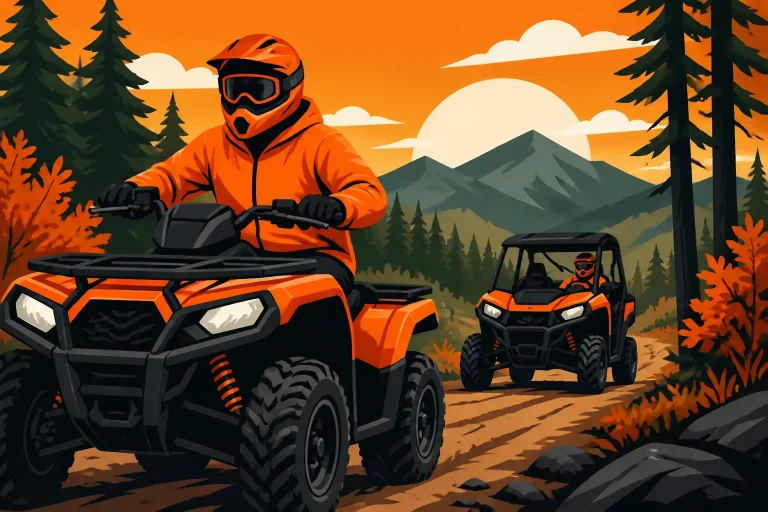
A machine’s headlight helps, but it does not make a rider easy to identify in every setting. Trees, uneven terrain, bends, low light, and clothing that blends into the background can make it hard for a hunter to notice an approaching ATV or UTV. Visibility deserves extra attention during hunting seasons, particularly around dawn and dusk.
Wear a high-visibility outer layer, such as a bright vest or jacket, where it is comfortable and suitable for the conditions. Choose a color that stands out against the forest rather than relying on camouflage, dark clothing, or the machine’s color. A vest can be stowed when it is not useful, but it should be easy to reach before you ride through an area where people may be hunting. If shopping for one, compare reflective or high-visibility options at outdoor retailers, including Amazon, and check that the garment fits securely over your riding layers.
Bright clothing is a visibility measure, not a substitute for following current laws or trail rules. Requirements can depend on the activity and season. Confirm applicable rules through the relevant official sources, and do not assume that a clothing choice alone makes an otherwise unsafe ride acceptable.
Other practical steps help:
- Use required lights and keep them working. Check the headlight and taillight before leaving. Clean mud from lenses, and do not count on a dim or obstructed light to alert people ahead.
- Keep your clothing visible from more than one angle. A bright layer on your back may be hard to see when you turn or stop. Consider visibility from the front and sides as well.
- Avoid unnecessary visual clutter. Loose straps, hanging gear, or a vest that catches on controls can create a hazard. Secure everything before moving.
- Carry a spare layer. Wet or cold weather can make it tempting to cover up with darker gear. A bright outer layer that fits over a warm midlayer gives you another option.
- Make yourself visible before the trail gets dark. Do not wait until visibility has already dropped to put on brighter gear or check your lights.
Riders may see a hunter’s orange clothing and assume the person is visible enough to them. That is not a reason to ride faster. A hunter may be partly concealed, facing away, or focused on an animal rather than the trail. Likewise, a rider’s bright clothing does not guarantee a hunter can see the machine through trees or terrain.
For further seasonal context, Blaze Orange in a New Hampshire November discusses why visibility matters during autumn outings. The useful principle is simple: make your group conspicuous, then ride as though someone could still be just out of sight.
Riding Considerately When Hunters Are Nearby
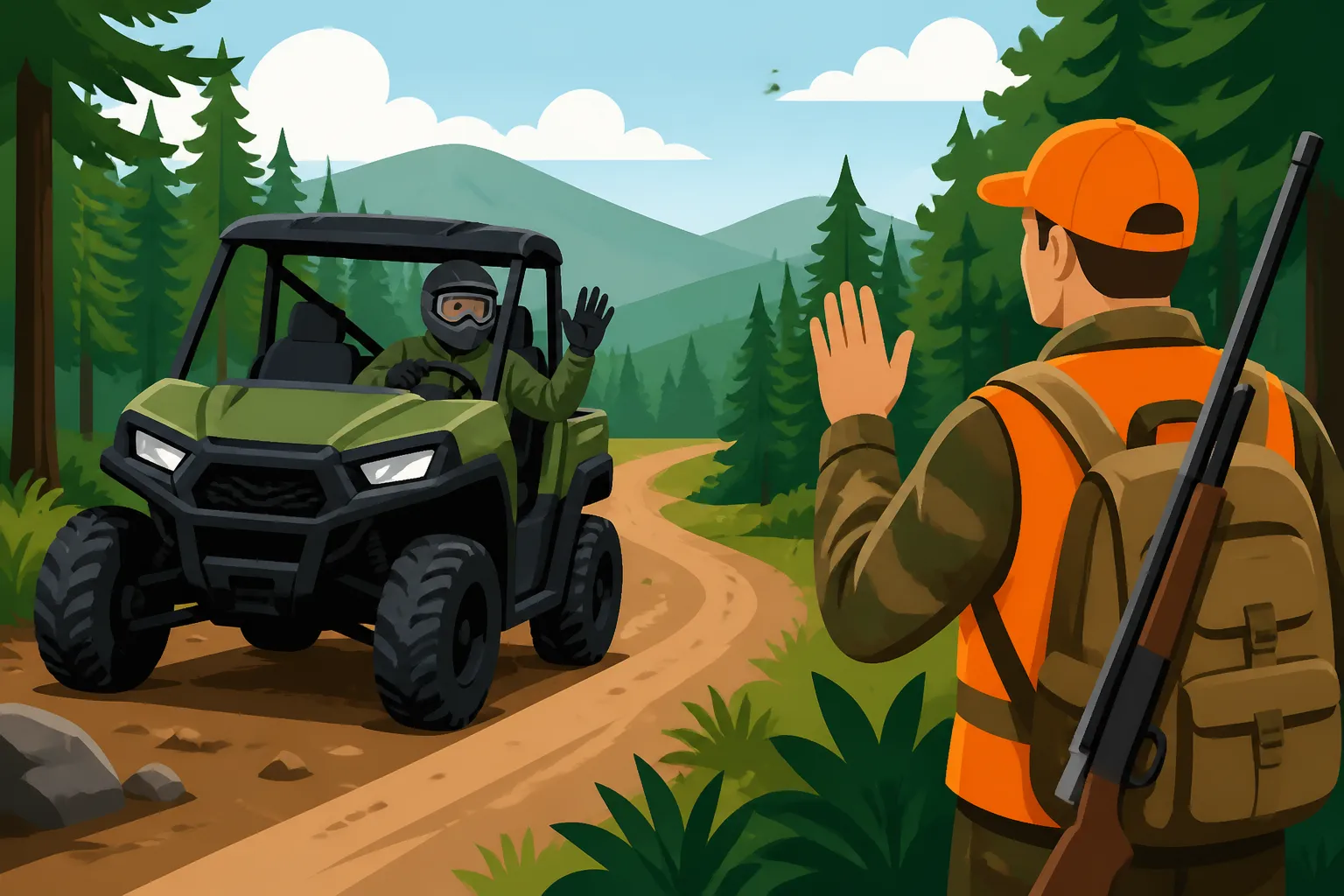
When you see a person on foot, slow down early and give them room. Do not assume the person has noticed your machine, even if the engine is audible. A hunter may be watching a slope, moving quietly, or standing behind brush just off the trail.
If the trail is narrow, stop in a safe place with enough room for the machine and any passengers. Keep a respectful distance instead of riding close to the person or trying to pass while they are stepping onto the trail. If the hunter signals that they need the route clear, wait for a safe opportunity to continue. A brief, calm greeting is often enough; there is no need to approach or start a conversation while someone is hunting.
Use extra care at places where sightlines are poor:
- blind corners and tight bends
- trail junctions and entrances
- narrow bridges and culverts
- openings between dense trees
- road crossings and areas with parked vehicles
- spots where a footpath meets the OHRV route
Slow before entering these areas, not after someone appears. Riding at a pace that lets you stop within the distance you can see is a useful rule on any trail, and especially where other users may be hard to spot. If you meet a group of riders, keep the group together and leave enough space for each machine to stop without bunching up.
Noise is another reason to be thoughtful. Do not rev the engine, use a horn repeatedly, or make unnecessary noise to draw someone’s attention. A controlled reduction in speed and a clear pause in a safe location are usually more useful than startling a person at close range. Keep exhaust and sound equipment within applicable requirements and avoid modifying a machine in ways that create extra noise.
If you hear a shot, do not assume it was fired at an animal, that it came from a particular direction, or that the area is safe to continue through. Stop where you can do so safely, keep the group together, and assess the situation. If the trail is unclear or you cannot tell whether people are close by, turn back only if you can do so without entering a closed route or creating another hazard. When in doubt, contact the trail manager or authorities for guidance rather than riding toward the sound.
Hunters may have dogs or other equipment with them. Treat any animal near the trail cautiously, slow down, and give the handler time to manage it. Do not try to pass close by or coax an animal toward the machine. A dog startled by an engine can move unpredictably, and a handler may need space to keep it under control.
The same consideration applies when your group is stopped. Park well off the traveled portion of the trail only where stopping is permitted and safe. Do not block an entrance, bridge, gate, or access point. Keep voices and music low, and do not leave litter or disturb hunting gear. If a person is using the area, give them room to continue without pressure.
What to Do When You Meet a Hunter
A calm, predictable response is usually safer than a quick maneuver. If a hunter is on or beside the trail, reduce speed gradually and stop where you have a clear view and stable footing. Avoid sudden swerves into brush, a side path, or ground that may be private or closed. Let the other person understand what you are doing before you move again.
Use this approach:
- Slow down as soon as you notice the person. Keep control of the machine and leave room to stop.
- Stop before the narrowest point if possible. Choose a visible, stable spot that does not block a junction, bridge, or gate.
- Keep passengers on the machine. Do not send someone walking ahead to investigate.
- Wait for a clear path. If the hunter needs to cross or move equipment, give them time and space.
- Proceed slowly once the route is clear. Continue only when you can see enough of the trail to ride safely.
If you find a person or animal in distress, do not assume you can safely move them or their equipment. Stop at a safe distance, call for emergency help if needed, and give responders the clearest location information you can. On remote trails, a junction name, trail marker, map coordinate, or nearby landmark may be more useful than a general description. Cell service can be unreliable, so let someone know your route and expected return time before setting out.
Do not touch a firearm, ammunition, hunting equipment, or an animal carcass. Keep passengers away from them too. If you encounter a firearm that appears unattended or a situation that seems unsafe, create distance and contact the appropriate authorities. Do not try to handle or secure the firearm yourself.
An encounter can also happen at a trailhead. A parked truck or trailer may belong to hunters, riders, or other visitors; it is not a reliable way to tell whether a trail is open or who has permission to be there. Park only in designated or otherwise permitted areas, avoid blocking vehicles, and check posted notices before unloading.
If the trail is blocked or a hunter asks you to stop
A hunter’s presence alone does not tell you the legal status of the trail, and a rider should not argue about access in the middle of a remote route. If someone asks you to stop, stop at a safe distance and keep the exchange calm. Ask whether there is a posted closure or a current notice you can verify. Do not drive past a gate, sign, or person who is directing traffic around an active hazard.
If the person claims the trail is closed and you cannot confirm otherwise, the safest immediate choice is to avoid escalating the encounter. Move only when it is safe and lawful, then contact the trail manager or relevant authority to clarify the status. That approach protects the relationship between riders, hunters, landowners, and clubs, which can matter to continued access.
If you believe someone is threatening you or another person, leave the area only if doing so can be done safely. Contact emergency services when there is an immediate danger. Do not try to settle a confrontation by shouting, riding closer, or filming from a position that increases the risk.
Planning Around Hunting Season and Changing Conditions
The safest plan is not necessarily to avoid every ride during hunting season. It is to choose a route and time with current information, then leave room to change plans. Hunting periods vary by species and method, and activity can differ from one location to another. Check the current hunting rules and any trail notices before traveling rather than relying on a remembered date or a general description of the season.
Consider choosing a route with clear access information and a straightforward return option. If the trail system has multiple branches, decide in advance which junctions you will use and where you will turn back if the route is crowded or unclear. A simple route is easier to communicate to passengers and to someone at home, and it reduces the likelihood of wandering onto an unauthorized side road.
Plan around visibility and daylight. Early and late hours can bring reduced light and more people moving quietly through the woods. If you ride at those times, make sure your lights work, wear visible outer clothing, and keep your speed conservative. Do not stretch a ride into darkness just to finish a loop if the trail is unfamiliar or your lights are not adequate.
Weather and seasonal conditions can change the practical safety of a route even when it remains open. Wet leaves, mud, washouts, and low visibility can make stopping distances longer and make it harder to see people ahead. Check New Hampshire Trail Conditions Before You Ride before leaving, and be willing to shorten the outing if conditions are worse than expected.
Be especially careful if the route crosses state-owned land, leased land, or private property. Different sections may have different rules or permission arrangements. A public trail system can include land that is not open for unrestricted travel, and an open trail is not permission to ride off it. Review New Hampshire Rules for Riding State Land and New Hampshire Rules for Riding Private Land if you are unsure what applies to a route.
A practical pre-ride plan includes:
- the name of the trail system and where you will stage
- the route you intend to take and a reasonable turnaround point
- current trail status and the source of that information
- working lights and a phone or other communication method
- a visible outer layer and suitable weather gear
- a person at home who knows when you expect to return
If you ride with a group, agree on how the leader will signal a stop and what everyone should do if the group separates. Keep enough space between machines for dust, mud, and safe stopping, but not so much that the group loses sight of each other at every bend. If someone has to stop, make sure the whole group knows before the last rider continues.
Respecting hunting access is also part of protecting OHRV access. Many trails rely on continued cooperation among landowners, clubs, hunters, and riders. Staying on marked routes, following closures, and avoiding confrontations helps keep that cooperation practical. If you notice a confusing sign or a trail condition that could create a conflict, report it to the responsible club or land manager rather than removing a sign or making your own route around it.
Frequently Asked Questions
Does hunting season close every New Hampshire ATV trail?
No. Hunting season by itself does not establish that every trail is closed. Trail access depends on the specific route, land manager, current restrictions, and posted notices. Check the status for the trail you plan to ride before leaving.
Should ATV and UTV riders wear blaze orange?
High-visibility clothing can help other people notice you, but do not assume it replaces any applicable legal or trail requirement. Check current official rules for the activity and season, and wear visible gear as a practical precaution.
What should I do if I meet a hunter on a trail?
Slow down early, stop in a safe place if needed, and give the person room to move. Continue only when the route is clear and you can see far enough to ride safely. Do not touch firearms or hunting equipment.
Can I ride around a gate or closure to avoid hunters?
No. Do not bypass a gate or closure. It may protect private property, active work, safety, or a seasonal restriction. Check with the responsible club or land manager if the notice is unclear.
Disclaimer
This article is for general informational purposes only and does not constitute professional advice. Laws, prices and regulations vary by location and change over time. Consult a qualified professional for guidance on your specific situation.