What New Hampshire Requires to Cross a Road
Navigating New Hampshire's vast network of trails and roads with your ATV or UTV can sometimes feel like trying to solve a puzzle with missing pieces. One of the biggest head-scratchers for many riders is figuring out exactly what's required when you need to cross a public road, or even ride on a designated street to connect trails. It's not always intuitive, and the rules are there for everyone's safety, preventing conflicts between OHRVs and conventional vehicles. This guide aims to clear up that confusion, detailing every requirement you need to know to safely and legally cross or ride on New Hampshire's roads.
The Fundamental Rule: Roads and OHRVs Are Usually Separate
It's a common misconception that if you see an OHRV on a road, all roads are fair game. In New Hampshire, the opposite is true. Unless explicitly designated, all public roads are considered off-limits for OHRV use. This default rule is the foundation of OHRV operation in the state, and understanding it is crucial before you even think about putting a tire on pavement.
Why Most New Hampshire Roads Are Closed by Default
Picture this: you're cruising down a beautiful, winding New Hampshire trail, the sun dappling through the trees, and suddenly you hit a paved road. Your first thought might be, "Can I just zip across?" or "Is this stretch of road part of the trail system?" The answer, more often than not, is no. New Hampshire's default stance is that its public roads, whether state highways or local town streets, are primarily for conventional motor vehicles. This isn't just about tradition; it's deeply rooted in safety and traffic management.
Imagine the chaos if OHRVs could just merge onto any road at any time. Different speeds, different handling characteristics, and different expectations for drivers would lead to countless accidents. OHRVs, by their nature, are designed for off-road terrain, not high-speed pavement travel. Their tires, suspension, and braking systems behave differently than those of a car or truck, making them less predictable in traffic. Plus, many OHRVs lack the full suite of safety features (like airbags or crush zones) that conventional vehicles have. The law is designed to minimize these risks, protecting both OHRV operators and the general public. It's about maintaining order, reducing the potential for collisions, and ensuring that everyone on the road knows what to expect. This is why you'll find strict rules governing [New Hampshire Rules for Riding a Town Street] and other thoroughfares.
The Importance of Town Designation for Road Use
So, if roads are closed by default, how do riders connect trails or access services in trail towns? This is where the concept of "town designation" comes in. New Hampshire law allows individual towns to open their roads to OHRVs, but it's not a casual decision. It requires a formal process by the town's selectboard, which typically involves public hearings, community input, and careful consideration of safety, noise, and traffic impacts. Once a road is "designated" for OHRV use, it essentially becomes a legal connector or access route.
However, even when a road is designated, it's not a free-for-all. These opened roads come with specific conditions and often have reduced speed limits, designated riding hours, and clear signage. You can't just assume that because one town has opened its main street, the next town over has done the same. Each town has the autonomy to decide which of its roads, if any, will be open to OHRVs. This localized control means that riders must always be vigilant, looking for official signs indicating OHRV access and understanding the specific rules for that particular stretch of pavement. It's a patchwork system, designed to balance the needs of OHRV enthusiasts with the concerns of local residents. Always remember to check local ordinances or trail maps before venturing onto any paved surface. Knowing [How a New Hampshire Town Opens Its Roads] is vital for any rider.
Navigating Designated OHRV Roads and Crossings
Once you understand that some roads can be legally used or crossed, the next step is to know how to do it properly. This isn't just about following the law; it's about staying safe and being a responsible rider. There are specific protocols for riding on designated roads and even stricter requirements for merely crossing undesignated highways.
Specific Rules for Riding on Opened Town Roads
When a New Hampshire town has gone through the process and officially opened certain roads for OHRV use, it's a fantastic convenience for riders, allowing seamless connection between trails, access to gas stations, restaurants, or lodging. However, these privileges come with a very clear set of rules designed to integrate OHRVs safely into the existing traffic flow. One of the most important rules is to always keep to the "extreme right" of the travel lane. This isn't just a polite suggestion; it's a legal requirement. It ensures that conventional vehicles have ample space to pass safely and helps prevent head-on conflicts. Imagine a pickup truck coming around a bend – if you're too far to the left, you could create a dangerous situation. You also need to yield the right-of-way to all conventional vehicles, without exception. This means if a car is approaching an intersection or making a turn, they have priority.
Speed limits are also typically much lower on designated OHRV roads than for regular traffic. Often, you'll see limits like 25 mph or even 10 mph in congested areas or near trailheads. These reduced speeds are crucial for safety, allowing both OHRV operators and other drivers more time to react. In towns like Gorham, for instance, you'll encounter specific limits as you ride through, which are clearly posted. Failing to adhere to these speed limits is not only illegal but also puts everyone at risk. Additionally, some towns might have specific hours during which OHRVs are allowed on their streets, so it's essential to be aware of those restrictions. Always look for signage and ride defensively, anticipating the movements of other vehicles. For detailed guidance, check out [Why New Hampshire Riders Keep to the Extreme Right].
Essential Equipment for Street-Legal Compliance
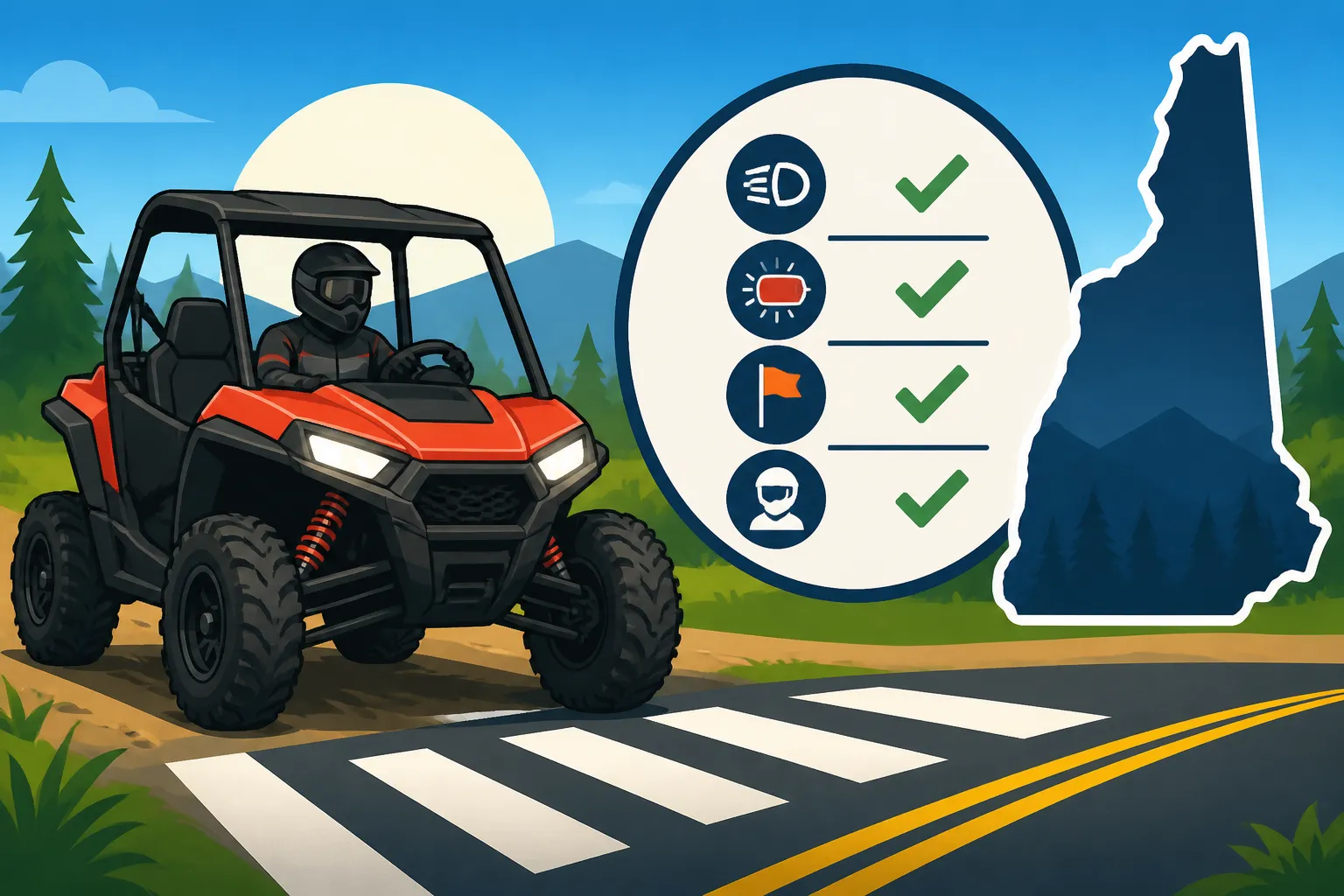
Riding on a designated road or crossing a highway means your OHRV needs to meet certain equipment standards that might not be strictly necessary for trail-only riding. These requirements are put in place to ensure your visibility and safety on shared roadways. First and foremost, you must have a functional headlight and taillight, and these must be on when riding on roads, especially during dawn, dusk, or at night. Visibility is key, and you want to make sure other drivers can see you coming and going.
Another critical piece of equipment is a rear-view mirror. While you might not need one on the trails, it's absolutely essential for road use, allowing you to monitor traffic behind you and make safe decisions. Aftermarket mirrors from brands like SuperATV are popular choices, offering robust construction suitable for OHRV vibrations while providing clear visibility. Beyond lighting and mirrors, your OHRV must also be equipped with an approved spark arrester on its exhaust system to prevent wildfires, and it must meet New Hampshire's sound limit, typically 96 decibels. Many aftermarket exhaust systems, while offering performance benefits, can exceed this limit if not specifically designed for compliance. If you're upgrading, ensuring your components, like an exhaust system or a sturdy set of mirrors from SuperATV, meet these specifications is crucial for legal and responsible road use. Don't forget, if you're under 18, a helmet is always required, and eye protection is mandatory for everyone unless your machine has an approved windshield. You can find more details in [New Hampshire Equipment Rules for Road Riding].
Safe Practices for Crossing Undesignated Highways
Perhaps the most common scenario for many OHRV riders is needing to cross a paved road that has not been designated for OHRV riding, simply to get from one section of a trail to another. This is where extra caution and strict adherence to the rules are paramount. The law is very clear on this: you must come to a full and complete stop before entering any paved public highway. This isn't a "California roll" stop; it's a complete cessation of movement, giving you time to observe traffic.
Once stopped, you must yield the right-of-way to all vehicular traffic on the highway. This means waiting until the road is completely clear in both directions, or until you are absolutely certain you can cross without impeding or endangering any other vehicle. When it's safe to proceed, you must cross the highway at as close to a ninety-degree angle as possible. This minimizes the time your OHRV is exposed to traffic and makes you more predictable to drivers. Accelerate smoothly and directly across, without weaving or hesitation. Never attempt to ride down the road, even for a short distance, unless it is specifically designated. The intent of the crossing rule is purely for transit, not travel. Always use your turn signals if equipped, or clear hand signals if not, to indicate your intentions. Remember, safety always comes first, and a moment of impatience can have severe consequences. This is covered in depth in [New Hampshire Rules for Crossing a Highway].
Understanding Rider Qualifications for Road Use
It's not just about the machine; it's also about the operator. New Hampshire has specific requirements for who can ride an OHRV, especially when it comes to shared public spaces like roads and crossings. These rules are designed to ensure riders have the necessary knowledge and maturity to operate safely.
Age Requirements and Supervision for Minors
New Hampshire has a tiered system for OHRV operator age and supervision, particularly strict when it comes to road use or crossings. Generally, no one under the age of 12 is allowed to operate an OHRV on public land or trails, period. This includes any road crossings. For young riders aged 12 and 13, they can operate an OHRV on public land if they possess a valid OHRV Safety Certificate and are directly supervised by an adult who is at least 25 years old and holds a valid driver's license. This supervisor must be within reasonable sight and hearing distance, ensuring they can intervene if needed.
When it comes to riders aged 14 and 15, the requirements ease slightly. They can operate an OHRV on public trails if they hold a valid OHRV Safety Certificate. However, they are still not allowed to operate an OHRV on a public road or street that has been designated for OHRV use unless they are accompanied by a licensed adult who is at least 25 years old, as per the rules for 12 and 13-year-olds. Essentially, the state wants to ensure that younger riders have experienced guidance when interacting with conventional traffic. Riders 16 and older who hold a valid driver's license generally have more freedom, but the safety certificate requirement often still applies unless specifically exempted by having a driver's license. This system helps protect our younger riders and other road users. It's a lot to keep track of, but it's essential. For a full breakdown, see [New Hampshire's Age and Supervision Rules] and [New Hampshire Helmet Rules for Riders Under 18].
Safety Certificates Versus Driver's Licenses
This is where a lot of riders, especially those new to New Hampshire, get tripped up. The state has a clear stance on OHRV safety education: most operators need to demonstrate proficiency. The primary way to do this is by obtaining a New Hampshire OHRV Safety Certificate. This certificate is earned by completing an approved safety course, which covers everything from safe operating practices to environmental responsibility and, of course, the rules of the road. It's a comprehensive program designed to ensure riders understand their responsibilities.
However, there's a significant exception: if you possess a valid motor vehicle driver's license, that often fulfills the safety certificate requirement for OHRV operation. The logic here is that a licensed driver has already demonstrated a baseline understanding of traffic laws, signs, and safe vehicle operation. This exemption is particularly relevant when it comes to road crossings and designated OHRV roads, as a driver's license indicates familiarity with the environment you're entering. It's crucial to understand that while a driver's license may substitute for the safety certificate, it doesn't exempt you from any other OHRV-specific laws, such as registration, equipment requirements, or town-specific rules. Furthermore, if your driver's license is suspended or revoked, it cannot be used to fulfill the safety certificate requirement for OHRV operation. Always carry proof of your safety certificate or driver's license with you when riding.
Local Variations and Key Considerations
New Hampshire's OHRV laws, particularly those concerning roads, often have a hyper-local flavor. While the state sets the overarching framework, individual towns have significant authority to tailor rules to their specific communities. This means what's permissible in one town might be strictly forbidden just a few miles down the trail.
Exploring Town-Specific Ordinances and Limits
The beauty of New Hampshire's OHRV network is often its ability to link towns, allowing riders to access services directly from the trails. However, this accessibility hinges entirely on local town ordinances. Take Gorham, for example, a pioneering "trail town" in the Ride the Wilds system. Gorham has designated several of its streets for OHRV use, allowing riders to seamlessly connect to the trail system, grab a meal, or refuel. But even in Gorham, there are specific rules: reduced speed limits apply, and certain routes are designated over others. You can't just ride anywhere.
Compare this to Berlin, another key trail town. While Berlin also embraces OHRVs, it might have different hours of operation for its designated streets or specific routes that machines can take. Some towns might only allow OHRV access for short connector stretches, while others might open more extensive routes. It's not uncommon for a town to have a strict closing time for OHRV street riding, like Berlin's ten o'clock closing, which you'd need to be aware of if you're planning an evening ride. The critical takeaway here is that you absolutely cannot assume consistency from one town to the next. Before riding on or even across roads in any unfamiliar town, it's your responsibility to check their specific ordinances, which are usually available on the town's website or posted at local trailheads. Relying on a general understanding could lead to fines or, worse, dangerous situations. Riding [Main Street in Gorham] is a prime example of where local rules come into play.
Common Mistakes and How to Avoid Them
Even experienced riders can sometimes make mistakes when it comes to New Hampshire's road rules. One of the most frequent errors is assuming that a home state registration is sufficient for road use or crossing. While your out-of-state registration might be valid for trails in your home state, New Hampshire requires all OHRVs operating on its public lands, including roads and crossings, to be registered in New Hampshire. There are no reciprocity agreements for OHRV registrations with neighboring states like Maine, Vermont, or Massachusetts. So, if you're visiting, you'll need to purchase a New Hampshire OHRV registration. This is why understanding [New Hampshire OHRV Registration Cost] is so important for visitors.
Another common pitfall is the misuse of sidewalks or parking lots. Sidewalks are strictly off-limits for OHRVs, regardless of whether a road is designated or not. Parking lots of private businesses can only be used with explicit permission from the landowner, and even then, only for access to the business, not as a shortcut or thoroughfare. Ignorance of these rules can lead to fines and strained relationships with local communities and landowners. It's also easy to forget about equipment requirements; riders might hit the trails with minimal gear and then find themselves needing to cross a road, only to realize they lack a mirror or proper lighting. Performing a quick equipment check before your ride, perhaps ensuring your turn signal kit or even an auxiliary light bar from SuperATV is working, can prevent an issue. Always remember that OHRV registration money often directly supports the trails you ride, so paying your [New Hampshire OHRV Registration Cost] is also a way to contribute to the sport. By being proactive, checking local rules, ensuring your machine is properly equipped (perhaps with a UTV signal kit from SuperATV for better road visibility), and having the correct registration, you can avoid these common, and often costly, mistakes.
Summary of Key Road Requirements for New Hampshire OHRVs
To help keep all these requirements straight, here's a quick overview of what you need to remember when encountering roads with your OHRV in New Hampshire:
| Requirement Category | Specific Rule | Details |
|---|---|---|
| General Road Access | Roads are closed by default | Only explicitly designated town roads are open to OHRVs. |
| On Designated Roads | Keep to the extreme right | Yield to all conventional vehicles. Maintain posted speed limits (often 25 mph or 10 mph). |
| Road Crossing (Undesignated) | Full stop before crossing | Cross at a ninety-degree angle. Yield to all traffic. Do not ride along the road, even briefly. |
| Equipment | Headlight, Taillight, Rear-view Mirror | Lights must be on when riding on roads. Spark arrester & 96-decibel sound limit required. |
| Helmets & Eye Protection | Required for all riders under 18 | Eye protection is required for all riders unless machine has a windshield. |
| Registration | New Hampshire OHRV Registration required | No reciprocity with other states. Applies to all OHRVs on public roads/trails, including crossings. |
| Rider Qualification | NH OHRV Safety Certificate or valid Driver's License | Required for all operators. Age-specific rules and supervision apply for minors, especially on roads. [Why the Registrant Must Be an Adult] |
| Local Ordinances | Always check town-specific rules | Speed limits, hours of operation, and designated routes vary by town (e.g., Gorham, Berlin). |
| Forbidden Areas | Sidewalks and most parking lots | Never ride on sidewalks. Private parking lots only with explicit permission for direct access. |
Remember, staying informed and riding responsibly ensures the continued enjoyment of New Hampshire's incredible OHRV network for everyone. Always prioritize safety, respect the rules, and be a good ambassador for the sport.
Disclaimer
This article is for general informational purposes only and does not constitute professional advice. Laws, prices and regulations vary by location and change over time. Consult a qualified professional for guidance on your specific situation.