Riding the Ammonoosuc Rail Trail Any Day
A planned ride can fall apart when a trail is closed, a connector is off limits, or your machine does not fit the route. The Ammonoosuc Rail Trail offers a way to explore New Hampshire’s North Country beyond the busiest club-trail corridors, but “any day” should never mean “without checking.” This guide covers access, planning, conditions, and considerate riding.
What “Any Day” Means on the Ammonoosuc Rail Trail
A rail-trail route through the Ammonoosuc Valley
The Ammonoosuc Rail Trail follows a former railroad corridor between the Littleton and Woodsville area, passing through communities including Lisbon and Bath. Its relatively direct route and connection to valley towns make it different from a network of winding woods trails: you’re riding a shared corridor with a clear linear direction, not choosing loops at every junction.
The phrase “any day” points to the trail’s potential for riding beyond the limited opening windows that apply to some seasonal trail systems. It does not guarantee that every segment is open every day, that every type of vehicle is allowed, or that conditions will be suitable. Weather, maintenance, local restrictions, and temporary closures can affect what is usable. Before setting out, check the trail’s current status and the rules for the specific stretch you intend to ride. The Ammonoosuc Valley Rail Trail in New Hampshire
Rail trails are shared spaces, too. Depending on the section and season, you may encounter pedestrians, cyclists, snowmobilers, other OHRV riders, or maintenance activity. A route that looks wide and straightforward on a map can feel quite different when people are moving at varied speeds or visibility is limited. Ride at a pace that leaves room to react, especially near road crossings, trail access points, and settled areas.
Open access is not permission to ride everywhere nearby
A rail trail may connect to roads, club trails, or other paths, but those connections do not automatically inherit the rail trail’s access rules. A tempting turn onto a woods road or private lane can take you outside the designated corridor. Stay on marked, permitted routes, and do not treat a visible tire track as proof that public OHRV access is allowed.
This is especially important when planning a longer outing. A rider may start on the rail trail, reach a junction, and assume the next path continues the same legal route. Instead, confirm that each connector is open to your machine and that you have permission wherever the route crosses private land. New Hampshire’s general rules for rail-trail riding are worth reviewing before departure: New Hampshire Rules for Riding a Rail Trail.
If you are traveling from another part of the state, build the day around the route itself rather than assuming it links seamlessly with every nearby trail system. The trail can make for a satisfying out-and-back ride, but extending it requires checking each transition separately. New Hampshire Trail Status Before You Ride
Plan the Route, Machine, and Starting Point
Check access and conditions before unloading
Start with the section you want to ride, not simply the trail’s name. Confirm where the usable route begins and ends, whether the chosen segment is open, and whether any temporary notices affect access. If you are planning to ride through several towns, verify the status of each segment and any road or trail crossing between them.
A digital mapping app such as onX Offroad can help you review your route, track your position, and spot junctions before you reach them. Treat it as a planning aid rather than official permission: compare what you see in the app with current trail information, posted signs, and local rules. A route line on a screen cannot tell you that a gate has been closed for maintenance or that a connector is not open to your vehicle.
Check practical details as well as access. Ask where you can legally park and unload, whether the trail surface is passable for your machine, and whether the route has changed after rain, flooding, or seasonal work. If an official map or local trail organization posts updates, review those before leaving home; New Hampshire Trail Conditions Before You Ride is a useful reminder to make that check part of the plan.
Confirm your vehicle fits the route
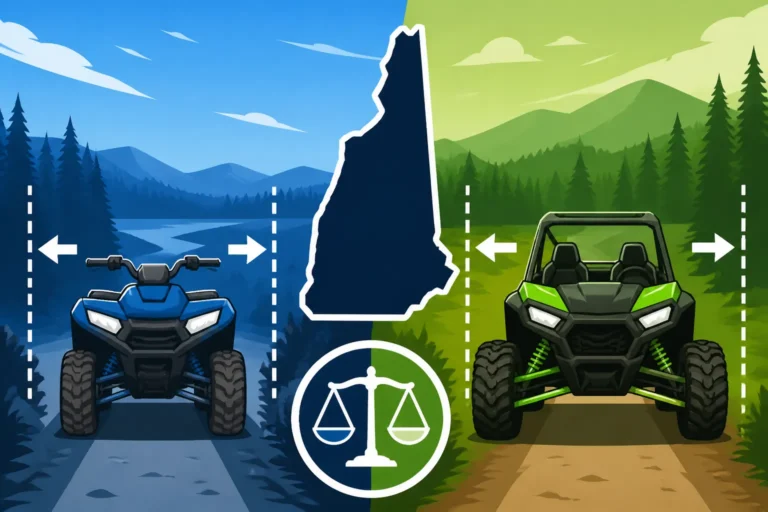
A rail-trail corridor can look generous in photographs, but vehicle width still matters. Do not assume that a wide path means every side-by-side is permitted. Check any width limits that apply to the trail or adjoining segments, and measure your machine as it is equipped, including accessories that add width. A machine that fits in the garage may not fit through a marked restriction or narrow gate.
That check is particularly important for UTV owners. Mirrors, cab accessories, tracks, or aftermarket additions can change the vehicle’s overall dimensions. Compare the actual machine with the stated limit before driving north, rather than discovering a restriction at the trail entrance. For background on how to think about this issue, see New Hampshire Rules for a Machine Over 50 Inches.
Registration and other riding requirements are separate from trail access. A machine may be registered and still be prohibited from a particular path, while an open route does not remove your obligation to carry required documents or follow applicable operating rules. Review New Hampshire OHRV Registration and Insurance before your trip, especially if you are visiting from another state or bringing a borrowed machine.
| Planning question | What to check before you go |
|---|---|
| Is the route open? | Confirm the status of the specific segment and look for temporary closures or notices. |
| Is my machine allowed? | Check vehicle type, width restrictions, and any local access rules. |
| Where can I unload? | Identify legal parking and staging options before hauling a trailer. |
| Can I use the connectors? | Verify that every turnoff or adjoining route is open to your machine. |
| What conditions should I expect? | Look for recent reports about mud, flooding, snow, ice, or maintenance. |
| What do I need to carry? | Check registration, safety, and equipment requirements for your ride. |
Make a realistic out-and-back plan
A simple route is not necessarily a short ride. Estimate your time based on the distance you plan to cover, the pace appropriate for a shared trail, and the stops you expect to make. Add room for road crossings, regrouping, checking a map, and turning around if conditions change. A plan that assumes you can maintain a fast pace from end to end is likely to feel rushed.
If you are riding with others, agree on a turnaround point and a regrouping plan before starting. Keep the group together in a way that allows every rider to navigate safely without crowding other trail users. A slower rider should not feel pressured to speed up to keep pace, and a faster rider should not disappear ahead at junctions.
Save your route information for offline use if you expect weak mobile coverage. onX Offroad can help you keep a digital route visible, but it is sensible to bring a charged phone, a backup battery, and a paper or downloaded map if you rely on navigation. Check the map at major junctions rather than waiting until you are uncertain about which path to take.
Ride Considerately Through Every Season
Share the corridor and approach crossings carefully
Rail trails are not private riding tracks. Reduce speed when approaching people on foot, cyclists, work crews, or anyone who may not hear you coming. Give others room, pass only when there is enough visibility and space, and avoid spraying dust, gravel, or mud at people using the corridor. A quick, calm pass often makes the whole ride more pleasant for everyone.
Road crossings deserve extra attention. Slow down early, watch for signs and sightline limitations, and follow the rules that apply at each crossing. Do not assume a clear view in one direction means the road is safe; traffic can approach quickly from the other side. If you are riding in a group, make sure each rider handles the crossing safely instead of following the machine ahead without looking.
Keep noise and behavior appropriate near homes and town areas. A corridor passes close to places where people live and work, so avoid unnecessary revving, littering, or blocking access points. These small choices help protect the welcome that makes shared trail access possible. For related guidance on riding across municipal boundaries, see [New Hampshire Rules for Riding Across a Town Line].
Conditions change with the season
In spring, thawing ground and heavy rain can leave sections soft or muddy. A trail that appears passable from a distance may have standing water, erosion, or a damaged edge. If conditions are poor, turning around protects the surface and helps avoid getting a machine stuck in a place where recovery would be difficult. Mud is not a reason to leave the established route in search of a firmer line.
Summer can bring dry dust, more mixed-use traffic, and sudden storms. Carry water, keep dust in mind when following other riders, and leave extra stopping room on loose surfaces. In fall, shorter daylight and wet leaves can make visibility and traction less predictable. Plan to finish well before dark unless your machine and the route are suitable for after-dark travel and you have checked the applicable requirements.
Winter riding requires its own checks. Snow or ice can change how the trail is used, and a corridor may have rules or shared-use patterns that differ from warmer months. Do not assume that a route open to one kind of winter use is automatically open to every vehicle. Review New Hampshire Rules for Riding in Winter and current local notices before heading out.
Leave the route as you found it
Stay on the designated surface and respect barriers, signs, and temporary closures. Going around a gate or riding onto a soft shoulder can damage the corridor and create a safety issue for other users. If a section is closed, do not try to bypass it through a field, driveway, or unmarked woods path. Choose another legal route or reschedule.
Pack out everything you bring in, including food wrappers and broken gear. If you stop, park where you are not blocking the trail or an access point. Take care around other users, wildlife, and private property, and keep noise to a reasonable level in populated areas.
A good ride is one that does not leave a problem for the next person. Before you depart, check that your group has all its equipment, that no vehicle is leaking or leaving debris, and that everyone knows the planned route back. If you spot a hazard or a closure notice, share the information through an appropriate local channel rather than trying to solve it by riding around the restriction.
A Simple Pre-Ride Checklist
Before you leave home
Confirm the section you want to ride is currently open and appropriate for your vehicle. Check recent trail conditions, vehicle-width restrictions, registration requirements, and any relevant seasonal rules. Choose legal parking and unloading arrangements in advance, especially if you are hauling a trailer. Parking a Trailer at a Club Staging Lot
Set a turnaround point, estimate the ride time conservatively, and save your navigation information. If you use onX Offroad, check that your map is available even if mobile service drops. Tell someone where you plan to ride and when you expect to return, particularly if you are exploring an unfamiliar section.
At the trail and on the way back
Read signs at the access point, even if you reviewed the route at home. Local notices can change, and a sign at the trail may give the most relevant information for that segment. If the route appears different from your map or conditions look unsafe, stop and reassess rather than trying to push through.
During the ride, keep a steady, considerate pace, give other users room, and remain on the permitted corridor. Recheck your position at junctions and turn around if access becomes unclear. With those habits in place, the Ammonoosuc Rail Trail can be a rewarding way to explore the valley without treating “any day” as a promise that every route, condition, or machine is automatically suitable.
Disclaimer
This article is for general informational purposes only and does not constitute professional advice. Laws, prices and regulations vary by location and change over time. Consult a qualified professional for guidance on your specific situation.