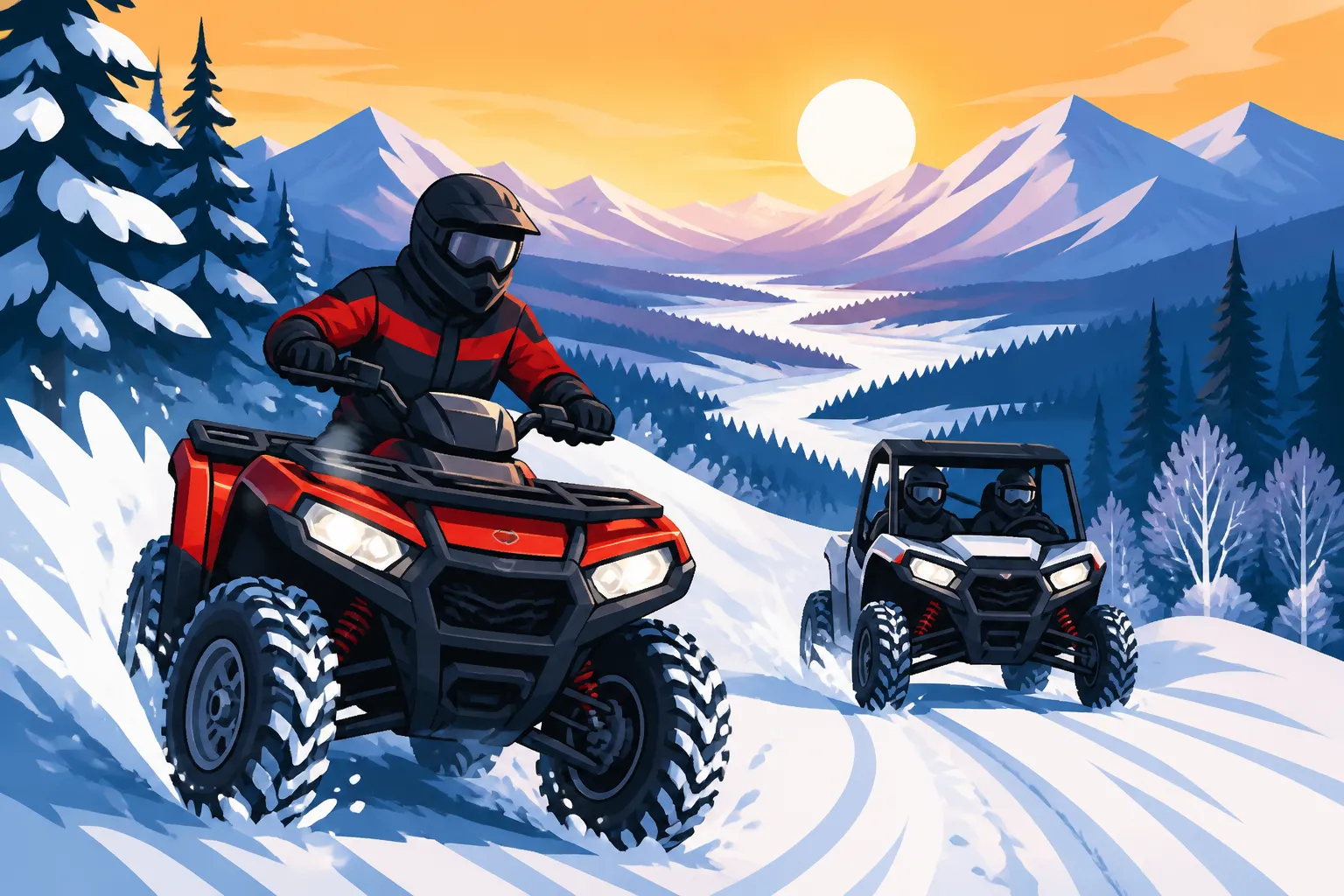
Riding Androscoggin Valley in Winter
Winter riding in New Hampshire’s Androscoggin Valley can be confusing: a corridor that carries ATVs in summer may be closed to wheeled machines once snowmobile season begins. This guide explains how to check what is actually open, plan a responsible winter outing, and avoid assuming that “year-round access” means every trail welcomes ATVs all winter.
What winter riding means in the Androscoggin Valley
Year-round access is not the same as year-round ATV access
The Androscoggin Valley includes riding areas around communities such as Berlin, Gorham, and Milan. The region’s reputation for extended access can make winter plans sound straightforward, but trail access is specific to the route, land, season, and machine. An area described as open year-round may include different corridors or activities in different seasons; it does not automatically mean ATVs and UTVs can use every summer trail in winter.
When snow arrives, many routes are managed primarily for snowmobiles. Some may be closed to wheeled OHRVs, while others may have seasonal restrictions, temporary closures, or conditions that make riding inappropriate even if a route appears on a map. Start with the club or trail manager responsible for the specific route, then confirm the status shortly before leaving. [Androscoggin Valley's Year-Round Access] offers useful background on the region’s extended riding opportunities.
It also helps to separate the season from the conditions. A corridor might have an announced winter opening date but still be unavailable until the managing club opens it. Early-season ground can be soft, thawing weather can damage trails, and a route can close with little notice. Treat a calendar date as a clue to check—not permission to ride. [Winter Access Opening November First] is relevant to understanding seasonal access, but the status of the exact trail you intend to use is what matters.
Wheeled OHRVs and snowmobiles may share a corridor at different times
A trail that serves ATVs in warmer months may become part of a snowmobile network after winter conditions develop. In some places, the same corridor is used by different machines in different seasons; in others, access changes according to a club’s rules and the condition of the trail. A snowmobile corridor appearing on a map is not proof that a wheeled ATV or UTV is allowed on it.
This distinction matters for safety as well as legality. Snowmobiles can travel quickly, and riders may meet around blind corners, narrow bridges, or wooded sections where stopping distance is limited. Do not enter a corridor simply because it looks rideable or because a summer map shows it as an ATV route. Check the managing organization’s current notice and follow posted signs at trail entrances. [Sharing a Corridor With Snowmobiles] explains why seasonal overlap needs particular care.
The season can also work in reverse: a corridor open to snowmobiles in winter may close to them in warmer months or change to a different use. [Why a Snowmobile Corridor Shuts in Summer] and [Trails That Carry Quads in Summer and Sleds in Winter] help illustrate why trail access should be checked by machine type and season, rather than inferred from a route’s name.
| What you are checking | Why it matters in winter | Best next step |
|---|---|---|
| Whether wheeled OHRVs are permitted | A snowmobile trail may not allow ATVs or UTVs | Confirm with the managing club or land manager |
| Current trail status | Thaw, damage, or local decisions can change access | Check notices close to departure |
| Posted signs and gates | They communicate restrictions at the trail entrance | Obey them even if a map shows a route |
| Snowmobile traffic | Shared or nearby corridors can have fast-moving traffic | Ride cautiously and stay alert |
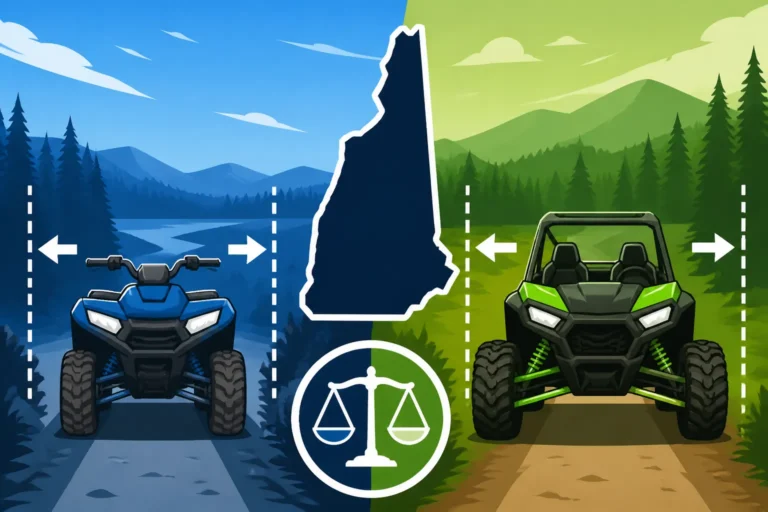
| Machine width and route limits | Gates and narrow sections may exclude some machines | Check the specific route’s limits before hauling north |
How to confirm a route before you ride
Check current notices, not just a saved map
A saved map can be useful for planning, but it cannot reliably tell you whether a route is open today. Before loading the machine, identify the club or organization responsible for the trail and look for its latest status information. Check for seasonal openings, closures, maintenance notices, and restrictions that apply specifically to wheeled machines. The general [New Hampshire Trail Status Before You Ride] guidance is a good starting point, while [New Hampshire Trails Open in Winter] can help you think through winter access more broadly.
Then confirm your understanding against conditions on the ground. A sign at a gate or trail entrance takes precedence over an old screenshot, a route line in a mapping app, or a friend’s memory of last season. If a notice is unclear, ask the club or land manager before you ride. That small step can prevent a frustrating trip to a closed trailhead—and avoid putting a landowner relationship or future access at risk.
Mapping apps can help you organize a route, but use them as planning tools rather than permission tools. For example, onX Offroad can help riders review mapped routes and prepare navigation before heading into an area. Downloading maps for offline use may be helpful where reception is limited. Still, confirm access with the trail manager, and do not assume a line shown in onX Offroad is open to your machine or authorized for winter riding.
Check the whole trip, not only the trail line
Winter access planning starts at the staging area. Confirm that your chosen parking or staging location is open, that trailers can be accommodated, and that you are not blocking a plowed road, private driveway, or snowmobile access point. A trail may be available while a particular lot is closed or unsuitable for winter use. Ask before relying on a familiar summer parking spot.
Plan the route so you know where it begins, where it ends, and what you will do if conditions change. Check whether the route crosses a town road, a bridge, private land, or a corridor managed by another club. A line that looks continuous on a screen can pass through several different management areas. Carry a paper map or another backup in case a phone battery drains quickly in the cold. onX Offroad may be useful for offline navigation, but it should sit alongside current club information and posted signs, not replace them.
Finally, be realistic about daylight and the group’s experience. Cold weather can make a short ride feel much longer, especially when a machine needs attention or someone gets wet. Set a turnaround time before leaving, tell someone where you plan to ride, and avoid stretching the route just because the group is having fun. In the North Country, cell service can be inconsistent; [Cell Dead Zones in the North Country] is a reminder to prepare for gaps in coverage rather than count on a call or live map loading everywhere.
Preparing an ATV or UTV for winter conditions
Cold weather changes the ride and the machine
Cold affects more than comfort. Batteries may have a harder time starting a machine, tires can feel different on packed snow or ice, and cold-weather clothing can restrict movement if it is bulky or poorly layered. Before the trip, follow your machine manufacturer’s guidance for winter operation, inspect it carefully, and check that the battery, tires, brakes, lights, and controls are in good condition. Do not assume a machine that ran well on a mild autumn ride is ready for a long outing in freezing weather.
Dress for the possibility that the ride takes longer than planned. Use layers that help manage sweat and wind, protect your hands and feet, and bring dry clothing in a sealed bag. A helmet and appropriate eye protection are essential riding gear; snow, wind, and low winter light can make visibility especially challenging. Keep your phone warm enough to function, and carry a way to navigate that does not depend on a strong data connection.
A UTV cab can reduce exposure to wind, but it does not eliminate winter risks. Windows can fog, snow can obscure lights, and a warm cabin can make it easy to underestimate how cold it is outside. Make sure passengers are dressed for a stop or breakdown, not just for the comfortable part of the ride. Keep an emergency kit accessible rather than buried under luggage.
Ride with snow, ice, and other trail users in mind
Winter surfaces change quickly. A shaded patch may be icy while a sunny section is soft; a packed track may conceal ruts, water, or debris. Ease into unfamiliar conditions, leave room to stop, and avoid sudden steering or braking that could make a machine slide. If the surface is soft enough that tires are cutting deep ruts, turn around rather than damaging the trail.
Give snowmobilers and other trail users plenty of room. Keep to the appropriate side of the corridor where required, slow down near intersections and blind corners, and be ready for traffic coming from either direction. Avoid stopping where riders cannot see you in time. If you meet a groomer, maintenance vehicle, or work crew, follow their instructions and give them space to operate.
Do not treat a frozen pond or lake as a shortcut between trails. Ice conditions can vary across a single body of water, and snow cover can hide cracks, thin spots, and open water. A winter route should be one you are permitted to use and can travel safely; if you do not have reliable information about ice and authorization, stay off it. The same caution applies to unmarked woods roads and tempting tracks: a visible path is not automatic permission.
A practical winter ride plan
Use a pre-ride checklist
A quick checklist helps catch the details that are easy to overlook when everyone is eager to get moving:
- Confirm machine-specific access. Verify that wheeled ATVs or UTVs are allowed on the exact route, rather than assuming a snowmobile corridor is open to them.
- Check current conditions. Review the responsible club’s latest notices and confirm any uncertain detail directly.
- Review the route and staging area. Check parking access, gates, road crossings, width limits, and any land-management boundaries.
- Prepare navigation. Save relevant information for offline use, carry a backup map, and remember that a mapping app such as onX Offroad does not establish permission to ride.
- Inspect the machine. Check key components, lights, tires, fuel, and any manufacturer-recommended winter preparations.
- Pack for a delay. Bring warm layers, water, food, basic repair supplies, and an emergency plan suited to the group.
- Set group expectations. Agree on pace, meeting points, spacing, and a turnaround time before leaving.
The list is deliberately practical: winter problems often start with a small assumption, such as “the lot was open last time” or “that line must still be an ATV trail.” A few minutes of checking can save a long drive to a closed entrance or a ride that puts unnecessary pressure on a club-maintained route.
Know when to change the plan
A good winter ride plan includes a fallback. If the route is closed to wheeled machines, choose a confirmed alternative or make a different kind of outing; do not ride around a gate, follow tracks onto private land, or continue past a closure sign. If warm weather has made the trail soft, turning back protects both the trail and your machine. If visibility drops, temperatures fall, or a rider is uncomfortable, shorten the ride.
That flexibility is part of responsible access. Local clubs and landowners make riding opportunities possible, and trail damage or disregard for closures can affect everyone who hopes to return. Check the rules that apply to the route, including [New Hampshire Rules for Riding a Snowmobile Trail], and respect any posted restrictions even when conditions look inviting.
For Androscoggin Valley winter riding, the safest assumption is simple: access depends on the specific corridor, machine, and current conditions. Confirm each one before unloading, carry a backup plan, and be ready to turn around when the trail—or the weather—says it is time.
Disclaimer
This article is for general informational purposes only and does not constitute professional advice. Laws, prices and regulations vary by location and change over time. Consult a qualified professional for guidance on your specific situation.