Overnight Parking in a Trail Town
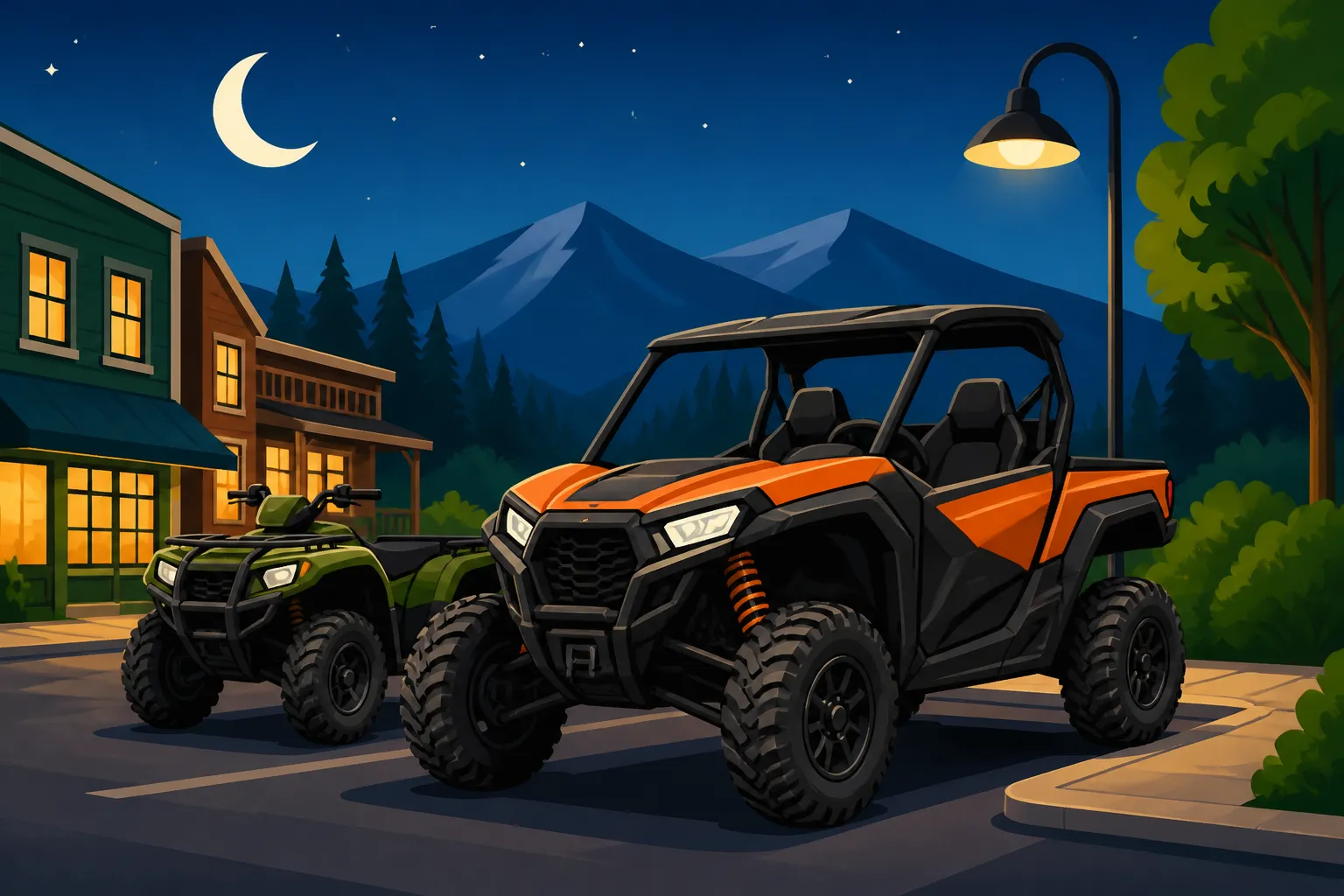
Overnight parking can turn an easy New Hampshire ATV trip into a frustrating one if you arrive in a trail town and find the lot is for day use, your trailer blocks traffic, or the machine can’t legally reach the trail from where you parked. This guide explains how to plan an overnight stop, confirm permission, protect your equipment, and avoid confusing parking access with riding access.
Plan overnight parking before you reach the trail town
Treat parking and trail access as two separate questions
A place to leave your truck and trailer overnight is not automatically a place where you can unload, ride away, or leave an ATV or UTV parked. A hotel might welcome guests’ trailers but not allow machines to be driven through its lot. A public lot might have spaces for visitors without permitting overnight parking. A trailhead may be intended for staging during a ride, not storing vehicles overnight.
Before you set out, get clear answers to three questions:
- Can you leave your vehicle and trailer there overnight?
- Can you leave the ATV or UTV there as well, or must it stay on the trailer?
- Is there a legal, open route from that parking location to the trail system?
Those details matter in northern New Hampshire towns such as Gorham, Berlin, Pittsburg, and Colebrook, where parking areas, lodging properties, trail access points, and town streets can each have different rules. Don’t assume that because a trail appears close on a map, you can ride to it from the lot. Check local rules and the relevant club’s trail information before unloading.
Start with the property owner or parking operator
For private parking, ask the business or landowner directly and describe your setup. “Can I park overnight?” may not give them enough information to answer accurately. Explain whether you have a truck, a long trailer, one or more machines, and whether you need to unload on site.
Ask about the exact dates, arrival and departure times, where the rig should be parked, and whether you need to reserve a space. Confirm whether the permission covers the truck and trailer only, or the ATV or UTV too. If you’re staying at a lodge or hotel, make sure the person answering understands that you’re bringing an off-highway recreational vehicle, not just a passenger car.
This is especially important when a group arrives in several trucks. A property may be able to fit one trailer but not four rigs without blocking guest parking or access for emergency vehicles. A quick call ahead can prevent an awkward late-night search for somewhere else to leave the trailer.
Check local rules instead of relying on assumptions
Public parking rules can differ from private-property rules, and a town’s permission to park does not necessarily authorize riding on nearby roads. New Hampshire OHRV road access depends on the road and local designation; the simple fact that a road connects a lot to a trail does not make it an approved riding route. Review Where New Hampshire Allows OHRVs on Roads and New Hampshire Rules for Riding a Town Street when planning how you’ll get between parking and the trail.
If you’re looking at a familiar spot in Gorham, don’t treat a known day-use or staging location as overnight storage unless the responsible operator has confirmed that use. For example, information about Parking at the Eastern Depot in Gorham can help you identify a location, but you should verify its parking terms for your specific trip rather than assuming overnight permission.
Choose a parking setup that fits your trip
Compare lodging, campgrounds, and designated staging areas
The best overnight parking option is usually the one that matches how you’re traveling. A lodging property can be convenient when you want to leave the machine secured and walk to dinner. A campground may suit a multi-day ride if it allows trailers and provides room to maneuver. A designated staging area can work for riding during permitted hours, but it may not offer overnight vehicle storage.
| Parking option | What may make it useful | What to confirm before arrival |
|---|---|---|
| Hotel, inn, or lodge | Close to food and lodging; may offer guest parking | Trailer space, overnight permission, unloading rules, and whether machines may be stored on the property |
| Campground or RV park | Often better suited to larger vehicles and multi-night stays | Reservation requirements, trailer dimensions, machine storage rules, and whether riding from the property is allowed |
| Public lot or trail staging area | Convenient for reaching a ride during its operating hours | Whether overnight parking is allowed, posted restrictions, and whether the lot is intended for staging only |
| Private lot by arrangement | Can be practical when a business or landowner gives permission | Written or clearly documented permission, exact parking area, hours, and any conditions |
| Remote or roadside location | May seem convenient when other lots are full | Whether parking is lawful and safe; do not assume an open shoulder or unposted land is available |
When you compare choices, look beyond the word “parking.” Ask whether the option is meant for a car, a truck with a trailer, or a vehicle carrying recreational machines. A tight downtown lot may fit a pickup but leave no safe way to turn around with a trailer. A wide lot may still have a posted overnight restriction.
If you plan to park and ride from a club lot, check the club’s current instructions before traveling. A trail map is useful for orientation, but it doesn’t establish that a parking area is open overnight or that every connecting road is legal for OHRV use. For broader trip planning, New Hampshire Trail Maps From a Club and New Hampshire Trail Status Before You Ride are useful starting points.
Think about trailer size and safe maneuvering
A parking plan that works for a car may fail when you arrive with a trailer. Measure the full length of the truck and trailer, including space needed to turn or back into a spot. If the trailer carries a side-by-side, remember that the machine’s width can affect where it can be unloaded and how it will fit once off the trailer.
When you call, describe the dimensions as accurately as you can. Ask whether the trailer can remain attached to the truck or whether the property expects it to be parked separately. If you’re traveling with another rider, agree on a parking plan before splitting between vehicles. Two rigs arriving at different times can create a problem if the available space was only suitable for one.
Arrive with enough daylight to park without rushing. Backing a loaded trailer into an unfamiliar space after dark is stressful, and it can create avoidable risks for pedestrians, parked vehicles, and the machines themselves. If the property cannot accommodate your setup, ask whether there is another permitted location nearby instead of improvising in a road shoulder or vacant lot.
Decide whether the machine stays loaded or gets unloaded
Leaving the ATV or UTV on the trailer can reduce the number of places you need to secure it, but it may make the trailer more attractive to thieves and expose the machine to weather. Unloading can make the trailer easier to park and let you secure the machine separately, but only do so where you have permission and room to work safely.
If unloading at lodging, ask where it is allowed. A machine may leak mud or water onto pavement, and riding through a guest lot may be prohibited even if the vehicle is registered. Be considerate of other guests and avoid blocking fire lanes, sidewalks, entrances, or service areas.
For machines left on a trailer, use appropriate locks and secure the trailer to the tow vehicle or another approved fixed point where possible. Remove loose gear and valuables. Don’t leave registration documents, keys, tools, or riding equipment visible in the truck. These steps don’t replace choosing an authorized, well-lit parking location, but they can make an overnight stop less vulnerable.
Confirm that your ride plan works from the parking location
Verify the route from lot to trail
A lot can be close to a trail and still have no legal riding connection to it. Before unloading, identify the route you intend to use and check whether it is open to OHRVs. This includes any town street, bridge, connector, or private stretch between the parking spot and the trail.
Use official trail information and local guidance to confirm access. The route shown on a mapping app is not proof that the trail is open, that OHRVs are permitted on the road, or that you have permission to cross private property. Tools such as onX Offroad can help you understand the surrounding route and terrain, but treat map information as a planning aid, not as permission. Confirm critical access details with the relevant club, land manager, or town.
If your plan involves moving a machine on public roads, review the rules for that road and the machine. New Hampshire has specific conditions for road riding and crossings, so check What New Hampshire Requires to Cross a Road and New Hampshire Rules for Riding a Class VI Road when they apply to your route. If there is no confirmed legal connection, keep the machine on the trailer and transport it to an appropriate staging point.
Check trail status close to departure
Trail access can change because of weather, maintenance, landowner decisions, seasonal restrictions, or other local conditions. A route that was open when you booked lodging may not be open when you arrive. This can be especially frustrating after a long drive, so build a status check into your travel routine.
Look for updates from the club or trail authority responsible for the area you intend to ride. Use onX Offroad to help organize your planned route if that’s part of your routine, then compare it with the club’s current trail information. Pay particular attention to closures, width restrictions, staging instructions, and any notices about conditions. New Hampshire Trail Conditions Before You Ride and New Hampshire Trail Closures to Check First can help you focus your check.
Keep a backup plan. If a trail entrance is closed or your planned connection proves unavailable, don’t ride around a barrier or cut across land to reach another route. Return to the trailer, contact the relevant club or property owner, and choose an open option. A changed plan is inconvenient; a trespass or trail violation can make the whole trip worse.
Use onX Offroad as a planning aid, not a permission slip
A navigation app can be helpful when you’re trying to understand how a hotel, campground, staging area, and trail network relate to one another. You can use onX Offroad to prepare a route, note likely turns, and identify places where you should verify access before leaving home. That is particularly useful when a group is unfamiliar with the North Country and cell coverage may be limited on parts of the ride.
Still, distinguish between a route displayed on a map and a route you are allowed to ride. A line on a screen does not establish that a road is open to OHRVs, that a landowner allows passage, or that overnight parking is permitted. Cross-check important details with local trail information and the person responsible for the parking site.
Download or save the information you need before you enter an area with limited reception. Share the intended route and parking plan with everyone in the group. If the route changes, make sure the other riders know where to meet and how to return to the trailer without relying on a single phone.
Make the overnight stop safer and less stressful
Secure the machines and keep the lot orderly
Park only in the area you were assigned or authorized to use. Keep the trailer inside the space, leave room for other vehicles, and don’t block entrances, loading zones, sidewalks, fire lanes, or snow-removal access. If the lot is shared with guests, make it easy for staff and other visitors to move around.
Lock the machines and trailer, and take important items into your room or secured vehicle. A cover may help protect equipment from weather, but use one only if it won’t conceal a problem or interfere with rules set by the property. Keep fuel and other equipment stored safely and in accordance with the property’s requirements.
If you arrive late, avoid unloading or starting machines when other guests are likely to be sleeping. Noise carries in small trail towns, and a quiet arrival is a simple courtesy. Be equally careful in the morning: load and depart without revving engines in a parking area or treating a business lot as a warm-up zone.
Keep your documents and group plan organized
Before the trip, make sure the machines are properly registered for the riding you plan to do and that the required registration materials are available. New Hampshire visitors should not assume that registration from another state automatically covers riding in New Hampshire. Review Riding New Hampshire With an Out-of-State Machine and New Hampshire OHRV Registration Paperwork before setting off.
Choose a meeting point in case the group gets separated, and agree on what to do if someone has a mechanical problem or the route closes. Keep the lodging address, parking instructions, and a contact number for the property accessible offline. If the trailer is parked somewhere separate from where you are staying, make sure every driver knows the location and the conditions for retrieving it.
A little organization also helps at checkout. Confirm whether the property expects you to move the trailer by a certain time, whether the lot has restrictions during cleaning or deliveries, and where to leave any parking pass. Don’t assume you can leave a rig behind after checking out unless the property has agreed to it.
Have a backup before the lot is full
Popular riding weekends can make parking tight, especially when several groups arrive with trailers. Ask about overflow arrangements when you reserve lodging or a campsite. If no approved overflow area exists, identify another option and confirm that it allows your vehicle and trailer before you need it.
Keep the backup plan specific: a named business or facility, permission or posted terms, and directions you can follow without mobile service. A vague idea to “find somewhere nearby” is not much help after dark with a loaded trailer. If the first location is full, contact the next option rather than leaving the rig on an unverified shoulder, access road, or private lot.
Most importantly, don’t let parking pressure push you into riding where access is uncertain. Keep the machine secured until you know the route is permitted and open. A few extra minutes on the phone before the trip can protect your equipment, respect local businesses and landowners, and spare you the frustration of discovering the parking rules after you’ve already unloaded.
Disclaimer
This article is for general informational purposes only and does not constitute professional advice. Laws, prices and regulations vary by location and change over time. Consult a qualified professional for guidance on your specific situation.