One Mirror on the Left Side
Navigating the beautiful trails and back roads of New Hampshire on your ATV or UTV is an incredible experience, but it comes with a specific set of rules, especially when you venture onto public streets. One of the most common points of confusion and a frequent source of frustration for riders is understanding the equipment requirements for road riding, particularly the mirror rules. This guide will walk you through exactly what New Hampshire requires for mirrors when your OHRV hits the pavement, along with other essential details to keep your ride legal and safe.
The New Hampshire Mirror Requirement for Road Riding
Imagine you're cruising down a scenic New Hampshire connector road, heading from one section of trail to another. Suddenly, you hear the rumble of a truck behind you. Without a proper mirror, you're forced to guess, crane your neck, or even swerve slightly to see who's coming. This isn't just inconvenient; it's genuinely dangerous. New Hampshire, recognizing the shared nature of its roadways, has a clear regulation to prevent just such scenarios.
Why a Mirror Matters on Public Roads
Riding an Off-Highway Recreational Vehicle (OHRV) on designated public roads means sharing the space with cars, trucks, motorcycles, and even bicycles. Unlike a secluded trail where you might only encounter other OHRVs moving in the same direction, a public road demands a much higher level of situational awareness. A mirror is your crucial second pair of eyes, allowing you to monitor traffic approaching from behind without having to constantly turn your head.
This constant head-turning isn't just cumbersome; it takes your eyes off the road ahead, even if only for a second or two. At 25 or 35 miles per hour, those seconds translate into a significant distance traveled blindly. Having a clear, well-adjusted mirror allows you to quickly glance, assess the situation, and make informed decisions about lane position, turning, or pulling over. It's about preventing rear-end collisions, safely merging, and simply being a courteous and predictable road user. The state isn't just trying to make things difficult; they're trying to keep everyone safe.
Specifics of the "One Mirror on the Left Side" Rule
New Hampshire law (specifically RSA 215-A:17) states that when an OHRV is operated on a public way, it must be equipped with "at least one mirror, securely attached to the left side of the vehicle, so located as to reflect to the driver a view of the highway for a distance of at least 200 feet to the rear of the vehicle." This is a pretty straightforward requirement, but let's break it down.
"Left side" means the driver's side. For most ATVs and UTVs, this will be mounted on the handlebars or the roll cage, positioned so the operator has an unobstructed view. While the law specifies at least one mirror on the left, many riders opt for two mirrors – one on each side – for enhanced safety and a wider field of view. There's no legal penalty for having more mirrors, only for having too few or poorly placed ones. When you're looking for replacement or aftermarket options, consider reputable brands like SuperATV, which offer a range of robust mirrors designed to withstand trail vibrations while providing clear visibility.
The "200 feet to the rear" part is key. This isn't just about having any mirror; it's about having one that's large enough and positioned correctly to provide a meaningful view of oncoming traffic. A tiny, decorative mirror might look cool, but if you can't see a car approaching from a reasonable distance, it's not meeting the spirit (or the letter) of the law. Always err on the side of caution and opt for a mirror that gives you ample visibility.
Mirror Placement and Adjustments for Optimal View
Getting a mirror installed isn't enough; it has to be positioned correctly for you. What works for one rider might not work for another due to height, seating position, or even the type of machine. Your mirror should be adjusted so that when you're in your normal riding position, you can see a significant portion of the road directly behind you, as well as a bit of the lane beside you, without having to awkwardly lean or stretch.
A good rule of thumb is to adjust your mirror so that you can just barely see the side of your own machine in the innermost edge of the mirror. This maximizes your rearward view while still giving you a reference point. Remember that vibrations from riding, especially on rougher sections of road or trail, can sometimes cause mirrors to shift. It's a good habit to give your mirror a quick check and adjustment before each ride, and periodically during longer journeys, to ensure it's still providing that crucial rearward vision. A securely mounted mirror, perhaps with a sturdy clamp system, will hold its position better.
Navigating Other Equipment Rules for New Hampshire Road Riding
While the mirror requirement is specific, it's just one piece of the puzzle when it comes to riding your OHRV legally on New Hampshire roads. The state has a comprehensive approach to ensuring safety, which means your machine needs to be properly outfitted beyond just a single mirror. Ignoring these other requirements can lead to fines and, more importantly, put you and others at risk.
Beyond the Mirror: Essential Lighting Requirements
Visibility isn't just about seeing what's behind you; it's also about being seen by others, especially when ambient light is low. New Hampshire mandates that OHRVs operated on public roads must be equipped with both a headlight and a taillight. These lights must be operational and visible from specific distances. Your headlight should be on whenever you're riding on a public way, especially in conditions like dawn, dusk, fog, rain, or at night.
The taillight is equally important, ensuring that vehicles approaching from behind can spot you, particularly when you slow down or stop. While not always explicitly required for OHRVs, functioning brake lights that illuminate when you apply the brakes are a critical safety feature and generally expected by other road users. If your machine is equipped with turn signals, always use them to clearly indicate your intentions. Upgrading to brighter LED lights, even if not strictly mandated, can significantly enhance your visibility to others on the road. Many aftermarket providers, including SuperATV, offer robust and bright LED light kits that improve both aesthetics and safety.
Sound Limits and Spark Arresters
New Hampshire takes noise pollution seriously, especially in residential areas and on shared roadways. OHRVs are subject to specific decibel limits. While these limits can vary slightly depending on the exact measurement standard and location, the general expectation is that your machine operates quietly. An aftermarket exhaust system might sound great on the trail, but if it pushes you over the legal decibel limit, you could face a fine when riding on a public road.
Equally important, and often overlooked, is the spark arrester requirement. A spark arrester is a device that prevents sparks from exiting the exhaust system and potentially igniting dry vegetation – a critical concern in New Hampshire's wooded areas. It's a fire prevention measure, and operating an OHRV without a functioning spark arrester is illegal and highly dangerous, regardless of whether you're on a trail or a connecting road. Always ensure your spark arrester is in good working order before you head out.
Other Safety Gear: Helmets and Eye Protection
While these aren't "equipment on the machine," they are crucial personal safety requirements that tie directly into road riding. In New Hampshire, riders under 18 years of age, and all passengers, regardless of age, must wear a helmet that meets federal standards. For adult operators (18 and older) who possess a valid driver's license, helmets are not mandatory on OHRVs, but they are always highly recommended for maximum protection.
Eye protection is another must-have. Whether it's goggles, a face shield on a helmet, or a windshield on a side-by-side, your eyes must be protected from debris, wind, and insects. The only exception is if your OHRV has a windshield that provides adequate protection. When riding on public roads, the likelihood of encountering kicked-up stones, dust, or even roadkill is higher, making eye protection even more vital. Just because the machine has a mirror doesn't mean you can skimp on protecting your head and eyes. For younger riders, completing an approved [New Hampshire Safety Certificate Minimum Age] course is also required when riding on public land or designated roads.
When and Where New Hampshire Allows OHRVs on Roads
Knowing your equipment requirements is vital, but it's equally important to understand when and where you're actually allowed to ride your OHRV on public roads in the Granite State. New Hampshire has a very specific framework for integrating OHRVs into its road network, and it's definitely not a free-for-all. Many riders find this confusing, expecting that if a road looks like a trail, it must be fair game. That's rarely the case.
Understanding Town-Designated Roads
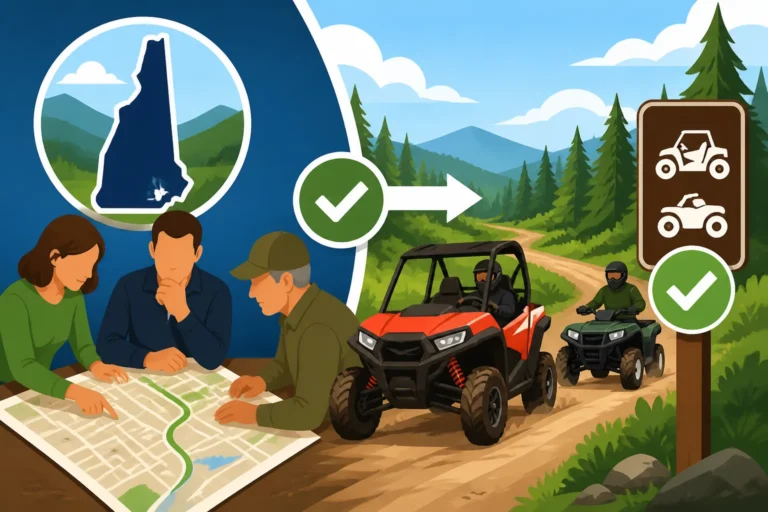
The vast majority of public roads in New Hampshire are closed by default to OHRV traffic. This is a critical point that many new or visiting riders miss. For an OHRV to legally operate on a town or city road, that specific road, or section of road, must be officially designated and opened by the local municipal government. This process typically involves a vote by the town's selectboard, often after a public hearing where residents and landowners can voice their opinions.
These designated roads are usually connector routes, allowing riders to link different trail systems, access fuel and services, or reach staging areas. You'll often see specific signage indicating that a road is open to OHRVs. Without such signage or explicit local ordinance, assume the road is closed. Riding on an undesignated road can result in significant fines and potentially even having your machine impounded. It’s crucial to remember that [Why New Hampshire Roads Are Closed by Default], so don't just assume a road is open if it looks suitable.
Riding Legally on Class IV, V, and VI Highways
New Hampshire classifies its highways into different categories, and OHRV access varies significantly across them. Most of the time, when we talk about OHRVs on roads, we're referring to town-designated roads or certain lower-class highways. For instance, Class IV, V, and VI highways are often gravel or unpaved roads, and some sections may be open to OHRVs under specific conditions.
- Class IV: These are discontinued highways that a town has chosen not to maintain, but still retain public access. Some Class IV roads might be open to OHRVs, particularly if they connect to designated trail systems.
- Class V: These are maintained local roads. Any access here for OHRVs would be entirely dependent on specific town designation, as discussed above.
- Class VI: These are also discontinued public roads, often unmaintained and sometimes barely passable by conventional vehicles. While they may resemble trails, riding an OHRV on a Class VI road still requires it to be designated as open by the town, just like any other public way.
It's vital to check local ordinances and trail maps, often provided by local OHRV clubs, to understand which specific sections of these road classes are open. Don't rely on intuition; always consult official sources. You can find out more by checking articles such as [New Hampshire Rules for Riding a Class VI Road] or [New Hampshire Rules for Riding a Class V Road].
Crossing Paved Roads and Intersection Protocols
Even if a road isn't designated for continuous OHRV travel, you will inevitably encounter situations where you need to cross a paved road or highway to get from one trail segment to another. New Hampshire has very strict rules for these crossings to ensure safety for all users. The primary rule is that you must come to a complete stop before entering the paved portion of the road.
You are required to cross the road at a 90-degree angle to the highway. This means you should approach the road perpendicularly, stop, look both ways for traffic, and then proceed directly across, minimizing the time you spend on the pavement. You must always yield to all conventional vehicle traffic on the highway. Think of it as crossing a busy street on foot – extreme caution is required. You cannot ride along the shoulder, or use the road as a shortcut, unless it's explicitly designated as an OHRV corridor. Ignoring these crossing protocols is a common source of accidents and citations. For a more detailed look, see [New Hampshire Rules for Crossing a Highway].
Practical Tips for a Safe Road Ride in New Hampshire
Riding your OHRV on designated roads in New Hampshire can be a fantastic way to link up trails, grab a bite in a trail town, or simply enjoy a different kind of scenic tour. However, it requires a different mindset and a stricter adherence to safety protocols than purely off-road riding. Preparing yourself and your machine thoroughly is key to a smooth and enjoyable experience.
Pre-Ride Checks and Maintenance
Before you even think about rolling your OHRV onto a public road, a thorough pre-ride inspection is non-negotiable. This isn't just about avoiding a breakdown; it's about ensuring your machine is safe and compliant with road-use regulations. Start with your tires: check the pressure and inspect for any damage or excessive wear. Ensure your brakes are functioning perfectly, both front and rear.
Next, focus on your lighting system. Test your headlight, taillight, and any brake lights or turn signals you might have. Are they bright and clear? Is anything loose or cracked? Crucially, double-check your mirror(s). Is it securely mounted, clean, and adjusted to give you that 200-foot view to the rear? If you've recently been on a particularly bumpy trail, give those mirror mounts an extra tighten. A well-maintained machine is a safer machine, and it also projects a more responsible image to other road users and law enforcement.
Riding Etiquette and Awareness
When sharing the road with conventional vehicles, your riding style needs to adapt. Always ride as far to the right side of the road as is safely possible. Maintain a safe and predictable speed, generally adhering to the posted speed limits for OHRVs on designated roads (which are often lower than for cars). Avoid sudden maneuvers, erratic movements, or swerving. Other drivers might not be accustomed to seeing OHRVs on the road, so making yourself as predictable as possible reduces confusion and the risk of an accident.
Be aware of your surroundings at all times. This includes not just traffic behind you (thanks to your mirror!) but also oncoming vehicles, pedestrians, cyclists, and potential hazards on the road surface. If you see a vehicle approaching rapidly from behind, consider pulling over safely to allow them to pass. Courtesy goes a long way in fostering good relationships between OHRV riders and other road users. Remember that towns like Gorham have specific speed limits and closing times, as highlighted in [Gorham's 25 mph Trail Limit] and [Berlin's Ten O'Clock Closing].
Planning Your Route to Include Open Roads
Spontaneity is fun on the trails, but when it comes to road riding, planning is essential. Never assume a road is open to OHRVs just because it looks like a good shortcut. Always consult official New Hampshire Fish and Game trail maps, local club maps, or town websites to verify which specific roads or sections of roads are legally designated for OHRV use. Many clubs, such as the Milan Trail Huggers or Great North Woods Riders, provide detailed maps that clearly mark these connectors.
Plan your route in advance, identifying where you'll be on trails and where you'll transition to roads. Know where your fuel stops, food options, or lodging might be if you're taking a longer trip. Having a clear plan not only keeps you legal but also ensures you don't waste time backtracking or getting lost. This foresight helps you enjoy the unique experience of linking together New Hampshire's vast trail systems with its scenic back roads. Consider checking [New Hampshire Trail Maps From a Club] for the most current information.
New Hampshire OHRV Road Riding Summary
Here's a quick overview of key requirements for OHRV road riding in New Hampshire:
| Requirement | Detail |
|---|---|
| Mirror | At least one mirror, securely attached to the left side, reflecting a view 200 feet to the rear. |
| Headlight/Taillight | Required and operational for visibility on public roads. Headlight must be on. |
| Brake Lights | Highly recommended for safety, often expected by other drivers. |
| Spark Arrester | Required for fire prevention. |
| Sound Limit | OHRVs must comply with state decibel limits. Aftermarket exhausts should be checked for compliance. |
| Helmets | Required for all riders under 18 and all passengers. Recommended for all. |
| Eye Protection | Required unless the OHRV has a suitable windshield. |
| Road Access | Roads are closed by default; only explicitly town-designated roads (or specific Class IV/VI sections) are open. Look for signs. |
| Road Crossing | Must stop, yield to all traffic, and cross at a 90-degree angle. |
| Speed | Adhere to posted OHRV speed limits, which may be lower than for cars. |
| Position | Ride as far to the right side of the road as safely possible. |
| Registration | Your OHRV must be properly registered in New Hampshire. [Registering an OHRV in New Hampshire] is a mandatory first step. |
| Safety Certificate | Required for riders aged 12-15 without a valid driver's license (or supervision if under 12). |
Whether you're exploring the [Ride the Wilds in Coos County] or just heading to a nearby store, understanding these rules ensures a safe and compliant ride.
Disclaimer
This article is for general informational purposes only and does not constitute professional advice. Laws, prices and regulations vary by location and change over time. Consult a qualified professional for guidance on your specific situation.