First Snow on an October Trail
An early October snowfall can make a New Hampshire ATV or UTV ride look like a winter adventure—but a white trail is not necessarily an open trail. Seasonal closures, wet ground, hidden ice, and changing conditions can turn a short outing into a frustrating or risky one. This guide explains how to check access, judge the conditions, and prepare before riding after the first snow.
Is an October ATV Trail Open After the First Snow
Snowfall does not change a trail’s status
The first flakes of the season can fall while some trails are still open, but snow itself does not extend the riding season or reopen a closed route. Trail access depends on the landowner, the trail system, and any seasonal rules or closures in effect. A trail that looks rideable may already be closed, even if there is no snow on the ground.
That distinction matters in places such as Coos County, Berlin, Pittsburg, and Gorham, where trail systems connect through multiple towns and land parcels. One section might be open while another is closed, or a route may have a gate or sign that changes your planned loop. Before setting out, check New Hampshire Trail Closing Dates and New Hampshire Trail Status Before You Ride. Confirm conditions with the relevant club or land manager, especially when a route crosses between trail networks.
October closing dates can vary by trail. Some systems close earlier in the month, while others may remain open later, depending on their rules and conditions. Do not assume that a trail is open simply because it was open last weekend, because a nearby route is still accessible, or because an app shows a line on the map. A mapped route is useful for planning, but it is not permission to ride.
Snowmobile corridors are not automatically ATV routes
The first snow can make a familiar summer trail look like a snowmobile trail, but seasonal use rules still apply. Some corridors serve different users at different times of year, and a snow-covered route does not automatically become legal for an ATV or UTV. Check New Hampshire Rules for Riding a Snowmobile Trail and New Hampshire Trails Open in Winter before assuming that a winter-looking trail is open to your machine.
This can be confusing when the trail is physically passable. You might see fresh tire tracks, a groomed surface, or snowmobile markers and wonder whether someone else has already established access. Those clues are not a reliable substitute for current rules. A snowmobile club’s winter route and an OHRV club’s fall route may overlap in places without having the same opening dates or permitted vehicles.
If a sign says closed, follow it, even if the snow is shallow and the trail looks firm. Do not ride around a gate or take an unmarked side path to get past a closure. Besides risking a citation or trail damage, ignoring access restrictions can jeopardize landowner relationships that help keep riding routes available.
How to Check Conditions Before You Ride
Check trail status close to departure
A forecast is not a trail report. A few inches of snow in town may mean rain, bare ground, or slush at a higher elevation, while a cold night can leave shaded sections icy even when the staging area looks clear. Check New Hampshire Trail Conditions Before You Ride and Checking the Trail Status Board shortly before leaving, then verify any uncertain section with the local club.
When planning a ride near Jericho Mountain State Park, for example, consider the conditions at the route you intend to use rather than relying only on what the weather is doing in Berlin. The same principle applies farther north around Pittsburg or along routes near Gorham: elevation, exposure, recent rain, and shade can all change the surface over a short distance. A report from several days earlier may no longer describe what you will encounter.
Use a map as a planning aid, not as proof of access. onX Offroad can help you review your planned route and identify where you need to pay attention to trail connections. Before you go, compare the mapped route with current local status information and posted signs. If you cannot confirm whether a section is open, plan around it rather than treating uncertainty as permission.
Read weather and ground conditions together
The temperature and precipitation forecast tell only part of the story. A warm afternoon after a snowfall can turn a hard surface into slush; overnight refreezing can then leave ruts and puddles with a slick crust. Rain before the snow can also soften the ground underneath, making a trail look frozen on top while remaining vulnerable to damage below.
Ask practical questions before you load the machine:
- Has the area had rain or thawing weather recently?
- Will temperatures rise above freezing during the ride?
- Are shaded hillsides or north-facing sections likely to stay icy?
- Does the club report soft, muddy, or water-covered trail sections?
- Are any gates, bridges, or connectors closed?
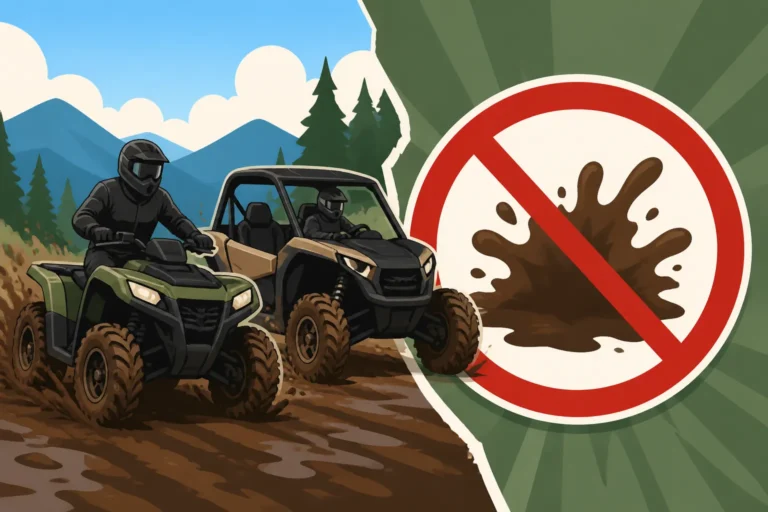
The concern is not only whether your tires can get through. Spinning wheels can tear up a soft trail and leave ruts that persist after the snow melts. If conditions are muddy, unstable, or restricted, postpone the ride. New Hampshire’s seasonal restrictions exist in part to protect trails when they are especially susceptible to damage; see New Hampshire’s Mud Season Ban for related guidance on riding when the ground is vulnerable.
| What you find | What it may mean | Sensible response |
|---|---|---|
| Thin snow over firm, open trail | The surface may still have hidden slick patches | Ride cautiously only after confirming access |
| Snow over soft or muddy ground | Tires may break through and damage the trail | Turn around or postpone |
| Ice in shaded areas | Reduced traction, especially on slopes and turns | Avoid the section if you cannot ride it safely |
| Fresh snow with no current trail report | Conditions and access are uncertain | Contact the club or choose a confirmed route |
| A closure sign or gate | The route is closed regardless of appearance | Do not enter or ride around the barrier |
Preparing an ATV or UTV for First Snow
Inspect the machine and carry cold-weather essentials
A machine that felt dependable in September may behave differently in near-freezing weather. Before riding, check tire condition and pressure, brakes, lights, throttle response, and the battery. Make sure the tires are appropriate for the conditions and that the tread is not worn smooth. Cold weather can also make clothing feel less protective once wind and motion are added.
Dress for a stop, not just for the ride. If a machine breaks down or the group has to wait, the temperature can feel much colder than it did at the trailhead. Wear layers that you can adjust, gloves that allow safe control of the machine, and footwear suited to wet or snowy ground. Bring water, a charged phone, basic first-aid supplies, and a way to contact your group if you become separated.
Pack for a delay rather than assuming the ride will go exactly to plan. A small tool kit, a tow strap appropriate for your machine, and a light can make an unexpected pause easier to manage. Keep equipment secured so it cannot shift during rough travel. If the route is remote, tell someone where you plan to ride and when you expect to return.
Plan for navigation and a safe turnaround
Snow can cover familiar rocks, ruts, trail edges, and smaller signs. Even a route you have ridden repeatedly may look unfamiliar when its landmarks are hidden. Download or save the route information you need before leaving an area with reliable service, and keep your group together at turns and junctions. onX Offroad may be useful for reviewing a planned route in advance, but do not use a digital map to override a closure sign or a club’s current access notice.
Agree on a turnaround point before starting. For example, if the first climb is icy or a connector is wetter than expected, turn back as a group rather than splitting up to search for an easier way around. If one machine is struggling for traction, continuing onto steeper ground or a narrower trail can make the situation worse. A planned ride does not have to become an all-or-nothing decision; shortening the route is often the sensible choice.
Keep a respectful distance from other trail users and avoid sudden steering or braking on slick ground. Ride at a pace that leaves room to react, and be especially careful near bridges, trail entrances, and shaded corners. If you cannot see the trail surface clearly, slow down enough to assess it before proceeding.
A Practical Go or No-Go Check
Use a simple decision process
A good first-snow outing starts with a few checks in the right order. First, confirm the exact trail system and route are open to your vehicle. Next, review recent local reports and the weather where you plan to ride—not only at home. Finally, inspect the machine, prepare for cold and delays, and make sure everyone in the group understands the turnaround plan.
If a route crosses several club areas, check each part separately. A route line that appears continuous may include a connector with different access rules. In that situation, contact the clubs involved or choose a route with clearly confirmed access. onX Offroad can be one part of your planning routine, alongside local trail updates and signs on the ground, but it should not be your only source for deciding whether to ride.
A conservative decision is not wasted preparation. If the trail is closed, unusually wet, or covered by conditions you cannot manage confidently, reschedule. The first snowfall will not be the last opportunity to ride, and avoiding a damaged trail or a difficult recovery is better than pushing ahead because the machine is already unloaded.
Keep the ride flexible
For a first-snow trip, plan a shorter route than you might choose in dry summer weather. That gives the group time to assess traction, visibility, and changing conditions without being committed to a long loop. Build in room to turn around, and avoid making a remote destination the only way to finish the ride.
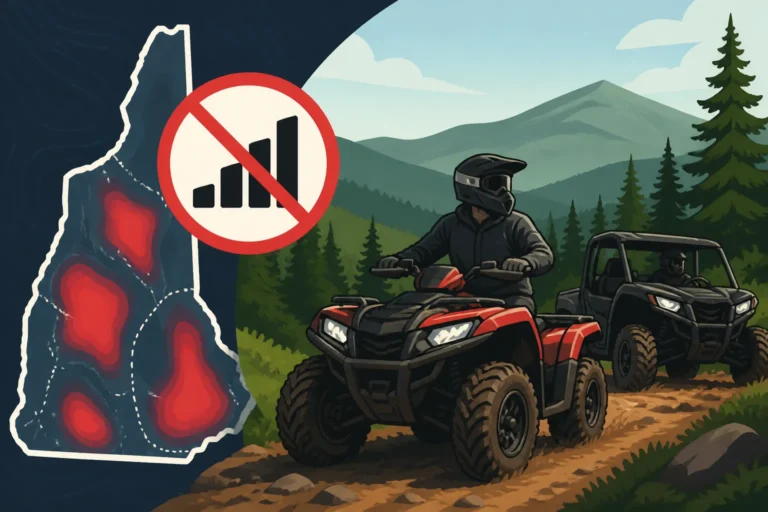
Tell a companion or family member your intended area and return time. If the group changes its route, update that person when practical. In northern New Hampshire, where service may be limited in some areas, it helps to start with a clear plan and avoid relying on a phone signal for every navigation decision.
Most importantly, leave the trail as you found it. Do not widen a route to bypass snow, mud, or a fallen obstacle, and do not continue through a section that is clearly closed or deteriorating. A careful ride protects your group and helps preserve access for future seasons.
Disclaimer
This article is for general informational purposes only and does not constitute professional advice. Laws, prices and regulations vary by location and change over time. Consult a qualified professional for guidance on your specific situation.