BoundTree Closing at 8 Inches of Snow
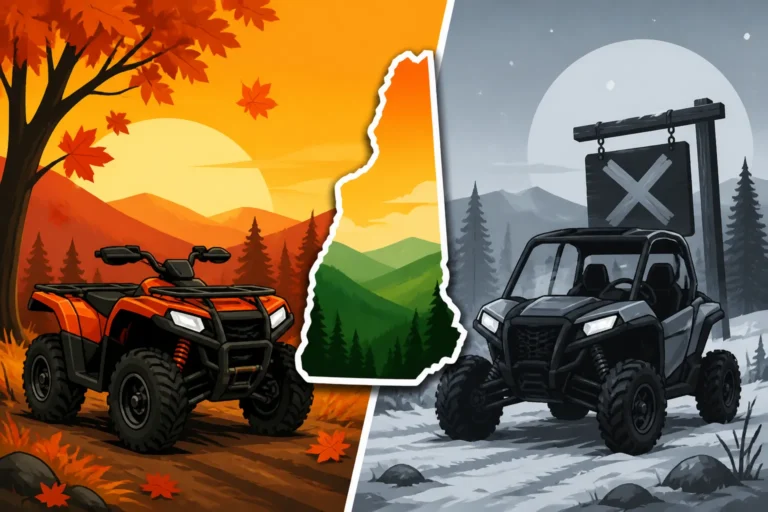
BoundTree’s eight-inch snow threshold can catch riders off guard: a route that was open for a late-season ATV or UTV ride may close once winter conditions arrive. The key is knowing what the threshold means, where to confirm a closure, and how to avoid driving to a trailhead only to find access has ended.
What BoundTree’s eight-inch snow closure means
A local trail decision, not a statewide rule
An eight-inch snow threshold is best understood as a condition used for BoundTree’s trail access, not as a universal New Hampshire rule for every ATV or UTV trail. Trail systems are managed in different places and under different arrangements, so one area’s winter policy does not automatically apply to another. A nearby route might close earlier, later, or under a separate seasonal schedule.
That difference matters when you are planning a ride across multiple trail areas. A machine may be ready, the forecast may look manageable, and the roads to the staging spot may be passable—but that does not establish that the trail itself is open. Check the current local notice before setting out, and review New Hampshire Trail Closing Dates to understand why seasonal end dates can vary across the state.
Why snow changes trail access
Snow can make a route difficult to use in ways that are not obvious from a road or driveway. Underneath it, the trail may be soft, uneven, or saturated. A thin layer can conceal ruts, drainage features, exposed rocks, and other obstacles. As a machine turns or climbs, its tires can break through the surface and disturb the trail below.
The concern is not just whether a rider can get through. Trail managers may need to protect the route for winter use, maintenance, or spring conditions. A closure can help prevent damage that takes time and volunteer work to repair. That is one reason a threshold such as eight inches should be treated as a practical closure trigger, rather than an invitation to ride until a certain spot looks impassable.
How a snow threshold relates to seasonal closures
Snow depth is only one factor in a trail’s status. A route may close because of a seasonal schedule, local conditions, landowner requirements, maintenance, or another restriction—even if the snow has not reached the stated threshold. Conversely, the arrival of snow does not prove that every trail in New Hampshire has closed.
It is helpful to distinguish a closure based on conditions from a planned seasonal closing. A conditions-based decision can come after a storm or a change in trail surface, while a seasonal closing may follow a schedule set by the managing group or landowner. For broader context, New Hampshire Trails Open in Winter and Why Mud Season Closes Everything explain why a trail being physically passable does not necessarily mean it is open to motorized use.
How to check whether BoundTree is open
Confirm the local notice before you travel
Start with the latest notice from the group responsible for the trail or the local trail-status channel it directs riders to use. Look for clear wording about the affected trail area, the date of the notice, and whether the closure applies to all motorized use or only particular routes. If a message says the system is closed after reaching the snow threshold, do not assume the closure ends when the snow melts; wait for a reopening notice or confirmation.
If a status post is vague, ask for clarification before loading the machine. A quick check can prevent a long drive, an awkward turn-around at a staging area, or an accidental ride onto a closed trail. New Hampshire Trail Status Before You Ride offers a useful starting point for making trail conditions part of your pre-ride routine.
Do not treat a map as proof of access
A map can show where a trail goes without confirming that it is open today. This distinction is especially important in winter, when route access may change faster than the base map. A line on a screen is not the same as current permission to ride.
Apps such as onX Offroad can help riders orient themselves and review mapped routes, but use them as navigation aids, not as the final authority on a closure. Check the local status separately, and compare it with any official trail information available. If you use onX Offroad, make sure you understand what its map is telling you—and what it cannot confirm about current access.
Watch for closures that affect only part of a planned ride
A trip may involve more than one trail system, connector, or access road. One section can close while another remains open, so a general impression that “the area is riding” may not answer whether your entire route is legal and accessible. Before leaving, identify where the route enters and exits each managed area and check the status of every section you intend to use.
A route planner can help you visualize those connections, but verify the closure information for each one. onX Offroad may be useful for reviewing your planned route alongside other trip details; still, confirm current access with the responsible local source. When in doubt, choose a route that stays entirely within a confirmed-open area rather than improvising around a closure.
What riders should do when snow reaches the threshold
Stop riding when the closure takes effect
If the trail manager announces that BoundTree is closed at the snow threshold, do not ride there simply because the trail looks firm from the parking area. Conditions can differ between shaded sections, open ground, low spots, and higher elevations. A machine can also damage a route before the rider realizes how soft the surface is beneath the snow.
Respecting a closure protects the trail and the relationships that make riding possible. Access often depends on landowners and local stewardship as well as the physical condition of the route. New Hampshire Landowner Permission Rules is a reminder that trail access is not a blanket right to ride wherever a machine can travel.
Avoid searching for an unofficial way around a closed section
A closed route should not be treated as a puzzle to solve by cutting through woods, crossing private ground, or using a nearby road that is not open to OHRVs. A detour can create a new trespass problem or put riders somewhere they are not permitted to be. Follow the marked route and the posted closure information, even if the alternative looks convenient.
If a closure divides a larger trail plan, change the plan rather than pushing through. Use a separate trail system only after confirming that it is open and that your machine is allowed there. New Hampshire Rules for Riding Private Land and New Hampshire Rules for Riding a Closed Trail are useful reminders to check permission and closure status before choosing an alternate route.
Prepare for a late-season ride before conditions change
Late-season riding calls for a little more planning than a midsummer outing. Check the forecast, trail status, daylight, access roads, and likely ground conditions before you leave. Bring suitable cold-weather layers and let someone know where you expect to ride. A route that is comfortable in autumn can become much less forgiving when snow, ice, or early darkness arrives.
Keep a backup plan that does not depend on getting around a closed trail. For example, decide in advance whether you will turn back, switch to a confirmed-open area, or end the ride if the notice changes. Riding a New Hampshire Trail in November can help riders think through the additional seasonal considerations that come with late fall.
| Before the ride | What to confirm | Why it matters |
|---|---|---|
| Trail status | The latest notice from the local manager or club | A mapped route may be closed even if it appears passable |
| Snow conditions | Whether the stated threshold has been reached and what the closure notice says | Snow can hide soft ground and trail hazards |
| Route connections | The status of every trail or connector on your planned route | One closed section can affect the whole ride |
| Access and permission | Whether the staging area and alternate routes are open to your machine | Nearby land or roads may have separate restrictions |
| Reopening information | A clear notice that access has resumed | Melting snow alone does not confirm that a trail is open |
Planning around BoundTree’s winter closure
Choose a confirmed-open alternative
If BoundTree is closed, look for another trail area only after checking its own current status and access rules. Do not assume that a neighboring system follows the same snow threshold or closing schedule. Different routes may be managed by different clubs or landowners, and their conditions can change independently.
Use Checking the Trail Status Board as a reminder to verify conditions close to departure, not just when you first begin planning. If you rely on a navigation app, onX Offroad can help you review route options, but pair that planning with a current local closure check. When no reliable update is available, postponing the ride is safer than guessing.
Understand how winter use can differ by corridor
Some corridors may have winter uses that do not match summer ATV or UTV access. Snowmobile activity, grooming, landowner agreements, and seasonal management can all affect what is allowed. A route shown as part of a broader network may not be open to wheeled machines once winter conditions arrive.
Before riding anywhere that overlaps with another winter use, check the specific rules for that route. Sharing a Corridor With Snowmobiles explains why riders should not assume that a trail’s winter appearance means it remains open to every type of vehicle. For BoundTree, follow the local closure notice and wait for a clear reopening announcement before returning.
Make the closure part of your seasonal routine
A reliable late-season routine is simple: check status before loading, check again before leaving, and check once more if weather changes during the day. Keep the trail manager’s updates easy to find, and avoid relying on old posts or a friend’s account of conditions from a previous weekend. A closure can happen after a storm, and a reopening should be confirmed rather than inferred.
This approach may feel cautious when the route looks rideable, but it saves frustration and helps preserve access for the next season. Treat the eight-inch threshold as a signal to stop and verify—not as a target to test on the trail. If BoundTree has announced a closure, wait for the responsible local source to confirm that riding has resumed.
Disclaimer
This article is for general informational purposes only and does not constitute professional advice. Laws, prices and regulations vary by location and change over time. Consult a qualified professional for guidance on your specific situation.