Logging Trucks on a Club Road
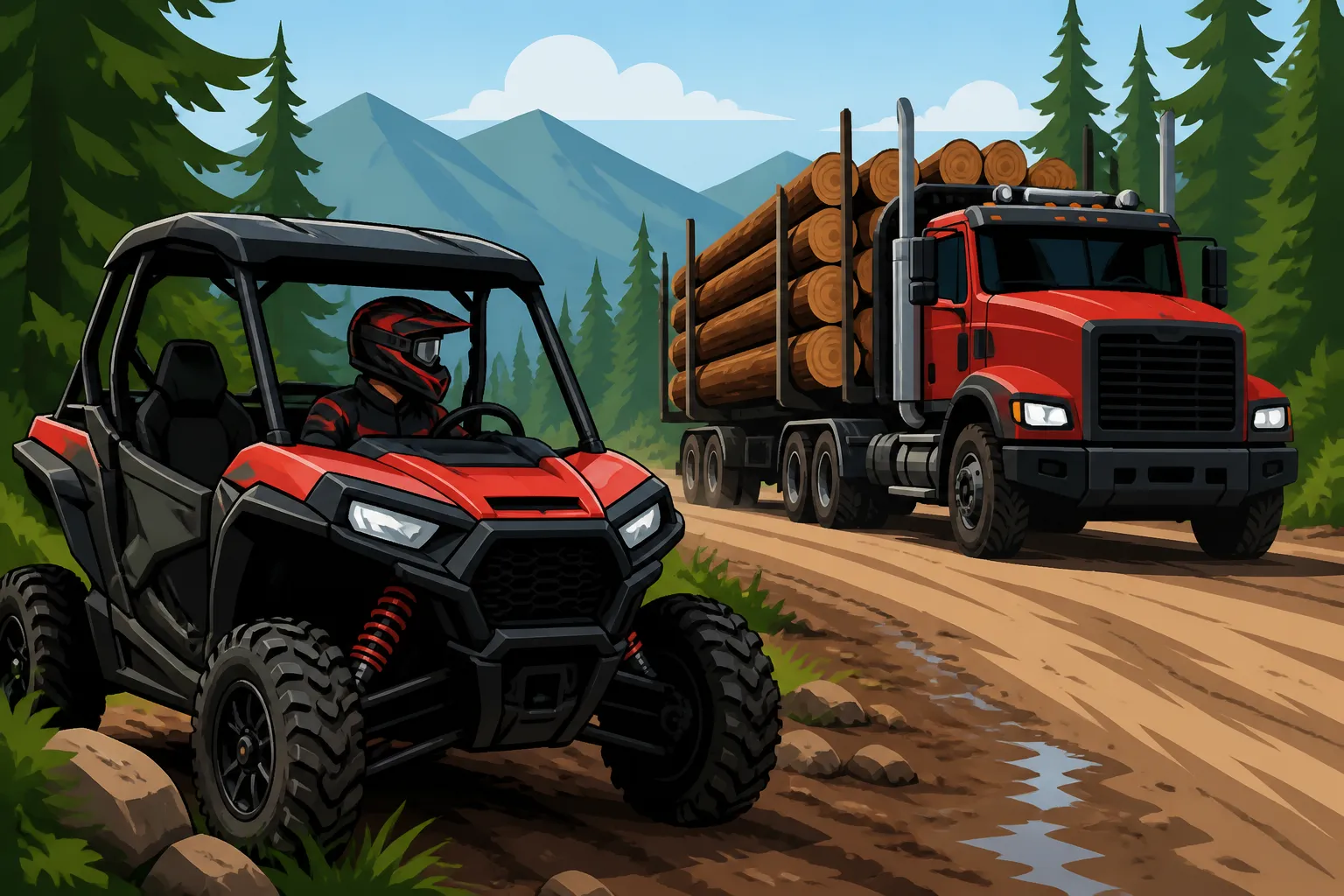
A logging truck on a New Hampshire club road can turn a relaxed ATV ride tense in seconds: the road may be narrow, dusty, and shared with heavy equipment that cannot stop or maneuver like a car. This guide explains how to recognize active haul routes, respond safely when trucks appear, and plan a ride without assuming every club trail is free of work traffic.
Why logging trucks use club roads
A trail can also be a working road
In northern New Hampshire, a route that feels like a recreational trail may also serve a working forest. Logging roads and club trails can overlap, meet, or run alongside one another. Trucks may use them to reach a timber operation, carry loads out of the woods, or move between work areas.
That shared use can surprise riders who expect a trail to function like a one-way recreational route. A club map shows where riding is directed, but it does not necessarily mean the route is closed to authorized work traffic. A truck may appear around a bend, come over a rise, or be backing into a landing where logs are being staged.
This is especially worth remembering when riding in Coos County, around Berlin, Pittsburg, or other North Country trail towns. A route can pass through working forest even when the ride itself feels remote and recreational. For broader context about how clubs maintain and manage trails, see Who Cuts and Maintains a Volunteer Club Trail.
Heavy trucks have limited room to react
A loaded logging truck is wide, heavy, and much slower to stop than an ATV or UTV. The driver may need most of the available road to make a turn, climb a grade, or keep the load stable. On a narrow road, there may be nowhere for the truck to move aside safely.
Visibility can also be limited. A truck cab sits high, and the driver may not see a small machine immediately, especially near a curve, at a crest, or in dust. A driver’s attention may be focused on the road surface, the load, other equipment, or a tight maneuver. Never assume that a driver has seen you just because you can see the truck.
The practical rule is simple: treat a logging truck as the vehicle that needs space. Slow down early, give the driver time to understand where you are, and avoid trying to slip past. If you’re riding with friends, tell the group what you see and make sure the riders behind you have time to react too.
What to do when a truck approaches
Slow down, stop, and make space
When you see or hear a logging truck, ease off the throttle and slow down well before reaching it. If the road is narrow, stop in a place where you are visible and where your machine is fully out of the truck’s path. A wide turnout or a clear spot off the traveled surface is better than stopping just beyond a blind corner.
Do not pull into soft ground, a ditch, or an unstable shoulder simply to get out of the way. A machine that tips or becomes stuck can create a second hazard, and loose ground may be difficult to judge. If there is no safe place to move aside, stop where you can be seen and wait rather than attempting a close pass.
Keep the group together and avoid blocking the road. Riders should not spread across the route or cluster in a spot where the truck has to squeeze through. If the driver needs to stop or maneuver, give them room to do it. A friendly wave can help acknowledge the driver, but it is not a substitute for leaving enough space.
Don’t follow close behind or pass without a clear signal
Logging trucks can throw dust, gravel, and debris. Following closely can leave you with poor visibility and little time to react if the truck slows, stops, or turns. Let the dust settle and keep a generous distance. If you can no longer see the road surface clearly, slow down further or stop somewhere safe.
Do not pass a truck just because it appears to be moving slowly. A truck may be turning into a landing, backing up, or preparing to stop. Its load can extend beyond the vehicle, and the driver may not be able to see a machine alongside or immediately behind the cab. Never ride into the truck’s blind area or try to squeeze between the truck and the edge of the road.
If you are unsure whether the driver has seen you or whether there is room to pass, wait. The safest response is often an uneventful pause. On a shared road, taking an extra minute is far better than forcing a close encounter with a large vehicle.
How to prepare for a shared-road ride
Check trail status and ride alert
Before heading out, check the trail status information posted by the relevant club or local trail network. A route can change because of logging activity, maintenance, weather, or landowner requests. Signs at the trailhead and along the route matter too; follow closures and directions even if an app or older map suggests the trail continues.
For navigation, use a map as a planning aid rather than as permission to ride. Apps such as onX Offroad can help riders review routes and understand where a planned ride goes, but map information may not reflect a temporary closure or active work operation. Check current club updates, pay attention to signs, and be ready to turn around if conditions on the ground differ from your plan.
If your group uses downloaded maps, make sure everyone knows the route and has a backup plan for a closure. Keep phones charged, and don’t assume cell service will be available in remote areas. For a wider look at finding current route information, see New Hampshire Trail Status Before You Ride and New Hampshire Trail Maps From a Club.
Ride as though you may meet work traffic
Before entering a narrow forest road, reduce speed enough that you can stop within the distance you can see. This matters on curves, steep grades, and dusty stretches, where visibility can change quickly. Keep extra room between machines so the whole group can stop without piling up.
Establish a simple group routine before setting out. For example, agree that the lead rider will slow and signal when a large vehicle appears, while the next rider makes sure the message reaches the rest of the group. Avoid relying on a hand signal that riders behind you cannot see through dust or around a bend. Stop in a safe location and communicate clearly.
It can also help to tell newer riders that encountering work traffic is not a reason to panic or hurry. The group should stop, assess the available space, and follow any directions given by workers. If there is active equipment or a marked closure, don’t ride around barriers or attempt to find a way through the work area.
| Situation | Safer response | Avoid |
|---|---|---|
| Truck appears ahead | Slow early, stop somewhere visible, and leave the road clear | Racing to a narrow shoulder or trying to squeeze past |
| Dust reduces visibility | Increase distance or stop until you can see the road | Following close behind the truck |
| Truck is turning or backing | Wait well outside its maneuvering space | Riding beside the cab or behind the load |
| Signs indicate a closure | Turn around and follow the posted direction | Going around a barrier or relying on an old map |
| No safe passing space is obvious | Wait for the driver or work crew to guide the situation | Assuming the truck will move over |
Trail etiquette around active logging
Respect signs, crews, and closures
A “closed” sign or barrier is not an invitation to look for a way around. Work areas can include moving trucks, loading equipment, unstable ground, and people on foot who may be difficult to see. Even if the road looks quiet, work can resume without much warning. Turn back and choose another route.
If a worker asks you to wait or take another route, follow the direction calmly. Workers may be coordinating several vehicles or equipment movements at once. A quick conversation can clarify whether a route is temporarily blocked, but don’t approach machinery or enter the work area to ask. Stay where you are visible and out of the way.
Shared access depends on riders behaving predictably. Leaving gates and barriers undisturbed, staying on marked routes, and respecting temporary closures helps protect both riders and the landowners and clubs that make access possible. For more on access responsibilities, see What a Club Does to Keep a Landowner Onside and New Hampshire Rules for Riding a Closed Trail.
Choose another route when conditions feel unsafe
Sometimes there is no safe place to pass, the road is too narrow, dust is heavy, or active work makes it unclear where vehicles will move next. That is a good reason to turn around. A planned loop may become an out-and-back, or your group may need to return to a staging area and select a different route.
Turning back can feel frustrating, especially after trailering a machine a long way or planning a full day around a particular ride. But the choice is not between completing the route and ruining the day. You can pause, check another club route, or adjust the plan. Riders looking for other options can explore New Hampshire’s Club Trail Network and New Hampshire Trail Conditions Before You Ride.
Keep the decision practical rather than emotional. If a truck is actively hauling, the route is signed closed, or the group cannot identify a safe place to wait, don’t continue into the work area. No shortcut or photo opportunity is worth putting a rider, worker, or truck driver at risk. The best shared-road ride is the one where everyone gets home safely, even if the route changes along the way.
Disclaimer
This article is for general informational purposes only and does not constitute professional advice. Laws, prices and regulations vary by location and change over time. Consult a qualified professional for guidance on your specific situation.