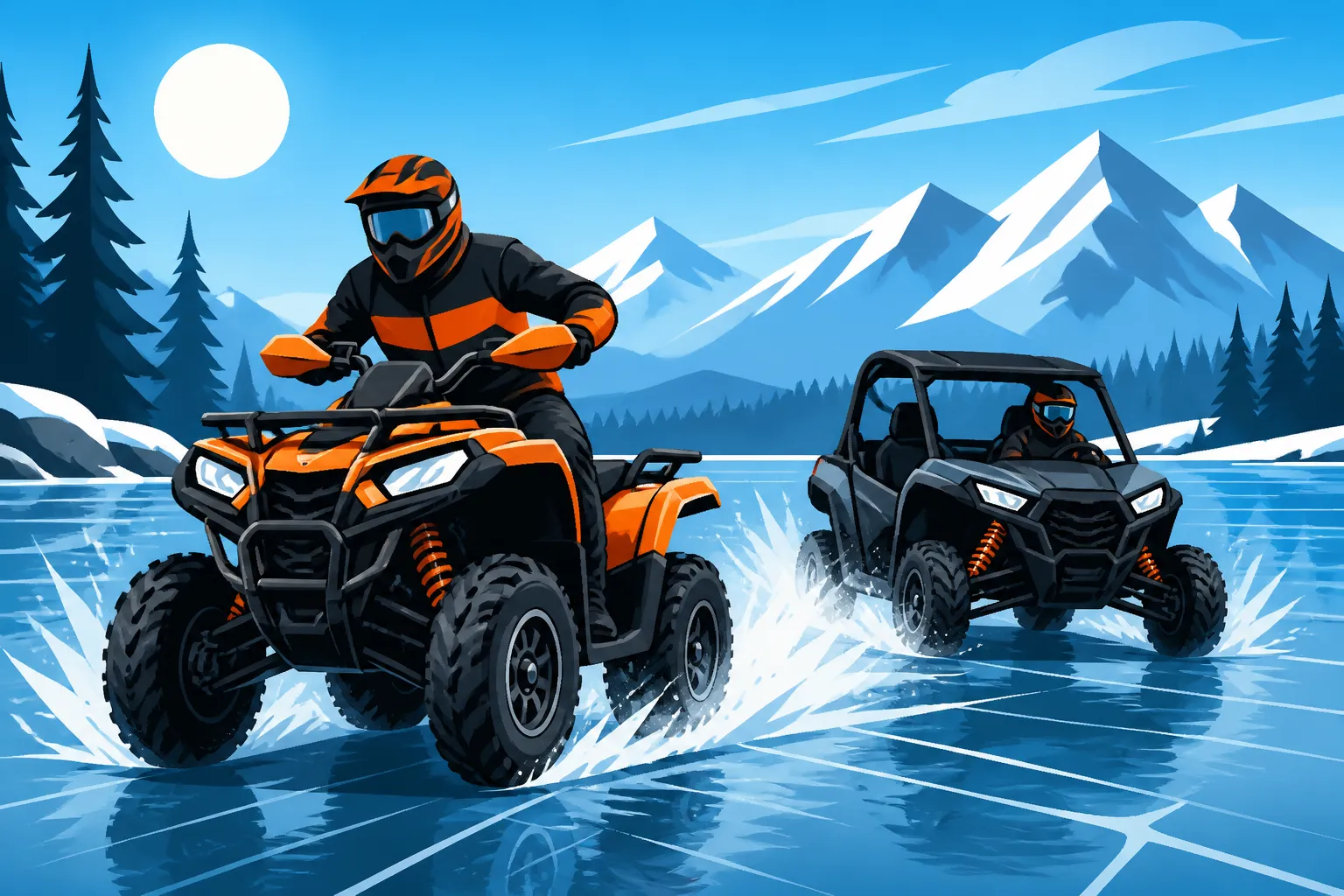
Riding a Frozen Pond in February
When that crisp New Hampshire air settles in during February, and you glance out at a vast, snow-covered lake, it's easy to picture the thrill of riding your ATV or UTV across that expansive, unmarred canvas. The thought of miles of open ice, a welcome change from tight trails, is incredibly enticing. But beneath that beautiful, frozen surface lie unique challenges and serious safety considerations that every rider needs to understand. This guide will help you navigate the allure and the risks, ensuring you approach riding a frozen pond in the Granite State both safely and legally.
The Unique Allure and Serious Risks of Riding Frozen Ponds
There's something undeniably captivating about the idea of taking your OHRV out onto a frozen lake or pond. It offers a kind of freedom and a riding experience you just can't get on traditional trails. However, that freedom comes with a significant need for caution.
Why the Ice Calls to OHRV Riders
For many OHRV enthusiasts, the winter months, especially February, present a distinct opportunity: frozen waterways. Imagine the sheer expanse of a large lake, covered in a blanket of snow or offering a slick, reflective surface of ice. It’s a completely different riding environment than the winding, often narrow, forest trails you’re used to. On ice, you have vast open spaces for exploration, the ability to practice turns and drifts without the immediate threat of trees or rocks, and often breathtaking views of the winter landscape. It feels like unlocking a whole new dimension of riding, a unique challenge and a powerful sense of adventure. The tranquility can also be a huge draw, far from the hustle and bustle, just you and your machine on nature's temporary highway.
The Silent Dangers Beneath the Surface
As appealing as the open ice is, it hides profound dangers that can turn a fun outing into a nightmare in an instant. Ice is rarely uniform. You might have several feet of solid ice in one spot, and just yards away, it could be only a few inches thick. Factors like underwater springs, moving currents from inlets or outlets, or even pressure ridges caused by shifting ice can create dangerously weak spots that are completely invisible from the surface. A sudden thaw, even a slight temperature increase over a few days, can rapidly degrade ice strength without obvious signs. The consequences of breaking through are severe: immediate exposure to freezing water, rapid onset of hypothermia, and the immense difficulty of self-rescue, especially when encumbered by heavy winter gear and being pulled down by a sinking machine. The unforgiving cold makes every second critical.
New Hampshire's Stance on Frozen Waterways
Here in New Hampshire, the law is quite clear when it comes to riding OHRVs on frozen bodies of water. The moment you move your machine off private property and onto a public lake or pond, even when frozen solid, it falls under the same registration requirements as riding on a public trail. This often catches people by surprise; they might assume that because it’s a frozen lake, it’s not really a "trail" in the traditional sense, or that their home state registration will suffice. That's simply not the case. If you're planning to ride on a frozen pond or lake in February, your OHRV needs to be registered with the State of New Hampshire. Think of a frozen lake as just another public riding area that requires proper authorization. You can learn more about this in articles like [New Hampshire OHRV Registration on a Frozen Pond] and [Frozen Lakes and New Hampshire Registration]. It's crucial to understand these rules, as ignorance is definitely not a defense if a conservation officer checks your setup. For a deeper dive into what applies, check out [New Hampshire Rules for Riding a Frozen Lake].
Prioritizing Safety: Essential Steps Before Riding on Ice
Safety on frozen water isn't just a recommendation; it's a non-negotiable requirement. Before you even think about putting a tire on the ice, you need to be absolutely meticulous in your preparation.
How to Assess Ice Conditions Like a Pro
The single most critical step before venturing onto any frozen body of water is to thoroughly assess the ice conditions. You cannot simply look at a vast white expanse and assume it's safe. Start by talking to locals – ice fishermen, long-time residents, or local OHRV clubs often have the best, most current information on ice thickness and problem areas. But don't just take their word for it; verify.
Always check the ice yourself. This means using an ice auger to drill test holes as you make your way out, especially if you're exploring a new area. Measure the thickness at several points. As a general guideline, a minimum of 5-7 inches of clear, solid ice is often recommended for a single ATV, and more for UTVs or multiple machines. However, these are minimums, and factors like currents, snow cover, and recent temperature fluctuations can quickly change things. Be especially wary of areas near inlets, outlets, bridges, or aerators, as these spots almost always have thinner, weaker ice due to moving water. Snow can also be deceptive; a thick blanket of snow can insulate the ice, preventing it from thickening further, and it can also hide dangerous cracks, slush, or open water. Remember, clear, hard ice is stronger than cloudy or milky ice, which may contain air bubbles or be weaker from thawing and refreezing. For more specific guidelines, consult [Ice Thickness Before You Ride].
Never Ride Alone: The Buddy System and Emergency Preparedness
Riding alone on frozen water is perhaps one of the most dangerous decisions you can make. The "buddy system" is absolutely non-negotiable here. Always ride with at least one, preferably several, other people, and ensure everyone in the group knows the safety plan.
Each rider should carry personal safety equipment designed for ice emergencies. This includes a set of ice picks (or "ice claws") worn around your neck, allowing you to pull yourself out if you break through. A throw rope, at least 50 feet long, should be easily accessible on each machine, ready to be deployed to assist a struggling rider. Waterproof communication devices, like a fully charged cell phone in a waterproof case or a satellite communicator, are vital, as cell service can be spotty in remote areas.
Beyond immediate rescue, prepare for the brutal cold. If someone falls in, hypothermia is an immediate threat. Knowing basic hypothermia first aid – how to get someone warm and dry quickly – can be a lifesaver. Carry a change of warm, dry clothes (sealed in waterproof bags), and high-energy snacks. The shared responsibility of a group significantly increases the chances of a successful rescue and recovery should the worst happen.
Equipping Your Machine for the Cold and Ice
Just as you prepare yourself, your OHRV needs specific attention for safe ice riding.
- Tires and Traction: Standard ATV/UTV tires may offer some grip on snow, but on clear ice, they're essentially slicks. For serious ice riding, many enthusiasts opt for studded tires. These provide dramatically improved traction for acceleration, braking, and steering control. Alternatively, some riders use tire chains, especially on larger UTVs, for added grip. Brands like SuperATV offer various tire options and accessories that can enhance traction and capability in challenging winter conditions.
- Winch: A reliable winch is a must-have for any serious OHRV rider, but it becomes even more critical on ice. If a machine gets stuck in deep snow or breaks through thin ice near the edge, a winch is often the only way to recover it. Ensure your winch is in excellent working order, with a strong rope or cable and a well-maintained battery.
- Cold Weather Maintenance: Before heading out, perform a thorough cold-weather check. Ensure your antifreeze levels are correct, your battery is fully charged and capable of handling extreme cold, and all fluids (oil, brake fluid) are appropriate for frigid temperatures. Check your belts and hoses for any signs of wear that could lead to failure in the cold. Keep your fuel tank full to prevent condensation and freezing of fuel lines.
- Lights: With shorter daylight hours in winter, ensuring all your lights are operational and bright is crucial for visibility, especially if an unexpected delay keeps you out after dark. An auxiliary light bar, perhaps from a brand like SuperATV, can provide extra illumination.
| Ice Thickness (Clear, Solid Ice) | Activity | Notes |
|---|---|---|
| 2 inches or less | STAY OFF! | Extremely dangerous, even for walking. |
| 3 inches | Ice fishing (foot travel) | Single person, cautious movement. |
| 4 inches | Group ice fishing, light snowmobiles | Spreading out, avoiding congregating in one spot. |
| 5-7 inches | Single ATV/UTV, snowmobiles (groomed) | Still exercise extreme caution, especially with heavier UTVs. |
| 8-12 inches | Medium-sized vehicles, groups of OHRVs | Allows more confidence, but constant vigilance is still required. |
| 12-15 inches | Small trucks, heavy equipment | Rarely recommended for recreational OHRV riding areas. |
Always remember: These are general guidelines. Ice conditions can vary significantly, even on the same body of water. When in doubt, stay off!
Legalities, Logistics, and Respecting the Environment
Riding on frozen ponds isn't just about personal safety; it's also about adhering to the law and being a responsible steward of New Hampshire's natural beauty. Ignoring these aspects can lead to fines, environmental damage, and loss of riding privileges.
Registration and Decals: Don't Get Caught Unprepared
Let’s be absolutely crystal clear: if you are riding your OHRV on a public frozen pond or lake in New Hampshire, your machine must be registered in New Hampshire. It's the same rule as riding on a land-based trail, and it applies equally to residents and non-residents. Your registration sticker and certificate prove you've done your part. You need to display your decals clearly on the OHRV, usually on the front and rear, so they are visible to law enforcement. Carrying your certificate with you while riding is also a good practice, even if the decals are properly affixed. Getting caught without proper registration isn't just a minor oversight; it can result in significant fines. Nobody wants their winter fun interrupted by a citation for an unregistered machine. You can find more comprehensive details about this in [When New Hampshire Registration Applies] and what the consequences are in [New Hampshire Fines for an Unregistered OHRV] or [New Hampshire Fines for No Registration]. Make sure you have everything in order before you trailer up. For new registrations, or if you're not sure about the process, check out [Registering an OHRV in New Hampshire].
Understanding Public vs. Private Access on Ice
While many of New Hampshire's larger lakes are public waterways, offering open access to the frozen surface, not all bodies of water are. Some smaller ponds or lakes might be entirely on private property, or their ownership might be ambiguous. Always assume land is private unless you know for certain it is public. Just because a pond is frozen doesn't automatically grant you permission to ride on it if the surrounding land, and thus the water, is privately owned. It's your responsibility to know the boundaries. Trespassing, even on frozen water, is still trespassing and can lead to legal trouble. If you're unsure, it's always best to seek permission from the landowner. A simple conversation can prevent a lot of headaches.
Environmental Responsibility and Wildlife Awareness
Our OHRVs are powerful machines, and with that power comes a responsibility to minimize our impact on the environment. Riding on ice can disturb wildlife, particularly animals that may be hibernating or seeking refuge near the water's edge. Avoid sensitive areas like marshlands, wildlife sanctuaries, or known nesting/resting spots.
It’s also crucial to prevent any spills of fuel or oil. A machine breaking through ice can release these pollutants directly into the water, causing significant damage to the aquatic ecosystem. Always ensure your machine is in good repair, free of leaks, and handle fuel carefully. Pack out everything you pack in – absolutely no litter should be left behind on the ice. A pristine frozen landscape is a privilege to ride, and we need to treat it with respect so future generations can enjoy it too. Remember, being a responsible rider ensures continued access to these beautiful areas.
Crucial Gear and Smart Riding Practices for Winter
Riding an OHRV on a frozen pond in February means dealing with extreme cold, potentially deep snow, and the inherent dangers of ice. Proper personal gear and smart riding techniques are just as vital as machine preparation.
Dressing for Extreme Cold and Water Immersion
Your personal gear needs to protect you not just from the cold, but also from the horrifying possibility of immersion in freezing water. Layering is key:
- Base Layers: Start with moisture-wicking synthetic or wool base layers to keep sweat away from your skin, preventing chilling.
- Mid-Layers: Add insulating layers like fleece or down for warmth.
- Outer Shell: Your outermost layer should be waterproof and windproof. Many experienced ice riders opt for specialized "floatation suits" or "survival suits." These garments are designed with built-in foam that provides buoyancy, helping you stay afloat if you break through the ice, and also offer excellent thermal protection.
- Extremities: Don't forget high-quality, insulated, waterproof gloves or mittens; warm, waterproof boots (consider boots rated for extreme cold); and a warm hat or balaclava under your helmet. Eye protection, typically goggles, is also essential to prevent windburn and improve visibility. While adults in New Hampshire don't always need a helmet on certain trails, riding on a frozen pond definitely warrants one for impact protection, even if for general riding [New Hampshire Helmet Law for OHRV Riders] may have different specifics.
Packing Your Winter Emergency Kit
Beyond your personal safety gear, a well-stocked emergency kit can be the difference between a minor inconvenience and a serious crisis in the remote winter landscape.
- Navigation: A reliable GPS device with pre-loaded maps, or a mapping app on a fully charged phone, is essential. It's easy to get disoriented on a vast, featureless frozen lake, especially in whiteout conditions.
- Tools & Repair: Carry a basic tool kit for roadside repairs, a tire repair kit, and a small air pump. A sturdy shovel can be invaluable for digging out of deep snowdrifts.
- Recovery: A tow strap is crucial for getting a stuck machine unstuck, and a small hand-held ice auger (if not already part of your ice-checking routine) can clear paths or create anchor points.
- Survival: Pack fire-starting materials (waterproof matches, lighter, fire starter), an extra set of warm, dry clothes (sealed in a waterproof bag), a first-aid kit, a headlamp or flashlight, high-energy snacks, and extra water (kept from freezing in an insulated container). A charged power bank for your phone is also a smart idea.
- Communication: A satellite messenger or personal locator beacon (PLB) is highly recommended for areas with no cell service.
Riding Techniques for Optimal Safety on Ice
Even with all the right gear, smart riding techniques are paramount.
- Smooth Movements: Avoid sudden acceleration, braking, or sharp turns. These actions can cause your tires to lose traction, leading to a skid or spin-out. Smooth, gradual inputs are key to maintaining control.
- Maintain Distance: Keep a generous distance between your machine and others in your group. This reduces the localized weight on the ice and provides more reaction time if someone ahead breaks through or encounters a hazard.
- Awareness of Speed: While the open ice might tempt you to open up the throttle, excessive speed reduces your reaction time and increases the severity of any incident. Adapt your speed to the conditions, especially if visibility is poor due to snow or fog.
- Avoid Pressure Ridges: These are areas where sheets of ice push against each other, creating raised cracks or buckles. They can be very unstable and dangerous. Approach them with extreme caution or, ideally, avoid them altogether.
- Stay Hydrated and Warm: It's easy to forget to drink water in the cold, but dehydration can impair judgment. Take regular breaks to warm up, rehydrate, and check on your fellow riders.
- Respect the "No Go" Zones: Always heed signs regarding thin ice, open water, or restricted areas. If you see open water, stay far away.
By combining meticulous preparation, strict adherence to safety protocols, and a deep respect for both the laws and the environment, you can enjoy the incredible experience of riding a frozen pond in New Hampshire this February. For more tips on riding in winter, generally, refer to [New Hampshire Rules for Riding in Winter].
Disclaimer
This article is for general informational purposes only and does not constitute professional advice. Laws, prices and regulations vary by location and change over time. Consult a qualified professional for guidance on your specific situation.