Whether a Club Trail Allows Tracks in Winter
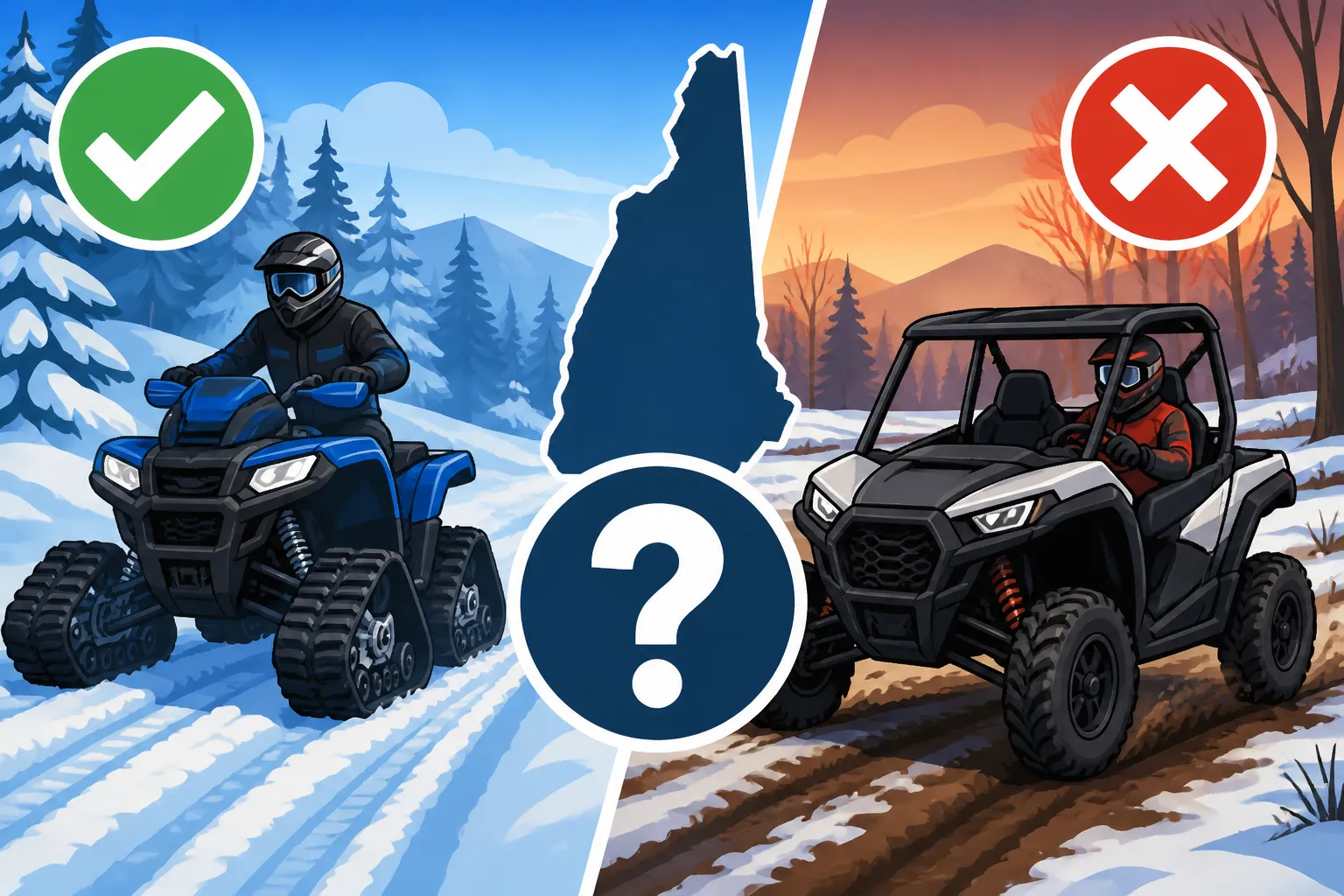
An ATV or UTV can look ready for winter once tracks are fitted, but that does not automatically make it welcome on a New Hampshire club trail. Winter access depends on the trail’s current status, the landowner’s permission, and the club’s rules for track-equipped machines. Before hauling north, confirm that the specific trail allows your machine—not just snowmobiles or other tracked vehicles.
A winter trail opening does not automatically allow ATV or UTV tracks
The short answer is: sometimes, but never assume so. A trail open to snowmobiles in winter may still be closed to ATVs and UTVs fitted with tracks. Snowmobile access, wheeled OHRV access, and track-equipped machine access can be treated differently.
New Hampshire club trails often cross private land, and permission to use a corridor is not necessarily permission to use it in every season or with every type of machine. A landowner may allow snowmobile traffic while the trail is groomed but not allow tracked ATVs. A club may also limit use to protect its trail surface or grooming work.
That means two common assumptions can lead you astray:
- “The trail is open in winter, so I can ride it.” The opening may apply only to snowmobiles or to specific uses.
- “My ATV has tracks, so it counts as a snowmobile.” Tracks do not by themselves establish that the machine is authorized for snowmobile trails.
Check the rules for the actual route you plan to ride. A trail system may include several clubs, private landowners, and different kinds of corridors. Permission in one section does not guarantee access on the next. For background on shared winter corridors, see Sharing a Corridor With Snowmobiles and New Hampshire Rules for Riding a Snowmobile Trail.
| Situation | What it tells you | What to confirm |
|---|---|---|
| A trail is shown as open for snowmobiles | Snowmobile use is allowed under current trail conditions | Whether track-equipped ATVs or UTVs are also allowed |
| A club has groomed the route | Grooming work has been done for an intended use | Whether your machine may travel on the groomed surface |
| A machine has tracks installed | The machine may be better suited to snow than with tires | Whether the club and landowner permit that machine and setup |
| The machine has a valid registration | The registration requirement may be satisfied | Whether the trail is open and your machine is approved for it |
| One trail club says yes | That club allows access on its part of the route | Whether every connecting club and landowner also allows it |
The practical rule is simple: get a clear yes for the specific machine and route before you ride. If a club’s public information says only “winter trails open,” ask what that means. Do not interpret silence as permission.
Permission, trail conditions, and machine details all matter
A club’s decision may reflect more than the season. It may depend on landowner agreements, the trail surface, grooming schedules, machine size, and the way the route connects to other trails. A machine that is acceptable on one route may be excluded from another.
Ask about the exact route and every trail connection
Start with the club responsible for the trailhead or route, then ask whether the route crosses into another club’s area. If it does, confirm the rules with each club. A route shown as continuous on a map can cross property or club boundaries where access conditions change.
Ask specifically:
- Are track-equipped ATVs allowed, track-equipped UTVs, both, or neither?
- Does permission apply to this trail and the date you plan to ride?
- Are there segments that are closed to OHRVs but open to snowmobiles?
- Do connecting clubs allow the same machine?
- Are there restrictions on machine width, weight, track setup, or passenger use?
- Is the trail groomed, and can your machine use it without interfering with grooming?
- Could a closure or landowner decision change access after you check?
A broad answer such as “the system is open” may not settle whether a particular tracked machine is permitted. Give the club the machine’s make and model, whether it is an ATV or UTV, and relevant measurements. Ask how the club determines size limits for a track-equipped machine rather than assuming the original tire width answers the question.
Winter surface conditions can change the answer
Permission to use a trail does not mean it is suitable every day. Thawing snow, soft ground, exposed rocks, drainage features, and freshly groomed surfaces can make even a legal route vulnerable to damage. Tracks may distribute weight differently from tires, but that does not guarantee the machine will leave no damage. The trail manager’s assessment and current conditions matter.
Stay off a route if it is closed, soft, or posted against your type of use. Avoid making a new path around a muddy, icy, or blocked section. Going around can damage vegetation or private property and may create a new route without permission. If trail status is unclear, check Checking the Trail Status Board and New Hampshire Trail Conditions Before You Ride, then contact the responsible club for a machine-specific answer.
A winter opening can also be temporary. A trail may close because of weather, landowner concerns, grooming work, or changing conditions. Recheck on the day you ride, especially after a thaw or heavy snowfall. Guidance on seasonal corridor access is available in Why a Snowmobile Corridor Shuts in Summer and New Hampshire Trails Open in Winter.
Keep access separate from safety and trail etiquette
Even when a machine is approved, it must be operated in a way that does not create avoidable conflict with snowmobilers, groomer operators, or other trail users. Follow posted directions, give others room, and yield as instructed. Do not ride onto a groomer’s work area or pass equipment unless the operator makes it safe to do so.
Carry the registration documents and any safety items required for your ride. A club’s permission to use a trail does not waive state rules or local restrictions. If the club asks riders to follow particular winter procedures, such as using a designated route or avoiding certain grooming periods, treat those as conditions of access.
Registration is not the same as permission to ride
New Hampshire OHRV registration and club trail access answer different questions. Registration concerns whether the machine is properly registered for use; permission concerns whether that particular machine may use that particular trail. Having one does not automatically provide the other.
Before riding, make sure you understand the registration requirement for your machine and situation. New Hampshire does not offer a separate universal trail pass that makes every route available; registration and trail permission are separate considerations. For a broader explanation, see New Hampshire OHRV Permits Explained and New Hampshire’s Club Membership and Access.
Visitors should not rely on an out-of-state registration alone
If you are bringing a machine from another state or Canada, do not assume its home registration settles New Hampshire requirements. Confirm the applicable New Hampshire registration rules before the trip, and separately ask the trail club about winter access for a track-equipped ATV or UTV. The state’s treatment of visiting machines is covered in Why New Hampshire Honors No Neighbor’s Registration.
If a track conversion changes the machine’s configuration, ask an authorized registration agent or the appropriate state office whether it affects how the machine should be registered or described. Do not rely on a seller’s claim that a conversion is automatically treated as a snowmobile, or that the machine’s original registration covers every use.
Even after registration is sorted out, you still need permission for the route. A valid decal cannot reopen a closed trail, override a landowner’s restriction, or turn snowmobile-only access into permission for an ATV or UTV.
How to confirm before you load the machine
A little preparation can prevent a wasted trip and protect a trail relationship that depends on landowner goodwill. Use this sequence before leaving home:
- Identify the exact machine. Note whether it is an ATV or UTV, its model, track setup, and relevant dimensions. If you are unsure which measurements matter, ask the club.
- Map the full route. Identify the trailhead, destination, and any connecting club areas. Do not assume a route remains under one club’s rules throughout.
- Check current trail status. Look for a winter notice, closure, or use restriction. Check again close to your ride because conditions can change.
- Contact the club responsible for the trail. Ask directly whether your specific track-equipped machine is allowed on the planned route and date.
- Check every connection. If the route crosses into another club’s system, get that club’s answer too.
- Confirm registration requirements. Resolve any questions about resident, nonresident, or converted-machine registration before you ride.
- Save the answer and follow posted signs. A written response can help you remember what was approved, but it does not override a later closure or sign.
When asking for permission, be precise. “Can I ride in winter?” is less useful than “May I ride this track-equipped UTV on this named trail from this trailhead on this date?” Explain that you plan to stay on the marked route and ask whether the answer covers the full connection. If the response is uncertain, take that as a reason to wait, not as implied approval.
A club that says no may be protecting a groomed surface, honoring a landowner’s conditions, or avoiding damage during marginal weather. Respect the decision. Riding without permission can jeopardize access for everyone, including riders who follow the rules.
The best answer is therefore not a blanket yes or no. Some New Hampshire club trails may allow tracked ATVs or UTVs in winter, while others may be limited to snowmobiles or closed to that use. Confirm the machine, route, conditions, and registration before you go; a winter trail opening alone is not enough.
Disclaimer
This article is for general informational purposes only and does not constitute professional advice. Laws, prices and regulations vary by location and change over time. Consult a qualified professional for guidance on your specific situation.