Meeting a Conservation Officer at a Northern Trailhead
A conservation officer at a northern New Hampshire trailhead may be checking more than whether your ATV or UTV has a decal. Registration, rider credentials, equipment and whether the trail is open can all matter. Knowing what to keep handy—and how to respond if an officer stops you—makes the encounter calmer and helps you avoid preventable problems.
What a Conservation Officer May Check
A trailhead check is a chance for an officer to confirm that riders and machines meet the rules for the place and conditions. The details depend on the situation, but it is sensible to be ready to show registration and any rider credentials required for the people in your group.
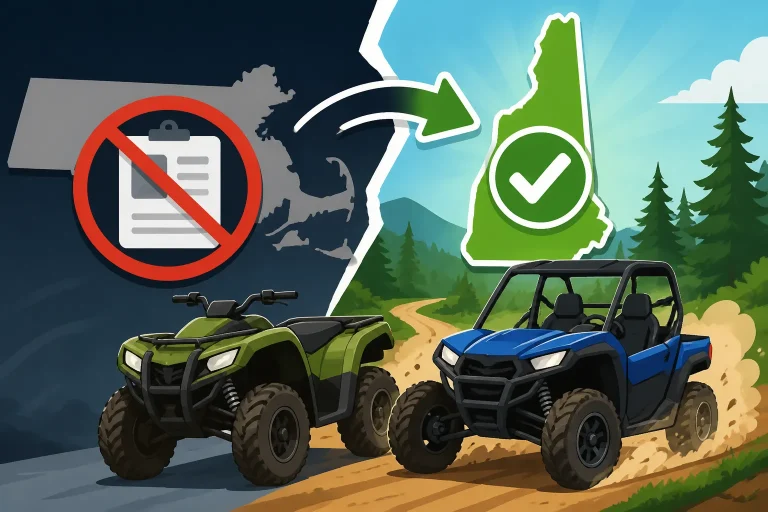
New Hampshire’s registration is not a separate trail pass: registration and access are closely connected. An out-of-state registration generally does not take the place of the New Hampshire registration required to ride here. If you are visiting, check the rules and registration options before traveling north; New Hampshire Rules for a Visiting Rider explains the visitor issue, and New Hampshire OHRV Permits Explained clarifies how registration relates to trail access.
| What may be checked | What to have ready | Why it matters |
|---|---|---|
| Registration | The machine’s current registration certificate and required decals | The machine must be properly registered for the riding you are doing |
| Rider eligibility | Proof of any required safety education and other relevant credentials | Age and license status can affect what a rider may do |
| Trail access | Current trail information and permission where required | A registered machine does not make a closed or restricted route open |
| Machine and equipment | Required equipment for the machine and riding circumstances | Equipment rules can apply even when the machine is registered |
| Group conduct | Riders’ ages, supervision and passenger arrangements where relevant | Rules may vary according to who is operating or riding on the machine |
Registration and decals
Keep the registration certificate accessible rather than buried under luggage or left in a tow vehicle. The required decals should be displayed as directed, clean enough to read and attached to the correct machine. An officer may compare the certificate with the machine and its identifying information.
A decal by itself is not a substitute for the certificate. Likewise, a document for one ATV or UTV does not establish that a second machine is registered. If you ride more than one machine, make sure the paperwork and decals match each one. See New Hampshire OHRV Decals and the Certificate for the distinction between the two, and Showing a Decal and a Certificate for what to have available during a check.
New Hampshire’s registration rules do not create a general exemption just because a machine is registered in another state. If you are bringing a machine from Maine, Vermont, Massachusetts or elsewhere, confirm the New Hampshire requirements rather than assuming your home-state paperwork is enough.
Rider credentials and age-related rules
The officer may ask about a rider’s age, safety education or license status if those details affect whether that person may operate the machine or ride without supervision. Requirements can differ by age and circumstances, so do not assume that one adult’s credentials cover everyone in a group.
For a younger rider, bring the required safety certificate and make sure the supervising adult and riding arrangement meet the applicable rules. Review New Hampshire Safety Education Requirements before the trip, especially if children or teenagers will be riding. If the machine is being operated by someone other than its owner, it is still the operator’s responsibility to understand the rules that apply to that ride.
Trail and equipment questions
Registration does not override a trail closure, a machine-width restriction or a landowner’s access conditions. An officer may ask where you are headed or whether you know the route is open. Northern trail networks can cross land with different access arrangements, and conditions can change because of weather, maintenance or landowner decisions.
Check current information before leaving the staging area. New Hampshire Trail Status Before You Ride can help you build that habit. Stay on the route you are authorized to use; riding beyond a marked trail or around a closure can create a separate problem even if your registration is current. See New Hampshire Rules for Riding Off a Marked Trail for more on that distinction.
Get Ready Before You Reach the Trailhead
A few checks at home or at the staging area can prevent a rushed search through gear while an officer waits. Make sure each machine’s paperwork is present, decals are attached correctly and riders know what documents or credentials they may need to show.
- Match each certificate to its machine. Check that you have the registration for every ATV or UTV in the group. Do not rely on a photo of another machine’s paperwork or on a registration certificate left with someone who is not riding with you.
- Check the decals. Confirm they are in the required locations and visible. If a decal has peeled off or become unreadable, resolve the problem before setting out; Replacing a New Hampshire OHRV Decal covers replacement steps.
- Review the route and its status. Verify that the trail system is open and that your machine fits any posted width limits. A route shown on an older map may not reflect a current closure.
- Confirm every rider’s eligibility. Check age, supervision and certificate requirements for the people who will operate or ride on the machines. Do this for each young rider, rather than relying on a quick assumption at the trailhead.
- Keep essential items reachable. Put the certificate and any required rider documentation somewhere protected but easy to access. A waterproof pouch can be useful, but it does not replace the original document when one is required.
- Brief the group. Agree that riders will stop together if an officer signals, avoid sudden movements and follow instructions. A group that knows the plan is less likely to scatter or create confusion.
If a certificate is missing, the machine’s registration is uncertain or a required decal is not in place, do not assume the officer will accept a verbal explanation as a substitute. Check how to correct the issue before riding. Registration and access rules are explained further in Why New Hampshire Has No Separate Trail Pass.
How to Handle the Stop
If an officer signals you to stop, do so promptly and safely. Slow down, pull over where there is room, and leave enough space for other riders and trail users to pass. If you are riding as a group, make sure the rest of the group stops safely too. Do not continue down the trail or turn away to avoid the check.
Once stopped, turn off the machine if it is safe to do so and wait for instructions. Keep your hands visible and avoid reaching suddenly into a pocket, pack or storage compartment. If you need to retrieve paperwork, tell the officer what you are reaching for and follow any directions. If you are wearing a helmet or goggles, wait for the officer’s instruction before removing them.
Be calm, direct and truthful. Provide the requested certificate or other information, and answer questions about your route or machine clearly. If you do not understand a question, ask for clarification rather than guessing. If a document is stored in another rider’s pack or vehicle, explain that plainly and ask how the officer wants you to proceed.
An officer may ask more than one person in a group for information. Do not answer for another rider unless asked, and do not interrupt while the officer is speaking with someone else. If a child is involved, a responsible adult should stay close and help the child understand the instructions without coaching them to give a particular answer.
A respectful interaction does not mean you have to agree with every explanation or conclusion on the spot. If you believe something has been misunderstood, state your concern calmly and ask what rule or requirement applies. Do not argue in the trail corridor or attempt to resolve a disagreement by riding away. If the officer issues a citation, follow the instructions provided for responding to it; you can address a dispute through the appropriate process later.
If the Officer Finds a Problem
The best next step depends on what the problem is. A missing document, an unreadable decal, a rider who does not meet the requirements and a closed trail are different issues. Listen carefully, ask what needs to be corrected and do not continue riding in a way the officer has told you is not allowed.
If you cannot produce the registration certificate immediately, explain where it is and ask what the officer requires. Do not claim that a machine is registered unless you know that it is. The officer may need to verify information or may give you instructions about what you can do next. A missing certificate does not make it safe to assume the ride can continue unchanged.
If the machine is not properly registered, stop using it on the trail until the issue is resolved. Penalties may apply for riding without registration, and the practical consequences can depend on the circumstances. New Hampshire Fines for Riding Without Registration discusses that risk; do not treat a possible fine as permission to ride without meeting the requirement.
If a rider’s age, supervision or safety credentials are at issue, do not try to fix the situation by having a different person take over in a way that still violates the rules. Ask what arrangement is permitted and follow the officer’s directions. Before your next outing, confirm the age and supervision requirements for that rider.
If the concern is a closed trail, width restriction or access permission, turn around or use an authorized route as directed. A current registration does not grant permission to cross private property, travel around a barrier or use a route that is closed. In the North Country, a short detour can cross land that has different access rules, so check the route rather than improvising.
After the encounter, note what you need to correct while the details are fresh. That might mean obtaining the proper registration, replacing a decal, reviewing a young rider’s eligibility or checking trail status more carefully before the next trip. If you receive a citation or are unsure what the officer’s instruction means, use the official contact or appeal information provided with the paperwork instead of relying on a guess.
Disclaimer
This article is for general informational purposes only and does not constitute professional advice. Laws, prices and regulations vary by location and change over time. Consult a qualified professional for guidance on your specific situation.