Why an Unposted Field Is Still Off Limits
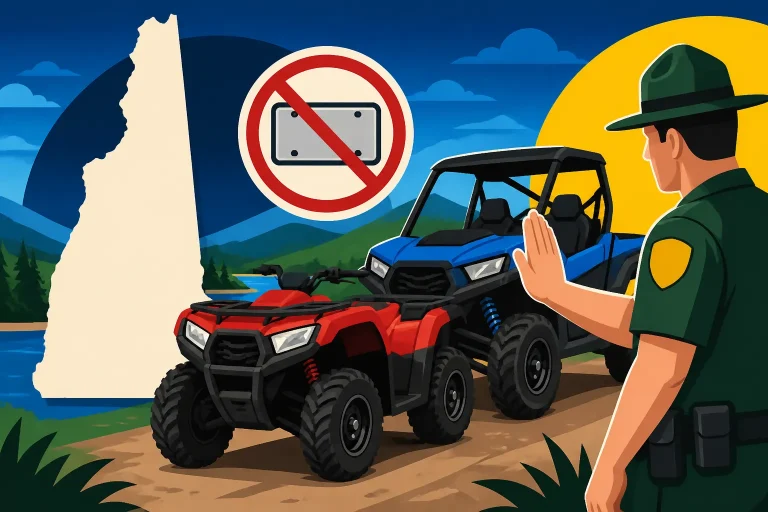
An open field can look like an easy shortcut between New Hampshire trails, especially when there is no fence or sign in sight. But an unposted field is not automatically open to ATV or UTV riding. The key question is whether you have permission to be there—and whether that permission covers the route you plan to take.
Why no sign does not mean you have permission
A missing “No Trespassing” sign is not a reliable invitation to ride. Land can be privately owned whether or not its boundaries are marked, and a field that looks unused may still be part of a farm, a home, a timber parcel, or land managed for another purpose. A rider should not assume that a lack of signs means a landowner has agreed to OHRV use.
Permission and posting are different things. A sign can make a restriction especially clear, but its absence does not establish that you have permission. The safe approach is to identify who controls the land and ask before entering. Why Unposted Land Is Not an Invitation
This matters even if you only intend to cross the field briefly. Riding through to reach a trail, get around a muddy spot, or meet another group is still entering and using the property. The same applies if you plan to stop for a moment, turn around, or follow tire tracks left by other riders. Tracks do not prove that the route is authorized or that the person who made them had permission.
There may be more at stake than the legal question of access. A field can contain crops, drainage features, stone walls, irrigation lines, livestock, or soft ground that is easily damaged. A machine can leave ruts, disturb animals, or damage property even during a short crossing. What looks like firm, empty ground from the trail may be wet or fragile up close.
The practical rule is simple: if you do not know that you are allowed to ride on the land, do not ride onto it. Riding Private Ground in New Hampshire
Permission can come from the person who controls the land
The person you need to ask is the owner or someone with authority to grant access. That may not be the nearest householder, the person who maintains a gate, or another rider who says the route is fine. Ownership and management can be complicated, so ask someone who can actually authorize recreational use.
If you are unsure where one parcel ends and another begins, do not guess at the boundary. A field, woods road, or driveway can cross multiple properties. Permission from one landowner does not automatically carry over to a neighboring parcel.
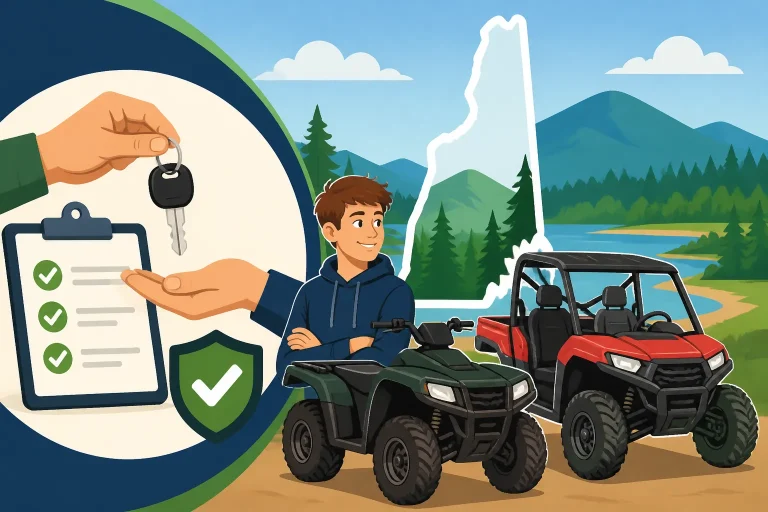
Verbal permission may be enough for a landowner to tell you that you can ride, but written permission is often more practical. It can help avoid misunderstandings about the route, dates, machines, group size, or conditions. For guidance on documenting an agreement, see New Hampshire Written Permission Requirements and Getting a Landowner’s Signature in New Hampshire.
Ask for permission that matches what you plan to do. Approval to cross one edge of a property does not necessarily mean you may ride around the whole field, bring a group, return later, or use a different route. Confirm the details rather than treating a general “go ahead” as unlimited access.
| Situation | What to do |
|---|---|
| You see an open field with no signs | Treat access as unconfirmed; stay out until you have permission |
| Another rider says the field is open | Verify with the person who controls the land |
| You have permission to cross a specific area | Stay on the agreed route and follow any conditions |
| A trail appears to continue across private land | Confirm that the route is an authorized trail |
| You reach a gate, barrier, or closed route | Stop; do not go around it unless the land manager says you may |
| You are not sure where the property boundary lies | Turn back or verify the boundary before riding |
A registration or nearby trail does not create access
An OHRV registration is not permission to ride on every piece of land in New Hampshire. It concerns the machine’s registration status; it does not give the registrant a right to cross private property. Likewise, being properly equipped or having the right paperwork does not make an unauthorized route lawful.
That distinction can be easy to miss when a field seems to connect two trail sections. A nearby marked trail does not mean that every adjoining field is part of the trail network. A route may use a specific corridor across private land with the landowner’s consent, while the rest of the property remains off limits. Follow the marked route and do not expand it because the ground looks rideable. For more on the difference between registration and trail access, see Club Trail Access in New Hampshire.
The same caution applies to a machine that is registered in another state. Reciprocity questions and land access are separate issues: even if a visitor has handled the machine’s registration requirements, that does not grant permission to use private land. Riding New Hampshire With an Out-of-State Machine
Use the authorized route, not the easiest-looking route
An approved trail may bend around a field, follow a woods road, or pass through a narrow corridor. The detour may seem unnecessary, but it can exist because the landowner approved that route and not a broader area. Cutting across the open ground can take you beyond the permission that makes the trail available.
Do not follow an unmarked shortcut just because it saves a few minutes. If trail markers become unclear, stop and check your map or the trail information provided by the responsible club or land manager. If you cannot tell whether you are still on the designated route, turn back to the last clear marker rather than exploring across private land.
A route that appears on a map also deserves a closer look if conditions have changed. A landowner may withdraw permission, a club may close a section, or a trail may be rerouted. Check current trail status before setting out, and respect closure notices even if the ground itself appears passable. For related guidance, see New Hampshire Rules for Riding Off a Marked Trail.
Your own property does not make adjoining land fair game
Permission to ride on your own land generally applies only to the property you own or control. It does not extend across a neighbor’s field, a shared access road, or a strip of land between your property and a trail. If your usual route leaves your parcel, get permission for the part that is not yours.
Registration rules may also apply depending on where you ride. Riding entirely on your own property and leaving it for a road, trail, or another parcel are different situations. If you are relying on a private-property exception, verify how the rule applies to your circumstances rather than assuming it covers a trip beyond your boundary. When Leaving Your Own Property Requires a Registration
Publicly owned land is not automatically open for any kind of OHRV use, either. Access rules can depend on the land manager, the location, and whether an established route is open to machines. A public field or wooded area should not be treated as a free-riding area without checking the applicable rules. See New Hampshire Rules for Riding State Land for that separate issue.
What to do before crossing a field
If a field appears to offer a shortcut, pause before entering. A few checks can prevent an argument with a landowner, damage to property, or a ride that ends in a citation or trail closure.
- Look for signs, barriers, and trail markers. A lack of signs does not give permission, but signs or a closed gate are clear reasons not to proceed without authorization. Markers can help show where an approved trail runs; they do not necessarily authorize riding elsewhere on the parcel.
- Identify the land manager. Ask the relevant owner, club, or land manager rather than relying on assumptions or secondhand claims. If you cannot identify who can authorize access, stay on a route you know is open.
- Ask about the exact route and activity. Explain where you want to enter and exit, what kind of machine you will use, when you plan to ride, and whether you will be alone or with a group. Ask about speed limits, gates, seasonal restrictions, and areas to avoid.
- Keep a record of the permission. If access is important to your ride, get the route and conditions in writing. Keep a copy available and make sure everyone in the group understands the limits.
- Stay on the approved route. Do not widen the route, ride through crops, leave the marked corridor, or let another group follow you into an area that was not included in the permission.
- Turn around if permission is unclear or withdrawn. Do not argue at the field edge or assume that prior access still applies. A landowner can set conditions for access and may change them.
A landowner may allow one person to cross a particular strip without opening the property to other riders. That is why “someone said it was okay” is not enough unless that person had authority and the permission applies to your machine and route. New Hampshire Written Permission Requirements
If a route crosses several properties
A trail or connector may pass through land controlled by more than one owner. Permission for one section does not automatically authorize the next. The club or trail manager may be able to clarify which parts of the route are established and whether they are currently open.
This is especially important when a route crosses a field, a logging road, or a corner of private land between two trail segments. Do not assume that a visible trail line or old tire marks mean every segment remains approved. Crossing a Corner of Private Land Between Trails
If a landowner tells you to leave, leave promptly and calmly. Do not continue riding while trying to negotiate, and do not treat an earlier invitation as permission to ignore a new restriction. If you believe the route is an established club trail, contact the club or manager afterward to confirm its status.
How to avoid turning a shortcut into a bigger problem
Respecting private boundaries helps protect access for other riders. Many trail networks depend on landowners who agree to allow a designated route across their property. An unauthorized crossing can damage the relationship that keeps that route open, and a landowner’s decision can affect more than one rider or one day’s trip.
Make a route plan that uses trails you know are open. Check the current status before departure, carry a suitable map, and leave enough time to turn back if a connection is closed or unclear. If a route becomes blocked, do not make your own detour through a field. Return to an authorized trail or use another route that has been confirmed as open.
When asking for permission, make it easy for the landowner to understand what you are requesting. Be specific about the location, timing, number of machines, and whether you want a one-time crossing or ongoing access. Accept limits without treating them as an invitation to negotiate on the trail. If the answer is no, choose another route.
The distinction to remember is straightforward: an unposted field may be physically accessible, but that does not make it an authorized OHRV route. Confirm permission, remain within its boundaries, and use only trails that are open to your machine. When access is uncertain, staying out is the safest choice.
Disclaimer
This article is for general informational purposes only and does not constitute professional advice. Laws, prices and regulations vary by location and change over time. Consult a qualified professional for guidance on your specific situation.