New Hampshire Rules for a Machine on a Frozen Lake
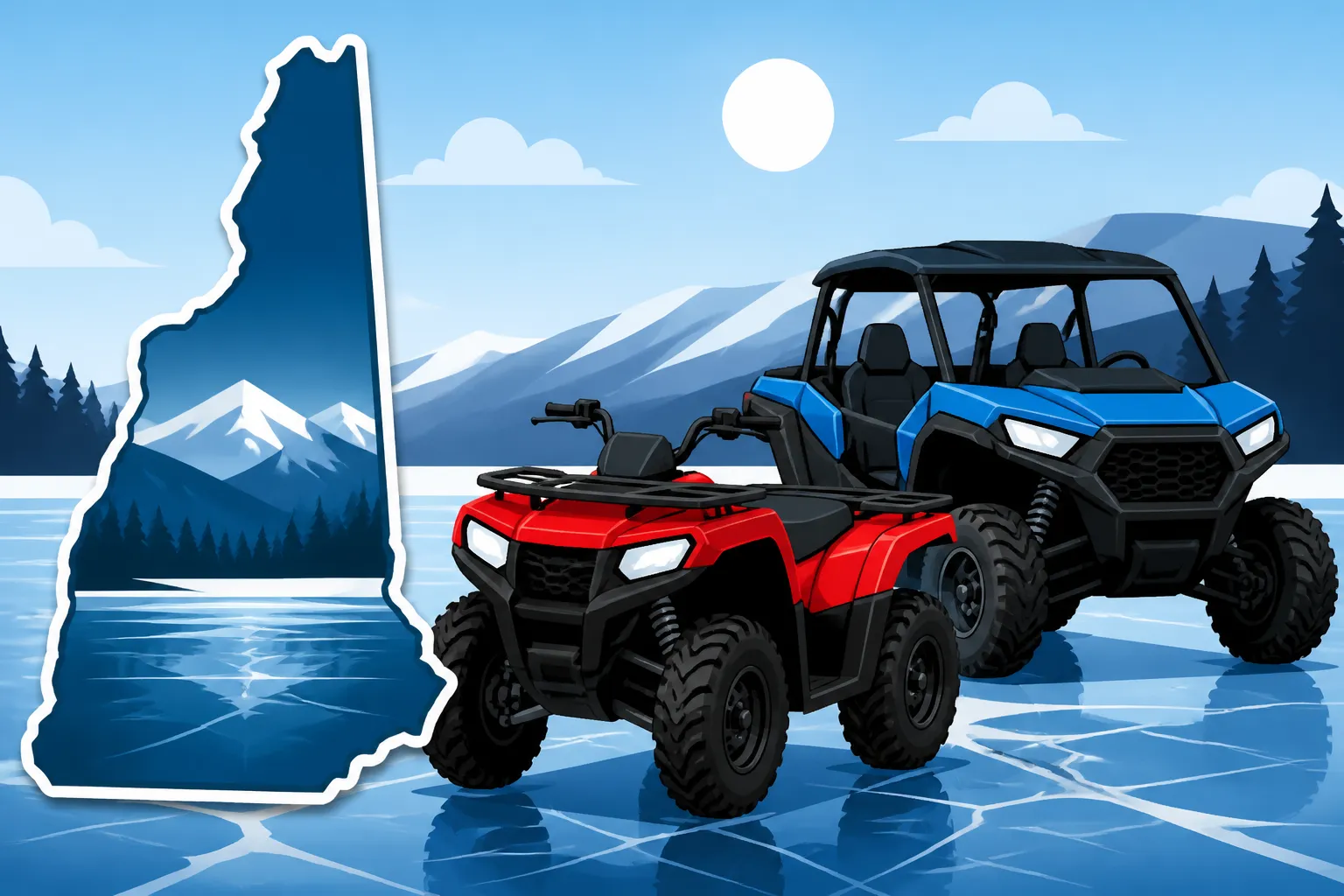
A frozen lake can look like an open riding area, but the ice does not make it a trail or guarantee that motorized travel is allowed. New Hampshire treats riding on frozen public water as a risk the operator accepts, and the state can close areas to motorized vehicles. Here’s how to think through registration, closures, and what to check before you head out.
What New Hampshire says about riding on frozen public water
According to the New Hampshire Fish and Game Department, operating a snowmobile or OHRV on the frozen surface of any public body of water is entirely at the operator’s own risk. If an accident happens, the state, city, or town is not legally responsible for the resulting accident.
That is a significant distinction from simply riding on a designated trail. The fact that a lake is frozen, or that you can see tracks on it, does not mean the surface is safe for your machine. Nor does the state’s disclaimer say that ice conditions have been checked or that a route across the water is suitable. The operator is accepting the risk of the ride.
The New Hampshire Fish and Game Department can also temporarily close all or part of a frozen water body’s surface to motorized vehicles in the interest of public safety. The exception specified by the department is fishing on foot. In other words, the closure authority described here concerns motorized use; it does not prohibit fishing on foot under that particular closure provision.
Before you take a machine onto ice, keep these points in mind:
- A public body of water may be subject to a temporary motorized-use closure.
- A closure can apply to all or only part of the frozen surface.
- Riding on the frozen surface is at the operator’s own risk.
- A visible track or another rider’s presence does not confirm that the route is open or safe.
- Fishing on foot is the stated exception to the temporary closure power for motorized vehicles.
The practical takeaway is to treat access and ice safety as separate questions. A lake may not be closed to motorized vehicles, but the operator still accepts the risk of being on the ice. Conversely, confidence in the ice does not override a closure. For a closer look at the riding considerations, see Riding a Frozen Lake in New Hampshire and Ice Thickness Before You Ride.
Registration still matters on the lake
A lake ride is still operation of a motorized vehicle away from the owner’s property. According to the Town of Newmarket, NH, all snowmobiles and OHRVs must be registered if operated in New Hampshire off the owner’s property. A public frozen lake does not become the owner’s property simply because it is covered in ice, so a rider should not treat lake travel as a registration-free exception.
The Town of Newmarket also states that New Hampshire OHRVs and snowmobiles are not titled. It says that a title, bill of sale, or previous registration is not required to register. That can be useful if you are preparing to register a machine before a winter trip, especially if you bought it privately or have incomplete paperwork. For more detail on the application process, see New Hampshire OHRV Registration Paperwork.
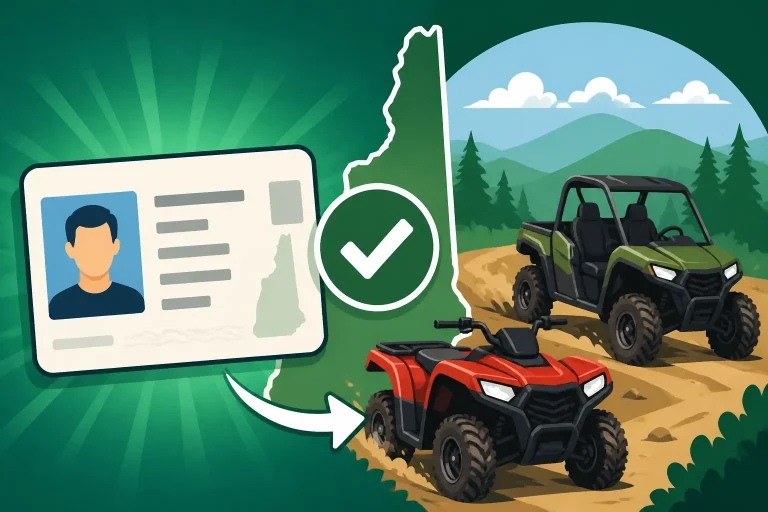
The registration process has eligibility and identification requirements. According to the Town of Newmarket, the owner registering an OHRV or snowmobile must be at least 18 years old, apply in person, and present a valid driver’s license or non-driver photo ID. Applicants seeking resident rates must present a valid New Hampshire driver’s license or New Hampshire non-driver photo ID.
The Town of Newmarket says the vehicle information required includes:
- Year of manufacture
- Make and model
- Displacement
- Primary and secondary colors
- Vehicle identification number
The owner also needs appropriate proof of club membership to qualify for an applicable member rate, according to the Town of Newmarket. Membership proof affects eligibility for that rate; it does not replace the registration requirement itself.
| Question | What to keep in mind |
|---|---|
| Does a frozen lake remove the registration requirement? | No. The Town of Newmarket says OHRVs and snowmobiles must be registered when operated off the owner’s property in New Hampshire. |
| Does New Hampshire title OHRVs and snowmobiles? | No, according to the Town of Newmarket. |
| Is a title, bill of sale, or prior registration needed to register? | The Town of Newmarket says these are not required. |
| Who can register the machine? | The owner must be at least 18, apply in person, and show valid photo identification, according to the Town of Newmarket. |
| Does registration prove the ice is safe or the lake is open? | No. Registration and current lake conditions or closures are separate matters. |
Registration is not a safety check, a confirmation that ice is suitable, or permission to ignore a closure. It is one part of preparing to operate legally. The separate questions—whether a motorized closure is in effect and whether conditions are acceptable—still need attention.
If the machine came from another state, do not assume that an out-of-state registration settles every New Hampshire requirement. The available rules here establish that New Hampshire registration applies to OHRVs and snowmobiles operated off the owner’s property, but they do not explain every reciprocity situation. Check the details for your machine before traveling; Registering an Out-of-State Machine in New Hampshire covers that issue.
Check for closures and changing conditions before you ride
The New Hampshire Fish and Game Department may temporarily close all or part of the frozen surface of a public water body to motorized vehicles for public safety. Because closures can be limited to a portion of the water, checking only whether a lake is generally open may not be enough. Confirm the current status of the area you actually intend to use.
For trail openings and closures, the Town of Newmarket directs riders to the New Hampshire Bureau of Trails. That is useful for trail-system information, but a lake closure is a distinct matter: the New Hampshire Fish and Game Department is the agency whose stated authority includes closing frozen water surfaces to motorized vehicles. If your plan includes riding from a trail onto a lake, check both the trail information and any applicable lake closure information. For general preparation, see New Hampshire Trail Status Before You Ride and New Hampshire Rules for Riding in Winter.
A sensible pre-ride check can be simple:
- Confirm that the public water body, or the part you plan to cross, is not closed to motorized vehicles.
- Check trail opening and closure information if you will use trails to reach the lake.
- Make sure the machine is registered if it will be operated off the owner’s property.
- Consider whether conditions have changed since you last checked.
- Be prepared to turn around if you encounter a closure or conditions that make continuing unsafe.
A trail connection does not necessarily mean that every nearby area is open to motorized use. Likewise, a lake that appears accessible from shore may have a closed section or conditions that change across its surface. Avoid treating a route on a map, a set of tracks, or a past visit as current confirmation.
For trail and closure questions, contact the New Hampshire Bureau of Trails. For registration questions, contact NH Fish and Game, as directed by the Town of Newmarket. Those are different questions, so contacting the right agency can save time: trail-system status belongs with the Bureau of Trails, while registration questions belong with NH Fish and Game.
How to plan a lake ride without confusing access, fees, and risk
It helps to separate three issues that are easy to blur together: registration, access, and physical risk. Registration concerns whether the machine is properly registered for use away from the owner’s property. Access concerns whether motorized use is open in the specific area. Risk concerns what can happen while operating on frozen water.
According to the Town of Newmarket, there are no additional trail user fees in New Hampshire, as of November 2026. That statement addresses additional trail-user fees; it should not be read as proof that a particular lake is open, that ice is safe, or that every type of site use is free. A fee question and a closure question are not interchangeable.
If ownership has changed, check registration before you ride. According to the Town of Newmarket, when ownership transfers, the registration and decals on the machine are no longer valid. The new owner must register the machine in their own name. A seller’s registration therefore should not be treated as something that automatically carries over to the buyer. More on the transfer process is available in Buying a Used ATV in New Hampshire and Selling an OHRV in New Hampshire.
A practical preparation sequence is:
- Sort out the machine’s registration. Confirm that the person who owns it has completed the applicable registration process before operating it off their property.
- Check the lake’s motorized-use status. Look for current information about temporary closures, including closures that cover only part of the frozen surface.
- Check the route to the water. If you are using trails to reach the lake, verify trail openings and closures with the New Hampshire Bureau of Trails.
- Make your own risk decision. The New Hampshire Fish and Game Department states that operating on frozen public water is entirely at the operator’s own risk. A lack of a posted closure is not a guarantee of safe ice.
- Be ready to change plans. If you cannot confirm the route is open, or conditions do not look acceptable, do not assume you can proceed because another rider has gone ahead.
These steps cannot remove the risk of riding on ice. They can, however, prevent a common planning mistake: assuming that registration means access, or that access means safety. Each needs to be considered independently.
If the machine is a snowmobile rather than an ATV or UTV, the same frozen-water risk statement applies. The New Hampshire Fish and Game Department describes the rule for snowmobiles and OHRVs, while the Town of Newmarket states that both must be registered when operated in New Hampshire off the owner’s property. For a related overview of riding on frozen water, see Riding a Frozen Pond in February.
Sources
- Town of Newmarket, NH — OHRV Registration | Newmarket, NH (checked November 3, 2026)
Disclaimer
This article is for general informational purposes only and does not constitute professional advice. Laws, prices and regulations vary by location and change over time. Consult a qualified professional for guidance on your specific situation.