New Hampshire Fines for No Registration
An ATV or UTV ride can turn into an expensive problem if the machine needs registration and you cannot show it. The rules depend on where you ride, and an out-of-state registration may not be enough. Here’s what can lead to a no-registration citation in New Hampshire, what to do if you receive one, and how to avoid the issue before your next ride.
When New Hampshire Requires ATV or UTV Registration
In New Hampshire, an ATV or UTV generally needs a valid OHRV registration to be operated on public trails and other places where OHRV registration is required. OHRV means off-highway recreational vehicle. The category includes many ATVs and side-by-sides, though a machine’s design and use can affect how it is classified. Check the applicable rules if you are unsure whether your particular machine qualifies.
Registration is not the same as permission to ride. A registered machine still must be used on a route that is open to it, and riders must follow local access rules. Conversely, permission to use a trail does not necessarily remove the registration requirement. The machine’s registration, the trail’s access rules, and any landowner permission are separate questions.
| Situation | What to check |
|---|---|
| Riding an open public OHRV trail | Whether the machine has a valid New Hampshire registration and required decals |
| Riding on private land | Whether registration is required for that location and whether you have the landowner’s permission |
| Visiting from another state | Whether New Hampshire requires a New Hampshire registration for the ride |
| Riding a rental | Whether the rental is registered and what documents or equipment the rental company requires |
| Riding a town road or crossing a road | Whether that specific road is open to OHRVs and what additional rules apply |
A frequent source of confusion is assuming that a registration from another state automatically carries over. New Hampshire’s rules for visitors can require a New Hampshire registration even when the machine is registered at home. Before heading out, check Why New Hampshire Honors No Neighbor’s Registration and Riding New Hampshire With an Out-of-State Machine. Do not rely on a plate or registration document from another state as proof that the machine can ride New Hampshire trails.
Private land can also be misunderstood. A landowner’s permission and the registration requirement are not interchangeable. The answer may depend on where the land is, how the machine is being operated, and whether the route includes public property or a trail open to OHRVs. For more on access, see Riding Private Ground in New Hampshire and New Hampshire Written Permission Requirements. If your ride leaves private property, even briefly, check the rules for every part of the route.
Registration also does not grant blanket access to every trail. Trails can be closed seasonally, limited by machine width, or restricted to particular vehicle types. Confirm that the route is open and suitable for your machine before riding. New Hampshire Trail Status Before You Ride is useful when you are planning a trip, while New Hampshire Trails for a Wide Machine can help you check width limits.
What a No-Registration Citation Can Mean
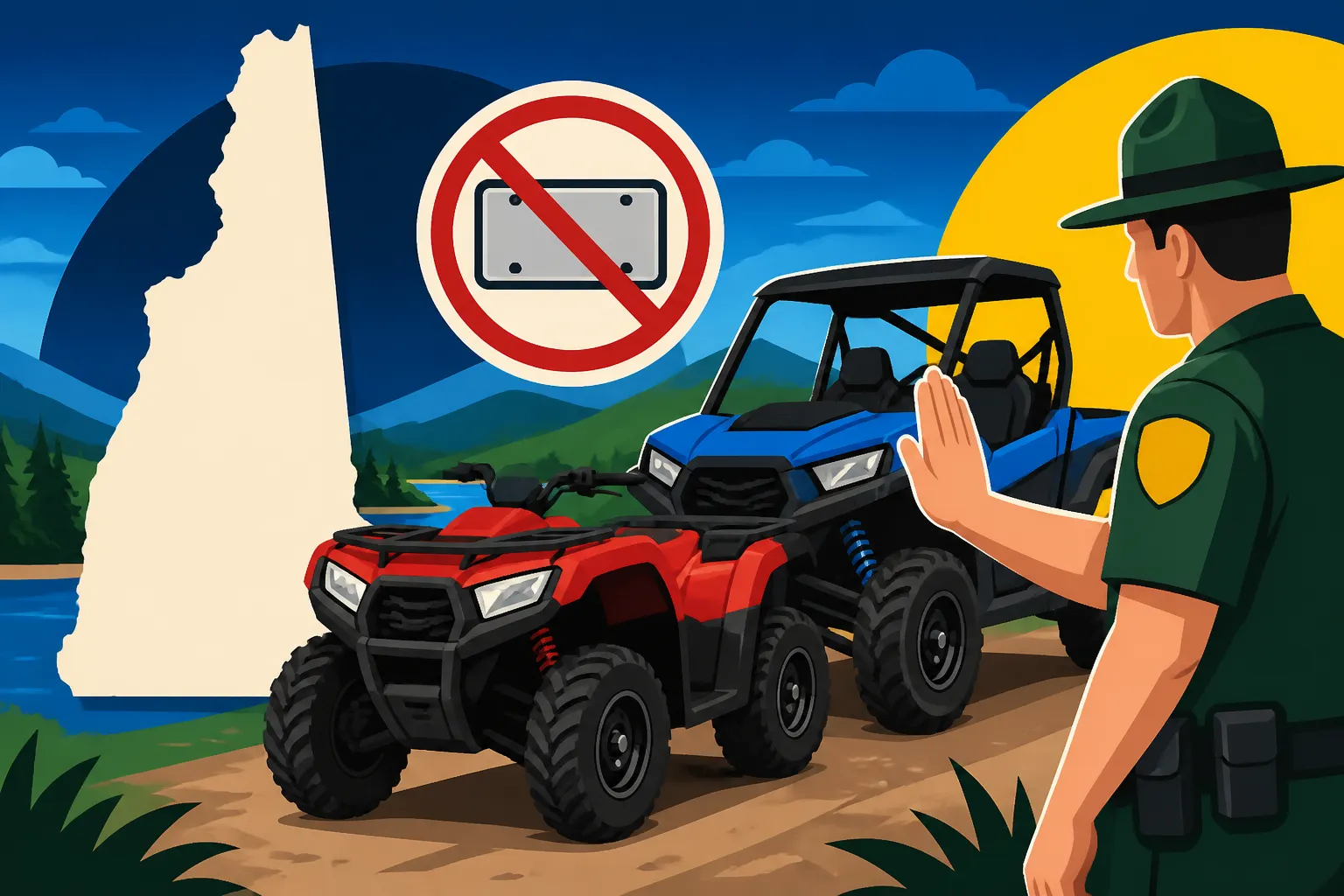
A rider who operates an OHRV without the required registration may be cited. The amount and consequences can depend on the circumstances and the applicable enforcement process, so there is no safe assumption that every no-registration situation will produce the same result. A first-time mistake, a visitor’s misunderstanding, and a deliberate decision to ride without registering are not necessarily handled identically.
A citation is not simply a request to pay the registration fee. The registration charge and any penalty are separate matters. Buying a registration after a stop may help you comply for future rides, but it does not automatically cancel a citation already issued. Follow the instructions on the citation and contact the issuing authority or court if you need to understand how to respond.
The rider may need to deal with other issues as well. For example, an officer may ask to see the registration certificate or check whether the decals are properly displayed. If a machine is registered but the rider cannot produce the required proof, that may raise a different issue from operating a machine that has never been registered or whose registration is no longer valid. Do not assume that one situation is treated exactly like another. See New Hampshire OHRV Decals and the Certificate for the distinction between the registration paperwork and the decals.
A stop may also reveal a separate violation, such as riding on a closed route or using a road that has not been opened to OHRVs. Registration does not make an otherwise prohibited ride legal. If an officer identifies more than one concern, ask politely what each citation or notice refers to, and read each document carefully. Information about unregistered riding is available in New Hampshire Fines for Riding Without Registration, and broader trail issues are covered in [New Hampshire Fines for a Trail Violation].
Do not guess at the fine, deadline, or hearing process based on a friend’s experience. Requirements can depend on the specific notice and may change. Read the citation for the response date and instructions, then confirm details with the court or agency named on it. Missing a deadline can create a new problem, even if the original citation was caused by a simple misunderstanding.
A citation also does not establish that the rider’s explanation will be accepted. If you believe the machine was properly registered, the registration was not required for that location, or the notice contains an error, gather supporting documents and follow the formal process. Keep your account factual and respectful. Avoid altering documents, ignoring notices, or assuming that a conversation at the trailhead replaces the required response.
What to Do If You Are Cited
A calm, organized response gives you the best chance of understanding what happened and meeting any deadline. These steps are general; the citation itself and the instructions from the responsible agency control your next actions.
-
Read the entire citation. Note the alleged violation, date, location, response deadline, and contact details. Check whether the notice directs you to pay, appear, or take another action. If any part is unclear, ask the listed court or agency rather than relying on a general online explanation.
-
Write down what happened while it is fresh. Record where you were riding, how you reached the location, what the officer said, and what documents you showed. Keep the account factual. If other people witnessed the stop, note their names and contact information.
-
Collect relevant records. Save your registration certificate, proof of purchase, any correspondence, and photographs that may help establish the machine’s status or location. If you were riding a rental, keep the rental agreement and ask the company for documentation showing the machine’s registration. Do not edit or change records.
-
Check the machine’s registration status. Confirm that the registration belongs to that machine and was valid on the ride date. A registration for a different machine, an expired registration, or paperwork that cannot be matched to the vehicle may not resolve the issue. If a machine was recently bought or transferred, review New Hampshire OHRV Registration Paperwork and Transferring a Registration to a New Machine.
-
Follow the response instructions. If you dispute the citation, use the process stated on the notice and bring or submit the documents requested. If you accept the violation, comply with the instructions by the deadline. If you are unsure what response is appropriate, contact the listed authority or speak with a qualified professional.
-
Fix the registration issue before riding again. Do not assume that getting the registration after the stop covers earlier riding or that an application alone authorizes you to use the trail. Wait until the registration is valid and you have the required certificate and decals. For the process, see Registering an OHRV in New Hampshire.
If you were visiting New Hampshire, check the rules before your next ride rather than assuming your home-state paperwork is enough. A nonresident registration option may be available for certain circumstances, but eligibility and terms matter. The short-term option is explained in New Hampshire’s Ten-Day Nonresident Registration. If you expect to return often, compare that option with the annual registration rules in When a Frequent Visitor Should Buy the Annual.
If the citation appears to involve decal placement rather than a missing registration, check the machine and paperwork before assuming the registration itself is invalid. Decals that are loose, damaged, or displayed incorrectly can create avoidable confusion during a stop. See New Hampshire OHRV Decal Placement and Replacing a New Hampshire OHRV Decal.
How to Avoid a No-Registration Problem
The most reliable approach is to confirm the rules before the machine is unloaded at a trailhead. Start with the location: identify the trail or land you plan to ride, confirm that it is open, and check which vehicle types it allows. Then confirm the machine’s registration status and make sure the registration applies to that vehicle and ride.
For a New Hampshire registration, keep the certificate with the machine or rider as required and display the decals according to the instructions. Make sure the certificate matches the machine’s identifying information. If the registration paperwork is lost, damaged, or does not match after a sale or transfer, resolve that before riding. New Hampshire OHRV Registration Paperwork and Replacing Lost New Hampshire Decals cover common documentation problems.
Visitors should check reciprocity specifically rather than treating a home-state registration as universal permission. A machine may be properly registered where it is normally kept and still need a New Hampshire registration to ride here. Confirm which registration option applies to your trip, where it can be obtained, and what proof you must carry. A short ride is not automatically exempt just because you are in the state briefly.
Rental customers should ask the rental company what registration and documents are supplied, and where the machine is allowed to go. Do not assume that the rental’s registration covers every trail or that it replaces the need to follow local restrictions. If you are borrowing a machine from a friend, ask to see its current paperwork and confirm that it is valid for the intended ride.
Finally, keep the different permissions straight. Registration addresses whether the vehicle is registered for operation; it does not replace a trail opening, local road designation, landowner permission, or compliance with rider and equipment rules. Check each requirement separately. That small amount of preparation is easier than sorting out a citation after a ride.
Disclaimer
This article is for general informational purposes only and does not constitute professional advice. Laws, prices and regulations vary by location and change over time. Consult a qualified professional for guidance on your specific situation.