New Hampshire Rules for a Rider Aged 15
A 15-year-old may be able to ride an ATV or UTV on New Hampshire trails without an adult beside them, but age alone does not settle the question. Safety education, registration, helmets, machine rules and road access all matter. Here’s how to check what a 15-year-old needs before heading out, and where trail rules differ from road rules.
What a 15-Year-Old Needs Before Riding
In New Hampshire, a 15-year-old riding an OHRV should have the required safety qualification or a qualifying driver’s license. A safety certificate is not the same thing as permission to ride anywhere: it addresses rider education, while registration and land-access rules still apply.
A rider who has not yet turned 16 should plan on having a valid OHRV safety certificate unless they hold a driver’s license that satisfies the requirement. The state’s New Hampshire Safety Certificate at Twelve explains the minimum age and qualification process. A driver’s license may serve as an alternative under the applicable rules, as covered in When a Driver’s License Replaces the Safety Certificate.
The practical checklist is:
- Confirm the rider’s qualification. Bring the safety certificate or qualifying license. If the rider has neither, do not assume being accompanied by an adult makes the ride legal.
- Check the machine’s registration. The ATV or UTV needs the registration required for the place and type of riding. A parent’s registration for another machine does not automatically cover it. See When New Hampshire Registration Applies and New Hampshire OHRV Registration for Two Machines.
- Check the exact route and land access. A trail, town road, private parcel and state-owned property can have different rules. An open trail nearby does not mean every connecting road or piece of land is open.
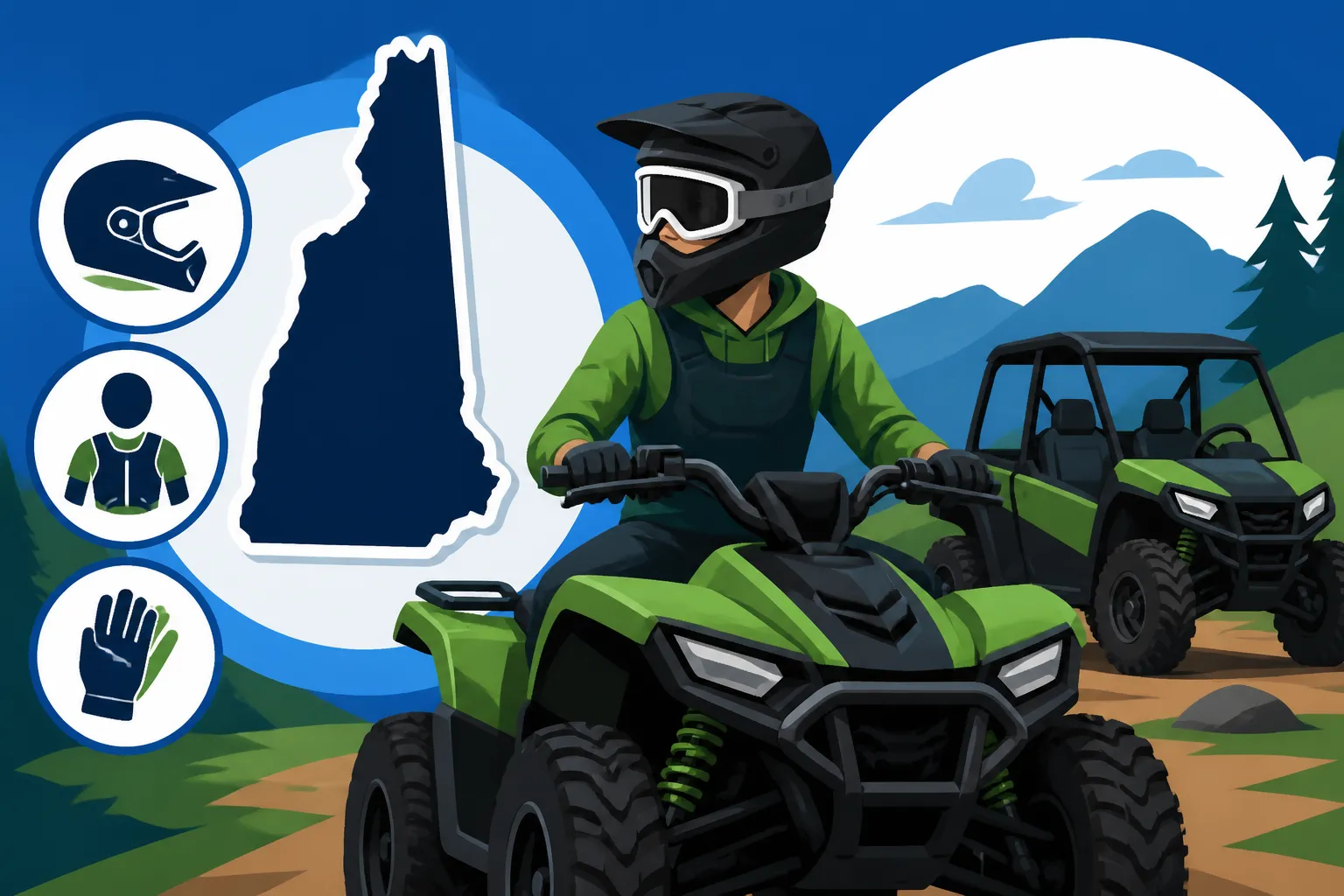
- Wear the required protective equipment. Riders under 18 must wear a helmet. Eye protection is also generally required unless the machine has a qualifying windshield. Review New Hampshire Helmet Law for OHRV Riders and New Hampshire Eye Protection Requirement.
- Confirm who must ride along. A 15-year-old’s qualification may allow independent trail riding in situations where a younger rider would need supervision. Road riding and other circumstances can bring separate companion requirements.
A parent or guardian should verify the rider’s certificate, registration and route before departure. Carrying the certificate and registration information can also make a roadside check easier. The rider should know where those documents are and how to show them, rather than relying on an adult to handle every question.
Can a 15-Year-Old Ride a Trail Alone?
A 15-year-old who meets the safety qualification requirement may generally ride an eligible public OHRV trail without an adult riding alongside. That is an important distinction from the rules for younger children. It does not mean every 15-year-old can ride every machine, trail or road alone.
The machine must be appropriate for the rider, properly registered and allowed on the particular route. Trails may have width limits, seasonal closures, operating restrictions or local conditions that affect access. A machine that is legal on one trail may not fit through another trail’s gate. Check the trail operator’s rules and status before driving to the trailhead.
The age distinction is easy to misread. The requirements for riders aged 12 and 13 are not necessarily the same as those for riders aged 14 and 15. A 15-year-old should not rely on advice meant for a younger child, or assume that reaching 15 removes every supervision requirement. For context, see Riders 14 and 15 Alone on New Hampshire Trails and New Hampshire Age Rules for OHRV Riders.
Riding with friends or family
A 15-year-old riding without an adult should have a practical plan, not just a legal qualification. Agree on a route, a return time and a check-in plan. Make sure the rider can operate the machine safely, understands trail signs and knows how to stop or turn back if conditions change.
For a group ride, an adult should still take responsibility for planning and communication even if the teen is allowed to operate independently. Riders can become separated at intersections, trail closures or staging areas. A phone may not work throughout a remote trail system, so do not make cell service the only emergency plan.
A parent should also consider the teen’s experience and the machine’s handling. A powerful or heavy machine can be difficult to control, especially on uneven ground, steep grades or loose surfaces. Legal eligibility does not establish that a particular machine is a good match for a rider’s size, judgment or skill.
Roads, Crossings and Private Land Are Different
Permission to ride a trail alone does not automatically allow a 15-year-old to ride along a road. New Hampshire road access for OHRVs depends on the type of road, local authorization, signs and the state’s operating rules. Many roads are closed to OHRVs unless specifically opened or designated. Start with Why New Hampshire Roads Are Closed by Default and How a New Hampshire Town Opens Its Roads.
A road that appears to connect two trails may still be closed. Even where OHRV road use is allowed, riders may have to follow specific requirements for the road, equipment, speed, crossings and companions. A teen without a driver’s license should be especially careful not to assume that a safety certificate is equivalent to a license for every road-use rule. See Why an Unlicensed Rider Needs a Companion at Any Age and What New Hampshire Requires to Cross a Road.
When a legal route requires crossing a road, the crossing is not the same as riding down it. Riders need to follow crossing rules, stop where required and use an authorized crossing. A trail map or route shown by a friend is not proof that a road segment is open. Look for current signs and local information before the ride.
Private land is another separate issue. A registration or safety certificate does not grant permission to cross someone’s property. Get permission from the landowner before riding private ground, and respect signs, gates and any limits on where or when riding is allowed. Details are in New Hampshire Written Permission Requirements and Why Unposted Land Is Not an Invitation.
For a 15-year-old’s route, check each part separately:
| Route or location | What to confirm |
|---|---|
| Public OHRV trail | Trail is open, machine is allowed, registration is valid, and rider meets qualification rules |
| Town road | The town has authorized OHRV use on that road and any rider or equipment restrictions are met |
| Road crossing | The crossing is permitted and the rider follows the required stopping and crossing procedure |
| Private land | The landowner has granted permission for the route and activity |
| State-owned or leased trail land | OHRV riding is permitted there under the site’s current rules |
A Parent’s Pre-Ride Check
A short check before the ride can prevent avoidable problems. Confirm that the certificate or qualifying license is valid, the machine’s registration is current, and the route is open to that machine. If the outing includes roads, verify that each road segment is authorized rather than relying on a general trail map.
Check the machine’s condition as well. Tires, brakes, throttle, lights and controls should work as intended. The rider should know how to shut the machine off, where the first-aid supplies are, and what to do if the group encounters a closed trail, an injured rider or a mechanical problem.
A 15-year-old should also understand that trail access can change. Seasonal closures, weather, maintenance and landowner decisions can affect a route. Check the current status before leaving and follow posted signs on the ride. If a trail is closed, do not ride around a barrier or use an unmarked bypass.
If a trip includes a town road or a crossing and there is uncertainty, choose a route that avoids it until the rule is confirmed. For questions about registration or safety education, use the relevant New Hampshire OHRV information channels; see New Hampshire OHRV Registration Help Line and New Hampshire Fish and Game and OHRVs.
The simple takeaway is that a qualified 15-year-old may be able to ride public trails independently, but qualification is only one part of the decision. Registration, protective equipment, route access and any road-specific restrictions still apply. Treat trail riding and road riding as separate questions, and verify both before the machine leaves home.
Disclaimer
This article is for general informational purposes only and does not constitute professional advice. Laws, prices and regulations vary by location and change over time. Consult a qualified professional for guidance on your specific situation.