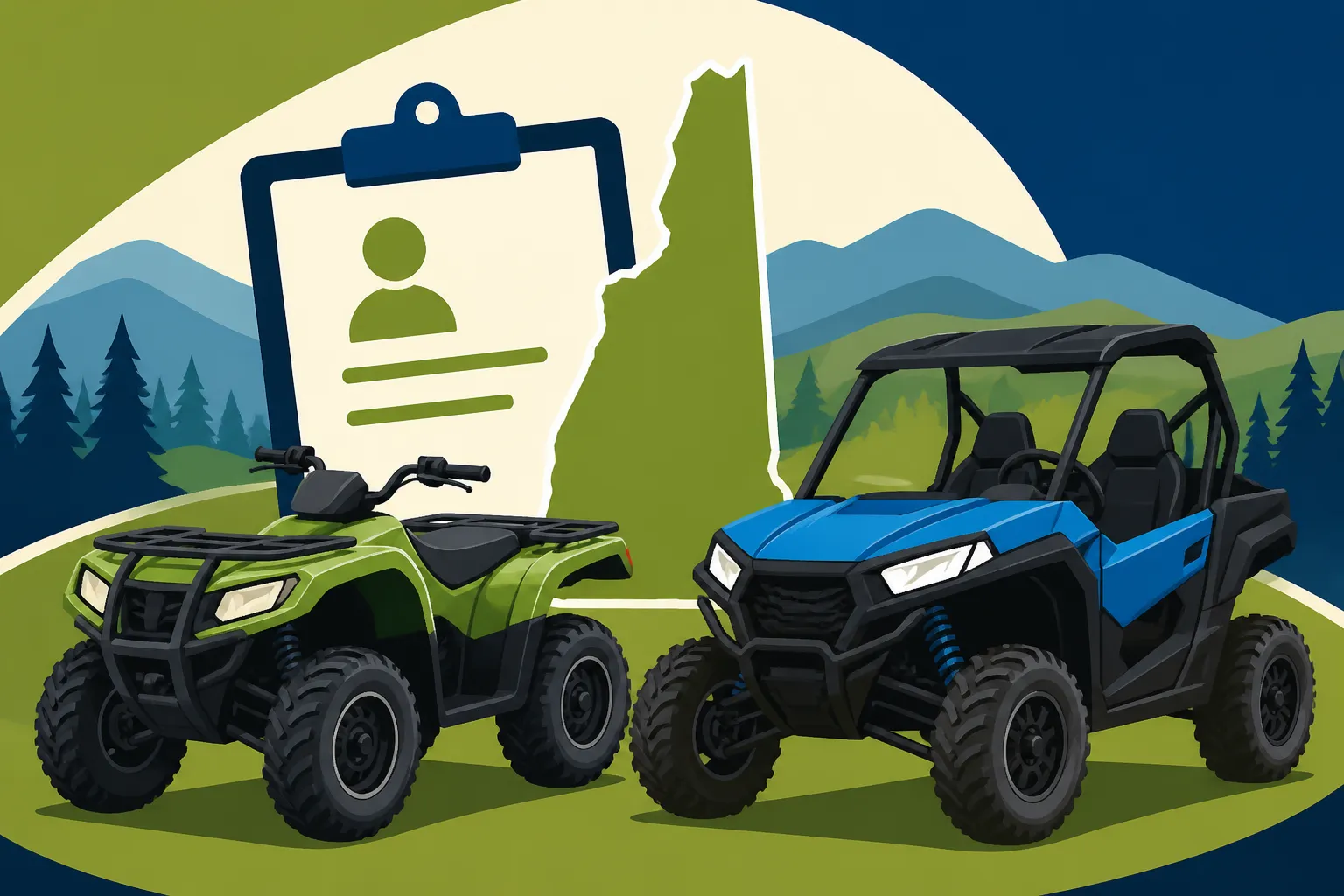
New Hampshire OHRV Registration for Two Machines
It's an exciting time when you're looking to expand your off-highway recreational vehicle (OHRV) fleet, perhaps adding a new UTV for family outings or a second ATV for a spouse or older child. But let's be honest, the thought of navigating the registration process again, this time for two machines, can feel a bit overwhelming. You've got questions: Does it double the hassle? Are there special rules? Will it cost a fortune? This guide is here to walk you through everything you need to know about registering two OHRVs in New Hampshire, helping you get both your machines trail-ready with minimal fuss and maximum understanding.
The Basics of Registering Multiple OHRVs in New Hampshire
When you start thinking about getting a second OHRV, one of the first things that pops into mind is usually, "Do I have to go through all that paperwork twice?" The short answer is yes, each machine is a distinct entity in the eyes of New Hampshire's OHRV laws. It's not like registering a second car on the same insurance policy; each off-road vehicle requires its own set of credentials.
Why Each Machine Needs Its Own Registration
Imagine a scenario: You and your partner decide to upgrade your single ATV to a side-by-side for family rides, but you also want to get a smaller ATV for your teenager who's just completed their safety course. You might think, "Well, I'm the owner of both, so maybe there's a family registration or a bulk discount." Unfortunately, that's not how it works in the Granite State. New Hampshire's OHRV registration system is explicitly tied to the individual machine, not the operator or owner.
Each OHRV, whether it's an ATV, UTV, or dirt bike, is issued a unique registration certificate and a corresponding set of decals. These decals, typically two in number, bear a specific registration number that identifies that particular vehicle on the trails. If you have a Can-Am Maverick and a Polaris RZR, each will have its own distinct registration number, its own certificate to carry, and its own decals to display. This system ensures that every machine operating on public trails or designated OHRV corridors can be individually identified, tracked, and verified for compliance. It’s a fundamental aspect of [Registering an OHRV in New Hampshire], and it applies equally whether you own one machine or a whole fleet. This individual registration helps with everything from trail management to accident investigation, ensuring accountability for every machine out there.
Understanding the New Hampshire Registration Year for Multiple Machines
New Hampshire operates on a consistent OHRV registration year that runs from May 1st to April 30th of the following year. This applies universally to all OHRV registrations, regardless of when you purchase or register your machine. For owners of multiple OHRVs, this consistent cycle is a double-edged sword: it offers predictability but can also lead to staggered expirations if you acquire your machines at different times of the year.
Let's say you registered your first ATV back in May, right at the start of the season. Its registration will expire the following April 30th. Then, in September, you decide to buy a second machine. That second OHRV's registration will also expire on April 30th, meaning you won't get a full year of use from that September registration. You effectively lose several months of validity, but you still pay the same annual fee as if you registered it in May. This can feel a bit frustrating, especially if you're not planning to ride much during the winter months. However, the consistent expiration date means that come April, you'll be looking at renewing both machines around the same time, which can simplify the process come renewal season. Being aware of [New Hampshire's May to April Registration Year] is key to planning your purchases and renewals, especially when managing multiple machines. It's simply the way the system is structured, so understanding it helps you avoid any surprises down the line.
Streamlining the Registration Process for Two OHRVs
Registering two OHRVs doesn't have to mean double the headache. With a little organization and knowing your options, you can make the process quite smooth. It often comes down to being prepared and choosing the most convenient method for your situation.
Gathering Your Paperwork for Multiple Registrations
The cornerstone of a smooth registration process, whether for one OHRV or two, is having all your paperwork in order. For each machine you intend to register, you'll need a separate set of documents. This isn't a situation where one bill of sale covers two vehicles; each OHRV requires its own proof of ownership, whether that's a manufacturer's statement of origin (MSO) for a brand-new machine, or a bill of sale if you purchased it used.
If you're buying a used machine privately, a well-drafted bill of sale is absolutely crucial. This document serves as your proof of ownership and should clearly list the OHRV's make, model, year, and crucially, its Vehicle Identification Number (VIN) or frame number. Many people find resources like LawDepot helpful for generating professional and legally sound bills of sale, ensuring all the necessary details are included for a smooth transfer of ownership. Having this documentation in order for both machines before you even head to a registration agent will save you immense time and potential frustration. Don't forget the completed OHRV registration application form for each machine, which can usually be downloaded from the New Hampshire Fish and Game Department website. Double-checking that you have all the required documents for [New Hampshire OHRV Registration Paperwork] for each OHRV is the best way to ensure your trip to the registration office is a quick and successful one.
Where to Register Both Your Machines
Once you've got all your paperwork sorted for both OHRVs, you have a few convenient options for actually getting them registered. Each method has its own advantages, especially when you're dealing with multiple machines.
One popular option is to visit a New Hampshire powersports dealer. Many dealers are authorized registration agents, meaning you can often complete the registration process right when you purchase a new machine. If you're buying two machines from the same dealer, this is incredibly convenient, as they can handle both registrations simultaneously. It’s a one-stop shop, eliminating the need for a separate trip. The dealer will have the application forms on hand, and their staff are usually very familiar with the process, making it quite seamless. For more details, check out [Registering at a Powersports Dealer].
Another excellent choice is to visit your local town clerk's office. Many town clerks are also authorized agents for OHRV registrations. This can be particularly handy if you've purchased your machines privately or from an out-of-state dealer. Registering with your town clerk often means less travel time if they are closer to you than a specific powersports dealer. The atmosphere at a town clerk's office can sometimes be less rushed, allowing you to easily process both registrations in one sitting. You can find more information about this option in [Registering at a New Hampshire Town Clerk]. Finally, you can always visit a New Hampshire Fish and Game Department office directly. While perhaps not as ubiquitous as town clerks or dealers, they are the ultimate authority, and their staff can handle any unique situations that might arise. Each of these options offers distinct benefits, but the key is that all are equipped to handle [Where to Register an OHRV in New Hampshire], and processing both your machines in one go is almost always possible, saving you precious riding time.
Cost Considerations and Club Membership for Dual Registrations
Let's talk about the bottom line. When you're registering two OHRVs, the costs do add up, but there are definitely ways to manage those expenses, particularly by leveraging the power of club membership. Understanding the fee structure is your first step to being a savvy OHRV owner.
Calculating the Cost for Two Machines
When you register two OHRVs in New Hampshire, it's important to remember that the standard registration fees apply per machine. There isn't a discount for registering a second or third vehicle; each one is processed as a separate transaction. The cost will depend on whether your OHRV is a wheeled vehicle (ATV, UTV, dirt bike) or a snowmobile, and whether you are a New Hampshire resident or a nonresident. On top of the base fee, there's a small $2 transaction fee added to each registration, which covers administrative costs.
So, if you're a New Hampshire resident registering two wheeled OHRVs, you'll pay the resident wheeled vehicle rate twice, plus two separate $2 transaction fees. If one is a snowmobile and the other a wheeled vehicle, you'll pay the respective fees for each. It's essentially two individual registration transactions bundled into one visit. While the overall number will be higher than for a single machine, knowing exactly what to expect helps you budget. You can always check the current fees on the New Hampshire Fish and Game Department website for the most up-to-date figures. For a detailed breakdown of the general fees, you can refer to [New Hampshire OHRV Registration Cost]. Just be prepared to multiply that base fee by the number of machines you're registering.
Maximizing Savings with Club Memberships
Here's where owning two machines can actually lead to significant savings: through an OHRV club membership. New Hampshire has a fantastic system that rewards riders who support the trail network by joining an approved OHRV club. When you're a member of a qualifying club, you become eligible for a substantial discount on your annual OHRV registration fee – typically $30 off the regular rate.
Now, imagine you're registering two machines. If you're a club member, that $30 discount applies to each machine you register. This means you could potentially save $60 on your total registration costs for both vehicles! For many riders, the annual cost of club membership is often less than or equal to the total savings you get from registering two machines. So, if you're planning on being a dedicated rider, especially with multiple OHRVs, joining a club isn't just about supporting the trails; it's a smart financial move. This is why [Why Club Membership Saves $30 in New Hampshire] is such a big deal for many, and for those with multiple machines, the savings truly multiply. [Two Machines and $60 Saved] is a very real outcome that makes club membership a no-brainer for many families and enthusiasts. Don't forget, you'll need to show proof of your club membership when you register to receive the discount. For more on the specifics, check out [New Hampshire Club Member Registration Rate].
| Registration Type (Example) | Cost Per Machine (without club) | Cost Per Machine (with club) | Total for Two Machines (without club) | Total for Two Machines (with club) | Potential Savings |
|---|---|---|---|---|---|
| Resident Wheeled OHRV | Check NHF&G Website | Check NHF&G Website | (Rate x 2) + $4 | (Club Rate x 2) + $4 | $60 |
| Nonresident Wheeled OHRV | Check NHF&G Website | Check NHF&G Website | (Rate x 2) + $4 | (Club Rate x 2) + $4 | $60 |
| Snowmobile (Resident/Nonres) | Check NHF&G Website | Check NHF&G Website | (Rate x 2) + $4 | (Club Rate x 2) + $4 | $60 |
Note: The actual rates are subject to change and can be found on the official New Hampshire Fish and Game Department website. The $4 in the table reflects the $2 transaction fee applied to each of the two machines.
Important Considerations for Owners of Multiple OHRVs
Managing two OHRVs means a bit more than just double the fun; it also means double the responsibility when it comes to compliance and maintenance. There are a few details that are easy to overlook but are absolutely critical for a worry-free riding season.
Decal Placement and Display for Each Machine
Once you’ve successfully registered both your OHRVs, you'll be issued two sets of decals, one for each machine. It's crucial to understand that these decals are unique to the OHRV they were issued for; you cannot swap them between your machines. Each set will feature a specific registration number that matches the corresponding OHRV's certificate.
The proper placement of these decals on each OHRV is not just a suggestion; it's a requirement. Generally, one decal should be affixed to the left side of the machine, and the other to the right, in a prominent and visible location. This ensures that law enforcement or trail monitors can easily verify your registration at a glance. For UTVs, they are often placed on the fenders or side panels. For ATVs, you'll typically put them on the front or rear fenders, depending on the design of the machine and the best visibility. Make sure the surface is clean and dry before applying the decals to ensure they adhere properly and last throughout the season. Incorrect or missing decals can lead to fines, so take a moment to ensure they're correctly displayed on both of your machines. You can find precise guidelines for [New Hampshire OHRV Decal Placement] on the Fish and Game Department's website or by asking your registration agent.
Managing Multiple Registrations and Renewals
One of the logistical challenges of owning two OHRVs is keeping track of two separate registrations and their respective renewal dates. While both registrations will technically expire on April 30th, you might register them at different times, or simply forget one amidst the excitement of riding. It's a common oversight that can easily be avoided with a bit of proactive planning.
A great tip is to set a reminder for yourself, perhaps on your calendar or phone, a month or two before April 30th. This way, you have ample time to gather your documents and renew both machines before the May 1st riding season officially kicks off. The good news is that New Hampshire often allows for online renewals, which is incredibly convenient when you're renewing multiple machines. You can often process both transactions in one sitting from the comfort of your home, avoiding lines and saving time. Just be sure to double-check that you're renewing the correct registration for each machine. What happens if you forget one? Riding an unregistered OHRV on public trails can result in significant fines. So, mark those calendars and ensure both your machines are current and legal. Staying on top of [Renewing a New Hampshire OHRV Registration] for each of your OHRVs means more time on the trails and less time worrying about expired paperwork.
Disclaimer
This article is for general informational purposes only and does not constitute professional advice. Laws, prices and regulations vary by location and change over time. Consult a qualified professional for guidance on your specific situation.