New Hampshire Rules for Riding Across a Town Line
Crossing a town line on an ATV or UTV can feel like one continuous ride, but access rules may change along the route. The town boundary alone does not tell you whether a trail remains open, whether a road is available to OHRVs, or whether your machine is properly registered. The practical approach is to check each segment, not just the route’s starting point.
What changes when a trail crosses a town line
A town line is an administrative boundary, not a guarantee that trail access stops or continues. A marked trail may connect through more than one town, but the section beyond the boundary still depends on its own access arrangements, trail status, and rules. A route shown as one line on a map can cross land managed by different towns, clubs, public agencies, or private owners.
That means two things can be true at once: your New Hampshire registration may remain valid on both sides of the line, while permission to ride does not. Registration is not a blanket authorization to use every trail, woods road, or public roadway in the state.
Think of the trip as a series of permitted segments. For each one, ask:
- Is this section open to the type and width of machine you are riding?
- Is the route on an authorized OHRV trail, or does it use a road?
- Does the trail remain open on the day you plan to ride?
- Are there signs, gates, or restrictions that apply at the boundary?
- Does the route require you to cross private land, a highway, or another type of corridor?
A trail sign may identify a route or club area, but it does not necessarily establish that the trail continues indefinitely. Follow posted directions and check for closure signs at junctions and town boundaries. If a trail ends at a gate or posted closure, do not assume that a nearby road or unmarked track is an authorized detour.
The town line can matter because different authorities may control the next section. A club may maintain a trail in one area, while the continuation depends on a separate landowner agreement or local decision. A route that is open in one town might be closed in the next because of seasonal conditions, maintenance, landowner concerns, or a local restriction.
Use current trail information before setting out. A map is useful for planning, but closures and conditions can change, and a printed or saved route may not reflect a recent change. New Hampshire Trail Status Before You Ride and New Hampshire Trail Maps From a Club can help you plan, but on the ground, posted signs and current access notices matter too.
Registration follows the machine, but access is local
For riding on public OHRV trails in New Hampshire, the machine generally needs to meet the state’s registration requirements. That state registration does not usually need to be replaced just because you cross from one town into another. You do not normally obtain a fresh town registration at every boundary.
But registration and trail access answer different questions:
- Registration concerns whether the machine is registered for the applicable use.
- Access concerns whether you may ride that particular trail, road, or parcel.
- Local road authorization concerns whether a town has opened a specific road or section to OHRVs.
- Operating rules concern matters such as signs, speed, safety equipment, and rider eligibility.
A registration decal cannot turn a closed road into an open one. Nor does a route’s presence on a map necessarily mean every machine can use it. Width restrictions, seasonal closures, trail-specific rules, or other conditions can apply.
If the machine is registered in another state, do not assume that registration alone authorizes riding in New Hampshire. New Hampshire’s requirements for visiting machines are separate from the rules of the machine’s home state. Check Riding New Hampshire With an Out-of-State Machine and Why New Hampshire Honors No Neighbor’s Registration before travelling. Those questions are especially important if you plan to ride a connected route that crosses town lines, since every New Hampshire segment still depends on the applicable state requirements and local access.
Visitors may have a short-term registration option for eligible wheeled vehicles, but it is not a general trail pass and should not be treated as permission to ride anywhere. Confirm current eligibility, where it can be obtained, and the dates it covers before relying on it. The Ten-Day Option for a New Hampshire Visitor explains the limited-use option, while When a Frequent Visitor Should Buy the Annual can help you compare it with a longer visit.
| Situation | What to check | What the check does not guarantee |
|---|---|---|
| Riding a marked trail across a town line | The trail’s status and any signs or restrictions on both sides | That every connected segment is open |
| Riding a machine registered in another state | Whether New Hampshire registration is required for your planned use | That home-state registration grants New Hampshire access |
| Reaching a town road from a trail | Whether that specific road or section is open to OHRVs | That all roads in the town are open |
| Using a private woods road | Permission from the landowner and any trail authorization | That an unposted road is available to ride |
| Continuing onto a club trail | Current club information, trail conditions, and machine restrictions | That club membership alone grants access to every trail |
For registration details, start with New Hampshire OHRV Permits Explained. For the more specific paperwork and process, see New Hampshire OHRV Registration Paperwork. Check the current official requirements before riding, particularly if your machine, registration status, or visit is unusual.
Town roads are not automatically part of the trail route
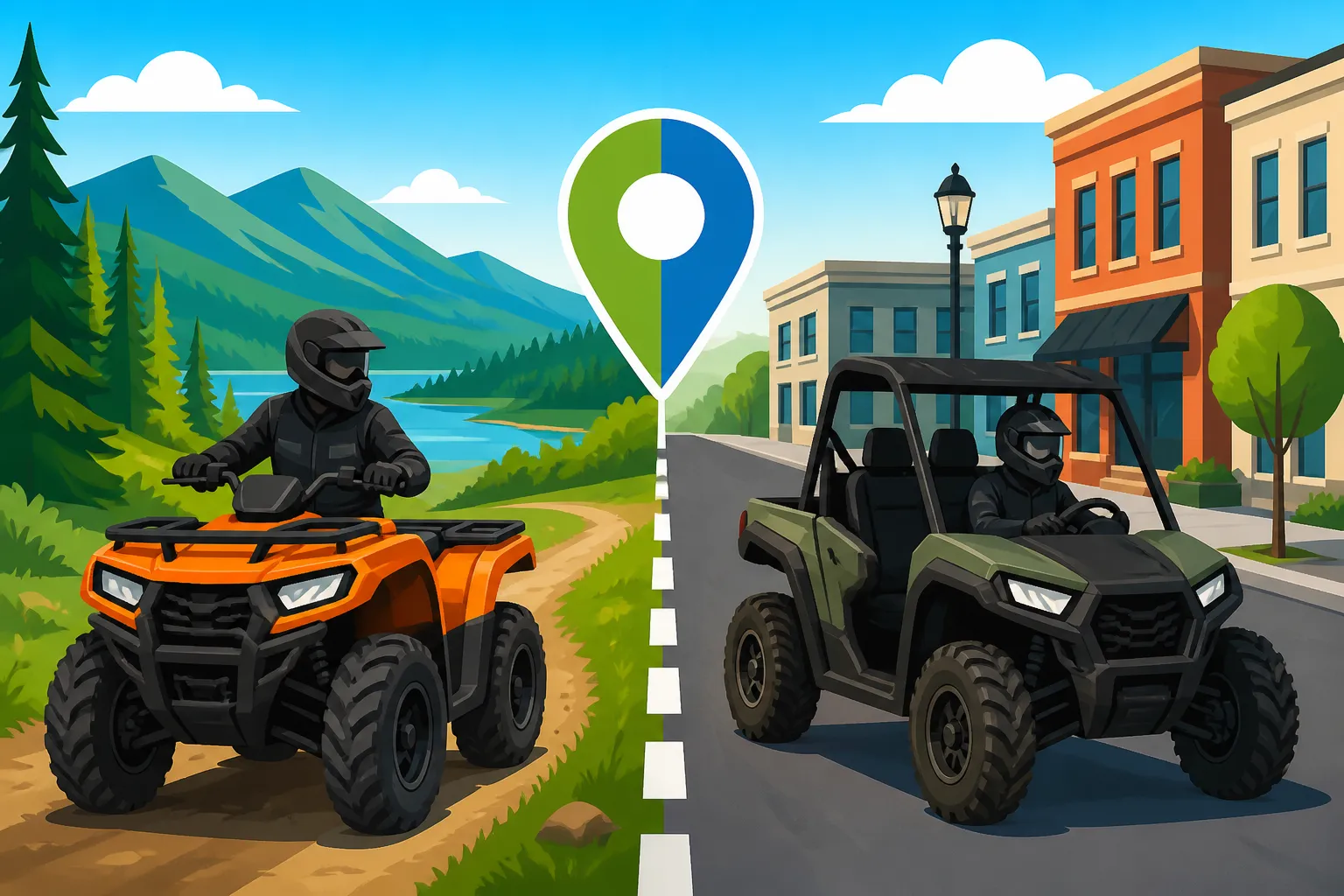
A common point of confusion is the difference between a trail crossing a town line and an OHRV riding on a town road. A town boundary does not, by itself, open the roads in either town to ATVs or UTVs. Road access depends on the road’s classification and whether the town has authorized OHRV use there.
Do not plan on riding along a road just because it appears to connect two trail sections, looks like a quiet gravel road, or has tire tracks on it. Roads are not automatically OHRV routes. Town decisions may apply only to specified roads or portions of roads, and the terms can include conditions such as operating hours, direction of travel, or a defined connection to a trail.
Before using a road as a connector, verify that the road itself is open to OHRVs and that the authorization covers the part you need. A designation in one town does not carry over into the next town. If the road crosses a boundary, check the rules for each town separately. Even where a road is open in both places, the approved route may end at the town line or require you to turn onto a designated trail.
The road’s class can also affect what is allowed. A Class VI road, a Class V road, and a state highway are not interchangeable categories. Their legal status and any local OHRV authorization can differ. Read Which of the Six Road Classes Allow OHRVs for background, and confirm the specific road rather than relying on a general description.
A road may be open to OHRVs only under a local designation. That does not mean the town has opened every road, every shoulder, or every driveway. A private driveway or woods road may have separate access conditions even when it connects to a route that is open to the public.
Where a route crosses a public road, the rules for the crossing are distinct from the rules for riding along the road. Use authorized crossing points and follow signs and traffic requirements. A trail crossing does not create permission to travel along the road, and a road designation does not necessarily authorize travel beyond the designated section. For the general road-access rules, see Where New Hampshire Allows OHRVs on Roads and New Hampshire Rules for Crossing a Highway.
If road access is unclear, treat it as unavailable until you can verify otherwise. Ask the relevant town office or consult current local information for the precise road name and section. “The town allows OHRVs” is too broad to answer whether a particular connector is legal.
Land access and trail closures can change at the boundary
Many trails depend on continued access across land that is not simply open for unrestricted riding. Clubs and public agencies may work with landowners to maintain routes, but that arrangement does not erase the landowner’s role or guarantee that a route remains open indefinitely. Permission can be limited to a designated corridor, a particular season, or stated riding conditions.
The important distinction is between a route that is officially available for OHRV use and an informal-looking track. An unposted field, woods road, or path is not automatically an invitation to ride. If you leave the marked route, cross a gate, or follow a side track without permission, you may be on land where riding is not authorized.
When a route crosses from one club area or managed section into another, check the next segment rather than assuming that one club’s information covers the entire trip. Clubs can provide useful maps and trail-condition updates, but their coverage and authority may end at a boundary. A membership may support trail work or qualify for a registration discount, but it does not itself grant access to every private parcel or every trail network. For more on the distinction, see New Hampshire’s Club Membership and Access.
Closures deserve particular attention. A route can close because of mud, damage, maintenance, weather, logging, hunting activity, landowner requests, or a seasonal schedule. Closures may affect only one section, so a long route can be open on one side of a town line and closed on the other. Do not ride around a closure sign to reconnect with the route. Find an authorized alternative or end the ride.
Before departure, check the latest trail status for the areas you plan to cross. Then pay attention to signs at trailheads, junctions, bridges, and boundaries. If a sign conflicts with an older map, follow the sign and seek clarification before continuing. Avoid treating a temporary closure as a suggestion or assuming that another group of riders’ presence proves the trail is open.
Weather and seasonal conditions can affect access even when there is no obvious barrier. A trail that was passable earlier may be closed or unsafe after rain, flooding, or maintenance work. Winter use may follow different arrangements from summer use, especially where corridors are shared with snowmobile activity. Check the conditions and permitted use for the season, not just the geographic route.
Private-land permission is also not a substitute for state registration or other required operating rules. Conversely, state registration does not replace the need for landowner permission where that is required. For the private-land distinction, see New Hampshire Written Permission Requirements. Keep any written permission or event instructions available if they apply to your ride.
A practical check before crossing into the next town
A little route checking before the ride can prevent a wrong turn from becoming an unlawful one. Plan the route by segment, and identify the points where it changes from trail to road, crosses a town boundary, or enters a different managed area.
- Confirm the machine’s registration. Make sure the registration is valid for the machine and the intended New Hampshire use. Visitors should check whether a New Hampshire registration is needed rather than relying only on home-state paperwork.
- Map the route by town and trail section. Identify the trail names, junctions, road connectors, and town boundaries. Do not assume a single line on a map represents one continuous permission.
- Check current trail status. Look for seasonal closures, temporary restrictions, damage, or changes in access. A route that was open on a previous visit may not be open now.
- Verify every road connector. Confirm that the specific road segment is open to OHRVs. If it crosses into another town, check that town’s authorization too.
- Read signs as you ride. Follow closure notices, detours, machine-width limits, and other posted directions. Stop and reassess if the route does not match your plan.
- Stay on the authorized route. Do not use a field, driveway, logging road, or side path as a shortcut without permission and confirmation that OHRV use is allowed.
- Have a backup plan. If a connector is closed or unclear, turn back or use a verified alternative. Do not improvise a route onto an unapproved road.
A good plan should answer more than “Can I get from here to there?” It should identify what kind of route each segment is, who provides current access information, and what you will do if a closure blocks the connection.
| Before riding | Good question to ask |
|---|---|
| At the starting trailhead | Is this trail open today for my type and width of machine? |
| Near a town boundary | Does the marked route continue, or does access change here? |
| At a road crossing | Is this a permitted crossing point, and what signs apply? |
| At a road connector | Is this exact road section open to OHRVs? |
| At an unfamiliar gate or sign | Is this a closure, a property boundary, or a route restriction? |
| When riding out of state | Does my home-state registration meet New Hampshire requirements? |
If the route is an organized ride, rental trip, or guided outing, check the organizer’s or operator’s instructions too. Their route may be limited to specific trails and conditions. Do not assume that following a group makes an otherwise closed trail or road legal for individual riding.
Frequently Asked Questions
Does New Hampshire registration work in every town?
State registration is not typically issued town by town, but it does not authorize riding on every trail or road. Local access, closures, and road designations still apply in each area.
Can I ride a town road to connect two trails?
Only if the specific road or section is open to OHRVs and your route follows the applicable conditions. A town’s general support for OHRV riding does not mean all its roads are open.
If a trail is open in one town, is it open across the boundary?
Not necessarily. Check the next segment’s status and signs. Trail access can change at a town line because of different landowners, managers, local decisions, or seasonal restrictions.
Is an out-of-state registration enough for a ride across New Hampshire?
Do not assume so. New Hampshire requirements may apply to visitors using public OHRV trails. Check the current rules for your machine and the length and type of visit before riding.
Disclaimer
This article is for general informational purposes only and does not constitute professional advice. Laws, prices and regulations vary by location and change over time. Consult a qualified professional for guidance on your specific situation.