Registering in Maine Before You Cross
Crossing from New Hampshire into Maine on an ATV or UTV can feel like a simple continuation of the same ride, especially when trails meet near the state line. The legal details do not travel with you, though. This guide explains why a New Hampshire registration may not cover riding in Maine, what to check before crossing, and how to avoid reaching a trail junction without the right paperwork.
Why New Hampshire registration may not cover Maine
Registration rules change at the state line
An ATV or UTV registration is not automatically a universal pass to ride wherever a trail continues. Each state sets its own rules for registration, trail use, and land access. A New Hampshire registration that lets you ride where authorized in New Hampshire does not, by itself, settle what you need to operate legally in Maine.
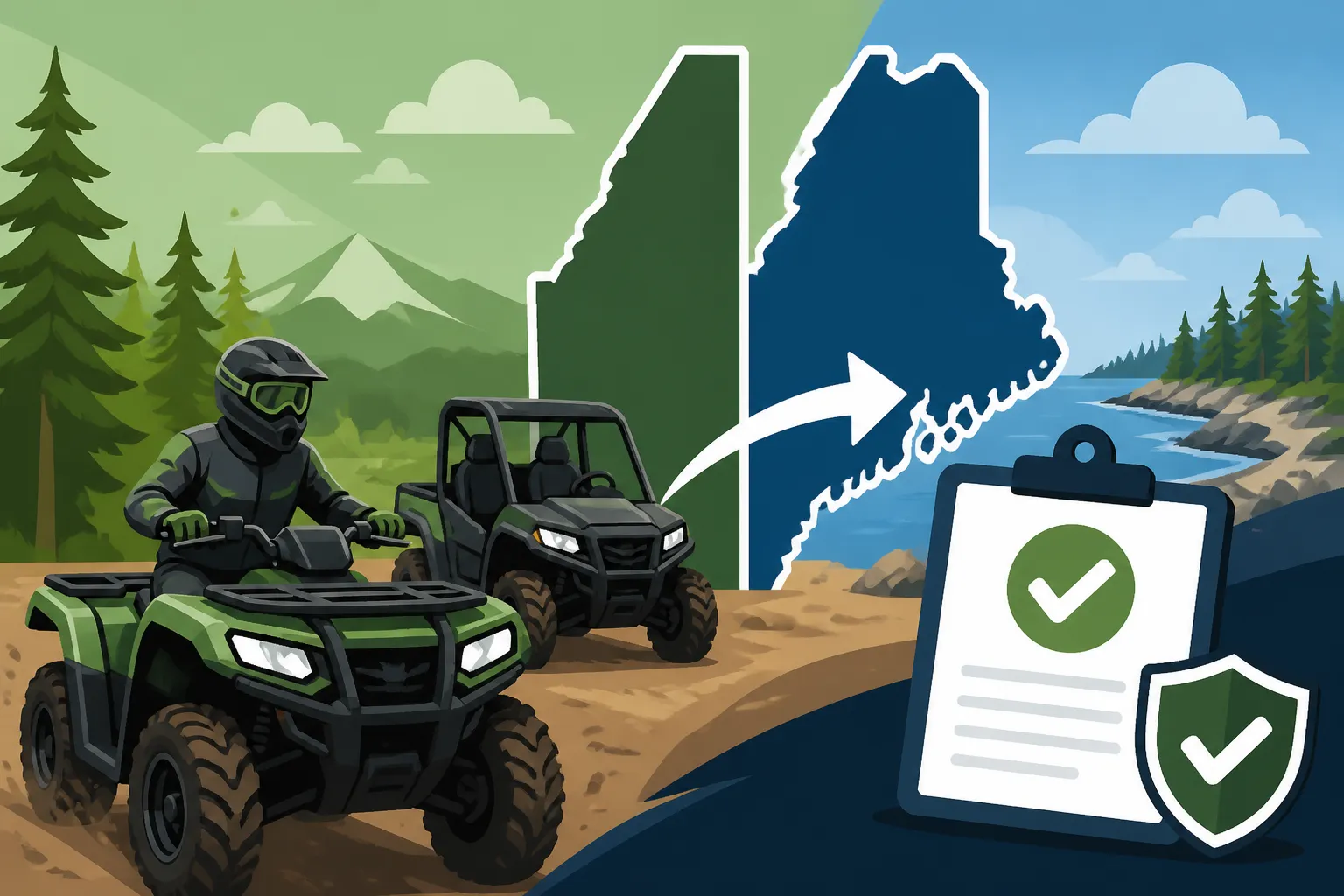
Maine generally requires an ATV to be registered there before it is operated in the state. A nonresident may qualify for an exception when the machine is registered in another state and that state grants Maine residents reciprocal riding privileges. Because New Hampshire generally requires visiting riders to register their machines locally, you should not assume your New Hampshire registration qualifies you for an exemption in Maine.
The practical approach is to arrange the Maine registration before you ride across the border, unless you have confirmed that a specific legal exemption applies to you and your machine. Don’t rely on what a friend remembers from a trip years ago or assume a registration decal from one state will satisfy another state’s requirements. For the New Hampshire side of the issue, see [Why No Maine Registration Works in New Hampshire] and [Does New Hampshire Honor a Maine Registration?]. Reciprocity is not something to guess at in either direction.
A connected trail does not mean the rules are shared
A route can cross a state line without any obvious barrier, sign, or change in terrain. You might be following a marked club trail, come around a bend, and find yourself in Maine before the map makes the change clear. That physical continuity can make it tempting to think that the same registration and trail permissions still apply. They may not.
At the border, treat the ride as entering a new jurisdiction. Your registration, the trail’s open status, and the landowner or trail-system permission all matter. The trail may continue on a Maine map but be closed for the season, open only to certain machine types, or routed across land where specific access rules apply. Registration is one requirement; it is not a guarantee that every connected trail is open to you.
If you’re planning a route that crosses the state line, read [New Hampshire Rules for Crossing Into Maine] before you go. It’s also worth reviewing [Crossing the Line Into Maine] as part of your trip planning. A few minutes spent checking the border segment can prevent an expensive, frustrating turn-around—or an unplanned ride on a trail where you should not be operating.
What to arrange before you cross
Get the Maine registration sorted out in advance
If your ride will take you onto Maine trails, confirm the Maine registration requirement and obtain the appropriate registration before operating there. Start early enough to have your paperwork and decals ready for the machine. Don’t wait until you are at a trailhead or standing near the state line to discover that an office is closed, an application needs information you left at home, or the registration has not been completed.
Gather the machine details and ownership documents you may need, and check the current process with the relevant Maine registration agent or official state resource. Requirements and application procedures can change, so verify the details directly rather than relying on an old checklist. For a used machine, make sure the identifying information on your paperwork matches the machine and that you can explain how you acquired it.
If the machine is registered in New Hampshire, keep that registration current for the New Hampshire portion of your ride as well. A Maine registration does not necessarily replace the separate New Hampshire registration requirement when you return to ride in New Hampshire. Each state’s registration applies to its own rules. The related guide [Registering a Visitor's Machine in New Hampshire] explains why a visiting machine may still need New Hampshire registration, while [New Hampshire OHRV Registration and Insurance] covers another part of preparing your machine for New Hampshire use.
Check your route, machine, and documents together
A smooth border crossing starts with a route that is legal for your machine—not merely one that looks passable on a screen. Check whether the Maine trails you plan to use allow your ATV or UTV, whether the route is open on the day of your ride, and whether the trail system permits you to travel through the connected area. Width restrictions, seasonal closures, and local trail conditions can change which route makes sense.
Before loading the trailer, check that you have the relevant registrations and any other required documents with you. Make sure the decals are displayed as required, and know where the certificates or other paperwork are stored. A certificate tucked into a truck glove box is not especially helpful if an officer asks to see it while you are on the machine miles from the staging area.
A quick pre-ride checklist helps catch the easy-to-miss details:
- Confirm the Maine registration requirement for your specific machine and situation.
- Complete the Maine registration before operating on Maine trails if it is required.
- Keep any required New Hampshire registration current for riding on the New Hampshire side.
- Check that your planned route is open and allows your machine type.
- Carry the relevant documents and confirm that decals are correctly displayed.
- Tell everyone in your group where the route crosses the state line.
This is also a good time to check [New Hampshire Trail Status Before You Ride] and [New Hampshire Trail Maps From a Club]. Those resources can help with the New Hampshire portion of a route, but they should not be treated as a substitute for checking Maine’s trail status and rules.
| Before the ride | What to confirm | Why it matters |
|---|---|---|
| State registration | Whether Maine registration is required for your machine | A New Hampshire registration may not qualify for a Maine exemption |
| Route | Which trails cross the border and where | A connected trail may be closed or restricted on one side |
| Machine eligibility | Whether the route allows your ATV or UTV | Width and vehicle-type restrictions can rule out a segment |
| Paperwork | Registrations and other documents you may need to carry | Documents should be available if requested during the ride |
| Trail status | Open dates, temporary closures, and local notices | Access can change with season, weather, or trail conditions |
Plan for the Maine side of the ride
Registration is not the same as trail access
It’s easy to think of a registration as permission to ride a whole region. In reality, it addresses only part of the question. You still need to use trails that are open to your type of machine and follow the access rules for the trail system and land you are crossing. A valid Maine registration does not authorize riding on a closed trail, leaving a marked route, or entering land without permission.
This distinction matters when your route crosses private land or follows a trail maintained through a network of clubs and landowners. Trails can depend on continuing landowner permission. If a landowner withdraws access, or a club closes a segment, the route may no longer be usable even if your machine and registration are otherwise in order.
Before you leave, check information from the clubs responsible for the trails on both sides of the border. A route-planning app such as onX Offroad can help you visualize trail connections and identify where a route appears to cross a state boundary. Use it as a planning aid, not as proof that a trail is currently open or that your machine is authorized to use it. Verify access with the relevant club or official trail information.
Build a border check into the route plan
When you plan a ride, mark the state line as a point where you pause and confirm your bearings—not as a place where you assume nothing changes. Make sure each rider in the group understands whether the route enters Maine, which trails you intend to use there, and what paperwork is required. This is especially helpful when several machines are traveling together and riders have different registrations or ownership arrangements.
If you use onX Offroad to review the route, check the map before departure and keep a separate note of trail status and registration requirements. Digital maps are useful for orientation, but they can’t guarantee that a trail is open on a particular day or that a landowner has granted access. Save the relevant club or official information so you can check it even if cell coverage disappears.
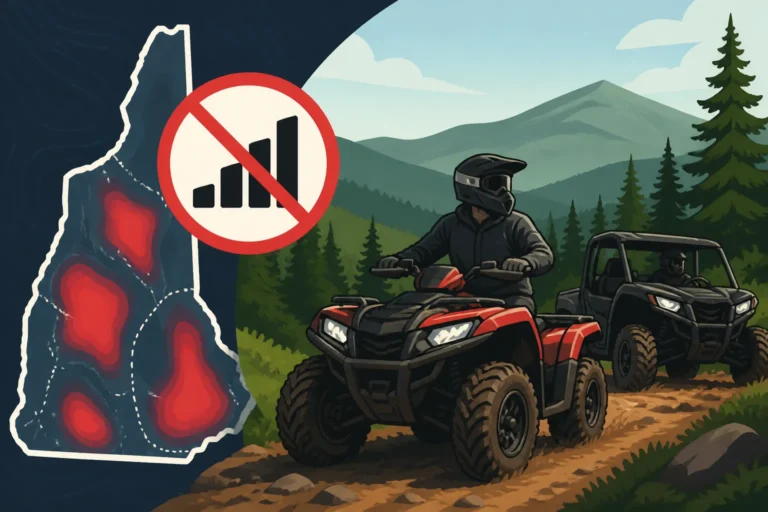
It can also help to plan a turn-around point before the border. If the Maine trail segment is closed, unclear, or unsuitable for your machine, you’ll have a practical alternative rather than feeling pressured to keep going. In northern New Hampshire, cell service can be limited in some riding areas, so don’t count on being able to sort out registration or trail access after you have already left the staging area.
Common mistakes that make a border ride harder
Assuming the registration from home follows you
The most common mistake is taking a New Hampshire registration as proof that the machine is automatically covered in Maine. It may feel reasonable: the machine is properly registered at home, the trail continues, and the state line may be little more than a sign. But the registration and reciprocity rules are determined by the states, not by how seamless the route looks.
Another version of the same mistake is assuming that a Maine registration replaces the need to meet New Hampshire requirements when you return. If your trip includes riding in both states, plan for both. The two-state checklist can seem like extra work, especially for a short outing, but it is far less disruptive than having to stop the ride because the paperwork was not arranged.
A third pitfall is confusing permission to cross the border with permission to ride the entire trail network. Border access, trail access, seasonal availability, and machine eligibility are separate checks. Keep them separate in your planning, and you are much less likely to overlook an important detail.
Leaving the paperwork and trail check until the last minute
A group can lose a surprising amount of ride time because one machine has incomplete paperwork or one rider assumed someone else had checked the Maine rules. Before the trip, ask each rider to confirm their machine’s registration and documents. Don’t treat a group leader’s registration as if it covers everyone else’s machine.
Last-minute trail checks can be just as frustrating. A route you rode previously may have changed, and an online map may not reflect a temporary closure. Check with the relevant club or official trail information close to your ride, and have a backup route. If you’re using onX Offroad, it can help you keep the route organized, but confirm current conditions through the organizations responsible for the trails.
For a cross-border ride, the most reliable habit is simple: check registration first, access second, and the route itself third. That order keeps you from treating a legal registration as a blanket trail pass and makes it easier to spot a problem while you still have time to fix it.
Disclaimer
This article is for general informational purposes only and does not constitute professional advice. Laws, prices and regulations vary by location and change over time. Consult a qualified professional for guidance on your specific situation.