New Hampshire Trails With Rock and Ledge
Rock and ledge can turn a New Hampshire ATV ride from a smooth cruise into a slow, technical outing, especially after rain or when loose stone shifts under your tires. This guide explains how to find suitable terrain, prepare your machine and riding group, and handle rocky sections without treating every trail as a challenge to conquer.
Where to look for rocky ATV and UTV trails
Start with the North Country trail network
Northern New Hampshire is a natural place to begin planning a ride with varied terrain. The interconnected trail areas around Berlin, Gorham, Milan, and Pittsburg offer access to extensive riding networks, but trail character can change quickly from one section to the next. A route that begins on a wide gravel road may lead to a narrower, rougher stretch—or a connector that is not appropriate for every machine.
Jericho Mountain State Park near Berlin is a well-known starting point for OHRV riding. The surrounding area connects with club trails, and riders can encounter a mix of surfaces and elevations. Treat any description of a trail as a starting clue, not a guarantee that you’ll find a particular rock garden or ledge on a given day. Conditions, access, and maintenance can change, so check the latest details before heading out. [New Hampshire's Jericho Mountain Trails]
Further north, clubs maintain trail networks around Pittsburg, Colebrook, and Errol. The Coos County system is broad, but it is not one uniform riding area: local clubs manage different sections, and connections can cross town lines or involve different trail rules. Planning a route through the North Country means confirming that each segment is open and suitable for your vehicle. [Ride the Wilds in Coos County]
Use trail descriptions as clues, not promises
A trail map may help you understand where a route goes, but the map alone may not tell you how rough a particular section feels. Ask local clubs or trail organizations about current conditions, machine-width restrictions, closures, and any known difficult stretches. Their updates can be more useful than a broad online description written for the whole region. [New Hampshire Trail Status Before You Ride]
Mapping apps can also help with route planning. onX Offroad may be useful for reviewing mapped routes and your position while riding, but an app should not replace local trail-status information or posted signs. A mapped line is not proof that a route is open, legal for your machine, or passable in current conditions. When using onX Offroad, check the route details before the trip and continue to follow signs and directions on the ground.
For trips that cross several club areas, save or download the information you need before leaving a town with reliable service. Cell coverage can be limited in parts of the North Country, and a phone that works at the trailhead may not work deep in the woods. [New Hampshire Trails With Cell Coverage]
| Planning question | Why it matters | What to check |
|---|---|---|
| Is the route open? | Seasonal closures and temporary conditions can affect access. | Current club or trail-status updates and signs |
| Is the trail suitable for my machine? | Width limits and rough sections can rule out some vehicles. | Trail rules, width restrictions, and local guidance |
| Does the route include rocky terrain? | A general trail description may not identify every technical stretch. | Recent reports and advice from the local club |
| Can I navigate without cell service? | Coverage may be unreliable in remote areas. | Offline maps, a charged device, and a backup plan |
| Do I have the required registration? | New Hampshire registration rules apply to many visiting riders. | Requirements for visitors and your machine |
Prepare your machine and group for ledge riding
Match the route to the least experienced rider
A rocky trail can feel very different from the seat than it does on a map. A confident rider may be comfortable picking a line over exposed stone, while a newer rider may feel pressured to follow too quickly. Before setting out, talk honestly about experience and agree that anyone can ask to stop, turn around, or take an easier route.
Choose a route that fits the whole group, not just the most experienced person. If you are riding with children, first-time riders, or someone who is unsure about uneven ground, avoid building the day around difficult terrain. A slower route with room to practice is often a better outing than a technically demanding trail that leaves someone anxious or exhausted.
Keep enough space between machines to make decisions without being rushed. On a rough incline, the rider ahead may stop unexpectedly to choose a line. Following too closely can leave the next machine with little room to brake or maneuver. Agree on a simple signal for stopping and regrouping, and make sure everyone knows not to crowd a rider who is working through a difficult section.
Inspect tires, controls, and protective gear
Before you leave the staging area, take a few minutes to look over the machine. Check tires for visible damage and appropriate pressure, confirm the brakes feel normal, and make sure the throttle and steering respond as expected. On a UTV, check seat belts and doors or nets; on an ATV, make sure the rider can reach and use the controls comfortably. If something feels wrong on the first easy stretch, do not assume it will improve on rough ground.
Wear a helmet and appropriate protective clothing, and bring eye protection suited to dust, branches, and flying grit. Gloves can improve comfort and grip during a long, bumpy ride. Carry water, basic supplies, and a way to communicate with your group if you become separated. Requirements can depend on the rider and circumstances, so review the applicable rules before your trip. [New Hampshire Helmet Rules for OHRV Riders]
A UTV’s extra stability and passenger capacity do not make rocky terrain risk-free. A side-by-side can still slide, tip, or suffer damage if a wheel drops off a ledge or the driver turns sharply on uneven ground. Keep passengers seated and belted, avoid abrupt steering, and do not let a passenger’s enthusiasm push the driver into a line they are not comfortable taking.
Ride rocky sections with patience and control
Choose a line before moving onto the obstacle
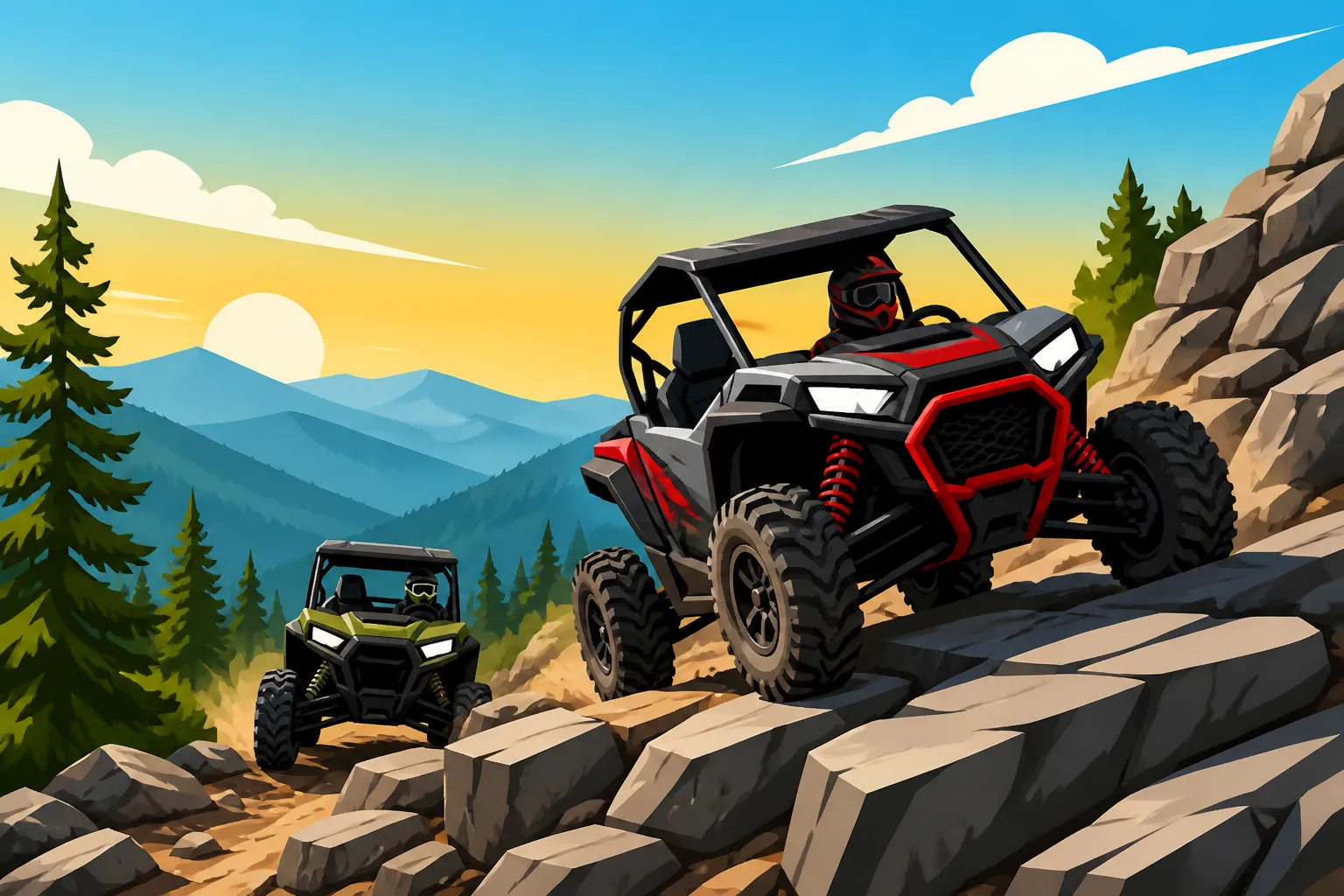
When you reach an unfamiliar ledge or rock-strewn section, stop where you can do so safely and look ahead. Identify the firmest-looking path, note loose stones that could move, and consider whether there is room to turn around. If another rider is nearby, give them space rather than following directly onto the same obstacle.
Move slowly and smoothly. Sudden throttle, hard braking, and sharp steering can unsettle a machine on uneven ground. Keep your eyes on the path ahead instead of fixating on the closest rock, and avoid placing a tire where it may drop unexpectedly. The best line is not necessarily the most dramatic one; it is the route you can travel with control and a clear exit.
If you cannot identify a safe line, or the obstacle looks beyond your ability or machine’s capability, turning back is a sensible decision. A route is not a test of nerve. Protecting your group, your vehicle, and the land matters more than proving you can get over a particular ledge.
Adapt to wet, loose, and changing surfaces
Rain can make exposed rock slick, wash loose gravel into new places, and turn a previously manageable section into a more difficult one. Mud can also hide ruts and holes between stones. Reduce speed when conditions change, and be especially cautious around slopes, sharp turns, and places where water crosses the trail.
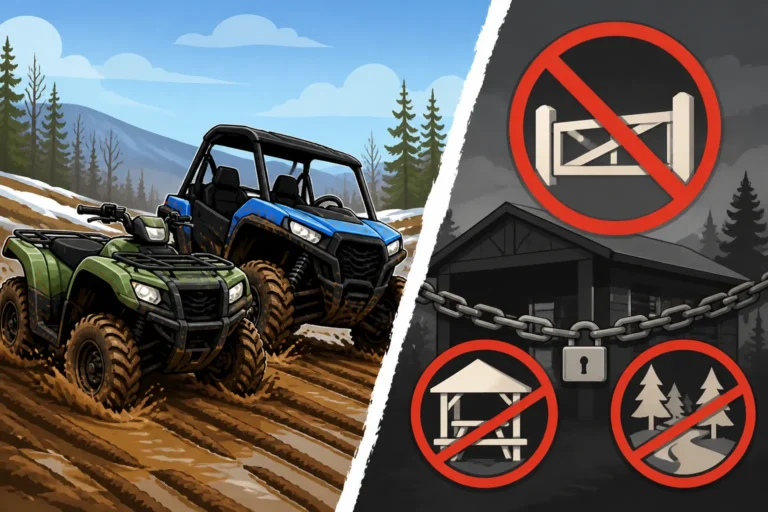
Do not ride around a difficult section by cutting into the woods or widening the trail. That can damage vegetation, disturb land, and create a new route that other riders may follow. Stay on the marked trail and respect signs, gates, and closures. If a route is blocked or appears unsafe, turn around or contact the relevant club for guidance rather than making your own bypass.
Trail widths matter as well as surface conditions. A wide UTV may not be allowed on every route that an ATV can use. Check restrictions before riding, and do not assume that a route shown on an app or map is open to your specific machine. [New Hampshire Trails for a Wide Machine]
Plan the ride around access, timing, and local rules
Confirm the trail is open and permitted
New Hampshire riding opportunities are shaped by landowner agreements, club maintenance, and seasonal access. Some trails close for reasons such as weather, land management, or changing conditions. A route that was open during a previous visit may not be open on your next one, so verify current status close to your departure.
Stay on designated trails and follow posted instructions. Permission to ride one section does not automatically grant permission to cross nearby private land. If you are unsure whether a path is authorized, do not treat the absence of a sign as permission. [New Hampshire Written Permission Requirements]
Registration is another part of trip planning, especially for visitors bringing a machine from another state. A home-state registration may not satisfy New Hampshire’s requirements for riding here. Review the rules for out-of-state machines before you travel, and carry any required documents with you. [Riding New Hampshire With an Out-of-State Machine]
Build a realistic route and leave room to turn around
Rocky riding usually takes longer than cruising a smooth trail. A short distance can require frequent stops to choose lines, help a new rider, or regroup after an obstacle. Leave extra time for breaks and navigation instead of scheduling the day so tightly that everyone feels pressure to keep moving.
Plan fuel and rest stops with the route in mind. In remote areas, do not assume that a convenient fuel station or cell signal will be available when you need one. Share your intended route with someone who is not riding, and set a reasonable check-in plan. If weather worsens or anyone in the group becomes tired, shorten the ride rather than pushing on to meet an arbitrary goal.
A useful plan includes a straightforward fallback: a known staging area, an easier return route, or a point where the group can turn back. Good preparation does not make a rocky trail predictable, but it gives you options when the terrain is rougher than expected.
The most enjoyable rock-and-ledge ride is not necessarily the one with the hardest obstacle. It is the one where the route suits your group, your machine, and the conditions that day. Check local trail information, ride within your limits, and leave the trail as you found it.
Disclaimer
This article is for general informational purposes only and does not constitute professional advice. Laws, prices and regulations vary by location and change over time. Consult a qualified professional for guidance on your specific situation.