Crossing at Ninety Degrees in New Hampshire
It's a familiar scenario for many of us who love exploring New Hampshire's vast trail networks on an ATV or UTV: you're enjoying a beautiful ride, making good time, and then suddenly, the trail ends at a paved road. Your next section of trail is just across the way, perhaps a few hundred feet down. The temptation to just scoot along the shoulder or even ride down the road a bit is real, but in New Hampshire, it’s a quick way to get into trouble and, more importantly, into danger. This guide is all about understanding and executing the specific, often misunderstood, rule of [Crossing a Road on an OHRV in New Hampshire]: the ninety-degree crossing. It's a critical safety measure and a legal requirement that keeps our trails connected while keeping everyone on the roads safe.
The Foundation: Why New Hampshire Mandates Ninety-Degree Crossings
Navigating New Hampshire's diverse terrain with an OHRV means encountering various landscapes, from dense woods to open fields, and inevitably, roads. Unlike some other states or regions where OHRVs might have more extensive road access, New Hampshire generally maintains a stricter approach, prioritizing safety and minimizing conflict with traditional vehicular traffic. The ninety-degree crossing rule isn't just an arbitrary line drawn in the sand; it's deeply rooted in the state's philosophy for integrating OHRVs into its public access framework.
New Hampshire's General Stance on OHRVs and Public Roads
Let's be clear from the get-go: in New Hampshire, OHRVs are generally not considered street-legal for prolonged travel on public roads. This means you can't just jump on your ATV or UTV and cruise down Main Street like you would in a car or motorcycle, unless a specific town has explicitly opened certain roads through a local ordinance. The fundamental principle is that OHRVs are for trails, and roads are for conventional vehicles. This distinction is crucial because it sets the stage for how any interaction between an OHRV and a public road must occur. The state understands that trails often intersect or need to use small segments of roads to connect, but this access is heavily regulated to prevent unsafe mixing of different types of traffic.
The default assumption is that OHRVs do not belong on roads. This is why when you approach a road on your machine, you must treat it with extreme caution and follow very specific rules. It's not about making things difficult for riders; it's about acknowledging the significant differences in speed, maneuverability, and visibility between a typical passenger vehicle and an OHRV. Think about it: an ATV or UTV, especially one that's been modified with aftermarket parts from a company like SuperATV for enhanced off-road performance, isn't designed for highway speeds or for blending seamlessly with commuter traffic. The sound, the width, the lack of traditional turn signals on many models—these factors all contribute to the need for distinct rules.
The "Minimal Impact" and Safety Rationale
The "minimal impact" philosophy is at the heart of the ninety-degree crossing rule. If OHRVs were allowed to travel along road shoulders or merge into traffic for any distance, it would increase the potential for accidents. A ninety-degree crossing, by its very nature, minimizes the time an OHRV spends on the paved surface, reducing exposure to other vehicles. It’s about being on the road for the absolute shortest duration possible, in the most predictable manner.
Consider the physics of it: OHRVs often have a higher center of gravity, knobbier tires, and different steering dynamics than road vehicles. Suddenly turning sharp corners or navigating tight road curves in a way that regular cars do can be more challenging and less stable for an OHRV. Crossing directly, at a right angle, means the machine travels straight across, in a direct line, minimizing complex maneuvers on the hard, potentially slippery pavement. This straight-line movement is easier to predict for oncoming traffic and generally safer for the OHRV operator. It also helps preserve the pavement itself, as prolonged travel or sharp turns by OHRVs with aggressive tires can sometimes accelerate road wear. Ultimately, this rule is a core component of [New Hampshire's Rules for Crossing a Highway] safely and responsibly, ensuring that the enjoyment of our trails doesn't come at the expense of road safety for anyone.
Deconstructing the Ninety-Degree Rule: What It Truly Means
When the New Hampshire Fish and Game Department or local law enforcement talks about a "ninety-degree crossing," they're not just throwing out a geometry term to sound official. They're describing a precise, safety-critical maneuver that every OHRV operator must understand and execute flawlessly. It's about how your machine physically moves across the road, and the implications of getting it wrong can be serious.
Visualizing "Ninety Degrees" on the Ground
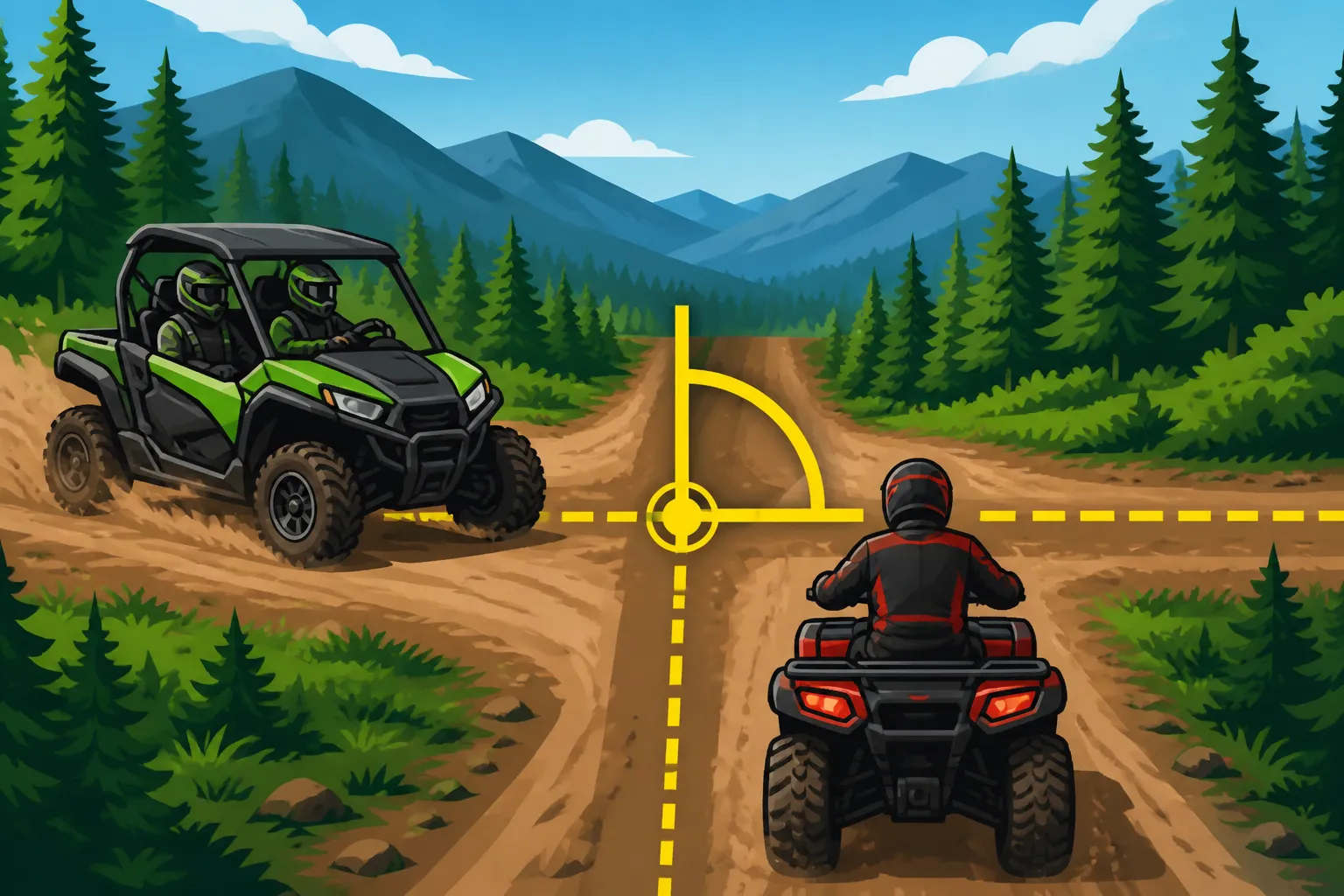
Imagine a straight line running down the middle of the road you need to cross. Now imagine the trail you're on, approaching that road. A ninety-degree crossing means your OHRV should hit that road as close to perpendicular as possible. Your machine's path should form a right angle with the flow of traffic. This isn't about aiming slightly down the road, or cutting a diagonal path that shortens the distance. It's about going straight across, directly from one side to the other.
Think of it this way: if you're approaching the road from the woods, you should emerge, stop, look, and then proceed straight across to the continuation of the trail on the other side. Your front wheels should ideally be pointing directly at the opposite trail entrance, not veering left or right. This might mean the trail itself is a little offset, and you might have to adjust your approach on the trail side to line up for a truly perpendicular crossing, but the actual time spent on the pavement must be straight across. This minimizes your time in the travel lanes and makes your path entirely predictable to any drivers who might be approaching. It’s a core component of [What New Hampshire Requires to Cross a Road] safely and legally.
The Safety Imperative: Why Straight Across is Best
The reason for this strict adherence to a perpendicular path boils down to a few key safety factors:
- Predictability for Other Drivers: When you cross straight, your trajectory is clear and unambiguous. Drivers approaching from either direction can easily gauge your path and speed, allowing them to anticipate your movement and react accordingly. If you were to angle across, or worse, ride down the shoulder for a stretch, it creates confusion and uncertainty for drivers, significantly increasing the risk of a collision. They might not know if you're trying to merge, turn, or simply cross.
- Reduced Time in the Lane of Travel: A direct, perpendicular crossing ensures you spend the absolute minimum amount of time in any active lane of traffic. Every extra second spent on the road, especially at an angle, increases your exposure to fast-moving vehicles. This rule is designed to get you off the pavement and back onto the trail as quickly and safely as possible.
- Optimal OHRV Handling on Pavement: Most OHRVs are not designed for high-speed maneuvering on hard pavement. The knobby tires that give you great traction on dirt, mud, and rocks can feel squirrelly or less responsive on asphalt, especially when turning sharply. A straight crossing minimizes the need for aggressive steering or braking on a surface your machine isn't optimized for. This is where quality components, perhaps a wider stance kit from SuperATV or upgraded suspension, can offer a bit more stability and confidence, but they don't negate the fundamental rule of straight-line crossing. It’s about using the right approach for the equipment you have, which is primarily an off-road machine.
Understanding and internalizing this rule is more than just avoiding a ticket; it's about protecting yourself and others. It's a critical piece of the puzzle for responsible OHRV operation in the Granite State and plays a role in how [New Hampshire Rules for Crossing a Highway] are enforced.
Executing a Safe Ninety-Degree Crossing: Your Step-by-Step Guide
Successfully navigating a road crossing in New Hampshire is a combination of legal compliance and good old-fashioned defensive riding. It's not a race; it's a carefully executed maneuver that requires your full attention. Let's break down the essential steps to ensure every road crossing is as safe and seamless as possible.
Step 1: Approaching and Stopping Before the Crossing
The moment you see that trail transitioning to a road, your mindset needs to shift. Reduce your speed well in advance. Coast up to the edge of the pavement, but do not enter the travel lane or even the shoulder until you have come to a complete and absolute stop. This isn't a "rolling stop" or a quick glance; this is a full pause, with your machine completely off the paved surface if possible, or right at its very edge. [Why You Must Stop Before Every Road Crossing] is paramount, and it’s a non-negotiable part of the rules.
Take this moment to assess your surroundings. Look for any signage that might indicate specific local rules, though the ninety-degree crossing is a statewide standard. Turn off your engine if the stop is prolonged and you need to hear better, especially on a busy road. This is your chance to gather all the necessary information before committing to the crossing. Ensure your machine is in neutral or park, allowing you to focus entirely on observation without worrying about accidentally rolling forward.
Step 2: Scanning for Traffic and Establishing Clear Sight Lines
Once stopped, your eyes and ears become your primary tools. You need to thoroughly scan both directions of the road for oncoming traffic. Don't just glance; actively look left, then right, then left again, perhaps several times. Pay attention to blind spots, hills, or curves that might obscure an approaching vehicle. Assume there's always a vehicle just out of sight until proven otherwise. This includes looking for bicycles, pedestrians, and even other OHRVs if it’s a designated crossing area.
Establishing clear sight lines is crucial. If trees, buildings, or parked vehicles block your view, you may need to inch forward very carefully, just enough to gain a better perspective, but always be prepared to stop instantly. If your OHRV has a rearview mirror, like many UTVs or those you can add from a company like SuperATV, use it to check for vehicles approaching from behind you, especially if you're stopping just shy of a busy intersection. Never rush this step. Patience here can literally save lives. Remember, a car traveling at 55 mph covers a significant distance in just a few seconds; you need ample time to see, react, and cross safely.
Step 3: Executing the Crossing Smoothly and Decisively
When you have a completely clear line of sight and no oncoming traffic, it's time to cross. Engage your gear, look one last time, and then proceed directly across the road at a ninety-degree angle. Maintain a steady, controlled speed—not too fast that you lose control, and not so slow that you linger in the roadway unnecessarily. The goal is to get from one side to the other in the most efficient and safest manner possible.
Avoid any sudden swerving or braking while on the pavement. Keep your steering wheel or handlebars straight, focused on the trail entrance on the opposite side. Once all your wheels are completely off the paved surface and you are back on the trail, you can then resume your normal riding speed and adjust your course. Never assume a driver saw you or will yield; always assume they didn't and act accordingly. The decisiveness of your crossing is as important as its perpendicularity. It communicates your intention clearly to anyone who might still be approaching. This deliberate approach is key to obeying [New Hampshire Rules for Crossing a Highway] and ensuring your ride continues uninterrupted and safely.
Common Misconceptions and Crucial Distinctions
Even with clear rules, it's easy for misunderstandings to creep in, especially when navigating the nuances of OHRV use on or near public roads. Clarifying these common misconceptions is essential for staying legal and, most importantly, safe in New Hampshire. The line between a legal crossing and an illegal road ride can sometimes feel blurry, but it's critically important to understand the difference.
The Shoulder is Not a Riding Lane
This is perhaps one of the most common and dangerous misconceptions. Many riders, seeing the paved shoulder alongside a road, might think it's a convenient, albeit temporary, extension of the trail, allowing them to ride a short distance to the next trail entrance or to gain a better vantage point for a crossing. Let me be unequivocally clear: the shoulder of a public road in New Hampshire is not a legal riding lane for OHRVs. Riding along the shoulder, even for a few yards, is a violation and can result in a hefty fine under [New Hampshire Fines for an OHRV Violation].
The ninety-degree rule specifically mandates that your machine enters the road, crosses straight over, and exits the road. There is no provision for traveling along the shoulder. Why? Because even on the shoulder, you are exposed to vehicular traffic, debris, and pedestrians, and you are acting unpredictably for drivers who expect vehicles to be on the road or stopped, not traveling in the shoulder. A car might pull over onto the shoulder suddenly, or a pedestrian might be walking there. Your OHRV, even if it has lights and mirrors that enhance visibility (like robust lighting kits or extra mirrors available from SuperATV), is still out of place on the shoulder, and you're at a significant disadvantage against a full-sized vehicle. Always remember: trail to pavement, straight across, back to trail. No shoulder travel allowed.
When a "Road" Isn't Just Pavement: Class VI Highways
New Hampshire has a classification system for its highways, and while most people think of "roads" as paved, state-maintained routes, there are other types. Specifically, Class VI highways are important to understand. These are typically unmaintained roads that are not regularly plowed or graded, often appearing more like rough tracks or logging roads. They can sometimes be open to OHRVs for travel, not just crossing, if a town has designated them as such through a local ordinance. However, this is a significant "if."
The crucial distinction here is that even if a Class VI highway feels like a trail, and even if your town has opened it, the rules for interacting with other classified roads (Class I-V) still apply. So, if your OHRV-friendly Class VI road crosses a paved Class V town road, you still must perform a ninety-degree crossing across that Class V road. You cannot simply continue your travel down or along the Class V road unless that specific Class V road has also been specifically designated for OHRV travel by the town. This can be confusing, as the appearance of a road doesn't always dictate its legal status for OHRVs. Always know the classification of the roads you're encountering and check for local ordinances if you're unsure. This level of detail is critical to avoiding fines and ensuring you're following [New Hampshire Rules for Riding a Class VI Road] or any other road type.
The Broader Context of OHRV Road Use in New Hampshire
Understanding the ninety-degree crossing rule is just one piece of the puzzle. It fits into a larger framework of regulations governing how OHRVs interact with New Hampshire's public road system. While direct travel on most roads is restricted, there are specific circumstances and town-level decisions that can influence where and how you ride. This broader context helps clarify why the ninety-degree rule is so strictly enforced and where else you might encounter OHRV use on public ways.
Designated Roads vs. Intersections and Connectors
It's important to distinguish between a "designated road" for OHRV travel and a simple road "crossing." As discussed, the default for most roads is that OHRVs are prohibited from traveling on them. However, individual towns in New Hampshire have the authority to open certain municipal roads, or portions thereof, to OHRV traffic. This is often done to connect trail systems, allow riders to access gas stations or restaurants, or facilitate passage through a town. When a town designates a road for OHRV use, it's typically a specific ordinance, and often comes with its own set of rules, such as speed limits, hours of operation, and sometimes even specific days of the week.
Even on these designated OHRV roads, the principles of safe operation remain paramount. The ninety-degree crossing rule still applies when a designated OHRV road intersects with another non-designated public road. You don't get a free pass just because you were on an OHRV-friendly street. This system aims to create a network of "trail towns" where riders can legitimately use certain roads, but always with clear boundaries and rules. Checking local ordinances and looking for specific signage in these towns is critical. For example, [Gorham's Open Streets] are a great example of a town embracing OHRV tourism, but even there, understanding where you can and cannot go, and how you cross other roads, is vital.
The Role of Local Ordinances and Selectboard Votes
The process by which a town opens a road to OHRV use is quite formal, involving [A New Hampshire Selectboard Vote to Open a Street] and public hearings. This isn't something that happens overnight or casually. Town selectboards must consider public safety, environmental impact, and the concerns of abutters (property owners adjacent to the road) before making such a decision. They must often provide [Fourteen Days' Notice Before a New Hampshire Hearing] and send [Letters Sent to Every Abutter].
Because of this specific process, what might be open in one town might be strictly off-limits in a neighboring town, even if the road looks similar. This means riders cannot assume uniformity. Just because you rode an OHRV on a town road in Berlin doesn't mean you can do the same in Conway without checking. This patchwork of regulations can be frustrating for riders, but it underscores the importance of being informed. Often, local OHRV clubs are the best resource for current information on which roads are open and what the rules are. They often work closely with towns to help develop these ordinances and maintain the trails that rely on them. Without these local efforts and adherence to the rules, the privilege of OHRV access, even for simple crossings, could be jeopardized.
Navigating Road Crossings Safely
| Step | Description | Why It's Important |
|---|---|---|
| 1. Approach with Caution | Reduce speed significantly as you near the road. Anticipate the stop well in advance. Come to a complete stop before entering the paved surface, ideally with your machine still on the trail or dirt shoulder. | Gives you time to react, assess the situation, and gather your thoughts. Prevents accidental rolling onto the road. Mandatory under [Why You Must Stop Before Every Road Crossing]. |
| 2. Observe and Listen | Look left, right, and left again. Check for oncoming traffic, pedestrians, and cyclists from all directions. Listen for vehicle sounds. Pay extra attention to blind spots or obscured views. | Ensures you have a clear understanding of traffic conditions. Prevents pulling out in front of a vehicle you didn't see. Your OHRV might be loud, especially with an aftermarket exhaust, making it harder to hear. Good mirrors, possibly from SuperATV, can aid rear visibility here. |
| 3. Position for Ninety Degrees | Ensure your machine is aligned to cross the road directly perpendicular (at a 90-degree angle) to the flow of traffic. Aim for the opposite trail entrance. Avoid angling down or up the road. | Minimizes time spent on the road and makes your path predictable for other drivers. Reduces risk of unstable handling on pavement. |
| 4. Cross Decisively | When the path is clear, proceed straight across the road with a steady, controlled speed. Do not hesitate or make sudden turns or stops while on the pavement. | Gets you off the road quickly and efficiently. Clear, unambiguous movement is safer. Any OHRV accessories, like strong tires, that enhance control and stability can be helpful here for a smooth crossing. |
| 5. Exit Completely | Ensure all wheels of your OHRV are fully off the paved surface and onto the trail before resuming normal speed or turning. | Confirms you are out of the travel lanes and safely back on designated OHRV terrain. The moment you leave the pavement, you are out of the immediate danger zone for conventional vehicle interaction. |
| 6. Be Visible | Ensure your OHRV's lights (headlights and taillights) are on, especially in low light or adverse weather. Consider wearing bright clothing. | Enhances your visibility to other drivers, making you easier to spot, particularly important as OHRVs are not always expected on roads. This is where New Hampshire Lighting Requirements for OHRVs are not just about legality, but about personal safety. |
Disclaimer
This article is for general informational purposes only and does not constitute professional advice. Laws, prices and regulations vary by location and time. Consult a qualified professional for guidance on your specific situation.