Why No Massachusetts Registration Works in New Hampshire
A Massachusetts ATV or UTV registration may be valid at home, but that does not make it valid for riding New Hampshire trails. The key issue is that New Hampshire requires its own OHRV registration for machines used in places where that registration applies. Here’s how the rule affects visitors, what to arrange before riding, and which details are easy to confuse.
Why a Massachusetts registration does not carry over
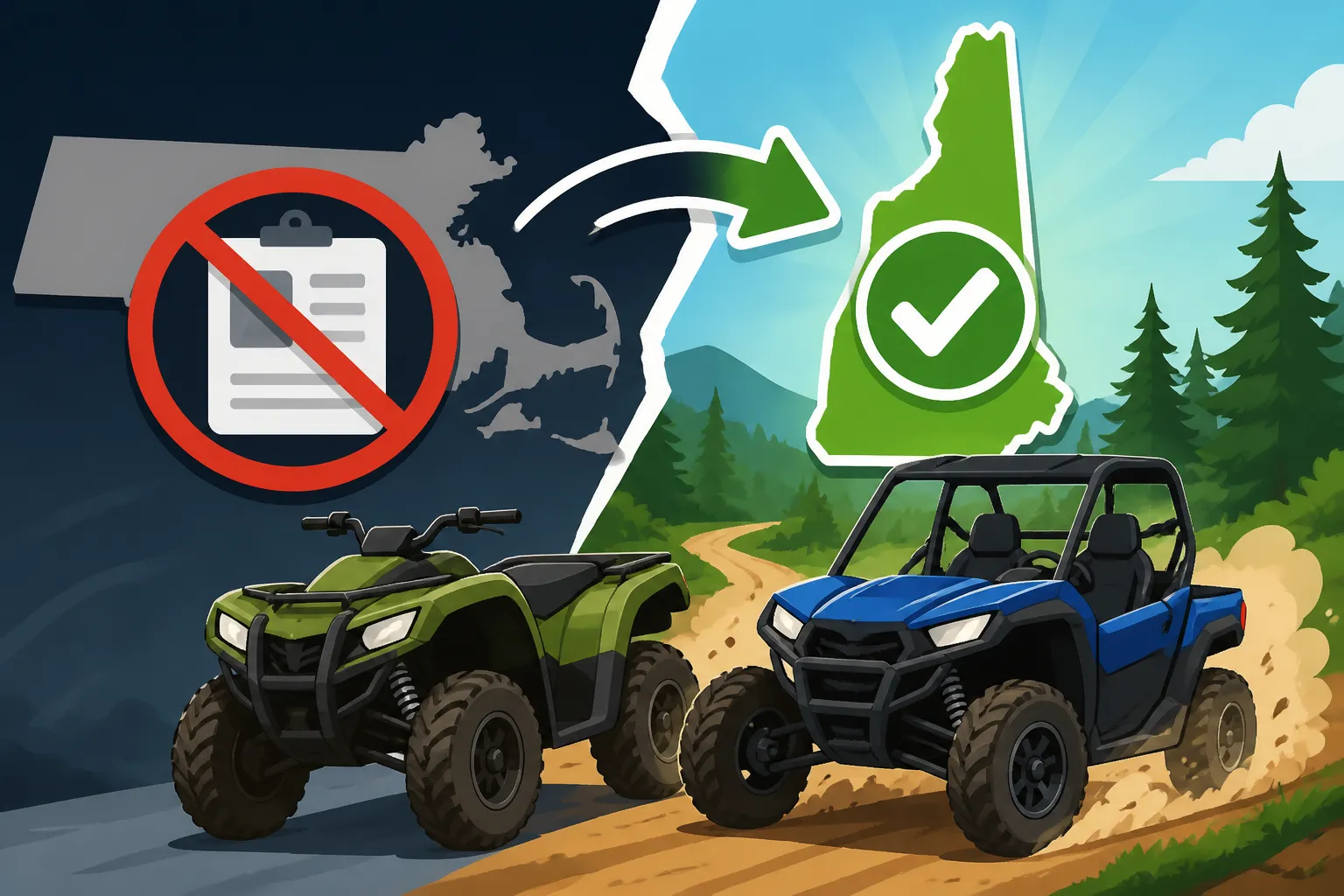
New Hampshire treats off-highway recreational vehicle registration as a state-specific requirement. A Massachusetts registration does not replace the registration New Hampshire requires for riding on its trails and other regulated riding areas. The same basic issue applies to a machine registered in another neighboring state, as explained in Why No Maine Registration Works in New Hampshire and Why No Vermont Registration Works in New Hampshire.
This is about where you ride, not where you live or where you bought the machine. A Massachusetts resident bringing an ATV north is still a visitor in New Hampshire for registration purposes. A New Hampshire resident who owns a machine registered in Massachusetts should not assume that the Massachusetts paperwork will cover riding on New Hampshire trails either.
The practical distinction is:
- Massachusetts registration is issued under Massachusetts rules.
- New Hampshire OHRV registration is the state registration needed for riding where New Hampshire requires it.
- Proof of ownership or a bill of sale can help establish who owns a machine, but neither one is a substitute for the required New Hampshire registration.
A machine might have a Massachusetts registration sticker, an out-of-state plate, a title, or registration documents and still need a New Hampshire registration before it is ridden on a New Hampshire trail. Paperwork that is valid in one state does not automatically satisfy another state’s OHRV rules.
That can feel counterintuitive if you are used to taking a registered vehicle across state lines. OHRV rules are not the same as rules for ordinary passenger vehicles. State registration systems and trail-access requirements are separate, and New Hampshire does not treat a Massachusetts OHRV registration as permission to ride its system.
The rule matters for ATVs, side-by-sides and other wheeled OHRVs. The type of machine may affect which registration option is available, but being registered in Massachusetts does not make the New Hampshire requirement disappear. If you are bringing a visitor’s machine, start with Registering a Visitor’s Machine in New Hampshire and confirm the option that fits your trip.
Keep road registration and OHRV registration separate
It is also important not to confuse OHRV registration with motor-vehicle registration for road use. A plate or other road-related paperwork does not automatically provide trail access, and an OHRV registration does not by itself make a machine street legal.
New Hampshire road use is limited and depends on the road, local designation, and applicable operating rules. A town may allow OHRVs on certain roads, but that is not blanket permission to ride any public road. The registration question and the road-access question are related, yet separate.
For example, a Massachusetts machine may be documented for a particular use in Massachusetts. That does not establish that it can ride a New Hampshire club trail, nor does it grant permission to travel along a New Hampshire road to reach that trail. Check the specific access rules for the route as well as the registration requirement.
What “no reciprocity” means in practice
For a visiting rider, “no reciprocity” means you should not plan to rely on the Massachusetts registration alone. It does not mean you must necessarily buy the same kind of registration a New Hampshire resident would choose. New Hampshire offers registration options for nonresidents, including a short-term option for eligible wheeled vehicles.
The difference is whether the New Hampshire registration is in place. The Massachusetts document may remain useful as evidence of the machine’s identity or ownership, but it is not a substitute for New Hampshire’s registration credential. If a question comes up at a registration agent or during a compliance check, be ready to show the New Hampshire registration and the required machine information.
What to arrange before bringing a machine north
Before hauling an ATV or UTV to New Hampshire, decide where you plan to ride and how long you expect to stay. Then choose the New Hampshire registration route that matches the trip. A weekend visit, several trips over the season, and a machine kept at a New Hampshire camp may call for different practical choices.
A nonresident’s short-term option is not the same as using a Massachusetts registration. It is a New Hampshire registration intended for a limited period. Annual registration is another option, and it may make more sense for someone who expects to return often. Check the current requirements and availability with an authorized registration agent or the relevant state office before setting out.
| Your situation | What to consider | What not to assume |
|---|---|---|
| One short visit with a wheeled machine | Ask whether the nonresident short-term registration fits your trip | Massachusetts registration alone is enough |
| Several visits during the season | Compare the available New Hampshire options for your expected use | The shortest option is always the best value |
| A machine kept at a New Hampshire camp | Arrange the required New Hampshire registration before riding | Out-of-state residency removes the requirement |
| A machine bought in Massachusetts | Gather ownership and machine details before applying | The seller’s registration transfers automatically |
| A machine intended for road use as well as trails | Check road-use rules separately from OHRV registration | OHRV registration makes the machine street legal |
Choose the registration period for the actual trip
New Hampshire has a May-to-April registration year, so the annual option does not necessarily line up with the calendar year. If you are weighing a short-term registration against an annual one, consider the actual dates you expect to ride, not just the number of days in your first visit. New Hampshire’s May to April Registration Year explains why the registration year is structured that way, while When a New Hampshire OHRV Registration Expires covers the expiration point.
A short-term registration may suit a visitor who is making a brief trip. If you plan to come back repeatedly, the annual option may be simpler. The right choice depends on your schedule and the current registration rules, so confirm the permitted term and any eligibility requirements before paying. Do not assume that you can extend a short-term registration or use it for a second visit without checking.
Also consider the machine itself. The nonresident short-term option is for wheeled vehicles, and there may be restrictions that make it unsuitable for another machine type or use. The details matter: a machine’s label or how it is marketed does not always settle how it is classified for registration.
Prepare the paperwork in advance
Registration agents need enough information to identify the machine and process the application. Before you travel, gather the machine’s identifying information and ownership documents. A Massachusetts registration document can be useful background, but bring any bill of sale, title, or other ownership paperwork you have as well. New Hampshire does not issue an OHRV title in the same way some vehicle buyers expect, so do not treat a title as the only document that can establish ownership. See New Hampshire OHRV Registration Paperwork for the documents to prepare.
Check that the identifying information on the machine matches the paperwork. A clear frame or vehicle identification number can help prevent delays, especially if you bought the machine privately or its prior documents are incomplete. If the ownership history is complicated, ask the registration agent what will be accepted before driving to the counter.
When you register, make sure the application accurately identifies the machine and the registrant. Registration is not a general pass that can be moved casually between machines. If you are bringing more than one ATV or UTV, confirm whether each needs its own registration. The requirements are not satisfied just because the machines are owned by the same person or transported on the same trailer.
What a New Hampshire registration does and does not allow
A New Hampshire OHRV registration addresses the state registration requirement. It does not give you unrestricted access to every trail, parcel of land, or road. Riders must still follow trail closures, landowner rules, local access restrictions, and operating requirements.
For a visitor, it helps to treat registration as one item in a pre-ride checklist rather than as a complete permission slip. Before riding, confirm that:
- Your machine has the appropriate New Hampshire registration.
- The trail or riding area is open to your type of machine.
- Your machine meets any trail-width restrictions.
- You have permission if the route crosses private land where permission is required.
- You understand any local road rules along the route.
- You have the required safety equipment and documents for your situation.
New Hampshire’s trail network includes routes managed by clubs and landowners as well as areas subject to specific public-land rules. A registered machine cannot be taken onto a closed trail, a route that excludes its width, or private property without the required permission. Conditions and access can change, so check trail status close to the day you ride.
Registration is not a trail pass for every route
The registration is the state credential, but access can still depend on the route. A trail may be open only during certain seasons, limited to machines within a specified width, or temporarily closed for weather, maintenance, or landowner reasons. A valid registration does not override those limits.
The same applies to road connections. A trail route may cross or briefly connect with a road, but that does not mean OHRVs may travel freely along the road. Towns decide whether certain roads are open to OHRVs, and riders must follow the rules for any designated route. Plan the full trip rather than assuming the machine can legally ride every connector shown on a map.
If a planned route crosses private land, registration does not grant permission to cross. Get permission in the form required for the situation and respect signs and closures. Land access is a separate issue from whether the machine is registered.
Keep the registration documents and decals in order
Once you register, follow the instructions for displaying the decals and carrying the registration certificate. Do not rely on a phone photograph or a Massachusetts document as a replacement for the New Hampshire credential. Keep the certificate where it can be presented if requested, and check that decals are attached as instructed and remain legible.
If you have a new machine, a transferred machine, or a registration that was recently issued, verify that the displayed decals and certificate correspond to the machine you are riding. A registration for another vehicle in your household does not cover the machine you brought on the trailer. If decals are damaged or lost, arrange replacements rather than riding with a missing or unreadable credential. New Hampshire OHRV Decal Placement explains where the decals belong.
For a broader overview of how the process works, see Registering an OHRV in New Hampshire. For a visitor choosing between registration periods, New Hampshire’s Ten-Day Nonresident Registration is the more focused resource.
Common Massachusetts visitor scenarios
“I’m only riding for one day”
The length of the planned ride does not make a Massachusetts registration valid in New Hampshire. If the machine will be used in a place where New Hampshire requires OHRV registration, arrange the appropriate New Hampshire registration before riding. Ask an authorized agent whether the short-term nonresident option is available for your machine and trip.
Do not wait until the machine is unloaded at a trailhead to sort out registration. Agent locations, opening hours, required documents, and processing steps can affect your schedule. Confirm those details in advance, especially if you are arriving outside normal business hours.
“My machine has a Massachusetts plate”
A plate or road-use document is not necessarily an OHRV registration that New Hampshire recognizes for trail riding. Even where a machine is registered for a permitted purpose in Massachusetts, that registration does not replace New Hampshire’s OHRV requirement. Ask the relevant New Hampshire registration agent what application category applies to the machine rather than relying on the plate as proof of trail eligibility.
Also remember that a plate does not guarantee road access in New Hampshire. A particular town’s road designation and the rules for riding on roads are independent questions.
“I bought the ATV in Massachusetts”
The place of purchase does not determine whether you can ride it in New Hampshire. A Massachusetts dealer’s paperwork may document the sale, but the new owner still needs to follow New Hampshire registration rules before using the machine where registration is required.
Keep the purchase paperwork and the machine’s identifying information together. If the dealer provided a registration document, bring it, but do not assume the registration automatically transfers or works across the state line. For a private purchase, a signed bill of sale and clear identification of the machine can be especially useful. The separate guide Registering a Machine Bought Privately in New Hampshire explains that kind of transaction.
“I’m storing the machine at a camp in New Hampshire”
Where the ATV is stored does not make Massachusetts registration sufficient for riding. If it will be used on New Hampshire trails, plan for the required New Hampshire registration. A camp location can also affect your practical choice: someone who rides multiple times over a season may want to compare available registration options rather than arranging paperwork for each visit.
Storage alone and riding are not the same thing. If you are leaving the machine on private property and not taking it into a place where registration is required, the facts may differ. But once you plan to use public trails or other regulated areas, check the registration requirement and access rules before the first ride.
“I have a Massachusetts registration and a New Hampshire registration”
Having both documents is not inherently a problem, but use the New Hampshire registration for New Hampshire riding and make sure it belongs to the machine being operated. Keep the paperwork consistent with the machine’s identification and follow each state’s rules when riding in that state.
If the registration details conflict—for example, the machine identification differs between documents—resolve the mismatch before riding. A mismatch can complicate a routine check and may signal that the registration was issued against the wrong machine details.
A simple pre-ride plan for Massachusetts riders
Use this sequence before you head north:
- Choose the riding area. Identify the trails or managed area you intend to use and check that it is open to your type and width of machine.
- Select a New Hampshire registration option. Decide whether a short-term nonresident registration or an annual registration better fits your trip.
- Confirm the current process. Contact an authorized agent or the appropriate state office to check eligibility, documents, and where registration can be completed.
- Gather machine and ownership details. Bring identifying information and relevant purchase or registration papers from Massachusetts.
- Check the decals and certificate. Follow New Hampshire’s display and document-carrying instructions.
- Review route access separately. Confirm land permission, local road designations, seasonal openings, and any trail-width limits.
- Recheck conditions before leaving. A route that was open when you planned the trip may have closed or changed.
This approach avoids the most common mistake: treating the Massachusetts registration as if it were a portable trail permit. It also helps prevent a second mistake, which is assuming that a New Hampshire registration alone guarantees access to a particular route.
If you are unsure whether your machine qualifies for a particular option, ask before you travel. Have the machine type, identifying details, trip dates, and Massachusetts paperwork ready when you contact the agent. A focused question is more useful than asking only whether an out-of-state registration is “good in New Hampshire,” because the answer depends on the use you have in mind.
Frequently Asked Questions
Can I ride a New Hampshire trail with only a Massachusetts ATV registration?
No. A Massachusetts registration does not replace the New Hampshire OHRV registration required for riding in places where New Hampshire requires it. Arrange the appropriate New Hampshire registration before riding.
Does a Massachusetts plate make my ATV street legal in New Hampshire?
Not by itself. Road use and OHRV registration are separate issues. Access depends on the road’s designation and the applicable New Hampshire rules.
Is the short-term nonresident registration the same as Massachusetts reciprocity?
No. It is a New Hampshire registration option for eligible visitors and machines, not recognition of the Massachusetts registration. Confirm its current eligibility and conditions before relying on it.
Do I need a separate registration for each machine?
Do not assume one registration covers multiple machines. Confirm the process for each ATV or UTV and make sure the registration and decals correspond to the machine being ridden.
Does New Hampshire registration let me ride any trail?
No. You must also follow trail openings, machine-width limits, landowner permissions, local road rules, and other access restrictions.
Disclaimer
This article is for general informational purposes only and does not constitute professional advice. Laws, prices and regulations vary by location and change over time. Consult a qualified professional for guidance on your specific situation.