Getting a Landowner’s Signature in New Hampshire
A landowner’s signature can be the difference between a welcome ride and unauthorized use of private property, but getting one does not automatically open every nearby trail. In New Hampshire, you need to understand whose permission counts, what the permission covers, and how it fits with registration and trail rules. This guide explains how to ask, what to put in writing, and what to carry.
What a landowner’s signature does and does not authorize
A signed permission note is evidence that the landowner, or someone authorized to act for the landowner, has allowed you to ride on specified private property under agreed conditions. It helps make the boundaries clear for both sides: where you may go, when you may ride, and what activities are allowed.
It is not a general ATV or UTV permit. A signature does not replace a required OHRV registration, make a closed trail open, authorize road riding where it is prohibited, or grant access across neighboring parcels. It also does not override restrictions set by a club, a town, a state agency, or another person who controls part of the route.
Think of permission as one piece of a larger access check. Before riding, you may need to confirm all of the following:
- Your machine is properly registered for the type of riding and your circumstances.
- You have permission to use each private parcel on your route, unless you are using an established trail with access already arranged.
- The trail or property is open to OHRV use.
- Your machine and riding group comply with applicable safety and operating rules.
- You can follow any special conditions the owner or trail operator sets.
New Hampshire does not issue a separate statewide trail pass that turns private land into public riding access. Registration and permission solve different problems. For a broader explanation, see New Hampshire OHRV Permits Explained and Why Your Registration Is the Access.
A signed note also cannot grant rights the signer does not have. For example, a person who owns one section of land cannot authorize you to cross another owner’s parcel. A tenant, caretaker, business manager, club officer, or relative may be able to grant access in some circumstances, but you should confirm that the landowner has actually given that person authority to do so.
The practical standard is straightforward: get clear written permission before entering private land for an OHRV ride, and make sure it comes from someone entitled to grant it. The state’s guidance and current rules are the right place to check if you are uncertain about a particular situation. For the core private-land rule, read Written Permission on New Hampshire Private Land.
When you need permission and how trail access differs
If you plan to ride on private land that is not part of an established trail system with access arranged for riders, do not assume that a missing sign means you may use it. An unposted field, woods road, driveway, logging road, or open-looking trail is not an invitation. The owner may have allowed other people to use it, may have granted access only to a club, or may not know riders are entering.
That is why the safest approach is to obtain permission directly rather than trying to infer it from the absence of a gate or sign. Why Unposted Land Is Not an Invitation explains the important difference between land that appears open and land you have permission to ride.
Private property outside an established trail system
You generally need written permission for a private parcel you intend to ride, even if your visit is brief or the route looks like a continuation of a public road. Ask before you enter. Do not ride in first and try to find the owner afterward.
Permission is especially important when you want to:
- Cross a parcel to connect two known trails.
- Use a woods road or logging road that is not clearly part of a public OHRV route.
- Ride on land near a camp, home, farm, business, or active work area.
- Park, stage, unload, refuel, camp, or take a break on private property.
- Use the property for an organized group ride, guided trip, filming, or event.
A permission to cross is not necessarily permission to explore. If an owner says you may use a specific corridor to reach a trail, stay on that corridor. Do not treat a narrow access approval as an invitation to ride elsewhere on the parcel.
Club trails and land arranged for public riding
Many established New Hampshire trail routes cross private land. A club or trail organization may have arranged access with landowners and may manage the route under specific conditions. In that situation, riders generally use the designated trail according to its rules; they do not normally need to obtain a separate signature from each landowner whose property the trail crosses.
That does not mean every private road or nearby track is open. Stay on the marked route, respect closure notices, and follow the club’s access requirements. The club’s arrangement may apply only to a particular trail, season, machine width, or type of use. New Hampshire’s Club Membership and Access describes how club access relates to riding in the state.
If you are unsure whether a route is an authorized club trail, check the trail information with the club or responsible trail operator before you ride. A line on an old map, an online route file, or another rider’s recollection is not enough to establish current permission. Conditions and access agreements can change, and landowners can withdraw access.
Public roads, public land, and leased trail land
A landowner’s signature does not decide whether an OHRV may use a public road or state-owned land. Road access depends on the applicable road and town rules. State land and leased trail land can have their own restrictions. Use the rules for the specific place rather than assuming a private-land permission note covers all land you encounter.
The same care applies where a trail crosses a mix of ownership types. A route may pass over private property, public land, and land made available under a lease or permission agreement. Each segment can have separate conditions. See New Hampshire Rules on Leased Trail Land and [New Hampshire Rules on State-Owned Land] for more on those situations.
| Where you plan to ride | Whose access arrangement matters | What to verify before riding |
|---|---|---|
| A private parcel outside an established route | The landowner or an authorized representative | Written permission, allowed area, dates, and conditions |
| A marked club trail crossing private land | The club or trail operator’s access arrangement | Current trail status, route markings, and club rules |
| A town road | The town’s current designation and road rules | Whether OHRVs are allowed on that specific road |
| State-owned land | The relevant public-land rules and current access status | Whether OHRV use is allowed in that area |
| A leased or temporarily authorized route | The organization managing access and any underlying land conditions | Whether the route is open and what restrictions apply |
When your planned ride moves between these categories, check each one separately. A signature from one landowner is not a shortcut around the rest.
Who can sign and how to confirm they have authority
The most reliable permission comes directly from the landowner. If that is not practical, ask the person offering access to explain their authority. A club may coordinate access for a marked trail; a property manager may handle permissions for an owner; a tenant may have permission to allow limited use. But a familiar name or a confident answer does not by itself prove that someone can grant OHRV access.
Identify the right owner or authorized person
Start by asking who owns or controls the land and who handles access requests. A neighbor may be able to point you in the right direction, but do not rely on a neighbor’s approval unless that person is also authorized to grant permission.
If you are approaching a business, camp, farm, or other organization, ask for the person responsible for property access. If a club says it has permission for a route, ask which trail is covered and whether the access arrangement is current. You do not need to demand private paperwork from a club, but you do need to be confident that you are following its designated route rather than an informal shortcut.
If ownership is divided or unclear, pause before riding. Land can have multiple owners, easements, tenants, and access arrangements. A permission from one person may not cover the full area or every use. Ask the signer to identify the parcel or route they control, and seek clarification for any adjoining land.
Make sure the permission covers the people and machines involved
A landowner may agree to one rider, one household, a small group, or a club activity. Do not assume a signature for you also covers friends, family members, guests, or a group you lead. Ask whether the permission applies to everyone who will ride and whether it is limited by group size.
The same goes for machines. If the owner gives permission for your ATV, do not assume a large side-by-side, a trailer, or another machine is included. Be candid about what you plan to bring, especially if the machine is wider, louder, or heavier than the owner might expect. Different parts of a trail system may have different width restrictions, and a landowner’s approval cannot change a trail’s technical limits.
If you are asking on behalf of a club, tour operator, rental business, event organizer, or other group, say so clearly. Personal permission is not necessarily commercial permission or event authorization. A landowner may agree to occasional individual riding but not to customers, repeated guided trips, advertising, or a public event. Separate permits or approvals may also apply to organized activities. See [New Hampshire Rules for an Organized Ride] and New Hampshire Rules for a Commercial Guide.
Treat unclear authority as a reason to wait
If the person cannot say whether they own the land or have permission to grant access, do not resolve the uncertainty by riding anyway. Ask them to check with the owner or provide a direct introduction. A short delay is better than creating a problem for the person who is trying to help you.
Keep a respectful tone. Many private-land access arrangements exist because owners and riders communicate well. A clear request, a clear answer, and a willingness to accept “no” help preserve those relationships.
How to ask for permission without creating a problem
A good request is specific, brief, and easy to answer. The owner should not have to guess what you want to do. Explain where you hope to ride, when, how many people and machines are involved, and whether you are asking to cross the land or use it for more than that.
Prepare before making contact
Before you call, email, or visit, gather the basics:
- Identify the parcel or route as clearly as you can.
- Decide the dates or season you are requesting.
- Count the riders and machines.
- Describe the type of machines, including whether you plan to use ATVs, UTVs, or both.
- Explain the purpose: crossing to reach a trail, riding a defined loop, staging, or another activity.
- Check whether the route connects to a legal, open trail and whether you need additional permission elsewhere.
If you have a map, mark the exact route and ask the owner to correct it if your understanding is wrong. Avoid sending a large, confusing map with no explanation. A simple marked image or clear written description can prevent misunderstandings about gates, buildings, fields, and neighboring parcels.
Make the request easy to understand
You might say:
“I’m asking for written permission for two registered ATVs to use the marked woods-road section on your property to connect with the club trail. We would ride during the dates we agree on, stay on that route, and keep the group small. Is that an area you control, and would you be comfortable granting permission under those conditions?”
Adapt that wording to your actual plan. Do not say “just passing through” if you also want to explore, stop, camp, or bring a group. Avoid vague phrases such as “use your land” when you mean a particular path. Specificity gives the landowner a fair chance to approve, limit, or decline the request.
If the owner says yes verbally, thank them and ask whether they are willing to put the permission in writing. The written record does not have to be elaborate to be useful, but it should be clear enough that you and the owner remember the same terms.
Accept conditions and a refusal
An owner may say yes only for certain dates, a specific route, a limited number of riders, or a particular type of machine. They may require low speeds near buildings, no night riding, no parking, or no riding during logging, hunting, planting, or other activity. If you accept, follow the conditions. If the conditions do not work for your trip, do not quietly ignore them; ask whether the owner is willing to adjust them or find another route.
If the answer is no, do not argue that the land is unposted, that other riders use it, or that you are only crossing. Thank the owner and make another plan. Permission is voluntary, and preserving the relationship matters beyond one ride.
A practical way to keep the exchange simple is to have a short permission form ready, but do not present a complicated legal document as though the owner must sign it. You can write the agreed terms in a plain note and let the owner review or change them. If you want a paper copy on hand, basic clipboards and document sleeves are easy to find at office-supply or outdoor shops; Amazon is one option for those ordinary supplies. The important part is the agreement, not the brand of stationery.
What to put in the written permission
A useful permission note answers the questions that are most likely to come up later. It should identify the people and property involved, describe the allowed use, and make any limits visible. Do not use a vague note that simply says “permission granted” if the owner expects you to stay on one trail or ride only on certain dates.
A clear note can include:
- The landowner’s name and a way to contact them.
- The name of the rider or group receiving permission.
- The property location or a map showing the approved area and route.
- The allowed activity, such as riding through a specified corridor or using an agreed loop.
- The machine types included, if relevant.
- The dates, season, or time period covered.
- Any limits on group size, hours, speed, stopping, parking, or other conduct.
- Any areas that must be avoided, such as buildings, fields, work sites, or sensitive ground.
- The date the permission was given.
- The landowner’s signature and the rider’s acknowledgment of the conditions.
A parcel street address may not describe the permitted area well enough. If the permission covers only a trail crossing, attach or refer to a marked map and label the route. If you draw a map, make the boundary and route understandable to someone who has not been on the ride.
Keep the terms narrow and accurate
Write what the owner actually approved, not what you hope the approval might cover. If the owner authorizes a single ride, do not write “ongoing access.” If permission is for a trail segment, do not describe the entire property as open. If it applies only to named riders, do not treat it as permission for guests.
A good permission note is not a substitute for the owner’s full consent. Do not add clauses or conditions the owner has not reviewed. If the request involves a business, group event, repeated commercial use, or potential liability concerns, the owner may want a more formal arrangement and professional advice.
If permission is conditional, include the conditions in the note or an attached message. Conditions should be plain enough that every rider in your group can follow them. “Stay on the marked route and do not pass through the lower field” is more useful than “be respectful.”
Signatures, electronic copies, and duplicates
Ask the owner to sign and date the written permission. Keep a copy for yourself and, when appropriate, provide a copy to the owner. If the agreement is made by email or another electronic method, save the message and confirm that it clearly identifies the owner, property, approved use, and conditions. Do not assume every digital format will be treated the same in every context; if the form of proof matters, check with the relevant official source.
For a paper original, take a clear photo or scan as a backup. Keep the copy legible and accessible on the ride. A small waterproof sleeve can protect it from rain and mud; Amazon is one place to look for basic document-protection supplies, though any suitable sleeve works. Do not rely only on a phone if the route has no service or the device battery may run down.
The signed note is not necessarily a transferable right. If you sell the machine, invite another rider, or change the group, ask whether the permission still applies. When the terms are uncertain, get the owner’s confirmation rather than interpreting silence as approval.
Carrying permission and following the conditions on a ride
Having a signed note is useful only if you can produce it and follow what it says. Keep the permission with the person responsible for the ride, tell every rider what the owner agreed to, and make sure the route on the ground matches the route on the paper or map.
Keep a copy available
Carry a paper copy in a protected pouch or keep an accessible digital copy as a backup. If several people are riding, it can help for the group leader and at least one other rider to have the details. That way, the whole group does not depend on one person’s phone or a document stored in a vehicle parked far away.
A phone photograph can be convenient, but make sure the image is readable and available offline. A faded, cropped, or incomplete picture may not show the route or the conditions. For a group, a simple printed copy can be easier to review at the trailhead. Amazon sells common waterproof sleeves and small organizers, but a clean, durable pouch from any retailer will do the job.
Permission does not replace required registration documents or other riding credentials. Carry the documents required for your machine and situation as well as the landowner’s note. If you need help understanding registration rules for a visiting machine, see Riding New Hampshire With an Out-of-State Machine and Why New Hampshire Honors No Neighbor’s Registration.
Brief the whole group
Before entering the property, explain the boundaries and conditions to everyone. Make sure riders know where to turn, where not to stop, and what to do if a gate is closed or work is underway. A signed agreement for the group does not help much if one rider leaves the approved route and creates a problem.
Use the route exactly as authorized. Do not widen a narrow trail to make room for a larger machine. Do not use a side road because it looks smoother. Do not assume that a gate left open means access is allowed or that an open gate means the property is unoccupied. If the route is blocked or the conditions have changed, stop and contact the owner or trail operator rather than improvising across another parcel.
Respect normal property concerns. Keep noise down near homes, avoid disturbing livestock and equipment, do not leave litter, and do not block a driveway or work access. If an owner has asked riders to avoid certain times or areas, treat that as part of the permission, not an optional courtesy.
Stop when permission is withdrawn or the situation changes
An owner may change their mind or close the route because of maintenance, weather, logging, hunting, a safety issue, or another reason. A signature from an earlier date does not mean the route must remain open forever. If you receive notice that access has ended, stop using the property and adjust your route.
If you encounter a closure sign, a gate, active work, or a landowner asking you to leave, do not argue from the permission note without first checking what has changed. Permission may have applied to a different route, date, or activity. Move out safely and contact the owner or the organization that manages the trail to clarify.
Special cases that call for more than a basic signature
Some situations are easy to confuse with ordinary individual access. In these cases, do not assume a personal permission note is enough.
Crossing private land between established trails
If a mapped route seems to require crossing a parcel that is not included in the trail system, ask the landowner before using it. A short connector can still cross private property, and the fact that it would make your ride easier does not create permission. Ask the club or trail operator whether an approved connection exists. If not, obtain written permission for the exact crossing or choose another route.
Never treat an old GPS track as proof that the connector is still authorized. Routes can change, and access agreements can end. Crossing a Corner of Private Land Between Trails covers why even a brief crossing needs careful attention.
Clubs, events, rentals, and commercial use
A landowner might be comfortable with an individual rider but not a large group, a public event, paid guiding, filming, or repeated rental traffic. If you are organizing a poker run, taking customers on a guided trip, or bringing a club group, describe the activity honestly and ask for permission that specifically covers it. Other approvals may apply in addition to the landowner’s consent.
For clubs, confirm that the permission is current and applies to the route and season you intend to use. Do not assume that a club’s general relationship with a landowner covers every member’s activity off the marked trail. For rental machines, check with the rental company as well as the trail operator; the renter’s agreement does not grant access to private land beyond routes the company is authorized to use.
Camps, farms, and land shared with other uses
A camp or farm may have several people using the property, and the person who is present may not be the person who can approve OHRV access. Ask who controls the route and whether riding could conflict with work, guests, livestock, or other uses.
A landowner may set seasonal restrictions to protect soft ground, crops, wildlife, or maintenance work. Conditions can change after rain, during harvest, or when equipment is moving. Even if a note allows use for a season, check whether the owner has issued a closure or changed the route before each ride.
Town roads, frozen water, and public land
A private-land signature is not a road designation, a state-land authorization, or approval to ride on frozen water. Each setting has separate rules and risks. If your route uses a town road, verify that the town has opened that specific road to OHRVs and follow the applicable restrictions. If you plan to ride on state-owned land or a frozen surface, check the rules for that place rather than relying on a landowner’s note.
Do not interpret an owner’s permission to reach the edge of a road or pond as permission to continue across it. The signer can authorize only the property and use they control.
A practical permission checklist before you ride
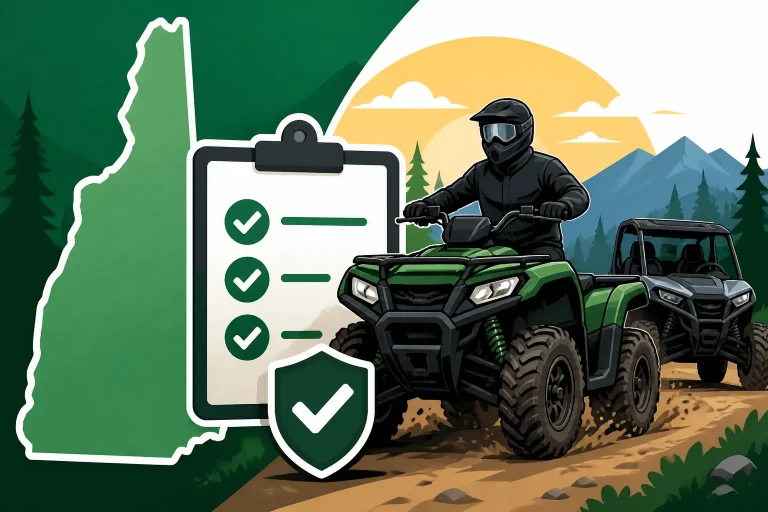
Before loading the ATV or UTV, run through this checklist:
- Identify every parcel and route. Know where the private property begins and ends, and whether your trip follows an established trail or a separate route.
- Confirm who controls the land. Obtain permission from the owner or a person authorized to grant it.
- Get the permission in writing. Include the rider or group, property, route, activity, dates, and restrictions.
- Check that the permission fits the trip. Confirm that it covers all riders, machine types, stops, and any group or commercial activity.
- Verify access elsewhere on the route. A single signature does not authorize riding across adjoining land, public roads, state land, or closed trails.
- Check current trail status. Confirm that the route is open and that the machine meets any trail limitations.
- Carry the permission and required riding documents. Keep copies protected and accessible.
- Brief everyone in the group. Make sure all riders understand the route and conditions.
- Respect closures and changed circumstances. If access is withdrawn or the route is blocked, stop and find an authorized alternative.
Getting a signature should be a straightforward conversation, not a way to pressure an owner into allowing access. Be specific, accept conditions, and make it easy for the owner to say no. If the permission does not clearly cover what you plan to do, ask before riding. That small amount of care protects the landowner’s interests, helps keep access arrangements in good standing, and gives your group a clearer answer when the route is uncertain.
Disclaimer
This article is for general informational purposes only and does not constitute professional advice. Laws, prices and regulations vary by location and change over time. Consult a qualified professional for guidance on your specific situation.