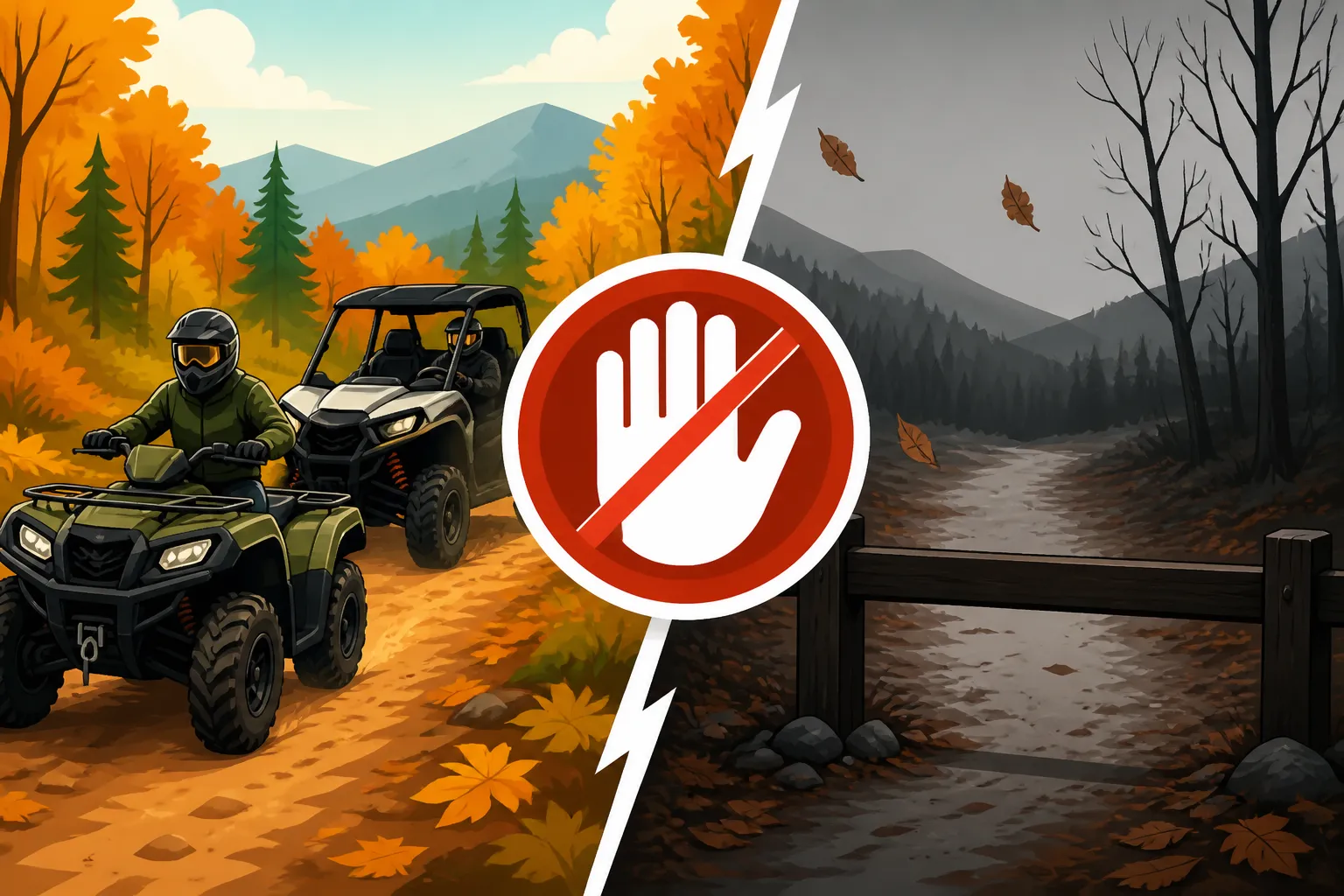
Why October 12 Ends Some Trails
A trail that was open last weekend can be closed by October 12, leaving riders frustrated if they have already planned a North Country trip or loaded the trailer. That date is not a universal New Hampshire shutdown rule. This guide explains why some routes close then, how closures are decided, and what to check before you ride.
Why October 12 Can Mark the End of a Trail Season
October 12 is not a statewide closing date
New Hampshire does not have one October 12 deadline that automatically closes every ATV or UTV trail in the state. A closing date may apply to a particular club system, trail segment, or landowner-approved route. Nearby trails can have different schedules, even when they appear to connect on a map.
That distinction matters when you are planning a ride. You might see a trail open on a regional map and assume the whole route is available, only to find that one section has closed. A closure on a connector can be enough to break a loop or leave you needing to turn around.
Some clubs close routes around October 12, while other systems stay open later when land access, trail conditions, and local rules allow. For a broader view of how dates vary, read New Hampshire’s October Closing Dates and New Hampshire Trails That Run to the End of October. The useful takeaway is simple: check the dates for the specific trail area you plan to ride, rather than relying on one statewide calendar.
Club and landowner decisions shape access
Many New Hampshire trails cross land that clubs access through agreements with private owners, municipalities, or other land managers. Permission may be seasonal and may come with conditions. If an agreement ends on a particular date, or a landowner asks for a trail to close earlier, the club cannot treat the route as open just because riders would like to continue using it.
Clubs also coordinate and maintain routes across connected parcels. A landowner may be comfortable with summer riding but not with fall traffic during hunting season or after heavy rain. If one important parcel closes, a club may need to close a longer section to prevent riders from reaching a dead end or continuing onto land where permission has ended. Why New Hampshire Clubs Close on October 12 offers more context on why that date matters in some trail systems.
This is why a familiar route can change from year to year. The trail itself may look unchanged, but access depends on permission and local decisions as well as the physical condition of the path. A gate, closure notice, or current club update should take precedence over what you remember from a previous season.
Fall conditions can make continued riding a poor fit
Autumn weather is unpredictable. A stretch of rain can soften a trail, flood low spots, or turn a firm surface into deep ruts. In some areas, ground that seems rideable from the seat of a machine is more vulnerable than it looks, particularly where water drains slowly or the route passes through wet soil.
A few machines can leave lasting damage when the surface is saturated. Rutting can direct water along the trail, wash out the tread, or make repairs harder for volunteers. Clubs may close routes to protect the trail before damage becomes extensive, rather than wait until a section is impassable.
Seasonal maintenance is another consideration. Clubs may use the end of the riding season to inspect culverts, clear drainage, repair signs, or prepare shared corridors for winter use. These factors do not explain every October 12 closure, but they help explain why a club may choose an earlier end date than riders expect.
Hunting Season and Shared Trail Use
Why fall brings extra caution
October overlaps with hunting activity in New Hampshire. Hunters and riders may be using nearby woods at the same time, and clubs or landowners may decide that closing a trail is the safest or most practical way to manage that overlap. The exact approach can vary by property and trail system.
A closure does not necessarily mean a trail is unsafe in every circumstance, and an open trail does not mean riders can ignore hunting-season precautions. If riding is permitted, wear visible clothing appropriate for the conditions and pay attention to posted notices. Keep to the marked route, avoid stopping where you block access, and be considerate of people using the surrounding land.
Review New Hampshire Rules for Riding in Hunting Season before heading out. Rules and landowner requirements can differ from the habits riders have picked up elsewhere, so do not assume that a route open in another state follows the same expectations.
A closure protects access as well as safety
A trail network depends on continued cooperation from the people who allow it to cross their land. Even when riders are careful, a busy fall weekend can create concerns about noise, parking, traffic, or conflicts with other land users. A club may close a route to address those concerns and preserve the relationship that allows the trail to remain available in future seasons.
That can be disappointing when you have traveled a long way, especially if the closure appears to affect only a short stretch. But riding around a barrier or continuing past a closure sign can put access at risk for everyone. It may also take riders onto land where they do not have permission to travel.
If a trail is closed, treat the closure as final unless the club or land manager clearly says otherwise. Do not rely on a paper map, a saved GPS track, or a friend’s report from an earlier week to override a current notice.
How to Check Whether a Trail Is Open
Check the club’s latest trail information
Before you leave home, look for current updates from the club responsible for the area. Check its trail-status page or board, recent announcements, and any posted information for the specific route you intend to use. New Hampshire Trail Status Before You Ride and Checking the Trail Status Board are useful starting points for building that habit.
Pay attention to the date and wording of an update. A map may still show the trail network, while a separate notice announces that certain segments have closed. Look for distinctions such as “closed for the season,” “temporarily closed,” or “open with restrictions.” If the update is unclear, contact the relevant club or trail manager before assuming the route is available.
It also helps to check more than once. A trail may be open when you plan your trip and close after a storm or a landowner decision before your ride date. If your trip depends on one connector, confirm that segment specifically rather than checking only the general status of the area.
Use maps as planning tools, not permission
A trail map is valuable for understanding where routes go, locating staging areas, and planning a loop. But a map can lag behind a closure or show a route without communicating its current status. Printed maps and saved tracks are especially easy to misread when they were downloaded weeks or months before the ride.
Navigation apps such as onX Offroad can help you organize a route and see where you expect to travel. Use that information alongside current club notices, not instead of them. A route displayed in an app is not proof that the trail is open, that access permission remains in effect, or that your machine fits any local width restriction.
For practical planning, use New Hampshire Trail Maps From a Club and New Hampshire Trail Conditions Before You Ride alongside your navigation tools. If you use onX Offroad, check that the route you saved still matches the current trail information, and be prepared to turn around if signs or a club update indicate a closure.
| What to check | Why it matters | What to do |
|---|---|---|
| Club trail-status update | Closures may be announced for individual routes | Check the responsible club shortly before traveling |
| Closure signs and gates | Conditions can change after you leave home | Obey signs on the ground and do not go around barriers |
| Land access and route connections | A closed connector can interrupt a longer loop | Confirm the status of key segments, not just the general area |
| Weather and trail conditions | Rain can make a trail vulnerable or impassable | Recheck conditions and adjust your plan if the ground is wet |
| Your map or navigation app | Saved routes may not reflect recent changes | Treat the map as a planning aid, not authorization to ride |
Planning a Ride When Some Trails Close Early
Build a backup route before you tow north
If your preferred trail system closes around October 12, avoid planning a trip around a single long loop with no alternatives. Identify a second route or riding area that is open during your travel window, and confirm its status separately. A backup plan is particularly useful when you are traveling to northern New Hampshire, where a closed connector can change how far you can ride before needing to return to your staging area.
Think through the practical details before setting out: where you can legally stage, whether the route has fuel or services nearby, how much daylight you have, and whether your group is comfortable turning back early. If you are using an unfamiliar trail network, download or save the appropriate club map ahead of time, then check for current updates on the day of the ride.
onX Offroad can be useful for keeping your planned route organized, but leave room for changes. Mark a turnaround point, identify a shorter option, and make sure everyone in your group understands that a closure sign overrides the route on a phone screen. A little flexibility is less frustrating than reaching a locked gate after hours on the road.
Have a clear plan for a closed trail
When you arrive and discover a closure, do not try to find an unofficial way around it. Turn back and use a route confirmed open by the club or land manager. Avoid crossing private property to reconnect with another trail unless you have permission to do so.
If the closure affects your whole plan, stop somewhere safe to regroup rather than making a rushed decision at the trail entrance. Check the club’s latest update, identify a legal alternate route, and tell the rest of your party what has changed. If there is no suitable option, ending the ride early is the responsible choice.
For trips later in the fall, review Riding a New Hampshire Trail in November before you make assumptions about what remains open. Seasonal access changes from place to place, and a trail that stays open elsewhere may not be available in the system you had in mind. The best planning habit is to verify access close to your ride date and follow the local notice when plans need to change.
Disclaimer
This article is for general informational purposes only and does not constitute professional advice. Laws, prices and regulations vary by location and change over time. Consult a qualified professional for guidance on your specific situation.