Riding Out of North Stratford
Riding out of North Stratford can be a rewarding way to explore Coos County, but planning matters: trail connections, seasonal openings, machine-width limits, and road crossings can change what you can ride. This guide explains how to prepare, check access, and ride responsibly, whether you’re bringing your own ATV or UTV or meeting friends nearby.
Plan a Ride From North Stratford
Understand the local trail network
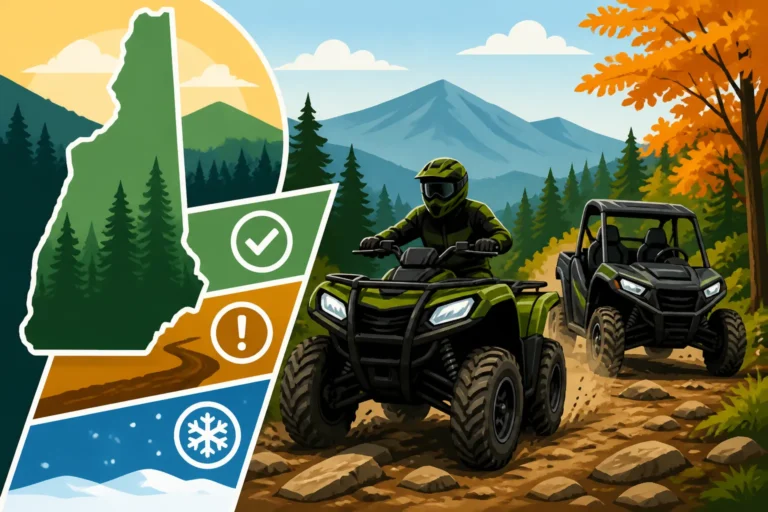
North Stratford sits in New Hampshire’s North Country, where riding opportunities are tied to club-managed trails and the wider regional network. Local routes may connect with trails in neighboring areas, but a line on a map does not guarantee that every connector is open or passable on the day you arrive. Landowner permissions, maintenance, weather, and seasonal restrictions can all affect access.
Start by identifying the trail system you intend to use and the club responsible for the area. North Country ATV is one useful place to begin when researching Stratford-area riding. Then check the club’s latest trail-status information before you leave home. An old map, a saved GPS track, or a route recommended by someone who rode last season may not reflect a current closure.
This is especially important if you’re hoping to make a long loop. A short closure can turn a planned circuit into an out-and-back ride, while a closed bridge or connector may mean there is no legal route through to the next section. For broader route ideas, see [New Hampshire ATV Trails Near Littleton](New Hampshire ATV Trails Near Littleton) and [1,000 New Hampshire Miles Linked in Coos County](1,000 New Hampshire Miles Linked in Coos County). Treat regional mileage as an overview, not a promise that every segment is open or suitable for your machine.
Check the route against your machine
Before committing to a trail, confirm that your ATV or UTV fits the route’s restrictions. Trail width rules can differ between systems, and gates or posted limits may exclude a machine even when the trail itself looks wide enough. A vehicle that fits one section might not be permitted on a nearby rail trail or connector.
Measure the machine’s actual width at its widest point, including accessories that affect its overall footprint. Do not rely only on the model name or a specification from a sales listing. If you have added wheels, a plow mount, fender flares, or other equipment, measure the machine as it will be ridden.
Also check whether the route is intended for ATVs, UTVs, trail bikes, or a specific class of machine. The [New Hampshire Trails With a 50-Inch Limit](New Hampshire Trails With a 50-Inch Limit) guide explains why width can matter on some routes, while [New Hampshire Trails for a Wide Machine](New Hampshire Trails for a Wide Machine) is a useful place to start if you ride a larger side-by-side. Never try to squeeze around a posted gate or ride beyond a limit simply because another vehicle has done so.
Build a realistic day plan
Give yourself more time than a map estimate suggests. Trail surfaces, slower sections, stops, weather, and unfamiliar intersections all affect how far you can comfortably travel. If your group includes newer riders or children, plan a shorter first outing and leave room for breaks rather than trying to cover the maximum distance.
Choose a turnaround point before you start, and identify a backup plan if a trail is closed. A map app such as onX Offroad can help you review terrain and organize a route, but it should complement—not replace—current local trail-status information, posted signs, and your own judgment. Save the map for offline use where possible, since mobile coverage can be limited in parts of the North Country.
Tell someone who is not riding with you where you plan to go and when you expect to return. Bring a charged phone, a way to navigate without service, water, basic tools, and clothing for changing conditions. If a route is unfamiliar, resist the temptation to keep pushing farther just because the group has not reached its planned mileage yet.
Confirm Access, Registration, and Seasonal Status
Check trail openings before traveling
Trail access is not necessarily year-round. Spring mud, maintenance work, landowner requests, hunting activity, snowmobile use, and weather can all influence when a route opens or closes. In particular, soft ground can be damaged quickly by heavy machines. Riding around a closure or onto a wet trail can create lasting damage and put future access at risk.
Check the relevant club’s updates shortly before your trip, not only when you book lodging or load your trailer. If you’re traveling a long distance, check again on the morning of the ride. A sudden closure can make a previously planned route unusable, and conditions in one part of the region may differ from those in another.
Useful background includes [New Hampshire Trail Status Before You Ride](New Hampshire Trail Status Before You Ride), [New Hampshire's Mud Season Ban](New Hampshire's Mud Season Ban), and [New Hampshire Trail Closing Dates](New Hampshire Trail Closing Dates). When a sign, gate, or current club notice conflicts with an old map or downloaded route, follow the current restriction. Do not assume that a route is open because it appears in an app.
Make sure the machine is properly registered
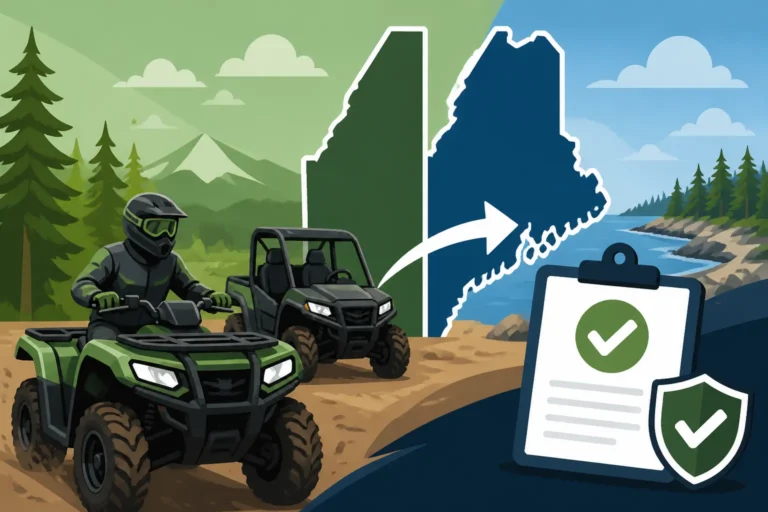
New Hampshire requires applicable OHRVs to be registered for riding on public trails and other places where registration applies. A registration from another state does not automatically replace the New Hampshire requirements for riding here. If you’re visiting from Maine, Vermont, Massachusetts, or elsewhere, check the rules before unloading the machine.
The registration process and requirements can depend on the machine and how you plan to use it. Review [Riding New Hampshire With an Out-of-State Machine](Riding New Hampshire With an Out-of-State Machine) and [New Hampshire OHRV Registration Paperwork](New Hampshire OHRV Registration Paperwork) before your trip. Carry the required registration documents with you, and make sure the decals are displayed as required rather than tucked away in a trailer or storage compartment.
If you are bringing a side-by-side, don’t assume that its size or road equipment changes its trail status. A UTV still needs to meet the applicable registration and trail rules, and road use is not automatically allowed just because a machine can be driven on pavement. For machine-specific background, see [Registering a UTV in New Hampshire](Registering a UTV in New Hampshire).
| Before you ride | What to confirm | Why it matters |
|---|---|---|
| Trail access | Current club status, closures, and posted signs | A mapped route may be closed or rerouted |
| Machine fit | Width limits and vehicle type allowed | Some trails or connectors restrict larger machines |
| Registration | New Hampshire requirements for your machine | Another state’s registration may not be enough |
| Road crossings | Legal crossing points and required equipment | Not every road or road segment is open to OHRVs |
| Navigation | Offline map, backup route, and turnaround point | Cell service and trail conditions can be unpredictable |
| Group readiness | Fuel, water, tools, and a return plan | Small problems can become difficult in remote areas |
Treat road connections as a separate question
A trail network may appear to pass through or near a town, but that does not mean every public road is open to OHRVs. New Hampshire roads are not generally open by default. A town must designate specific roads or sections for OHRV use, and those permissions can come with limits.
Do not follow another rider onto pavement simply because they appear to know the route. Confirm that the road segment is designated for OHRVs and that your machine and riding situation comply with the applicable rules. Where road riding is permitted, operators may need to follow requirements involving speed, position, lighting, mirrors, stopping, and crossings. For the general framework, see [How a New Hampshire Town Opens Its Roads](How a New Hampshire Town Opens Its Roads) and [New Hampshire Rules for Riding a Town Street](New Hampshire Rules for Riding a Town Street).
At a road crossing, slow down and assess visibility, traffic, and the legal crossing point. A trail crossing is not permission to ride along the road, and a nearby connector does not make a closed road legal. If the route is unclear, stop and verify rather than improvising a shortcut.
Ride Safely and Respect the Area
Prepare for changing trail conditions
North Country trails can vary from smooth, easy-going stretches to rougher or more technical sections. Rain can leave low areas muddy, while dry weather can bring dust and loose gravel. Fallen branches, washouts, exposed rocks, and other obstacles may appear between maintenance checks.
Adjust your pace to the conditions instead of trying to keep up with the fastest rider in the group. Leave space between machines, especially where dust or a bend limits visibility. On a UTV, keep passengers seated and secured as intended by the vehicle’s safety system. On an ATV, stay within your own ability and avoid sudden steering or braking on loose ground.
A navigation app such as onX Offroad can help you understand where you are relative to mapped routes, but an app cannot tell you whether a trail has become impassable since the map was updated. Use it as one part of your planning, alongside local club notices and on-the-ground signs. If you encounter an unexpected closure or unsafe condition, turn around rather than creating a new track around it.
Be thoughtful around landowners and other users
Many trails depend on continued cooperation from landowners. Stay on the marked route, keep out of fields and driveways, and do not treat unposted land as an invitation to ride. A route crossing private property does not grant permission to leave the designated trail. If a landowner has closed an access point, respect that decision and follow the club’s guidance.
Keep noise under control, avoid spinning tires, and slow down near homes, trailheads, and other areas where people may be walking or working. Yield appropriately to other trail users and conventional vehicles. Give logging or maintenance equipment plenty of space, and never assume the operator can see you.
These everyday choices help protect access for everyone who rides. For more on access and permission, review [New Hampshire Landowner Permission Rules](New Hampshire Landowner Permission Rules) and [New Hampshire Rules for Riding State Land](New Hampshire Rules for Riding State Land). If you ride with a group, make sure the least experienced person knows the plan and feels comfortable asking to stop or turn back.
Carry the essentials and set group expectations
A small amount of preparation can prevent a minor delay from becoming a stressful situation. Bring water, food, weather-appropriate layers, a first-aid kit, basic tools, and supplies suited to your machine. Check fuel before setting out and avoid planning a route that leaves no margin for an unexpected detour.
Agree on a few simple group rules before starting: who leads, who rides at the back, where everyone waits at intersections, and what to do if someone gets separated. Stop at safe locations rather than blocking a trail or standing in a blind corner. If a rider needs help, keep the rest of the group out of the way and communicate clearly.
New riders should be especially cautious about following tracks without understanding where they lead. A saved route may cross a closed segment, a restricted trail, or a road that is not designated for OHRV use. Use onX Offroad or another navigation tool to orient yourself, but confirm the route against current local information before relying on it.
Make North Stratford a Better Ride
Choose the right kind of outing
North Stratford can work well as a starting point for a day ride, but the best plan depends on your group and equipment. A family ride with newer operators calls for a different route and pace than a full-day trip with experienced riders. Before choosing a destination, compare the expected distance, terrain, width rules, access points, and places where the group can safely stop.
If you are visiting from outside the area, plan around the practical details too: where you can legally stage, whether there is room to park a trailer, and how far you need to travel to reach an open trail. Do not assume that a visible pull-off is an approved staging area. Check local guidance, use designated parking where available, and avoid blocking roads, gates, or private driveways.
For broader trip planning, [Riding 100 Miles Out of Pittsburg](Riding 100 Miles Out of Pittsburg) and [Planning a Week on Ride the Wilds](Planning a Week on Ride the Wilds) offer useful regional context. Those ideas can help you think about distance and connections, but always confirm whether a particular trail is open and appropriate for your machine before building it into your itinerary.
Leave the route as you found it
Pack out everything you bring in, including food wrappers, broken straps, and disposable items. Do not leave vehicle parts or trash at trailheads, and do not wash mud or fuel residue into streams or wetlands. If your machine develops a mechanical problem, move it only where it is safe and legal to do so; avoid widening the trail or damaging the surrounding ground.
If you encounter a damaged sign, blocked trail, or unsafe washout, report it to the appropriate club or land manager when you can. Avoid moving barriers or signs yourself. A closure may be protecting a landowner’s property, a sensitive area, or a trail crew’s work, even when the reason is not immediately obvious.
A successful ride out of North Stratford is not just about covering miles. It is about choosing an open route, staying within the rules, keeping the group comfortable, and helping preserve access for the next visit. Check current conditions, ride within your ability, and be willing to change plans when the trail tells you to.
Disclaimer
This article is for general informational purposes only and does not constitute professional advice. Laws, prices and regulations vary by location and change over time. Consult a qualified professional for guidance on your specific situation.