New Hampshire Trail Opening Day
New Hampshire’s ATV trails rarely open all at once, so a sunny weekend can still catch you out: one club system may be ready while a nearby route remains closed for mud, maintenance, or landowner restrictions. This guide explains how to find an opening date you can rely on, check the trail before hauling north, and avoid turning opening day into a frustrating dead end.
Why New Hampshire ATV Trail Opening Day Varies
There Is No Single Statewide Opening Day
New Hampshire’s trail network includes routes managed by different clubs, landowners, and public agencies. That means “opening day” is usually a system-by-system announcement, not a single date when every trail in the state becomes rideable. A route near Pittsburg may have a different opening status from one near Berlin, even if both are part of a broader North Country trip.
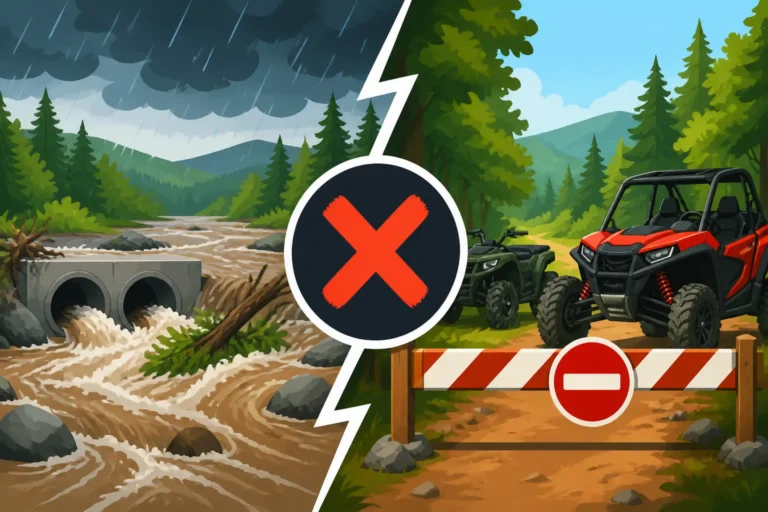
Spring conditions are a big reason for the difference. Snowmelt and rain can leave trails soft, muddy, or vulnerable to damage. A trail that looks passable at the entrance may still have saturated sections farther in, where tires can churn up the surface or damage a culvert. Clubs and land managers may delay access to protect the trail and the relationships that keep routes open.
It helps to think of opening as a local decision rather than a statewide calendar event. Before you set a date, check the specific system you want to ride, including any connecting trails and town roads on your planned loop. The [New Hampshire's Club Trail Network] gives useful context for how routes connect, but a connection on a map does not guarantee every segment is open on the same day.
Mud Season Can Delay the Ride You Planned
The spring freeze-thaw cycle can make trail conditions change quickly. A route that seemed firm during a cold morning may soften as temperatures rise. Recent rain, snowmelt, shade, drainage, and the ground beneath the trail all affect how quickly a section dries out. There is no reliable shortcut based on the weather in your driveway or at the trailhead alone.
Closures during this period are not just inconvenient paperwork. A machine can leave deep ruts that collect water and make the route harder to maintain. A narrow trail can be especially vulnerable when riders repeatedly pass through a soft section. Respecting a closure helps protect access for the rest of the season, too.
If you are deciding whether to ride in early spring, check [New Hampshire's Mud Season Ban] and the current rules for the land or trail system you plan to use. Don’t treat a trail as open just because it is not blocked by a gate or marked with a sign at the spot where you arrive. Confirm the status before unloading, and turn around if the route is posted closed or visibly too soft to ride responsibly.
How to Confirm a Trail Is Open
Check the Club or Land Manager First
The most dependable place to confirm an opening is the organization responsible for the particular trail system. Depending on where you are going, that may mean checking a local ATV club’s updates, a land manager’s notice, or a trail-status board. Look for information that names the system or section you intend to ride, rather than relying on a general statement that “trails are open.”
A short phone call or message can save a long drive. This matters when you are heading to an area such as Colebrook, Dummer, Gorham, or Pittsburg, where a trip may involve several trail segments. Ask whether the staging area is open, whether connecting routes are available, and whether any restrictions apply to your machine’s width or type.
Some clubs post trail information frequently, while others update it when conditions or access change. Use [New Hampshire Trail Status Before You Ride] as a reminder to check close to departure, and look at [Checking the Trail Status Board] for the kind of status information riders should seek. If you find an update but cannot tell whether it applies to your planned loop, contact the club rather than assuming the entire network has the same status.
Use Maps for Planning, Not as Proof of Access
A map is useful for understanding where a route goes, how it connects to a staging area, and whether your plan depends on crossing a town or land boundary. Apps such as onX Offroad can help you review terrain and organize a route before leaving home. But a mapped line is not the same as confirmation that the trail is open today, and it does not override a closure notice or landowner restriction.
Use maps alongside information from the trail manager. You might mark a primary route and a backup option, then check both for current access before you go. If you are using onX Offroad, treat it as a planning aid: verify the trail’s opening status through the responsible club or land manager, and pay attention to posted signs once you arrive.
A club’s own map can be especially helpful for understanding the network and its staging locations. [New Hampshire Trail Maps From a Club] is a useful starting point for that kind of preparation. Before heading out, also check whether the route has width limits or other machine-specific restrictions. A trail can be open but still unsuitable for a particular UTV.
| What to verify | Why it matters | Best next step |
|---|---|---|
| Trail system status | Opening dates can differ between nearby areas | Check the responsible club or land manager |
| Specific route segments | A partial opening may leave your planned loop incomplete | Confirm each connection on your route |
| Staging area access | An open trail may not mean every parking area is available | Check the trailhead or staging-area notice |
| Machine width and type | Some routes have restrictions even when open | Review club rules and posted signs |
| Recent conditions | Rain and thaw can change conditions quickly | Recheck close to departure |
| Seasonal land rules | Public and private land may have separate restrictions | Confirm rules for each land area |
Planning Your First Ride of the Season
Choose a Simple Route and Leave Room to Turn Back
Opening weekend is not the best time to plan an ambitious, unfamiliar loop that depends on several trail connections. Start with a route where you understand the staging area and can identify a straightforward return path. That makes it easier to adapt if a section is closed, muddy, or more challenging than you expected.
For example, if you are planning a ride around Berlin or the Ride the Wilds area, verify which sections are actually open rather than assuming a larger mapped network is fully available. If your plan connects multiple club areas, check each one independently. Build in a backup route that does not depend on crossing a questionable segment.
Keep the day flexible. A posted closure, unexpected soft ground, or a trail crew working on a section is a good reason to change plans. Do not ride around a barricade or create a new path beside a muddy section. If the only available option is to ignore a closure, the ride is not ready to happen there.
Prepare Your Machine and Group for Spring Conditions
A machine that ran well at the end of last season may need attention before its first spring outing. Check the tires, brakes, lights, battery, fluids, and controls. Look for cracked or loose parts, and make sure the machine’s registration and required equipment are in order. Spring rides can also involve wet ground, so pack clothing that stays comfortable if conditions turn cold or damp.
For a group ride, agree on basic expectations before you leave the staging area. Decide who is leading, who is riding at the back, and where the group will stop if someone needs help. Make sure everyone knows the planned route and what to do if the group becomes separated. A simple plan matters even on familiar trails, especially when detours or closures split riders onto different routes.
Download or save the information you need before you lose service. onX Offroad may help you keep a route available for planning and navigation, but do not rely on a phone map as a substitute for checking trail status, following signs, or carrying the essentials for your ride. Share your route and expected return time with someone who is not riding with you.
Opening-Day Etiquette and Common Mistakes
Respect Closures, Signs, and Landowner Access
Many New Hampshire routes depend on cooperation between clubs and private landowners. Access can be affected by a single section of land, so riding where you are not permitted can put more than one trail segment at risk. Follow signs, stay on marked routes, and do not assume that an unposted field or woods road is open to ATV use.
If an open trail crosses or approaches private property, stay on the designated route and follow any posted instructions. [Riding State Land Before May 23] is a reminder that seasonal rules can apply to public land as well as club trails; check the relevant land rules rather than assuming a club opening notice covers every property along the way.
Be considerate around trail crews and other users. Slow down near work areas, give people room, and follow any temporary directions. If you see damage, a washed-out section, or a blocked route, report it to the responsible club or land manager rather than trying to repair or bypass it yourself.
Avoid These Opening-Day Assumptions
One common mistake is treating a club’s opening announcement as permission to ride every nearby trail. The announcement may refer to only part of a system, or conditions may have changed since it was posted. Another is assuming that a machine can use a trail simply because it fits through the entrance; posted width limits and route-specific restrictions still matter.
It is also easy to overestimate how much of the day you can cover. Spring conditions can make a familiar route slower, and detours may be limited. If you are visiting from out of town, build in time to confirm the staging location, registration requirements, and local access rules before making the drive. [New Hampshire's October Closing Dates] can also help you think about the other end of the riding season: trail access is seasonal, and a good trip depends on checking both opening and closing information rather than planning around assumptions.
Here is a practical pre-departure routine:
- Pick the specific trail system and staging area you plan to use.
- Check the responsible club or land manager’s latest status notice.
- Confirm that every route segment in your planned loop is open.
- Review width limits, registration requirements, and other restrictions.
- Check the forecast and recent conditions, not just the temperature at home.
- Save your route details and tell someone where you are going.
- Recheck for updates before loading the machine.
- At the trailhead, follow signs and turn back if the route is closed or too soft.
A little extra checking can feel tedious when you are eager to get riding, but it is much better than hauling your ATV or UTV north only to find a closed gate. New Hampshire’s opening dates make the most sense when you treat them as local, changeable trail information. Confirm the route, respect the conditions, and let the people managing the trails guide your first ride of the season.
Disclaimer
This article is for general informational purposes only and does not constitute professional advice. Laws, prices and regulations vary by location and change over time. Consult a qualified professional for guidance on your specific situation.