New Hampshire ATV Camping Near the Trails
Finding a campsite near New Hampshire ATV trails can make a weekend ride much easier, but “near” does not always mean you can ride straight from your tent or RV to a legal trail. This guide explains how to choose a practical base, check trail access, plan around local rules, and avoid arriving with a trailer only to discover your route starts somewhere else.
Choose a camping base that matches your ride
New Hampshire’s trail options are spread across different regions, and a campground that works well for one route may be inconvenient for another. Before reserving, identify the riding area you want to explore, then check the campground’s location, vehicle access, and current trail connections.
Camping near Ride the Wilds in Coos County
Pittsburg, Colebrook, Errol, and the surrounding North Country communities are common starting points for riders exploring the northern trail network. The region’s connected trails can make it possible to plan longer rides between towns, but individual connectors, access points, and trail conditions can change. A campsite that looks close on a map may still require a legal road connection or a short trip with your trailer to a staging area.
When comparing campgrounds, ask whether they accommodate the kind of setup you have: a tent, a travel trailer, or a larger RV with an ATV or UTV in tow. Find out where the trailer and machine can be parked, whether the property has space to turn around, and whether there are restrictions on washing or maintaining machines. Those details matter when you arrive late, the site is narrow, or a muddy ride leaves your vehicle needing attention.
Also ask the campground directly whether guests may ride from the property to a designated trail. Do not assume that a nearby woods road, gravel road, or trail-shaped line on a navigation map is open to OHRVs. Land ownership and access rules can change across a short distance. Reviewing [Ride the Wilds in Coos County] and [New Hampshire's Club Trail Network] can help you understand the broader riding area, while a local club or campground can clarify which access points are usable for your dates.
Camping near Jericho Mountain and Berlin
Jericho Mountain State Park near Berlin is another area riders may consider when planning a trip. Before choosing a campsite nearby, distinguish between being close to the park and having permission to ride from your campsite to a trail. A campground may be convenient for trailering to a riding area without offering a legal direct connection from its entrance.
Ask about the route between your accommodation and the trailhead, not just the mileage. If the campground says there is trail access, request specific details: where the route begins, whether it is open to your machine, and whether it depends on a road designation or landowner permission. If access is not clear, plan to transport the machine to a suitable staging area instead of counting on riding through town or along a road.
Some visitors prefer a campground or RV site; others want a cabin or lodge close to the riding area. Either way, confirm what is included and what is not. A place to sleep does not automatically include machine storage, trailer parking, trail access, or a registration. For planning, see [Camping at Jericho Mountain] and [Jericho's Campground Season], then contact the property directly about its current arrangements.
| Camping setup | Best fit | Questions to ask before booking |
|---|---|---|
| Tent site | Riders traveling light and comfortable with basic facilities | Is there secure parking nearby, and where can the trailer go? |
| RV or travel-trailer site | Families or groups bringing their own accommodation | Can the site fit both the RV and the ATV or UTV trailer? |
| Cabin or lodge | Riders who want indoor lodging after a long day outside | Is there machine parking, and is trail access direct or by trailer? |
| Campground near a trailhead | Visitors prioritizing quick access to a specific riding area | Is the route open to your machine, or does the campground only sit nearby? |
Confirm trail access before you reserve
The most important camping question is not simply how far a property is from a trail. It is whether the entire route between the property and the riding area is legal, open, and appropriate for your machine. Checking this before you pay can prevent a frustrating first morning spent searching for another place to unload.
Ask what “trail access” means
When a listing says “near trails,” it might mean the property is a short drive from a trailhead. “Direct access” might mean a marked trail begins on or near the property, but it is still worth confirming the route and any conditions. Ask whether guests can ride directly from the campsite, whether they need to trailer to a staging lot, and whether the access changes by season.
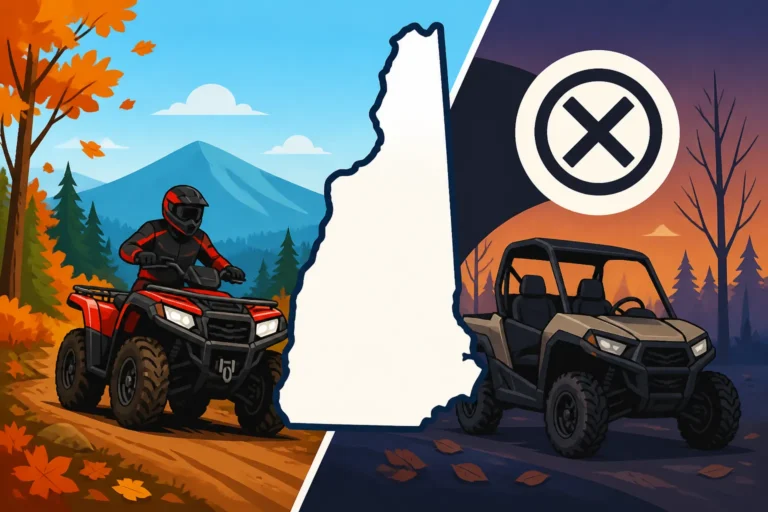
Be precise about the machine you are bringing. A route suitable for one ATV may not accommodate a wider side-by-side. Trail width limits and club-specific rules can differ, and a machine’s advertised width is not always the same as its widest point once accessories are fitted. If you ride a UTV, check the applicable restrictions before committing to a campground or route. [New Hampshire Trails With a 50-Inch Limit] and [New Hampshire Trails for a Wide Machine] are useful starting points for understanding why machine dimensions can affect your plans.
The same care applies to roads. A route between a campground and a trail may cross or use a road that is not open to OHRVs. Do not treat an ordinary road, a logging road, or a road shown on a general map as an authorized riding connection. If the campground cannot explain the route clearly, ask the local club or relevant land manager before you rely on it.
Check trail status and maps close to your trip
Trail access is seasonal and can change because of weather, maintenance, landowner decisions, or temporary closures. A route that was open during a previous visit may not be open on your arrival weekend. Check conditions shortly before departure and again before unloading. That small step can save you from towing the machine to a closed entrance or planning a loop that cannot be completed.
Use club information and current trail-status updates as your primary planning tools. A GPS app can help you organize a route, but a line on a screen does not prove that a trail is open or that you have permission to ride it. onX Offroad can be useful for reviewing mapped routes and saving trip notes, but compare what you see there with local club information and posted signs. Keep an offline map available in case mobile service drops out in the North Country.
Make a simple backup plan before leaving home. Identify another legal staging area, a nearby place to refuel if one is available along your intended route, and a shorter ride in case a connector is closed. Check [New Hampshire Trail Status Before You Ride] and [New Hampshire Trail Maps From a Club] for ways to make your route planning more grounded in local conditions.
Plan your campsite, trailer, and daily routine
A comfortable base is about more than sleeping arrangements. Your campsite needs to work with your vehicle, trailer, machine, and the practical rhythm of riding—loading up, returning muddy, securing equipment, and getting ready for the next day.
Confirm parking and trailer logistics
Before booking, provide the campground with your vehicle and trailer dimensions if you know them. Ask whether you can park the truck and trailer at your site or whether there is a separate parking area. A site that fits an RV may not have room for a second vehicle, a long trailer, and the turning space needed to maneuver safely.
If you expect to unload at a club staging area, check its parking arrangements separately. A staging lot is not necessarily overnight parking, and space may be limited on busy weekends. Ask where visitors are allowed to leave a trailer, whether overnight parking is permitted, and whether there are restrictions on leaving equipment unattended. [Parking a Trailer at a Club Staging Lot] is a useful topic to review before you plan to use a lot as your daily starting point.
Think through what happens after the ride, too. Find out whether the campground allows machine washing, where muddy gear can be stored, and whether there is a safe place to park the ATV or UTV overnight. If you are carrying fuel, tools, or riding gear, check the property’s rules rather than assuming everything can be stored wherever convenient. A quick conversation can prevent misunderstandings when you arrive.
Respect property boundaries and local riding rules
A trail beside a campground does not automatically grant permission to ride across the campground, neighboring land, or a connecting field. Even unposted private property is not an invitation to cross it. Stay on designated routes and get clear permission before riding on private ground. Keep that permission in writing when required, and follow any boundaries or conditions the landowner gives you.
Be especially cautious when a route appears to cross private land between two public or club trails. A connector may depend on a specific landowner agreement, and access can be withdrawn. If the trail is signed as closed, do not ride around the barrier or make your own detour. One unauthorized shortcut can damage a property relationship that local clubs rely on to keep routes open. Review [New Hampshire Rules for Riding Private Land] and [New Hampshire Landowner Permission Rules] before assuming a route is available.
Finally, confirm what paperwork and safety requirements apply to your machine and riders. Visitors should not assume that a registration from another state is sufficient for riding in New Hampshire. Check the rules for your situation before the trip, and keep required documents with you. The most relaxing campsite is the one that lets you start the ride prepared, not the one that leaves registration or access questions until you reach the trailhead.
Build a practical camping itinerary
Once you have a campsite and a confirmed access plan, organize the trip around realistic ride days. In the North Country, distances between towns can be substantial, and a long route may take more time than expected if conditions are slow or a trail requires a detour.
Match the campsite to the length of your ride
For a single-day visit, a campsite close to the trail system can reduce towing and setup time. For a multi-day trip, staying in one location may work if the trails you want to ride connect conveniently from there. If you plan to explore different areas, compare the time and effort of moving your campsite with the alternative of driving the machine and trailer to separate staging locations.
Leave room in the schedule for weather, trail conditions, and unplanned stops. A ride that looks straightforward on a map can take longer when the group includes newer riders, children, or machines with different capabilities. Save your preferred route in onX Offroad or another navigation tool, but also note the club or official source you checked for access. Share the plan with everyone in the group so no one is relying on a route they have not seen.
For a weekend itinerary, consider keeping the first ride relatively short. Use it to confirm that your machine, gear, and navigation setup are ready before committing to a longer loop. If trail conditions or a closure affect the day, a shorter route gives you more flexibility. [New Hampshire Trails With Lodging on the Route] can also help when you are comparing a single base with a ride that passes through more than one town.
Make a pre-trip checklist
A short checklist is especially useful when several people are coordinating camping and riding. It helps catch the easily missed details—such as trailer parking or a machine-width restriction—before they turn into a problem at the campground entrance.
- Confirm the campground reservation and the site’s vehicle and trailer capacity.
- Ask whether riding directly from the property is permitted and get the route explained.
- Verify trail openings, closures, and machine-width limits with local trail information.
- Check registration, rider-safety, and equipment requirements for your group.
- Save a map for offline use and carry a backup route.
- Identify the correct staging area if you must trailer to the trail.
- Confirm where machines, trailers, muddy gear, and fuel may be stored.
- Keep a second ride option in case weather or access changes your plan.
If you are traveling with a group, assign one person to confirm lodging and another to check route access. That simple division prevents the familiar last-minute scramble in which everyone assumed someone else had called. onX Offroad may help the group keep a shared route or saved notes organized, but local trail-status information and posted directions should guide the final decision.
New Hampshire ATV camping is easiest when you treat the campsite and the ride as one plan: choose a region, confirm the legal route, check parking and machine restrictions, and have a backup if access changes. A few specific questions before booking can turn a “near the trails” listing into a genuinely workable base for your trip.
Disclaimer
This article is for general informational purposes only and does not constitute professional advice. Laws, prices and regulations vary by location and change over time. Consult a qualified professional for guidance on your specific situation.