Riding as an Adult With No Driver’s License
It's incredibly frustrating when you're eager to hit the trails or explore the beautiful New Hampshire backcountry on your ATV or UTV, only to run into questions about licenses. Many folks assume a driver's license is a universal requirement for operating any motorized vehicle, but when it comes to off-highway recreational vehicles (OHRVs), the rules can be a little different. This guide will walk you through exactly what an adult needs to know if they want to ride an OHRV in New Hampshire without a traditional driver's license, clearing up confusion so you can ride confidently and legally.
The Core Question: Do You Need a Driver's License to Ride in New Hampshire?
This is where a lot of the confusion begins, and it's a completely fair question. For many, the instinct is to say "yes, of course," but New Hampshire has a nuanced approach to OHRV operation that distinguishes between riding on dedicated trails and riding on public roads. Understanding this distinction is absolutely crucial, especially for adults who might not hold a traditional driver's license.
When a License Isn't Necessary for Trail Riding
Let's start with the good news for trail enthusiasts: for operating an OHRV on most designated OHRV trails and private land with permission, a traditional driver's license isn't always the make-or-break requirement for an adult. New Hampshire focuses heavily on a different credential for these off-highway adventures: the OHRV Safety Certificate.
Think of the safety certificate as your official passport to the trails. It demonstrates that you've been educated on safe riding practices, environmental responsibility, and the rules specific to OHRV operation. If you're an adult and don't possess a valid motor vehicle driver's license, this certificate becomes your primary document for legal trail riding. This is a common path for many who love the outdoors but perhaps don't drive on public roads for various reasons, or for those who simply haven't obtained a license yet. It allows them to fully participate in the OHRV community and enjoy the vast trail networks New Hampshire offers, from the [Ride the Wilds in Coos County] to the smaller local club trails.
However, it's vital to remember that while the safety certificate is what you need, a regular driver's license also fulfills the safety education requirement for adults. So, if you do have a driver's license, you don't necessarily need to go out and get a separate OHRV Safety Certificate for trail riding purposes. It's an either/or situation for adults: either a valid driver's license or a valid OHRV Safety Certificate.
The Driver's License Rule for Public Roads
Now, this is where things get a bit more complex, and often, less flexible. While New Hampshire has an incredible network of OHRV trails, many of them connect through various towns, sometimes utilizing public roads for short stretches or designated corridors. This is where the distinction between "off-highway" and "on-highway" really comes into play, and where a driver's license often becomes a necessity for adults.
In New Hampshire, towns have the authority to open certain public roads or sections of roads for OHRV use. When a town does this, these designated segments become part of the OHRV trail system. However, even when opened for OHRV travel, these are still public roads. The general rule in New Hampshire is that to operate a motor vehicle on a public way, you must possess a valid driver's license. While OHRVs have their own distinct category, when they venture onto these opened public roads, the expectation is that the operator meets the same licensing standards as someone driving a car. This means that if an adult wants to ride their ATV or UTV on any section of a public road, even one officially designated as an OHRV corridor, they will typically need a valid driver's license. There's a fundamental difference between riding off-pavement on a private trail and operating on a road intended for general public use, and the state often applies similar rules regarding operator licensing in the latter scenario. Ignoring this can lead to serious fines for an [New Hampshire Fines for an Unregistered OHRV] or unlicensed operation, even if your OHRV is perfectly registered.
Understanding New Hampshire's Safety Certificate
Given that a driver's license isn't always a given for everyone, let's dive deeper into the OHRV Safety Certificate. This certificate is designed to ensure that riders understand the unique responsibilities and safety protocols involved in operating an OHRV. It's not just a piece of paper; it's proof that you've gained essential knowledge for safe and responsible enjoyment of our state's beautiful trails.
Who Needs the Safety Certificate?
The OHRV Safety Certificate requirements are primarily designed to ensure younger and inexperienced riders get proper instruction. Generally, anyone under the age of 18 operating an OHRV in New Hampshire needs to complete an approved OHRV safety course and carry the certificate. This applies whether they are riding on public trails, private land (unless it's their own private property and they aren't leaving it), or designated roads.
For adults – specifically, those aged 18 and older – the rules offer a bit more flexibility. As mentioned earlier, if you possess a valid motor vehicle driver's license, that license effectively fulfills the safety education requirement. You don't need a separate OHRV Safety Certificate to ride on trails or designated OHRV routes on public roads. However, if you are an adult and you do not hold a valid motor vehicle driver's license, then you must complete an approved OHRV safety course and carry the safety certificate when operating an OHRV anywhere off your own private property. This ensures that even without a traditional driving background, you are still well-versed in OHRV-specific safety and regulations. This dual requirement system ensures that all adult riders, regardless of their licensing status, have received foundational safety instruction before hitting the public trails.
How to Get Your Safety Certificate (If You Need One)
Obtaining an OHRV Safety Certificate in New Hampshire is a straightforward process, designed to be accessible to a wide range of individuals. The state recognizes the importance of education for safe riding and offers several avenues to get certified.
One popular option is to complete an online OHRV safety course. These courses are self-paced and can be done from the comfort of your home, making them incredibly convenient for busy schedules. They cover everything from basic machine operation and trail etiquette to environmental impact and New Hampshire-specific laws. There is typically a fee associated with these online programs, which goes towards the course provider. Completing the [The Online OHRV Safety Course Costs $34.95] is a great way to get it done on your own time.
Another excellent option is to attend a free classroom course offered by certified instructors, often through the New Hampshire Fish and Game Department or local clubs. These in-person sessions provide a more interactive learning environment, allowing for questions and direct engagement with experienced riders and instructors. While these courses require a specific time commitment and might involve traveling to a location, many riders find the direct instruction and camaraderie valuable. Check the Fish and Game website for schedules and locations of [The Free Classroom Course in New Hampshire]. Regardless of which method you choose, both options culminate in a certification that allows you, as an adult without a driver's license, to legally operate your OHRV on New Hampshire's extensive network of trails.
Navigating Public Roads Without a Driver's License
This is the segment where many hopeful riders without a driver's license encounter significant hurdles. The dream of riding directly from your campsite to a local diner, or connecting trail systems via a short stint on pavement, often involves using public roads. Understanding the specific regulations around this is critical to avoid legal trouble and ensure everyone's safety.
The Reality of "Street Legal" OHRVs and Licenses
The term "street legal ATV" can be a bit of a misnomer in New Hampshire, as the state doesn't generally permit ATVs or UTVs to be registered and operated as conventional motor vehicles on all public roads. Instead, New Hampshire has a system where individual towns can designate specific roads or sections of roads as open to OHRVs. When a road is opened, it becomes an extension of the OHRV trail system for that specific purpose.
However, and this is the crucial point for adults without a driver's license, these are still public ways. State law generally requires anyone operating a motor vehicle on a public way to possess a valid driver's license. While OHRVs are treated differently for registration and equipment purposes, the operator of an OHRV on a public road, even a designated one, is expected to adhere to basic licensing requirements for public road use. This means that if you're an adult and lack a driver's license, riding on these designated public roads is generally not permitted, even if your machine is registered and you have your OHRV Safety Certificate. The safety certificate is for off-highway operation, not a substitute for a driver's license on a public road. While New Hampshire has [New Hampshire Towns That Allow OHRVs on Roads], the privilege of using them often comes with the requirement of a valid driver's license for the operator. For example, [Are ATVs Street Legal in New Hampshire?] explores this in more detail, highlighting that the answer is almost always "no" for general street use.
Exceptions and Designated Crossings
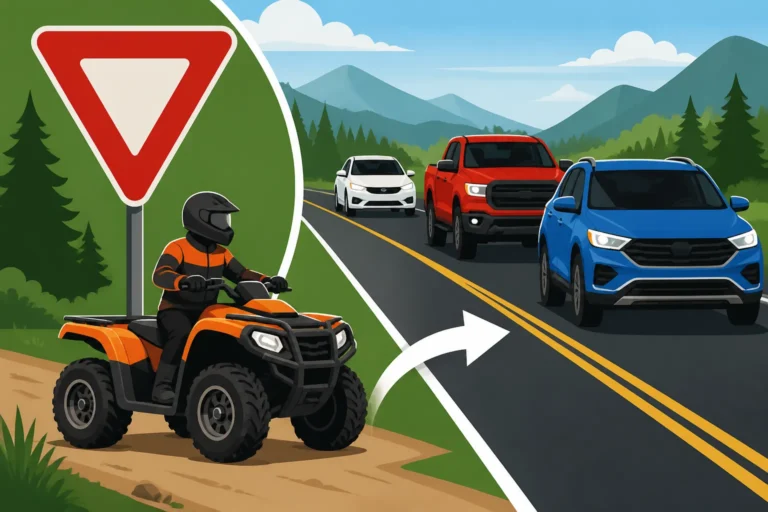
While the general rule is strict regarding public roads and driver's licenses, there are very specific, limited scenarios that might seem like exceptions but are, in fact, carefully regulated. The most common "exception" is the act of crossing a public road. New Hampshire law allows OHRVs to cross public roads at a 90-degree angle, after coming to a complete stop and yielding to all vehicular traffic, provided the crossing connects two parts of a legal trail system.
For adults without a driver's license, these crossings present a tricky situation. While the act of crossing itself is brief, the overall legality of operating the OHRV to reach that crossing point – if it involves any travel on a public road, even the shoulder – typically still requires a driver's license. It's not a free pass to operate your OHRV on pavement without a license, but rather a narrow allowance for trail continuity. Imagine you're on a club trail, and it briefly requires you to cross a paved road to continue on the other side. This crossing is permissible. However, if you've trailered your OHRV to a parking lot and then plan to ride it down the public road, even a short distance, to reach that crossing, that "riding down the road" part is likely where you'd run into issues without a driver's license. The safest approach for an adult without a driver's license is to strictly limit riding to private property with permission or exclusively off-highway trails that do not require any travel on public roads, even for short stretches.
What This Means for Your Riding Plans
So, what's the takeaway? For adults in New Hampshire without a driver's license, your OHRV riding opportunities are still vibrant, but they come with specific boundaries. It’s all about knowing where you can ride and ensuring you have the correct documentation for that location.
Riding on Private Property and Leased Land
For an adult without a driver's license, the most straightforward and least complicated riding scenario is on private property, provided you have explicit permission from the landowner. When you're on private land that you own or have permission to use, the requirements are simplified. You still need to operate your machine safely and responsibly, but the need for a driver's license or even an OHRV Safety Certificate often isn't applicable unless you're leaving that property. It's your space, your rules (within reason and state safety statutes).
However, most of the fantastic riding in New Hampshire happens on vast networks of interconnected trails, many of which are on land leased by OHRV clubs or state-managed areas. For these "leased trail lands" and state-owned properties, the OHRV Safety Certificate becomes absolutely essential for adults without a driver's license. These club trails, like those making up the [New Hampshire's Club Trail Network], are often built and maintained by volunteers and require all riders to abide by state laws. While you might not be on a public road, you are still on property where state regulations apply. Always ensure you have written permission if you're riding on private ground that isn't part of an established trail system, as outlined in [New Hampshire Landowner Permission Rules].
Riding with a Companion and Supervision Rules
While New Hampshire has very specific supervision rules for minor OHRV riders, which you can read about in [New Hampshire Rules for a Rider Aged 13] or [New Hampshire Supervision Rules for Minors], these rules don't directly apply to adult riders. An adult, whether they have a driver's license or solely an OHRV Safety Certificate, is generally considered competent to operate an OHRV independently on designated off-highway trails.
The concept of needing a companion primarily comes into play for younger, unlicensed riders or those in specific age brackets. For an adult without a driver's license but possessing an OHRV Safety Certificate, the main restriction isn't about having a companion, but rather about the type of terrain they can legally access. As long as you stick to designated off-highway trails and private land with permission, your safety certificate is your ticket to ride solo or with friends. The moment public roads become involved, however, the companion rule doesn't magically make up for the lack of a driver's license for the adult operator. It's a fundamental difference in the legal requirements for public road operation versus off-highway trail operation.
Accessories for Trail Riding
Regardless of your licensing status, if you're hitting the trails, ensuring your OHRV is properly equipped and maintained is paramount. Safety isn't just about what you carry in your wallet; it's about what you have on your machine and on your person. Helmets, eye protection, and appropriate riding gear are non-negotiables for everyone.
Beyond the basics, many riders enjoy customizing their machines for better performance, safety, or comfort on the trails. For instance, if you're exploring some of the more rugged New Hampshire trails, perhaps thinking about an adventure at [Jericho Mountain State Park at Berlin], you might consider upgrading your suspension or adding stronger skid plates. Aftermarket parts can significantly enhance your experience. Companies like SuperATV offer a vast array of accessories, from heavy-duty axles and lift kits for increased ground clearance to winches for those sticky situations. Even if you're sticking to less aggressive trails, a good set of tires designed for varied terrain or a quality roof and windshield for your UTV can greatly improve comfort and protection. Just remember that while these upgrades enhance your ride, they don't change the legal requirements for a driver's license when on public roads. Always ensure any modifications comply with New Hampshire's OHRV equipment rules, especially regarding sound limits and spark arresters.
Here's a quick reference to help clarify the requirements:
| Scenario | Adult with Driver's License | Adult without Driver's License |
|---|---|---|
| Riding on Private Property (with permission) | No specific state certificate/license required (local rules may vary) | No specific state certificate/license required (local rules may vary) |
| Riding on Designated OHRV Trails (not on public roads) | Driver's License satisfies safety requirement | OHRV Safety Certificate REQUIRED |
| Riding on Public Roads (designated OHRV corridors) | Driver's License REQUIRED | NOT PERMITTED (Driver's License REQUIRED for public roads) |
| Crossing a Public Road (90-degree angle) | Driver's License (if operating on road to get to crossing) | NOT PERMITTED to operate on road to get to crossing (crossing itself is brief, but implies legal operation to reach it) |
| OHRV Registration | REQUIRED for all scenarios off private property | REQUIRED for all scenarios off private property |
Disclaimer
This article is for general informational purposes only and does not constitute professional advice. Laws, prices and regulations vary by location and change over time. Consult a qualified professional for guidance on your specific situation.