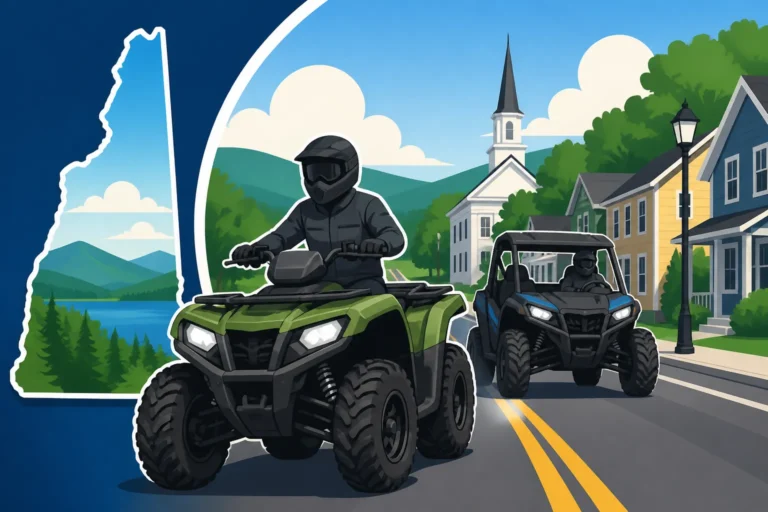
Zero Tolerance on Gorham’s Streets
It’s incredibly frustrating to be out on your OHRV, enjoying the fresh air and scenery, only to hit a public road and wonder if you’re breaking the law. New Hampshire is a fantastic state for riding, but when it comes to riding your ATV or UTV on town streets, the rules can feel like a tangled web, especially in places known for strict adherence to ordinances like Gorham. This guide is designed to clarify the ins and outs of legally riding your off-highway recreational vehicle on designated public roads and crossing highways in the Granite State, helping you navigate the system with confidence.
New Hampshire's General Stance on OHRVs and Public Roads
Let's be clear from the start: New Hampshire isn't like some other states where OHRVs are generally street-legal. Here, the default position is that public roads, including town streets, are closed to OHRV traffic. This isn't meant to spoil anyone's fun; it's rooted in safety concerns for both OHRV operators and conventional vehicle traffic, as well as preserving the character of residential areas. Breaking this rule can lead to significant penalties, so it’s crucial to understand the foundation of these regulations before you even think about putting a tire on the pavement.
Why Roads Are Closed by Default
The primary reason New Hampshire roads are closed to OHRVs by default is a combination of legislative intent and practical safety considerations. OHRVs are designed for off-road environments, where surfaces are uneven, speeds are generally lower, and there’s less interaction with traditional cars and trucks. When these machines are introduced to paved public roads, the dynamics change dramatically. Braking distances, tire grip, and rider visibility are all different compared to a street-legal vehicle. The state's approach is to err on the side of caution, protecting riders and the public alike from potential hazards.
Furthermore, towns and cities have a vested interest in managing traffic flow, noise levels, and infrastructure wear. Allowing OHRVs on every road without specific designation would create a free-for-all, potentially overwhelming local services and impacting the quality of life for residents. This default closure is a protective measure, placing the burden on towns to actively open their roads rather than having to close them. It's a common source of confusion for visitors from states with different rules, leading to unexpected fines if they aren't aware. You might have your machine set up perfectly with all the bells and whistles from a brand like SuperATV, but if the road isn't open, it simply doesn't matter.
How Towns Designate Roads for OHRV Use
Given the default closure, how do OHRVs end up on town roads at all? The power to open specific roads rests squarely with the local municipal authority, typically the town's Selectboard. They have a formal process to follow, which isn't just a casual nod or a verbal agreement. It involves a public hearing, allowing residents to voice their opinions, concerns, and support. This is a crucial democratic step that ensures the community has a say in how their local infrastructure is used.
For a Selectboard to designate a town road as open for OHRV use, they must hold a public hearing and provide at least fourteen days' notice to all abutters – that’s anyone who owns property directly bordering the proposed road segment. This notice is often sent via verified mail to ensure everyone is properly informed. After the hearing, the Selectboard votes, and if approved, the designation becomes official. This rigorous process highlights that opening roads to OHRVs is a significant decision, not taken lightly, and it's always subject to local conditions and community feedback. These designations are not permanent either; they often need to be renewed periodically, requiring towns to revisit the discussion and ensure the rules still serve the community's best interests. This is why you'll see specific signage indicating which roads are open, and it's vital for riders to pay close attention to it. [How a New Hampshire Town Designates a Road] provides more detail on this process.
Towns That Have Opened Their Streets to OHRVs
While the default is "closed," several forward-thinking towns in New Hampshire have recognized the economic and recreational benefits of integrating OHRVs into their local fabric. These "trail towns" have become popular destinations for riders, offering direct access to vast trail networks and the convenience of riding right to local businesses. However, each town has its own set of rules, hours of operation, and designated routes, so it's never a one-size-fits-all situation.
Gorham's Open Streets: A Case Study in Specificity
Gorham, New Hampshire, is perhaps one of the most well-known examples of a town that has embraced OHRVs. Its main streets and many secondary roads are open, allowing riders to access the extensive Ride the Wilds trail system directly from town, visit restaurants, gas stations, and lodging. This has been a massive boon for Gorham's economy, transforming it into a vibrant OHRV hub. However, this openness comes with a strict set of rules that riders must obey, leading to what many call "zero tolerance" enforcement.
In Gorham, you'll find designated routes clearly marked, and deviating from these can quickly put you in violation. Speed limits on these designated streets are often significantly lower than for conventional vehicles, typically 25 mph, and even slower in specific areas like trail entrances where it might drop to 10 mph. [Gorham's Open Streets] provides specific insights into how this system works. Riders are expected to operate their machines as if they were conventional vehicles, yielding to traffic, pedestrians, and maintaining a respectful demeanor. Law enforcement in Gorham is diligent about ensuring these rules are followed, issuing citations for everything from speeding to riding on a closed sidewalk. The intent is to maintain safety and harmony between OHRV riders and other town residents and visitors, allowing everyone to enjoy the community responsibly.
Berlin's Rules and Other Trail Towns
Just a short ride from Gorham, Berlin also plays a significant role in New Hampshire's OHRV scene, particularly with the Jericho Mountain State Park at its doorstep. Berlin has also opened certain roads to OHRVs, allowing riders to connect to trails and access amenities. However, Berlin has its own unique nuances. For instance, Berlin has an evening curfew for OHRV operation on town streets, often around 10:00 PM. This is a common local ordinance aimed at minimizing noise disturbances for residents during late hours.
Other towns, particularly in the northern part of the state, have similar arrangements, each with their own local quirks regarding speed limits, designated routes, and times of operation. It's not uncommon to find towns that have opened some roads but keep others, particularly residential side streets, strictly closed. Before you even trailer your machine to a new riding area, it's always a good idea to check with the local police department or town hall for the most current OHRV ordinances. The New Hampshire Fish and Game Department's website often has links or resources for specific town regulations, or you can check directly with the local OHRV clubs that maintain the trails in those areas. Understanding these local variations is key to a hassle-free ride, whether you’re passing through or staying a while. [New Hampshire Towns That Allow OHRVs on Roads] is a great resource for identifying these communities.
Specific Rules for Riding on Designated Town Roads
Once you're on a town road that's officially open to OHRVs, you can't just ride it like a trail. There are specific protocols that govern how you operate your machine to ensure safety and compliance with the law. These rules are designed to integrate OHRVs into existing traffic patterns as smoothly and safely as possible. It's not just about what your machine can do, but how you responsibly use it in a shared space.
Adhering to Speed Limits and Traffic Flow
Perhaps the most critical rule on designated town roads is adherence to speed limits. These limits are almost always lower than the posted speed limit for conventional vehicles. In Gorham, for example, the OHRV speed limit on town streets is often capped at 25 mph, and sometimes even lower, such as 10 mph near trailheads or in densely populated areas. This isn't arbitrary; it's because OHRVs handle differently on pavement, have a higher center of gravity, and can be less visible to other motorists. Riding faster than the designated OHRV speed limit is a surefire way to attract attention from law enforcement and earn a citation.
Beyond speed, you're expected to operate your machine within the flow of traffic, maintaining a safe distance from other vehicles. This means riding on the far right of the paved or unpaved portion of the road, and if it's a multi-lane road, staying in the rightmost lane. Yielding to every conventional vehicle, including cars, trucks, and motorcycles, is also mandatory. You are the guest on the road, and you must prioritize the safety and movement of others. It’s also important to remember that these rules apply to all OHRVs, whether you’re on a trail bike or a fully accessorized side-by-side from a company like SuperATV. [Riding the Far Right of a Town Road] further explains the expectations for road placement.
Parking and Accessing Businesses
One of the great advantages of riding in a trail town is the ability to access local businesses directly from your OHRV. However, you can't just park anywhere. You must adhere to the same parking regulations as conventional vehicles. This means parking in designated parking spots, not blocking fire lanes, sidewalks, or private driveways. Some towns might have specific OHRV parking areas, especially near popular trailheads or downtown business districts, so keep an eye out for signage.
When accessing businesses, you're generally expected to ride directly into a parking lot or designated area and then dismount. Riding your OHRV through pedestrian areas, on sidewalks, or into storefronts is strictly prohibited. The idea is convenience, not chaos. If you're riding with a group, ensure everyone understands and follows these parking protocols to avoid causing congestion or drawing negative attention. Remember, the continued privilege of riding in these towns depends on the responsible behavior of all riders. [Parking at the Eastern Depot in Gorham] can offer a good example of how to park responsibly in a trail town.
Navigating Road Crossings and Private Property
Even if you're not riding miles on open roads, you will inevitably encounter situations where you need to cross a public road or briefly use private land to connect trails. These scenarios also come with strict regulations that must be followed to ensure safety and prevent trespassing. It's often where riders get into trouble, assuming a quick hop across the pavement is no big deal.
The Rules for Crossing a Highway
Crossing a public highway or road in New Hampshire when it's not a designated OHRV road is permitted under specific conditions, but it's far from a free-for-all. The rules are designed for maximum safety, treating every crossing as a potentially hazardous maneuver. First and foremost, you must come to a complete stop before entering the paved portion of the road. This means stopping at the very edge of the pavement, allowing you a clear view of oncoming traffic in both directions.
Once you have a clear line of sight and there's no oncoming traffic, you must cross the road at as close to a ninety-degree angle as possible. This minimizes your time on the pavement and reduces the risk of being broadsided. You cannot ride down the shoulder, cut diagonally across, or use the road as a connector unless it's explicitly designated as an OHRV road. After crossing, you must immediately re-enter the trail or private property on the other side. Think of it like a brief, controlled interruption of vehicle traffic, not an extension of your trail ride. [New Hampshire Rules for Crossing a Highway] lays out these critical steps in detail.
Private Land and Permission
Many OHRV trails in New Hampshire traverse private land, thanks to the generosity of landowners who grant permission to clubs and the state. However, this permission is often for designated trails only and does not extend beyond those marked corridors. Riding off a marked trail onto private property, even if it looks like an unused field or woods, is considered trespassing unless you have explicit written permission from the landowner.
The state's default rule is that unposted land is not an invitation to ride. Unlike some other recreational activities, OHRVs require specific permission or designated public access. Even if you're just cutting a corner between two trails, if that corner is private land not part of the established corridor, you could be trespassing. Always respect "No Trespassing" signs and assume private land is off-limits unless clearly marked as part of a public trail or you have a signed agreement. Landowner relations are the backbone of New Hampshire's extensive trail system, and respecting private property is crucial for maintaining those relationships. [New Hampshire Landowner Permission Rules] is a must-read for anyone riding on private land.
Equipment, Age, and Safety Requirements for Road Riding
Riding an OHRV on any public way, whether crossing or on a designated street, means your machine and you as the operator must meet certain safety and equipment standards. These are in place to ensure you are visible, controllable, and that all riders, especially minors, are protected. It's not just about having a powerful machine; it's about having a safe and compliant one.
Essential Equipment for Road Use
When you're operating an OHRV on a designated public road, even briefly, your machine needs to be equipped similarly to a conventional vehicle in certain aspects. This includes a working headlight and taillight, which are crucial for visibility, especially during dawn, dusk, or adverse weather conditions. For nighttime riding, these are absolutely non-negotiable.
Another often-overlooked but critical piece of equipment is a rear-view mirror. New Hampshire law specifically requires a rearview mirror for any OHRV operating on a public way, allowing the operator to see what's behind them, just like in a car. Many aftermarket companies, including SuperATV, offer a wide range of mirrors that can be easily installed on ATVs and UTVs to meet this requirement. You also need a functioning spark arrester to prevent wildfires and a muffler system that keeps your machine within the state's noise limits, typically 96 decibels. Failing to meet these equipment standards can result in a fine, regardless of how short your ride on the road might be. [New Hampshire Mirror Requirement for Road Riding] and [Headlight and Taillight on a New Hampshire Road] offer more details.
Age and Supervision Rules
New Hampshire has very clear age and supervision rules for OHRV operators, which are especially important when operating on or near public roads. Generally, riders under the age of 18 are subject to specific requirements. For instance, a person 12 years of age or older must possess a valid OHRV safety certificate (or a valid driver's license, which substitutes for the safety certificate) to operate an OHRV on public land or approved trails. However, riding on public roads adds another layer of scrutiny.
| Age Group | OHRV Safety Certificate/Driver's License | Supervision on Public Trails/Roads | Helmet Requirement |
|---|---|---|---|
| Under 12 | Not applicable | Required (Adult 25+ licensed) | Always |
| 12-13 years | Required | Required (Adult 25+ licensed) | Always |
| 14-15 years | Required | May ride alone on trails, but needs adult supervision (25+ licensed) on roads | Always |
| 16-17 years | Required | May ride alone on trails, needs adult supervision (25+ licensed) on roads | Always |
| 18 and over | Not required (driver's license suffices) | May ride alone | Recommended, but not required by law |
It's important to note that while an 18-year-old and above doesn't legally need a helmet in New Hampshire, it is always a good idea, especially on roads. For anyone under 18, a helmet is absolutely mandatory, regardless of where they are riding. Additionally, if you are an adult rider with a suspended driver's license, your OHRV safety certificate does not override that suspension for operating on any public way. [New Hampshire Age Rules for OHRV Riders] provides a comprehensive breakdown of these regulations.
Consequences of Non-Compliance on New Hampshire Roads
Ignoring the rules for OHRV operation on public roads in New Hampshire isn't just a slap on the wrist; it can lead to significant legal and financial consequences. Enforcement is taken seriously, particularly in towns that have invested heavily in creating OHRV-friendly environments but expect respectful and lawful behavior in return. Officers are trained to spot violations, and they won't hesitate to issue citations.
Fines and Penalties for Violations
Riding an unregistered OHRV on a public road, riding on a closed road, or failing to meet equipment requirements can all result in substantial fines. These fines are designed to be deterrents and can quickly add up, turning what was supposed to be a fun day out into a costly mistake. For example, riding on a closed town road might incur a fine, and if your machine isn't properly registered for New Hampshire, that's another fine on top of it. [New Hampshire Fines for an Unregistered OHRV] gives a clear picture of what you might face.
Beyond monetary penalties, repeated or serious offenses can sometimes lead to more severe consequences, such as impoundment of your machine or even temporary loss of riding privileges. It's not just about the immediate cost; it's about the inconvenience, the potential legal record, and the negative impact on the reputation of OHRV riders as a whole. Every rider has a responsibility to adhere to the rules, ensuring that the privilege of riding in New Hampshire is preserved for everyone.
The Impact of "Zero Tolerance" Enforcement
In towns like Gorham, the term "zero tolerance" isn't just a catchy phrase; it's a reflection of how local law enforcement approaches OHRV violations. This means that officers are less likely to give warnings and more likely to issue citations for even minor infractions. This strict approach is often born out of necessity – to manage high volumes of riders, maintain safety for both OHRV operators and town residents, and ensure the rules that allow OHRVs on roads are respected.
For riders, this means there's little room for error. An officer on patrol isn't going to care if you "didn't know" the speed limit dropped or that a particular side street was closed. The expectation is that you, as the operator, are fully aware of and compliant with all local ordinances and state statutes. This is why doing your homework before you ride is so incredibly important. Don't rely on assumptions or what you heard from another rider; verify the rules yourself. Staying informed and compliant is the best way to ensure your New Hampshire OHRV adventure is memorable for all the right reasons. [Zero Tolerance on Gorham's Streets] directly addresses this strict enforcement.
Table: Key Differences – Crossing vs. Riding Designated Roads
To help clarify the distinct rules for brief crossings versus extended riding on designated public roads, here's a quick comparison:
| Feature/Action | Crossing a Public Road (Non-Designated) | Riding on a Designated Public Road (e.g., Gorham Main Street) |
|---|---|---|
| Purpose | Connect trails, move between private properties | Access businesses, lodging, connect to trail networks, travel within town |
| Duration on Pavement | Minimal, as quickly as possible | Extended, can travel length of designated road |
| Angle of Approach | As close to 90 degrees as possible | Follows road, integrates with traffic flow |
| Stop Requirement | Full stop at pavement edge, yield to all traffic | Stop at traffic signals/signs, yield as conventional vehicle |
| Speed Limit | No specific limit for crossing, but must be safe and controlled | Explicit OHRV speed limits (e.g., 25 mph, 10 mph) |
| Road Placement | Straight across, minimal longitudinal travel | Far right of road, follow lanes |
| Equipment Check | Headlight/Taillight, Mirror, Spark Arrester, Muffler | Headlight/Taillight, Mirror, Spark Arrester, Muffler, etc. |
| Local Ordinances | Primarily state law for crossings | State law PLUS specific town ordinances (hours, routes) |
| Enforcement Focus | Safety of crossing, immediate re-entry | Speed, lane discipline, noise, parking, all traffic laws |
This table highlights that while both scenarios involve public ways, the expectations and specific rules governing your OHRV operation are quite different. Always approach each situation with caution and a clear understanding of what's legally required.
Disclaimer
This article is for general informational purposes only and does not constitute professional advice. Laws, prices and regulations vary by location and change over time. Consult a qualified professional for guidance on your specific situation.