Registering a Borrowed Machine in New Hampshire
You're all set to hit the incredible trails of New Hampshire on an ATV or UTV, maybe borrowing a friend's trusty machine or using a family member's side-by-side for an epic weekend adventure. But then the question hits you: "Does this borrowed machine need to be registered in my name, or does the owner's registration cover it?" It's a common point of confusion that can cause a real headache if you don't get it sorted before you load up the trailer. This guide will walk you through exactly what's required to register a borrowed OHRV in the Granite State, ensuring you can hit the trails legally and without a hitch.
Why Borrowed Machines Need New Hampshire Registration
It's a common misconception that if a machine is registered in another state, or if the owner has it registered, you're all set to ride in New Hampshire. Unfortunately, that's not how it works here. New Hampshire has very specific rules designed to fund and maintain its extensive trail system, and these rules apply to every off-highway recreational vehicle (OHRV) that touches its public lands and designated trails, regardless of who owns it or where it's typically kept.
It's Not About Who Owns It, But Where It's Ridden
Think of it this way: New Hampshire's registration isn't just about identifying the owner; it's a permit to operate the machine on its trails. Every dollar collected from OHRV registrations goes directly back into the trail system – maintaining trails, building bridges, funding clubs, and providing educational programs. If a borrowed machine, even one from out of state, isn't registered in New Hampshire, it's essentially getting a free ride on a system that others are paying to support. This is why the state doesn't honor registrations from other states. You'll definitely want to understand [Why New Hampshire Honors No Neighbor's Registration] if you're coming from Maine, Vermont, or Massachusetts.
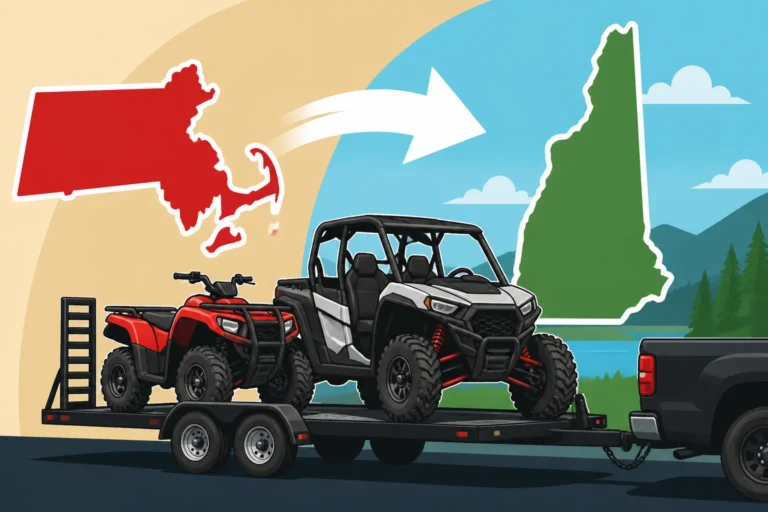
Imagine you're driving up from Massachusetts with a buddy's quad. It's registered and insured in Massachusetts, but the moment those tires hit a New Hampshire state trail or designated road, it needs a New Hampshire registration. It doesn't matter if your friend is riding right next to you on their own registered machine; your borrowed one still needs its own permit to play. This requirement helps ensure that everyone who enjoys our beautiful trails contributes to their upkeep. Without these registrations, the trails wouldn't be nearly as well-maintained or extensive as they are.
The "Home State" Exception Myth
Many riders assume that if their machine is registered in their home state, that registration should be valid in New Hampshire as a "reciprocity" agreement. This simply isn't the case for OHRVs in New Hampshire. While some states have agreements for street-legal vehicles, OHRVs are treated differently. The primary reason for this strict policy is directly tied to the funding mechanism for our trail network. New Hampshire's approach ensures that local clubs and the Fish and Game Department have the resources they need to keep thousands of miles of trails open and safe for everyone.
This means that whether you're borrowing a machine from a neighbor just across the border in Vermont or a cousin in Florida, if you plan to ride it in New Hampshire, it must have a valid New Hampshire OHRV registration. There's no exception based on the machine's primary registration state. Even if the owner has a New Hampshire registration already, if they've lent it to you and you're the one operating it, you'll still need to ensure you have the proper documentation, and in some cases, the original owner might need to provide you with a written permission slip to register it. It all boils down to making sure every machine on the trail is contributing to the ecosystem that makes our riding so incredible. Don't risk a fine; get it registered! [New Hampshire Fines for an Unregistered OHRV] can be quite a buzzkill.
Protecting the Landowner and Trail System
Beyond the financial aspect, the registration process in New Hampshire serves another vital function: it helps manage and protect the relationships with the private landowners who generously allow trails to cross their property. A significant portion of New Hampshire's OHRV trail system runs over private land. When a machine is registered, it falls under the purview of state regulations, which include rules about respecting private property, staying on marked trails, and adhering to noise limits.
Having every machine registered helps the New Hampshire Fish and Game Department, along with local clubs, ensure accountability and foster a responsible riding culture. When issues arise, having a clear registration system makes it easier to track down operators and address concerns. This ultimately helps maintain the good graces of landowners, which is absolutely critical for the continued existence of our trails. Without landowner permission, many of our favorite riding spots would simply vanish. So, by making sure that borrowed machine is properly registered, you're not just complying with the law; you're actively helping to preserve the future of OHRV riding in New Hampshire for everyone. You can learn more about [New Hampshire Fish and Game and OHRVs] and their role in this.
Understanding the "Registrant" in New Hampshire
When you're dealing with a borrowed machine, one of the trickiest parts can be figuring out who actually needs to be listed as the "registrant" on the application. It's not always as straightforward as it seems, especially since you're not the legal owner of the machine. New Hampshire law focuses on who is operating the machine and who has permission to register it.
Who Can Legally Register the Machine
In New Hampshire, the person who registers the OHRV is typically the owner. However, if you are borrowing a machine, you, as the operator, are responsible for ensuring it's properly registered for your use in New Hampshire. This doesn't necessarily mean the registration will be in your name as the owner, but rather that you facilitate the registration process. The registration certificate will still reflect the actual owner's details, but it will be an active New Hampshire registration for that specific machine.
The key here is proving you have legal possession and permission to register the machine on the owner's behalf. If the owner is with you, it's often easiest for them to handle the registration if they are a New Hampshire resident or already have an account with the Fish and Game Department. If you're going to be the one handling the process because the owner isn't present or lives out of state, you'll need clear documentation proving their ownership and their permission for you to register it. This is a vital step to avoid any holdups at the registration counter.
When the Owner Isn't Present
This is where things can get a little more complicated, but it's entirely manageable with the right preparation. If the machine's owner isn't physically with you when you go to register it, you must have written proof that they own the machine and that they've given you permission to register it in New Hampshire. This isn't just a suggestion; it's a firm requirement from the New Hampshire Fish and Game Department to prevent fraudulent registrations.
A simple, notarized letter from the owner stating they are the legal owner of the OHRV (including the VIN or serial number) and explicitly granting you permission to register it in New Hampshire for a specific period is often sufficient. Some people even create a simple "temporary loan agreement" which outlines the terms. This document acts as your authority to act on the owner's behalf. Without it, the agent processing your registration will likely turn you away, as they have no way of verifying your right to register the machine. This protection ensures that machines aren't registered by unauthorized individuals.
The Role of a Bill of Sale (Even for Borrowed, for Proof of Ownership/Permission)
You might be thinking, "Why would I need a bill of sale if I'm just borrowing the machine?" It's a fair question! While you won't be generating a new bill of sale for a borrowed machine, the original bill of sale (or certificate of origin/title, if your state issues them) is absolutely crucial. This document serves as the primary proof of ownership for the person who actually owns the OHRV.
When you go to register a machine that isn't yours, you'll need to present documentation that clearly establishes who the legal owner is. The original owner's bill of sale, or a copy of it, is the best way to do this. It shows the chain of ownership and helps verify that the person granting you permission to register the machine is indeed the rightful owner. Without this, even with a permission letter, there might be questions about the machine's provenance. Think of it as a supporting document that validates the owner's right to lend it and your right to register it on their behalf. You'll also need this information for filling out [The New Hampshire OHRV Registration Application].
Gathering the Paperwork for a Borrowed OHRV
Okay, so you've got your head wrapped around why you need to register and who's responsible. Now, let's talk about the nitty-gritty: the actual paperwork. This is where most people get tripped up, so paying close attention here will save you a lot of grief and a wasted trip to the registration office.
Proof of Ownership: The Essentials
Even though you're borrowing the machine, the registration agent needs to see proof of who owns it. This is typically one of a few documents:
- Original Bill of Sale: This is usually the easiest and most common form of proof for OHRVs, as New Hampshire does not title these machines. It should clearly show the make, model, year, and Vehicle Identification Number (VIN) or serial number of the OHRV, along with the names of the buyer and seller, and the date of sale.
- Manufacturer's Certificate of Origin (MCO/MSO): If the machine is brand new or has never been registered before, the MCO will be the primary document.
- Previous Registration Certificate: If the machine was previously registered in another state (which doesn't honor titles for OHRVs), a valid, current registration certificate from that state can often serve as proof of ownership, alongside a bill of sale.
It's absolutely vital that the VIN or serial number on the proof of ownership document matches the VIN on the machine itself exactly. Double-check this before you leave for the registration office! A mismatch, even by one character, will prevent you from registering. Make sure you have the original document or a clear, legible copy. While a copy might be accepted for showing ownership, for the actual registration you will need either the original proof of ownership or a copy that the owner can verify if present.
Permission to Register: A Critical Document
This is perhaps the most important piece of paper when registering a borrowed OHRV. As discussed, if the owner isn't physically with you at the registration counter, you must have their written permission to register their machine. This permission slip should include:
- Owner's Full Name and Address: Clearly identify the legal owner.
- Machine Details: Make, model, year, and VIN/serial number.
- Statement of Permission: A clear sentence stating that the owner grants you (your full name) permission to register the OHRV in New Hampshire.
- Dates of Permission: Specify the period for which this permission is valid (e.g., "for the 2024-2025 registration season" or "from May 1, 2024, to April 30, 2025").
- Owner's Signature: The legal owner must sign this document.
- Notarization: While not always strictly required by every single agent, having this letter notarized adds an undeniable layer of legal validity and will prevent any potential issues or rejections at the counter. It shows that the owner's identity and intent were verified.
Services like LawDepot offer templates for general power of attorney or authorization letters that can be adapted for this purpose. While not specifically an OHRV registration form, their legal document templates can give you a solid starting point for drafting a comprehensive and legally sound permission letter, ensuring all necessary details are included. Just remember to tailor it precisely to your situation and the OHRV registration requirements. Using a reputable template from LawDepot can give you peace of mind that you've covered all your bases.
Your Personal Identification
Finally, don't forget yourself! You, as the person physically present and completing the registration, will need to show valid photo identification. This could be your driver's license, state-issued ID, or passport. The name on your ID should match the name on the permission letter from the owner (if applicable) and the name you'll be signing on the application.
Also, be prepared with your current mailing address and contact information. The New Hampshire OHRV registration certificate and decals will be mailed to the address you provide, so ensure it's accurate and where you can reliably receive mail. Remember, the registration year runs from [New Hampshire's May to April Registration Year], so you'll want to get it done at the beginning of the season for maximum riding time.
Here's a quick reference table for the documents you'll need:
| Document Type | For Owner (if present) | For Borrower (owner not present) |
|---|---|---|
| Proof of Ownership | Original Bill of Sale / MCO / Previous Reg | Original or Copy of Bill of Sale / MCO / Prev Reg |
| Permission Letter | Not applicable (owner is present) | Required (notarized strongly recommended) |
| Your Photo ID | Required | Required |
| OHRV Reg. Application | Can be filled out on site or pre-printed | Can be filled out on site or pre-printed |
| Payment for Fees | Required | Required |
Practical Steps to Register a Borrowed Machine
Now that you've got all your ducks (and documents) in a row, let's talk about the actual process of getting that borrowed machine registered. It's usually quite straightforward once you have everything prepared.
Choosing Your Registration Agent
New Hampshire offers several convenient ways to register an OHRV. You can choose the method that works best for your schedule and location:
- Online Registration: This is often the quickest and easiest way, if the machine has been previously registered in New Hampshire and you have the previous registration details (often the previous decal number or prior registrant's information). However, for a first-time New Hampshire registration, especially for a borrowed out-of-state machine, you'll likely need to go in person for the initial setup.
- NH Fish and Game Department Headquarters: Located in Concord, this is the main hub for all OHRV registrations. They are fully equipped to handle all scenarios, including complex ones like borrowed machines.
- Authorized Registration Agents: Many ATV/UTV dealerships and some convenience stores across the state are authorized to process OHRV registrations. These are often the most convenient option, especially if you're already in a riding area. You can find a list of [Where to Register an OHRV in New Hampshire] on the Fish and Game website.
- Town Clerks: While some town clerks can register OHRVs, it's not universal. Always call ahead to your specific town clerk's office to confirm they offer OHRV registration services and what their specific requirements are, as some might prefer you go directly to Fish and Game or an authorized agent for more complex situations involving borrowed machines.
When dealing with a borrowed machine that's new to New Hampshire's system, an in-person visit to Fish and Game or a well-versed authorized agent is generally recommended to ensure all paperwork is correctly submitted and any questions can be immediately addressed.
Filling Out the Application Accurately
The OHRV registration application form is pretty standard. You'll need to provide information about the machine and the registrant.
- Machine Information: This includes the make, model, year, color, and crucially, the VIN or serial number. Double-check this against your proof of ownership and the machine itself.
- Owner Information: The application will ask for the legal owner's name, address, and contact information. Even though you're the one facilitating the registration, the owner's details are what go on the official document.
- Registrant Information: If you, the borrower, are listed as the contact person on the permission letter, your information might be included here, but the primary owner details will still be paramount.
- Club Membership: If the owner is a member of a New Hampshire OHRV club, you'll want to indicate that on the form. Club members often get a discounted registration rate, so it's worth checking if the owner is part of an approved club. Make sure you have their club name and membership number if applicable. You can learn more about [Why Club Membership Saves $30 in New Hampshire].
Take your time filling out the form. Any errors could delay your registration or even require you to restart the process. If you have any questions while filling it out, don't hesitate to ask the registration agent for clarification. They are there to help! You can often find a blank [The New Hampshire OHRV Registration Application] online to review before you go.
What to Expect at the Counter
When you arrive at your chosen registration location with all your documents, here's a general idea of what to expect:
- Present Documents: Hand over your proof of ownership, the permission letter (if applicable), your photo ID, and the completed application form.
- Verification: The agent will meticulously review all your documents, especially checking the VIN against the machine's proof of ownership and the application. They will also verify your identity. This is where a clear, notarized permission letter for a borrowed machine really shines, as it makes their job much easier.
- Payment: You'll pay the applicable registration fees. [New Hampshire OHRV Registration Cost] varies depending on the machine type (ATV vs. UTV vs. trail bike), the registrant's residency status (resident vs. nonresident), and whether they are a club member. Be prepared for a transaction fee as well.
- Temporary Tag/Receipt: Once processed, you'll receive a temporary paper registration that allows you to ride immediately.
- Decals and Certificate: The official OHRV certificate and two numbered decals will be mailed to the address provided on the application, typically within a week or two. Once you receive them, remember to apply the decals correctly to your borrowed machine. [New Hampshire OHRV Decal Placement] is important for visibility.
Remember, a borrowed machine needs the same registration as if you owned it yourself if you plan to ride it on New Hampshire's trail system. Taking the time to gather the necessary paperwork, especially the owner's proof of ownership and a solid permission letter (perhaps drafted with help from a resource like LawDepot), will ensure a smooth process and get you out on the trails faster. Happy riding!
Disclaimer
This article is for general informational purposes only and does not constitute professional advice. Laws, prices and regulations vary by location and change over time. Consult a qualified professional for guidance on your specific situation.